
You can be an accomplished leader and still struggle to communicate with confidence when it matters most. Perhaps you hold back your opinions in important meetings, struggle to get your message across to senior stakeholders, or find yourself rehearsing difficult conversations long before they happen. You know what you want to say, yet it doesn’t always come across the way you intend. This is where communication skills coaching for leaders can make a difference.
Effective leadership communication isn’t just about choosing the right words, mastering presentation techniques or projecting confidence. It’s also about understanding what may be getting in your way – whether that’s self-doubt, overthinking, fear of conflict or the need for approval. When these patterns influence how you communicate, even your strongest ideas may go unheard. In this guide, we’ll explore how to strengthen your communication skills, recognise the internal barriers that may be limiting your effectiveness, and develop the confidence to express yourself with greater clarity and authenticity.
Key Takeaways
- Effective communication skills coaching for leaders moves away from rehearsed corporate scripts and focuses on aligning your internal state with your natural presence.
- Protective patterns like overthinking and perfectionism are learned safety habits, not personal flaws, that quietly create mental friction and second-guessing.
- Grounded communication balances authority and empathy by establishing genuine self trust instead of projecting a performative persona.
- The 3R framework of Release, Reprogram, and Recondition provides a practical pathway to quiet mental chatter and communicate with calm conviction.
- True executive growth is never about fixing who you are; it is about uncovering the natural clarity and courage you already carry.
Beyond Scripts: Why Traditional Communication Skills Coaching for Leaders Often Fails
Most executive training treats public speaking and dialogue like a stage performance. You are taught power poses, vocal modulation, and rigid frameworks for delivering tough feedback. Yet leadership communication is not a theatrical routine. It is a direct reflection of your internal state. When you layer clever scripts on top of internal tension, your listeners do not hear confidence; they sense hesitation.
This is where conventional communication skills coaching for leaders misses the mark. Adding more techniques only widens the "High-Achiever Self-Trust Gap." This gap is the silent chasm between what you know in your gut and what you actually dare to voice in a room of peers. Instead of grounding you, excessive tactics increase mental chatter. You end up calculating every syllable, scanning faces for validation, and diluting your message.
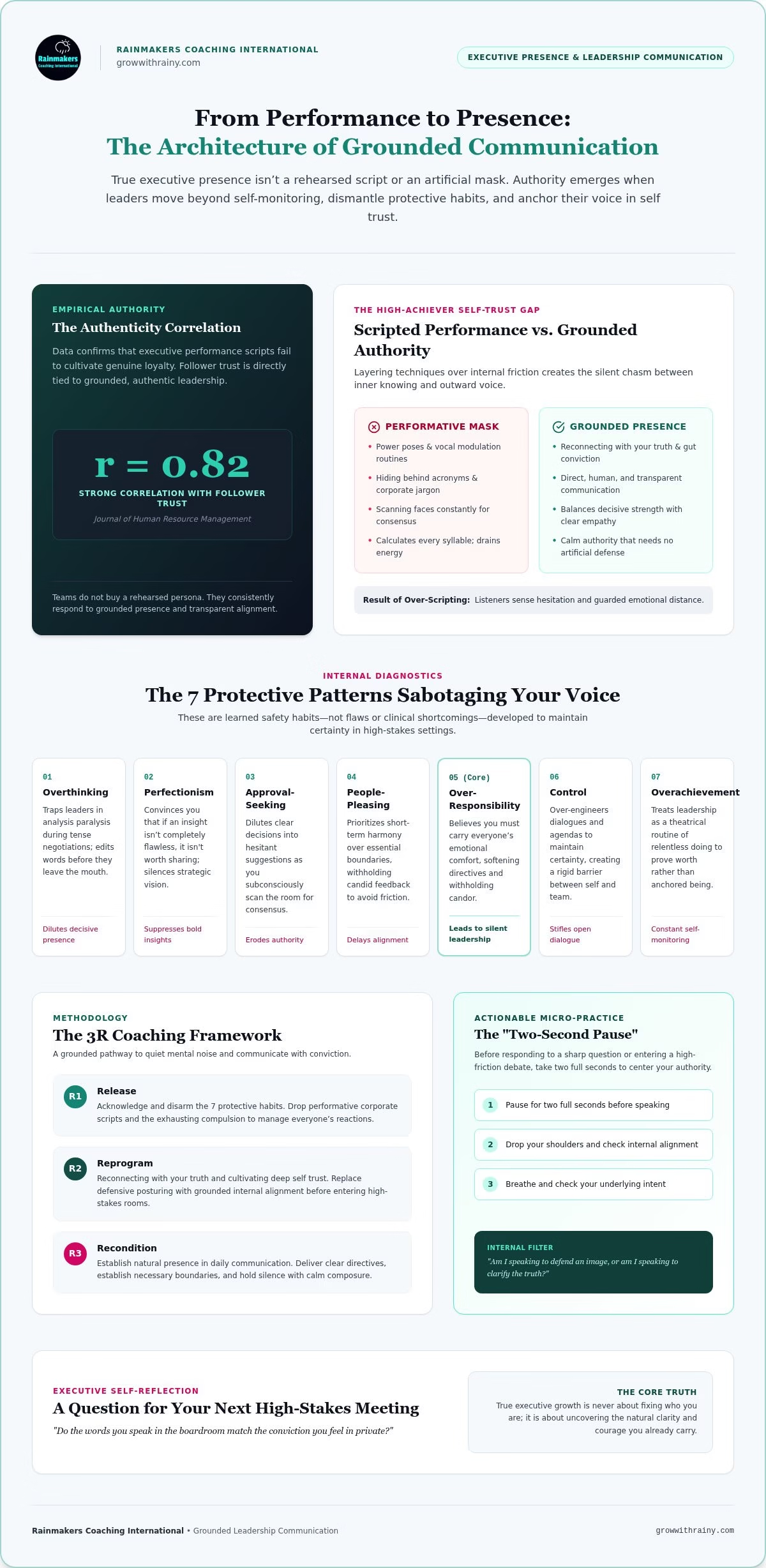
Research published in the Journal of Human Resource Management shows that authentic leadership behavior correlates strongly with follower trust (r = 0.82). Your team doesn’t buy a rehearsed persona. They respond to grounded presence.
The Trap of the "Polished" Leader
Relying on sterile corporate jargon often serves as an emotional shield. When you feel exposed, hiding behind acronyms and polished speaking tracks feels safe. But it also erects a wall between you and your team.
Maintaining a corporate mask is physically exhausting. It forces you to monitor your image rather than engage in the conversation. When you focus solely on looking the part, you rob your team of the clear, human guidance they actually need to navigate uncertainty.
Reconnecting with Your Truth
Real authority begins with self trust. When you are grounded in your own conviction, you don’t need to dominate the room with volume or speed. You speak from a place of calm clarity that requires no artificial defense.
A simple coaching shift you can use immediately is the "Two-Second Pause." Before answering a sharp question or stepping into a debate, pause for two full seconds. Drop your shoulders, breathe, and check your alignment. Ask yourself: Am I speaking to defend an image, or am I speaking to clarify the truth?
Take an honest look at your recent board updates or 1-on-1s. Do the words you speak in the room match the conviction you feel in private?
The 7 Protective Patterns Sabotaging Your Leadership Voice
When high performers struggle to communicate, the issue is rarely a lack of intelligence or skill. At Rainmakers, we recognize that communication breakdowns stem from learned protective patterns. These habits are not clinical diagnoses or personality flaws. They are simply protective strategies developed over time to maintain safety and certainty in high-stakes settings.
Seven primary patterns quietly sabotage leadership presence: Perfectionism, Approval-Seeking, People-Pleasing, Over-Responsibility, Overthinking, Control, and Overachievement. In high-pressure moments, they hijack your natural voice:
- Overthinking: Traps you in analysis paralysis during tense negotiations, editing your words before they leave your mouth.
- Perfectionism: Convinces you that if a thought isn’t flawless, it isn’t worth sharing, keeping your best strategic insights silent.
- Approval-Seeking: Dilutes clear decisions into hesitant suggestions as you subconsciously scan the room for consensus.
When you explore deep communication skills coaching for leaders, the work shifts from mastering speech techniques to recognizing these automatic behaviors before they take the wheel.
Over-Responsibility and the Silent Leader
A core Rainmakers Principle reveals that Over-Responsibility begins when you believe you must keep everyone comfortable. When you shoulder the emotional weight of your entire team, direct communication collapses. You soften critical directives, delay essential boundaries, and withhold necessary candor because you dread causing distress.
Ask yourself: Are you holding back direct feedback simply because you feel overly responsible for how someone else might react to the truth?
Overachievement vs. Authentic Impact
Overachievement uses relentless performance as proof of worth. In corporate meetings, this manifests as constantly "performing" leadership rather than simply being present. As Herminia Ibarra notes when exploring the authenticity paradox, leaders often cling to outdated, performative behaviors under the guise of staying true to themselves, which actually restricts genuine growth.
True authority begins when you stop proving your competence and start trusting your presence. If you notice these protective habits creating friction in your daily interactions, exploring them in a dedicated coaching conversation can help you uncover the natural authority already resting beneath the noise.
Grounded Communication: Moving from Performance to Presence
Grounded communication sits right at the intersection of clarity and self trust. It is the steady presence that remains when you drop the urge to manage impressions. When leaders step into a boardroom, the room reads their nervous system long before processing their arguments. If your internal state is frantic, even the most polished talking points will land with friction.
Through the Rainmakers Transformation System™, communication skills coaching for leaders stops being an exercise in adding techniques. Instead, it becomes a process of releasing the need to perform so your natural authority can breathe. The goal isn’t to project confidence loudly; it’s about holding an anchored space that invites your team into real alignment.
According to research synthesized by the Center for Creative Leadership on core leadership communication skills, effective executive interaction hinges on genuine active listening and psychological safety rather than top-down information delivery. When you substitute stagecraft for presence, that safety evaporates.
Reclaiming Your Truth in High-Stakes Events
Boardroom tension often triggers an urgent reflex to fix the immediate discomfort. Yet true presence requires you to hold space for tough realities rather than rushing to smooth them over. When you remain steady amid conflict, your grounded composure reassures the entire table.
Stepping back from reactionary problem-solving allows you to speak with strategic perspective. You can explore this deeper in our guide on Executive Presence: Reclaiming Self-Trust for Authentic Leadership in 2026 , which examines how internal balance shapes external credibility.
The Power of Emotional Perceptiveness
Listening makes up 70% of transformational communication skills coaching for leaders. Most professionals listen while planning their rebuttal, which keeps them locked inside their own heads. Real perceptual depth means noticing the protective habits operating behind someone else’s pushback.
When an executive resists your plan, they may simply be reacting from control or fear. You can de-escalate this friction through reflective listening: mirror back their underlying concern without defending your stance. This simple practice clears emotional static, reconnecting with your truth while giving others space to do the same.
Reflect on your own week: In which specific meetings do you feel most grounded, and how does the tone, pacing, and impact of your voice shift during those interactions?
How to Reclaim Your Voice: The 3R Coaching Framework
Sustainable growth requires a clear, repeatable methodology. Meaningful communication skills coaching for leaders does not pile on more rules for how to stand or modulate your tone. Instead, it systematically dissolves the internal resistance that blocks your message.
Developed over more than a decade of coaching executives, the proprietary Rainmakers Transformation System™ guides this process through three stages: Release, Reprogram, and Recondition.
- Release: You identify and shed the protective strategies, such as over-responsibility or overthinking, that mask your innate authority. Letting go of these habits clears space to reconnect with your truth.
- Reprogram: You actively shift the internal narrative. You move away from the silent demand of "I must be flawless to keep control" and step into the steady conviction of "I am grounded, and my insight has weight."
- Recondition: You practice new relational responses in low-stakes daily moments first, anchoring self trust into your communication before stepping into high-stakes negotiations. Recondition is about making the new behaviour sticks, until it becomes a part of the upgraded version of yourself.
The organizational impact of this work is tangible. Research published in 2025 in Taylor & Francis Organizational Psychology highlights that authentic leader communication directly improves follower well-being (β = 0.111, p < 0.05) and builds deep interpersonal trust. Grounded presence isn’t just an internal comfort; it directly fosters team-wide psychological safety.
From Insight to Transformation
Recognizing a protective habit is helpful, but intellectual awareness alone won’t break an automatic reflex. Real transformation relies on 3R Integration, bridging conscious realization with everyday somatic response.
You can initiate this shift tomorrow morning with a simple Grounding Reflection. Before opening your laptop, take three deep breaths and set a singular vocal intention: Today, I choose to speak to create clarity, not to win approval. This brief pause resets your nervous system before the day demands your energy.
Building Your Leadership Development Plan
Embedding these practices into your broader Leadership Development Plan 2026 ensures that your progress remains steady rather than accidental. Reconditioning also transforms how you handle feedback, turning defensive reactions into curious, anchored inquiries.
Looking at how you currently engage with your team, what is one protective pattern you feel ready to release today?
Leading with Impact: The Rainmakers Approach to Executive Growth
At Rainmakers, we hold a distinct point of view: the ultimate goal of executive development isn’t simply accumulating outward milestones. It is about becoming more fully yourself. Meaningful communication skills coaching for leaders never treats you as a broken machine that needs fixing. Instead, the coaching journey is designed to uncover the hidden treasures of insight, clarity, and courage that pressure and self-doubt have buried beneath old coping habits.
Hesitation in the workplace rarely stays confined to office walls. When you swallow your opinions in an executive committee, that tension follows you home, draining your evening energy and fracturing your presence with family.
Miscommunication exacts a massive toll across the board; data from the 2026 State of Business Communication study shows that professionals spend an average of 7.47 hours every week clarifying ambiguous messages and managing misunderstandings. When you resolve internal friction at the root, your personal and professional worlds both regain alignment.
When Deeper Support is Useful
Reading frameworks can provide clarity, but intellectual comprehension often hits a ceiling when old habits like People-Pleasing or Control are deeply wired. It is tough to spot your own blind spots while standing inside them. Partnering with a heart-centered coach provides the supportive mirror needed to dismantle those reflexes without judgment.
If you are ready to move beyond protective habits and anchor your communication in deep self trust, you can Explore Executive Coaching Singapore to align your voice with your strategic responsibilities.
Your Next Step Toward Grounded Leadership
Lasting executive transformation is fundamentally an act of subtraction. You don’t need to adopt a fabricated persona; you simply need to remove the internal barriers keeping you from speaking your truth. Our specialized Building Rock Solid Confidence program gives you the grounded tools to lead with quiet strength and clear conviction.
Whenever you are ready to stop managing impressions and start leading with authentic authority, Book a coaching conversation with Rainy to begin your journey.
Pause for a moment and consider this coaching question: If you trusted yourself completely, what is the one clear thing you would say in your very next meeting?
Reclaim Your Natural Authority in Every Room
True executive presence isn’t about memorizing another corporate script or projecting artificial certainty. It begins the moment you release learned protective habits like overthinking and people-pleasing, allowing yourself to settle into genuine self trust. When you stop performing for approval and start reconnecting with your truth, speaking with calm, decisive clarity becomes second nature.
Specialising in high-achieving professionals for more than a decade, our proprietary Rainmakers Transformation System™ helps you move past internal friction and lead from quiet strength. Authentic communication skills coaching for leaders doesn’t focus on altering your personality or managing superficial optics. It simply uncovers the natural clarity, courage, and grounded insight that workplace pressure has overshadowed.
Your organization doesn’t need a rehearsed persona at the head of the table. They need the steady, grounded leader you already are when you trust your voice.
Frequently Asked Questions
What exactly is communication skills coaching for leaders?
Communication skills coaching for leaders is a transformational process that aligns your internal state with your external expression. Rather than teaching rigid scripts or theatrical stage tricks, it helps you identify learned protective patterns that create hesitation. By building deep self trust, you learn to articulate strategic vision, establish firm boundaries, and speak with calm authority in high-pressure boardroom interactions.
How is coaching different from a public speaking workshop?
Public speaking workshops typically teach external presentation mechanics, like hand gestures, pacing, and vocal projection. While those techniques have value, they rarely address why you feel anxious or second-guess yourself before speaking. Leadership coaching works from the inside out. It addresses the emotional friction, perfectionism, and internal dialogue that cause mental clutter, enabling you to communicate with natural presence rather than performative polish.
I am already a successful leader; why do I need communication coaching?
The strategies that drove your early success can easily become the blind spots that limit your next phase of executive impact. You might achieve results through pure grit or over-responsibility, but your communication may still carry unspoken tension. Coaching helps you shift from proving competence to holding space for your organization, allowing you to influence senior stakeholders effortlessly without burning out your emotional reserves.
Can communication coaching help with Imposter Syndrome after a promotion?
Yes. Stepping into a larger executive role often triggers protective habits like overthinking and people-pleasing, making you feel like a fraud among peers. Coaching does not treat this as a clinical defect, but as a normal protective response to uncertainty. By releasing the urge to perform perfection, you learn to own your seat at the table and speak from genuine conviction.
How long does it take to see a real change in my leadership presence?
Shifts in self-awareness often occur during your very first few sessions as you recognize the patterns driving your communication friction. Embodying lasting behavioural change typically unfolds over several months of deliberate practice. Through the Rainmakers Transformation Journey™, you systematically release old habits, reprogram your mindset, and recondition your responses in real-time workplace conversations until grounded presence feels like second nature.
Will I have to change my personality to communicate better?
No. Transformational coaching is never about fixing who you are or forcing introverts to become loud extroverts. The true goal is removing the protective layers that disguise your natural strengths. When you drop performative scripts and reconnect with your truth, you uncover the inherent wisdom, calm authority, and clarity already within you. You become more fully yourself, not an imitation of someone else.
What is the "High-Achiever Self-Trust Gap" in communication?
The High-Achiever Self-Trust Gap is the disconnect between your proven executive competence and the private hesitation you feel when expressing your perspective. On paper, you possess deep expertise and strategic insight. In high-stakes meetings, however, protective habits like approval-seeking dilute your message. Targeted communication skills coaching for leaders bridges this gap by grounding your voice in self trust rather than external validation.
Does executive coaching help with difficult conversations and conflict?
Yes, because conflict avoidance is usually driven by over-responsibility or people-pleasing. Leaders often soften difficult truths out of fear of how others might react. Executive coaching teaches you to hold firm, respectful boundaries without becoming defensive or aggressive. You learn how to stay emotionally regulated under fire, address difficult topics cleanly, and maintain psychological safety across your entire team.

Article by
Rainy Rainmaker
Rainy Rainmaker is the founder of Rainmakers Coaching International and a transformational coach for confidence, self-trust, and authentic leadership. Based in Singapore, she helps high-achieving professionals, managers, and leaders who appear capable on the outside but feel quietly held back by self-doubt, overthinking, imposter feelings, burnout, or a loss of direction. Through her signature Rainmaker Transformation Journey™, Rainy helps clients uncover the insights already within them and turn inner clarity into aligned action that creates lasting change in how they work, lead and live.
