Career coaching services give mid-career professionals a focused, one-to-one space to work out what they want from the next stage of work. If you have built real experience and still feel unsure about direction, a coaching conversation helps you separate what you want from what you have simply grown used to. In Singapore, coaching sits alongside advisory appointments, workshops and Career Conversion Programmes, so the right choice depends on whether you need information, reflection or a plan.
Key Takeaways
- Mid-career professionals often have plenty of options but struggle to trust their own choice.
- Coaching, counselling and outplacement have different aims.
- A coaching session starts with your question and ends with a practical next step.
- Warning signs include guaranteed outcomes, pressure to commit and unclear scope.
- Coaching helps most when the same career question keeps returning.
Career guidance for mid-career professionals
Career guidance helps you connect your skills, interests and circumstances with possible work directions. At mid-career, the question changes. You are rarely asking what job you can get. You are asking what work still fits you.
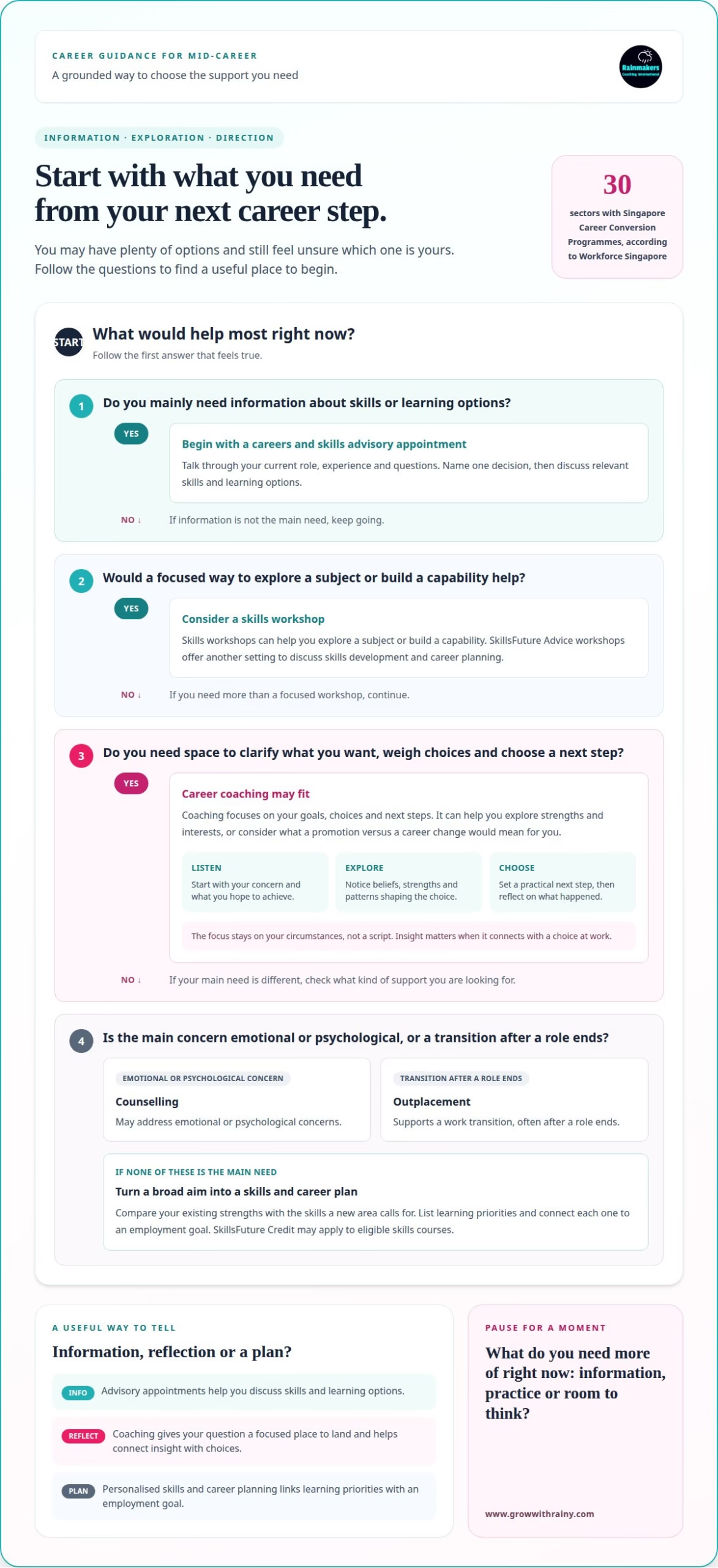
In Singapore, you can start with a careers and skills advisory appointment, a workshop or a longer coaching process. In an advisory appointment, the conversation often begins with your current role, experience and questions. Then you name one decision, such as deepening your expertise or exploring a new field. The adviser can discuss relevant skills and learning options. Singapore Career Conversion Programmes are available across around 30 sectors, according to Workforce Singapore.
Personalised skills and career planning turns broad aims into a direction. Compare your existing strengths with the skills a new area calls for. Then list your learning priorities and link each one to an employment goal.
SkillsFuture Credit may apply when your plan includes eligible skills courses. Skills workshops help you explore a subject or build a capability. SkillsFuture Advice workshops are another setting to discuss skills development and career planning.
How do career coaching services compare with career counselling and outplacement? Coaching focuses on your goals, choices and next steps. Counselling may address emotional or psychological concerns. Outplacement supports a work transition, often after a role ends.
What career coaching services are available in Singapore? You can find advisory appointments, SkillsFuture Advice workshops, skills workshops, skills planning and private career coaching. Each answers a different need.
What does a career coach help with? A coach helps you clarify priorities, explore strengths and interests, and turn a broad question into goals and next steps. If you are weighing a promotion against a career change, a coach helps you examine what each would mean for you.
How much do career coaching services cost in Singapore? The cost depends on the coaching scope and the support involved, and you receive it after a quote request.
What should I look for when choosing a career coach for job search, interview, or career change support? Look for a clear scope, a relevant approach and room to talk about your goals. Ask whether the focus is career direction or practical preparation. A career change often needs deeper exploration of your interests and transferable strengths.
Read more in this overview of career guidance and counseling principles. If you feel stuck in the middle of an organisation, this guide to career stagnation for middle managers may help.
What a career coaching session looks like
A career coaching session gives your question a focused place to land. You might bring a choice between staying in a familiar role and pursuing a new direction. The coach helps you see what is driving the choice and what matters most. The conversation stays tied to your circumstances, not a script.
A session often follows a few steps:
- The coach listens to your current concern and what you hope to achieve.
- You explore the beliefs, strengths or patterns shaping your decision.
- You choose a practical next step, such as clarifying what you value in your work or preparing for a conversation about change.
In a later conversation, you review what happened. If you planned to speak with your manager, you reflect on how it went and what you learned. New priorities can then shape your next goal. This cycle of reflection, action and review connects insight with choices at work.
Some settings add practical preparation. Students at Nanyang Technological University in Singapore may request a resume critique and mock interview session as part of career coaching. So session content varies by setting and goal.
For mid-career professionals, the useful questions are often quiet ones. What have you outgrown? What are you still proud of? Where do you hold back? Notice that insight alone is not the finish line. The shift shows up when you act differently.
What should I look for when choosing a qualified career coach in Singapore? Look for relevant coaching experience, a clear explanation of the process and respect for your goals. Ask how sessions support decision-making and whether the approach suits you.
What are the best career coaching services in Singapore for mid-career professionals? The best fit depends on whether you need career direction, support through a transition or reflection on leadership. Choose a service that makes room for your experience.
What are the risks or warning signs when hiring a career coach? Watch for promises of a guaranteed job, pressure to commit before you understand the process, or unclear boundaries around what coaching includes. If the focus drifts from your goals, pause and ask whether the fit is right.
If you are comparing options, this guide on how to choose the best career coach for you may help.
Self-awareness and self-trust in mid-career
A career decision can look practical on the surface and feel unsettled underneath. You might be weighing a promotion while wondering whether you still value the work. Good guidance explores both the choice and the signals behind it. Notice what gives you energy, what drains it and what you want work to make possible.
Sometimes career confusion is not a lack of options. Sometimes you do not trust yourself enough to choose. That is worth asking honestly.
Self-awareness is more than a list of strengths. Connect each strength to a real experience. Leading a complex project might show that you enjoy bringing people together or working through ambiguity. Those details give richer direction than a label like "good communicator."
Your values shape how a role feels. If you value autonomy, a tightly controlled environment may wear on you, even with a respected title. If contribution matters, tasks that feel disconnected from a meaningful outcome may leave you flat. Exploring this helps you tell temporary frustration from a deeper mismatch.
Look for patterns across roles. Which responsibilities do you keep taking on? When do you do your best thinking? Where do you hold back? If you always take on team development, that may point toward mentoring or leadership work.
According to Public Service Division, a career coaching session helped one public officer set clear goals and plan her career growth. A goal gains weight when it joins personal insight to a practical choice, such as building a capability or seeking a new responsibility.
Self-awareness also means noticing protective habits. You may avoid speaking up because visibility felt risky in a past workplace. Ask whether that response still serves you. This is not about forcing confidence. It is about reconnecting with your truth and building self-trust.
For senior professionals, misalignment can be subtle. You may keep succeeding while your motivation fades. Our guide to career misalignment for senior leaders explores this further.
Personal priorities also sit beside the demands of a field. The Volunteer Career Advisors initiative provides sector- and occupation-specific insights on emerging trends and in-demand skills from industry veterans. Weigh those signals against your values and strengths. What are your current career choices asking you to understand about yourself?
Career interests and employment goals
An interest becomes useful when it points toward work you can explore. If you are drawn to solving customer problems, you might look at service design, account management or operations. Ask what sits beneath the interest: the tasks you enjoy, the contribution you want to make and the conditions in which you do your best work.
Interests are not job titles. "I want to lead" could mean mentoring colleagues, shaping decisions or owning a project. Each carries different responsibilities. Separate the activity that energises you from the status attached to a role.
Next, connect your interests to your experience. If you enjoy improving processes, you may already have coordinated teams or fixed recurring problems. These examples reveal transferable capabilities and show where more learning could help. You do not have to start over.
Employment goals give direction a practical shape. Instead of aiming for "better work," define a goal such as a role with more creative responsibility or closer customer contact. Make it specific enough to guide decisions and open enough to adapt.
Separate the outcome from the next step. If your goal is project leadership, ask what experience would make that credible. It might be a cross-team initiative or naming the leadership strengths you already use.
Good goals also reflect real constraints. Caregiving, current commitments and preferred working conditions all affect which opportunities suit you. Naming this helps you shape a goal that works in your life.
Your goals may change as your interests clarify. Check whether a goal still reflects what you want or an expectation you inherited. For more on this, see how to set career goals you will actually keep.
What kind of work would feel meaningful enough to guide your next decision?
When mid-career professionals should seek coaching
You do not need to wait for a crisis. A promotion, a new responsibility or a growing sense of disengagement can each be a good moment to pause. Coaching helps you understand what is changing before you decide.
Consider coaching when the same question keeps returning. You may be successful yet unsure what you want next, a feeling explored in when success no longer feels meaningful. A coach can help you explore whether the tension comes from your responsibilities, relationships, values or hopes for growth. A senior professional, for example, may enjoy leading people but feel far from daily decisions.
A career transition is another time. If you are considering a new industry, the challenge goes beyond naming roles. You can look at what you want to carry forward, what you are ready to leave behind and how your experience transfers.
Coaching also helps when an opportunity feels exciting and unsettling at once. A leadership role may offer influence while raising questions about visibility. Rather than treating hesitation as a reason to decline, separate practical concerns from protective patterns.
Recurring friction deserves attention too. If you often avoid speaking up, overextend yourself or accept work that conflicts with your priorities, those patterns may be shaping your career. The pattern that helped you succeed at one stage can limit the next. A coaching conversation can explore what sustains it. The goal is more choice, not self-criticism.
Timing matters when career decisions touch life outside work. A move into management might suit your interests but not your current capacity. Both realities belong in the decision.
You may not need coaching if your direction is clear and you only need a specific practical service. Coaching fits best when reflection or recurring friction is blocking your next step. If your goals are clear but hard to sustain, this guide to career goal procrastination may help.
What change in your work is asking for your attention now?
Rainmakers Coaching International
Rainmakers Coaching International helps mid-career professionals explore career direction through inside-out coaching. Rather than adding more strategies or frameworks, the work focuses on reconnecting with your own truth and self-trust, and recognising the gifts and resources you may have overlooked.
Career questions often connect with how you lead, work and live. Rainmakers Coaching International offers Life Coaching, Career Coaching and Executive Coaching. If your question is about direction, goals or a transition, a conversation is a natural next step.
If you would like to explore your next step, contact Rainmakers Coaching International.
Frequently Asked Questions
When Should You Attend One?
Attend when a career decision keeps taking up mental space, even after you have weighed the obvious options. After a team reorganisation, for example, you may need to decide whether your new responsibilities still fit your priorities. You can bring the decision as it stands, even if you do not yet know what you want.
What should I expect during a career coaching session?
Expect a focused conversation shaped by your current question, not a fixed test. You might discuss what prompted the session, what you have already considered and which constraints matter. The coach may reflect patterns back to you and invite you to examine them. What might become clearer if you gave yourself room to explore the decision?

Article by
Rainy Rainmaker
Rainy Rainmaker is the founder of Rainmakers Coaching International and a transformational coach for confidence, self-trust, and authentic leadership. Based in Singapore, she helps high-achieving professionals, managers, and leaders who appear capable on the outside but feel quietly held back by self-doubt, overthinking, imposter feelings, burnout, or a loss of direction. Through her signature Rainmaker Transformation Journey™, Rainy helps clients uncover the insights already within them and turn inner clarity into aligned action that creates lasting change in how they work, lead and live.
