Changing careers after years in the workforce can raise a difficult question. How do you explore a different direction while accounting for the experience, income and responsibilities you’ve built? Mid-career transition coaching services can help you assess your options, recognise transferable strengths and clarify what you want from your next role.
Choosing a coach starts with understanding the support you need. You may want help identifying a direction, weighing a particular opportunity or finding the confidence to act. Alongside practical considerations, coaching can help you explore how your expectations, sense of identity or concerns about change may influence your choices.
In Singapore, this guide explains what transition coaching can support, how to compare coaching approaches, and how to think about upskilling and costs without losing sight of what you need from your next chapter.
You’ll also find ways to assess whether you need support with career direction, decision-making, or building confidence to act. The right coaching should help you reconnect with what matters to you, not push you towards a path that doesn’t feel like yours. What might become clearer if you had the moment to consider your options carefully?
Key Takeaways
- Use coaching to clarify what you want from your next career chapter and explore options that fit your strengths and priorities.
- Understand how a coach can support decision-making and transition planning without choosing your career path for you.
- Consider how targeted upskilling can support a career change, and explore Singapore’s training support options.
- Compare coaching pricing models by looking at what the support includes and how it fits your needs and goals.
- Recognise when career, career development, life or executive coaching may help you move forward with greater self-trust.
How a career transition coach supports research into industries and career options
A career transition coach can help turn a broad interest into focused exploration. Start by clarifying your strengths, priorities, and the conditions you want from work. Then connect those insights to roles, industries, and skills you can investigate. For example, if you value problem-solving and flexibility, you might compare data analysis with digital marketing. Coaching supports your decision-making rather than choosing a path for you.
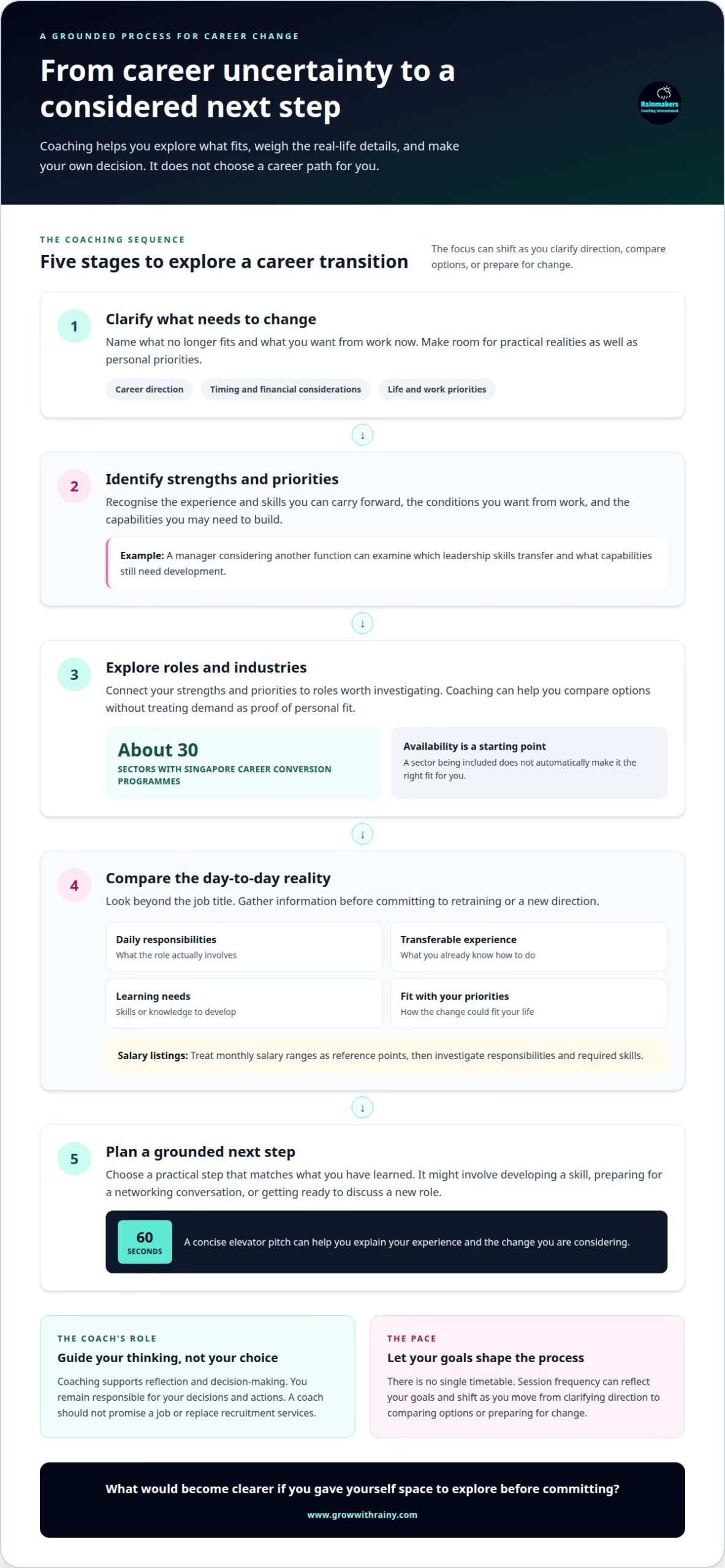
Singapore’s Career Conversion Programmes are available in about 30 sectors. That gives career changers a broad starting point, but a sector’s availability alone doesn’t make it a good fit. Coaching can help weigh the role’s daily responsibilities, transferable experience, learning needs, and how the change fits your life. If a career shift also raises questions about meaning beyond work, career and life priorities can be considered together.
How long does career transition coaching take, and how often are sessions? There’s no single timetable: the process depends on whether you’re clarifying direction, comparing options, or preparing for a change. Session frequency can reflect your goals and shift as your decisions develop.
Singapore job listings with monthly salary ranges can make career exploration more concrete. Treat each figure as a reference point, then investigate the role’s actual responsibilities and required skills.
Compare more than salary. Consider the day-to-day work, the skills you already have, what you would need to learn, and whether the role fits your priorities. A coach can help you identify what you still need to understand before committing to retraining or a new direction.
Coaching can continue beyond initial career research. Periodic sessions can help you revisit assumptions, reflect on new information, and make decisions as your priorities shift. This may be useful when you’re exploring a second career or moving into leadership in a different industry. The focus is on building self-trust and making grounded choices, rather than pursuing an opportunity simply because it is in demand.
Services and support a career transition coach can provide
A coach can help you approach a career switch thoughtfully, from clarifying priorities to preparing for conversations about a new role. The support should fit the decision you’re facing, not impose a predetermined outcome.
Available Coaching Services
Career transition coaching focuses on direction, transferable skills, and decisions involved in changing roles or industries. Career development coaching can support growth within your current field, while executive coaching may suit leaders considering a change in responsibility or impact. The distinction matters: useful support addresses your actual transition rather than offering a generic interview checklist.
To choose a qualified career transition coach in Singapore, look for relevant experience with career decisions, a clear coaching approach, and an ability to work with your priorities. Discuss what the process covers and how progress will be reviewed before beginning.
Coaching may help you gain clearer direction, strengthen self-trust, and identify practical next steps, such as skills to develop. No single success rate captures every person’s goals; assess progress against the outcomes you set for your transition.
Coaching has limits. A coach can guide reflection and decisions, but shouldn’t promise a job, or replace recruitment services. If you need clinical mental health support, career coaching isn’t a substitute.
Coaching Programme Steps
A coaching programme may follow a sequence: clarify what needs to change, identify strengths and priorities, explore relevant options, and plan action. For example, a manager considering a move into another function might examine which leadership skills transfer and what capabilities they need to develop. This differs from ongoing career development, which may focus on progression without a change in direction.
Support may also include preparing for a networking conversation or interview. A concise 60-second elevator pitch can help explain your experience and the change you’re considering. The coach guides your thinking; you remain responsible for decisions and actions.
Consider whether your main obstacle is uncertainty, an outdated view of your strengths, or hesitation about acting. Identifying the difference helps shape a useful coaching focus. Career coaching can help you reconnect with your priorities and explore a grounded next step.
If you’re weighing a career switch and want support clarifying what matters, discuss your career direction and the questions you want coaching to help you explore.
Career coaching can offer a structured process if you’re uncertain about your next direction or your current career no longer fits your priorities. It can help you assess options and plan a transition carefully, taking timing, financial considerations, and personal and professional priorities into account.
Career coaches support your thinking and decision-making process rather than telling you which career to choose. Coaching can help you consider whether a possible move fits what matters to you, without treating the coach’s perspective as a decision or guarantee. Bring your concerns and priorities into the conversation, then use the process to identify a considered, workable next step.
How Career Coaching Guides Upskilling for Career Changes
Upskilling works best when it serves a clear career direction. A career coach can help connect your experience with the capabilities a new role requires, then identify learning gaps worth addressing. For example, a project manager moving towards data analysis may need technical training while carrying forward planning and stakeholder skills. This keeps the course choice connected to your goals, rather than treating every qualification as equally relevant.
Singapore offers several SkillsFuture pathways for mid-career training. Eligible Singaporeans aged 40 and above can receive up to 90% subsidy for courses funded by the Ministry of Education and SkillsFuture Singapore. A coach can help you consider how these options fit your intended role and learning needs.
The SkillsFuture Career Transition Programme offers training lasting three to 12 months. Eligible trainees can receive course fee funding of up to 70%; Singaporean workers aged 40 and above can receive subsidies of up to 90%. Funding can cover up to 95% of course fees for workers unemployed for six months or more. These rates make eligibility and employment circumstances important parts of course planning.
Training support can also affect how you plan time away from work. The allowance is computed at 50% of an individual’s average income over the latest available 12-month period. A coach can help you weigh this support alongside course duration, work commitments, and the skills required for your chosen direction.
- Clarify the target: identify the role or function the training should support.
- Map transferable skills: connect current strengths with requirements in the new field.
- Identify the gap: distinguish essential technical skills from skills you already use.
- Compare course fit: consider course content, duration, funding eligibility, and practical application.
This sequence helps career professionals avoid enrolling simply because a course is popular. If you’re considering cybersecurity, for instance, first explore the role’s work and required capabilities. Then assess whether formal training addresses a genuine gap. Singapore’s SkillsFuture Credit is available to Singaporeans aged 25 and above, with an opening credit of S$500. That support can inform course planning, but the career objective should guide it.
Skills also change over time. Technical skills may become less relevant, while transferable abilities such as communication and leadership can support movement between roles. Upskilling might involve a targeted course alongside developing adaptable strengths. What capability would help make your next career step feel more grounded?
Career coaching costs and pricing models
Career coaching fees depend on the support involved, not simply the coach’s job title. An hourly arrangement may suit a focused decision, such as weighing an internal move against a new career path. A package may suit a broader transition involving direction, confidence, and action planning. Compare what each format helps you work through with the needs of your next step.
Some coaching arrangements focus on sessions as needed; others follow a programme built around agreed goals. A specific question may need a narrower scope than a career change involving a new industry and upskilling. Compare session length, frequency, preparation, and follow-up support. Clarify whether the work covers reflection and decisions or practical materials such as a résumé. Whether résumé writing is included depends on the coaching arrangement.
Are career coaching fees tax-deductible or eligible for SkillsFuture support in Singapore? SkillsFuture support for career changes is tied to eligible training and course fees, rather than being a general subsidy for coaching sessions. Whether a coaching fee qualifies for tax treatment depends on applicable tax rules, so don’t assume it is deductible.
What Singapore government grants or subsidies support mid-career career coaching? The SkillsFuture Mid-Career Enhanced Subsidy and SkillsFuture Career Transition Programme support eligible training, while the Mid-Career Training Allowance supports eligible trainees. These schemes can help with learning costs or training income, but they are not general grants for coaching fees.
For coaching fees, the price depends on the case and is provided after a quote request; relevant factors include your goals, scope, session format, frequency, and level of support. A clear proposal should connect those factors to the work involved. For example, a professional choosing between career paths may need a different focus from someone preparing for a leadership transition.
- Hourly sessions: may suit a defined decision or a focused conversation about one career move.
- Packages: can provide continuity across direction-setting, exploring options, and planning action.
- Programme-based support: may organise sessions around specific goals and milestones.
Before choosing a coaching format, name the outcome you want. Are you looking for clearer direction, more confidence in a decision, or support to stay accountable to a transition plan? Compare the format, scope, and costs with that outcome.
If your main need is a funded course, SkillsFuture training support may be more relevant than help with coaching fees. If you need perspective and support with decision-making, coaching can help you examine the choice behind the course.
What mid-career transition coaching services are available in Singapore?
Singapore offers different forms of support for professionals considering a change. Career coaching can help clarify direction, weigh a career pivot, or plan a return after job loss. Some programmes provide structured exposure to a different workplace, while training schemes support a move into another role. The right fit depends on whether you need help with decisions, workplace experience, or new skills.
Career coaching can be useful when uncertainty is the main challenge. A coach can help you explore what matters in your working life, identify the skills you want to carry forward, and consider how a change may affect your wellbeing. For example, a senior contributor considering a purpose-driven second career might compare options with personal priorities and existing experience.
Singapore’s Mid-Career Pathways Programme is for workers aged 40 and above who want to switch careers. Participants attach to a host organisation for four to six months, gaining exposure to a different work environment. If performance is deemed satisfactory, the host company must hire the participant for at least 12 months upon programme completion. This option offers workplace experience, rather than coaching focused mainly on reflection and decisions.
Career Conversion Programmes provide another route, across about 30 sectors. Their Place-and-Train option requires employers to hire participants before training them on the job. That sequence can suit someone with a clear target role and an employer ready to support the transition. By contrast, a coach can help someone still weighing which direction or function feels relevant.
These supports meet different needs. Consider the distinction:
- Career coaching: clarifies direction, priorities, and choices before or during a transition.
- Mid-Career Pathways Programme: provides a four-to-six-month attachment and workplace exposure.
- Place-and-Train: begins with employer hiring, followed by on-the-job training.
- Career Conversion Programmes: support role changes across about 30 sectors.
Some professionals need more than a role change. If a career pivot follows job loss, coaching may help you rebuild confidence and define a grounded next step. If your concern is sustaining a meaningful career, coaching can also help connect work decisions with wider wellbeing. Coaching does not replace workplace placements or employer-led training available through Singapore programmes.
Start by naming the decision in front of you. If you’re unsure which career direction fits, coaching can help you clarify your options. If you’ve chosen a role, a placement or employer-led training may provide practical exposure. Which kind of support would help you move forward with greater self-trust?
Rainmakers Coaching International
Rainmakers Coaching International helps professionals approach career change from the inside out. Through coaching, you can reconnect with what matters to you, recognise your strengths, and notice protective patterns that may be affecting your choices. This inner work can shape how you work, lead, and live, supporting change that feels grounded and sustainable.
Career and career development coaching can support clearer direction and professional growth. If a transition also touches your confidence, wellbeing, or leadership, life coaching or executive coaching can help you explore those connected parts of your experience. The focus is not another external framework. It is building self-trust and making choices that reflect what matters to you.
If you’re ready to explore your next step, contact Rainmakers Coaching International.
Let your next move begin with self-trust
A career change can begin before you choose a new role. It can start when you notice what no longer fits and make room to hear what matters now. The value of mid career transition coaching services is not handing your future to someone else, but creating space to make a decision that feels like yours.
Rainmakers Coaching International offers Career Coaching , Life Coaching, and Executive Coaching for people navigating change across work and life. Its inside-out approach centres on reconnecting with what matters to you, recognising strengths you may have overlooked, and loosening patterns that keep you stuck. As your inner perspective shifts, so can the way you work, lead, and live.
You don’t need every detail resolved before taking a next step. You can begin with the question that feels most pressing, whether it’s about direction, confidence, or how your work fits with your life. Give yourself room to explore it thoughtfully.
Your next chapter can start with an honest conversation and a little more trust in yourself.
Frequently Asked Questions
What is career transition or career change coaching?
Career transition coaching is a collaborative process for working through a change in your professional direction. A coach helps you consider what you want to carry forward, what you’re ready to leave behind, and what might make a new path feel right. For example, you could explore whether dissatisfaction comes from your role, workplace, or industry before deciding what kind of change to pursue.
What is included in mid-career coaching packages in Singapore?
Mid-career coaching is tailored to your goals, so the focus can vary. Sessions may centre on career direction, professional development, or executive leadership skills. For instance, if you’re questioning your next move, you might clarify what matters to you; if you’re a leader seeking growth, you might explore how you want to lead. Discuss the outcomes you want so the coaching stays relevant to your situation. What would you most like to understand about your next step?
What outcomes and success rates do career transition coaching services report?
Coaching may help you gain clearer career direction, strengthen self-trust, and identify practical next steps, such as skills to develop, hidden resources to tap on, etc. No single success rate captures everyone’s goals; assess progress against the outcomes you set for your transition. What would meaningful progress look like for you?

Article by
Rainy Rainmaker
Rainy Rainmaker is the founder of Rainmakers Coaching International and a transformational coach for confidence, self-trust, and authentic leadership. Based in Singapore, she helps high-achieving professionals, managers, and leaders who appear capable on the outside but feel quietly held back by self-doubt, overthinking, imposter feelings, burnout, or a loss of direction. Through her signature Rainmaker Transformation Journey™, Rainy helps clients uncover the insights already within them and turn inner clarity into aligned action that creates lasting change in how they work, lead and live.
