“Get promoted” or “develop my leadership skills” can be a useful starting point. The next question is what you’ll do to work towards it. A career development plan turns an ambition into specific actions, with clear milestones and time set aside to follow through.
Start by considering what you want to achieve and why it matters to you. Your goal might be a more senior role, a change of direction or greater confidence in your current responsibilities. Assessing your strengths, experience and development needs can help you choose useful next steps. It may also reveal where uncertainty about your readiness is affecting what you’re willing to pursue.
In this guide, you’ll learn how to create a career development plan, identify learning opportunities and set realistic milestones. You’ll also explore how to review your progress and adjust your plan as you learn more about what you want.
Key Takeaways
- Clarify what you want from your career, then shape goals around your strengths, values, and priorities.
- Turn broad ambitions into measurable milestones and timelines that make progress easier to see.
- Explore possible directions through research and practical experiences before committing to a major change.
- Build skills through a mix of hands-on opportunities, learning, and supportive professional relationships.
- Review your direction as your circumstances change, and consider coaching when you want support reconnecting with your strengths and choosing a grounded next step.
What is a Career Development Plan (CDP)?
Career development is the ongoing process of shaping your work as your skills, priorities, and opportunities change. A plan turns that process into goals, measurable targets, milestones, and timelines. It connects what matters now with choices you may make later.
Career Development as a Lifelong Process
Career development means building skills, exploring possibilities, and choosing work that fits your evolving goals throughout your working life. It matters because a role that suited you earlier may no longer match your strengths or priorities. Career stages can offer context: establishment is described as 1-5 years, advancement as 5-15 years, consolidation as 15-25 years, and leadership as 20-30 or more years. These ranges are guides, not deadlines.
The Purpose of the Plan
A career development plan records the professional goals, skills, experiences, and actions that support your growth. It matters because a broad wish, such as “do more meaningful work,” can feel hard to act on until you define what meaningful work means to you. You might identify a target role, the capabilities it requires, and a milestone for gaining relevant experience. Your priorities could also include job satisfaction, leadership, income, or work-life balance.
Creating a Plan with a Career Coach
A career coach can help clarify priorities, explore options, identify skills to develop, and shape goals and milestones. The value is not simply having a document. It is connecting career choices with your strengths and values, so your next step feels grounded.
A useful process has four parts: name what matters, identify a direction, map the skills or experiences needed, and define actions with timelines. A coach can help you explore whether leadership genuinely appeals to you or simply feels like the expected next move. You might try leading a project rather than pursuing a title without considering whether it fits.
To discuss development with a manager, connect your interests to a role or capability you want to explore. Give a specific example, such as a project you’d like to lead, and explain what you hope to learn. This gives your manager something concrete to discuss, including expectations, support, and possible opportunities in your current role.
Common mistakes include choosing goals to impress others, setting targets without milestones, and treating an initial direction as permanent. “Become a senior leader” offers little guidance without a timeline or capability to build. Another risk is overlooking priorities such as work-life balance. Ask whether each goal reflects your values, what evidence will show progress, and what you might adjust if circumstances change.
Learning opportunities and professional development
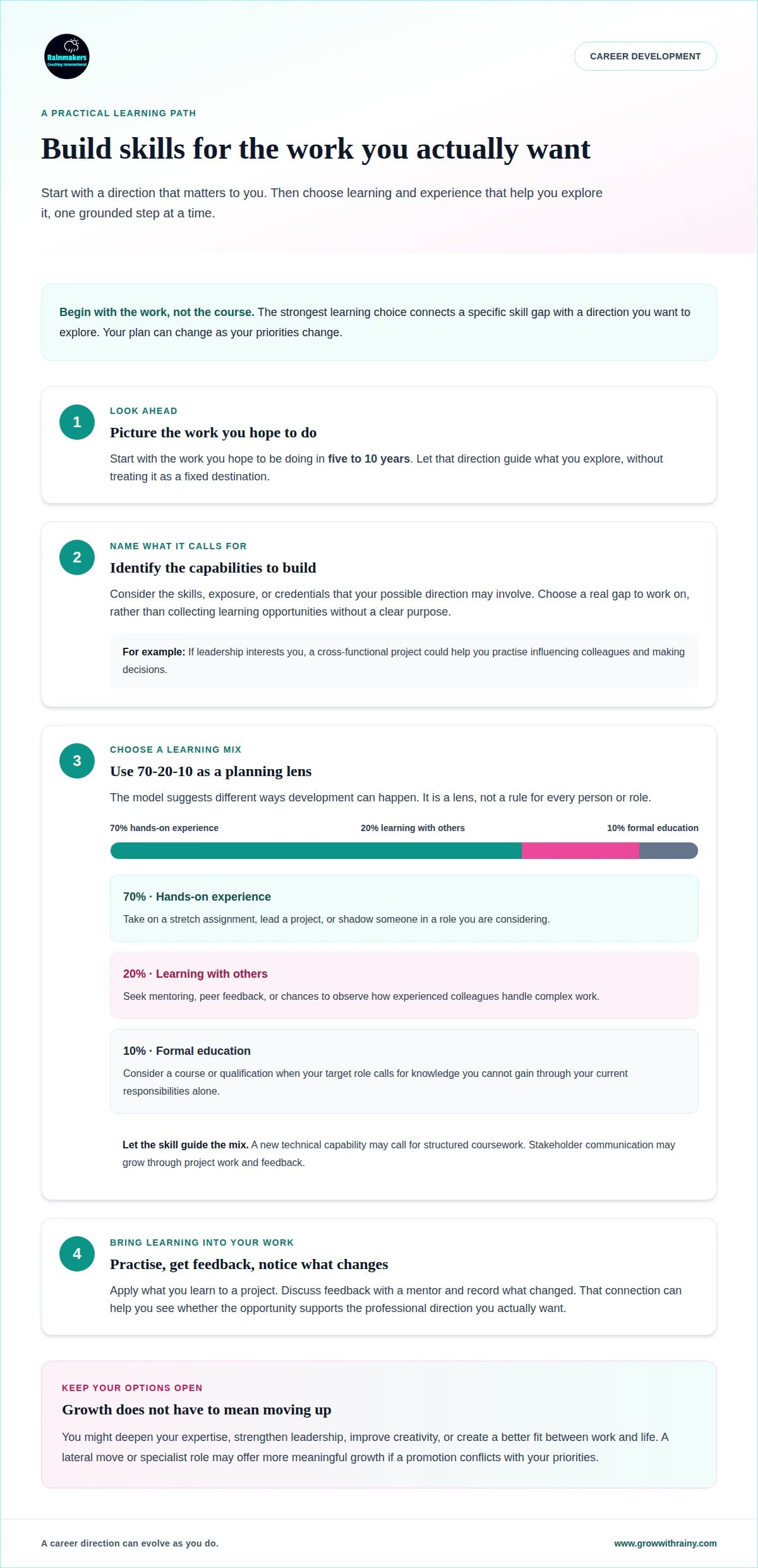
Learning can happen through formal study, practical work, and relationships with experienced colleagues. The strongest choice connects a specific skill gap with the direction you want to explore.
Start with the work you hope to do in five to 10 years. Then identify what capabilities, exposure, or credentials that work may involve. If you’re considering a move into leadership, for example, a cross-functional project could help you practise influencing colleagues and making decisions.
The 70-20-10 model offers one way to think about development: 70% through hands-on experience, 20% through social connections and interactions, and 10% through formal education. Treat it as a planning lens, not a rule for every person or role. A new technical capability may call for structured coursework, while stronger stakeholder communication may grow through project work and feedback.
- Hands-on experience: Take on a stretch assignment, lead a project, or shadow a colleague in a role you’re considering.
- Learning with others: Seek mentoring, peer feedback, or opportunities to observe how experienced colleagues handle complex work.
- Formal learning: Consider a course or qualification when your target role calls for knowledge you cannot gain through current responsibilities alone.
Professional development doesn’t have to mean moving up. You might deepen your expertise, strengthen leadership, improve creativity, or create a better fit between work and life. If a promotion brings responsibilities that conflict with your priorities, a lateral move or specialist role may offer more meaningful growth.
In Singapore, include SkillsFuture in your search for courses and funding support, or explore providers like Trainetics Academy to find relevant educational programs. The right choice depends on how closely a course fits your goal, its time commitment, and the skills it develops.
Learning paths also differ by field. A researcher might explore opportunities in academia, industry, policy, or entrepreneurship. An experienced professional might consider a similar range when their current environment no longer fits. Each path calls for different evidence of readiness, such as research experience, applied work, policy knowledge, or business development skills.
Before adding an opportunity, connect it to a capability and a real application. For example, if you want broader influence, choose learning that includes practice presenting recommendations, not only theory. A career-direction coaching conversation can help you distinguish between skills you genuinely want to build and expectations you’ve simply inherited.
Then apply what you learn to your current work. A course becomes more useful when you put its ideas to work on a project, discuss feedback with a mentor, and record what changed. That connection helps you decide whether the opportunity supports the professional direction you actually want.
Career research and hands-on exploration with a career coach
Research helps turn an interesting possibility into a clearer career choice. A coach can help you test assumptions, compare roles, and identify practical ways to experience the work.
Career exploration isn’t limited to people beginning their working lives. The exploration stage is often associated with ages 18-24, but professionals can revisit direction whenever their priorities or circumstances shift. A mid-career manager, for example, might explore specialist work without assuming promotion is the only next step.
Start by choosing a few roles or work settings to investigate. Compare their daily responsibilities, required capabilities, working environment, and contribution. If you’re considering policy work in Singapore, examine how it differs from an industry role that uses your existing expertise. Focus on the work itself, not just the title or perceived status.
A career coach can help you separate evidence from expectation. Perhaps you believe a senior role means less meaningful work, or that a new field requires a particular personality. A coach can explore where those beliefs came from and help identify questions worth testing. That reflection can reveal assumptions as well as strengths you haven’t yet used.
Research becomes more useful when it leads to a small, real-world experiment. Depending on the role, exploration might include:
- Speaking with someone who performs the work and asking about a typical project.
- Shadowing a colleague or mentor to observe real responsibilities.
- Taking on an internal assignment that uses a relevant skill.
- Joining a short project that exposes you to a different team or field.
For example, someone considering entrepreneurship could test a business idea through a small project before making a larger commitment. Someone drawn to academia could compare research, teaching, and administrative responsibilities. Each experiment gives you observations about the tasks, relationships, and environment involved.
Keep a simple record after each conversation or experience. Note what energised you, what felt draining, and which skills you used. If a project involving client presentations feels engaging, that evidence may point towards roles with more advisory work. If the same task creates friction, explore which part feels misaligned before drawing conclusions.
For career research in Singapore, compare local role descriptions, employer expectations, and the skills requested across relevant opportunities. Look for recurring capabilities, then consider how your experience translates. A coach can help you interpret that information alongside your values, strengths, and practical constraints, rather than treating a job title as a complete picture of the work.
You don’t need certainty before you begin exploring. A focused conversation, a shadowing opportunity, or one unfamiliar project can reveal what a job description cannot. Which part of your current work would you like more of, and which part would you rather leave behind?
Reviewing and adjusting a career plan with a career coach
A plan needs room to respond to real life. Review it at least annually, and whenever your goals or circumstances change.
For a practical starting rhythm, review your progress every six months. Look at what has changed since the previous review, not just which tasks are complete. A promotion, a new caregiving responsibility, or a shift in priorities may change what a meaningful next step looks like.
Use each review to examine four areas: progress, energy, obstacles, and fit. Progress shows which actions moved forward. Energy reveals which work feels engaging or draining. Obstacles identify missing support or skills. Fit asks whether the direction still reflects your values and priorities.
- Progress: Which milestone did you reach, and what helped?
- Energy: Which recent task felt aligned with your strengths?
- Obstacles: What delayed an action, and what support could help?
- Fit: Does the goal still match the life and work you want?
A career coach can help you interpret your answers without treating a delay as personal failure. For example, if a leadership project stalled because your responsibilities changed, the useful response may be to revise the timeline or find another way to practise leadership. If the goal no longer feels relevant, explore what has shifted before carrying it forward out of habit.
When a manager supports your development, progress reviews can include a focused conversation about work opportunities. Discuss what you have tried, what feedback you received, and which responsibility could help build the next capability. If a manager identifies a roadblock, you can adjust the plan around available projects, expectations, or training. You can also keep a progress record to share with your manager.
Consider a mid-career professional who wants broader influence but finds their current role leaves little room for cross-team work. A review might show that the original goal still matters, while the chosen action is impractical. The next step could shift from seeking an immediate role change to requesting a project involving another team. The direction stays intentional; the route becomes more workable.
Keep the record simple: note the goal, recent evidence, obstacles, and next action. A clear goal-setting process can make progress easier to assess, especially when a goal feels too broad. If circumstances change, update the action or timeline rather than preserving an outdated version for consistency’s sake.
A review is not a test of commitment. It is a chance to choose deliberately. At your next six-month check-in, what evidence would tell you that your current direction still fits?
Career development goal examples
A goal becomes actionable when it describes a change you can observe, not just a feeling you hope to reach. “Grow as a leader” is difficult to assess. “Lead a cross-functional project and gather feedback from its stakeholders” gives you a visible action and evidence to review. The best examples also reflect what matters to you, whether that is influence, fulfilment, expertise, or balance.
A career coach can help turn broad ambitions into SMART objectives: specific, measurable, attainable, relevant, and time-bound. For example, a productivity goal could be to increase output over a defined period, with smaller milestones to track progress. A coach can help test whether the measure is meaningful and whether the actions fit your role and circumstances.
Choose a time horizon that suits the goal. Medium-term career goals are intended to be achieved within 1-5 years. One long-term example is becoming a fully qualified architect within 7-10 years, or preparing for an airline career through structured flight training at Aero Global Aviation Academy. A longer horizon needs nearer milestones, such as completing relevant learning, gaining practical experience, and reviewing progress along the way.
Use examples as starting points, then adapt them to your work and priorities:
- Build a skill: Practise presenting recommendations during a project, then gather feedback on clarity and influence.
- Grow responsibility: Lead a team initiative and document decisions, outcomes, and lessons for a future leadership role.
- Explore a direction: Arrange voluntary physiotherapy work experience with a football club by 1st January 2027.
- Support meaningful work: Start a community volunteering opportunity by Easter 2027, connecting service with a personal value.
- Strengthen performance: Set a productivity target, such as the 20% annual increase, and track the 2% monthly steps.
Each example needs a clear measure and a reason it matters. For a leadership goal, evidence might include completing a project and receiving stakeholder feedback. For a skill goal, evidence might be applying the skill to a real assignment. If the measure is outside your control, such as receiving a promotion, define actions you can influence, including developing a capability or taking on relevant work.
Keep the goal realistic without making it small. If progress stalls, review the measure, timeline, and support you need. Which example reflects the work and life you want, rather than an expectation you have inherited?
Rainmakers Coaching International: Career development Coaching
Rainmakers Coaching International offers career development coaching for professionals seeking clearer direction and more meaningful growth. If you know the next step on paper but feel uncertain about it, coaching can help you explore what matters beneath that choice.
The approach works from the inside out. Rather than adding more frameworks or focusing only on career mechanics, coaching supports you in reconnecting with what feels true to you, recognising your innate gifts, and uncovering resources you may have overlooked. It can also help you notice protective patterns that no longer serve your goals. A shift in your inner perspective can influence how you work, lead, and live.
Choose Career Coaching when your questions centre on direction or professional growth. If leadership challenges or broader life priorities shape your decisions, Executive Coaching or Life Coaching may be relevant. What might become clearer if you had space to explore your next move?
Choose a next step that feels like yours
A career development plan matters when it reflects more than what looks impressive. Let it connect your next professional move with the kind of life and leadership you want. If your direction changes, that isn’t failure. It’s useful information about what fits now.
Before taking action, ask what you want your work to make possible beyond a title. Perhaps you want greater influence, room to learn, or a steadier relationship with your work. Choose one manageable experiment, then notice what it reveals about your strengths, values, and energy. That evidence can shape a more authentic next move.
Inside-out coaching can help you hear that evidence clearly, especially if external expectations have been louder than your own preferences. Rainmakers Coaching International supports professionals exploring career direction alongside the inner patterns that influence how they work, lead, and live. You don’t need every answer before beginning. You need a next step you can stand behind.
Move at a pace that lets self-trust grow alongside your choices. Your next chapter can begin with one honest decision.
Frequently Asked Questions
Why start early?
Starting early gives you more time to notice what kinds of work suit you. The National Society of Leadership and Success recommends beginning a career development plan during the first year of college. For a mid-career professional, starting now can also help clarify choices before a major transition, such as moving into management or changing fields. Early reflection doesn’t lock you into one path. It helps you make choices with greater awareness.
What is a career development plan and what should it include?
A career development plan is a working record of your professional direction and the actions that support it. Include priorities, capabilities to build, useful experiences, milestones, and timelines. You can also note constraints that affect your choices, such as caregiving responsibilities or limited opportunities to practise a skill at work. For example, someone aiming to manage a team could record the leadership experience they want and how they’ll seek feedback.
What are examples of short-term and long-term career goals?
A short-term goal could be facilitating a client workshop to practise presenting and guiding discussion. A longer-term goal might be moving into a role where you shape organisation-wide priorities. The distinction is less about ambition than the time and development each goal requires. For either goal, identify evidence of progress, such as completing the workshop and reflecting on participant feedback, or taking on work with broader organisational influence.
How can a career coach help identify skills, strengths and career gaps?
A career coach can help you examine work examples, feedback, and responsibilities to identify strengths you may overlook. They can also guide a skills gap analysis, comparing the capabilities needed for a target role with your current experience. For instance, colleagues may highlight your strong technical judgement, while a future role may require more stakeholder influence. This can help you distinguish a skill to develop from a strength to use more fully.
How often should I review and update my career goals?
Review your goals at least annually, and sooner if your circumstances change. Six-monthly reviews offer a useful starting rhythm. For example, if a new responsibility shifts your priorities, decide whether to adjust your goal, timeline, or next action. Note what changed and why. That record can help you see whether you’re making a considered adjustment or continuing with a direction that no longer fits.

Article by
Rainy Rainmaker
Rainy Rainmaker is the founder of Rainmakers Coaching International and a transformational coach for confidence, self-trust, and authentic leadership. Based in Singapore, she helps high-achieving professionals, managers, and leaders who appear capable on the outside but feel quietly held back by self-doubt, overthinking, imposter feelings, burnout, or a loss of direction. Through her signature Rainmaker Transformation Journey™, Rainy helps clients uncover the insights already within them and turn inner clarity into aligned action that creates lasting change in how they work, lead and live.
