
You may be questioning where your career is heading, or whether your work reflects what matters to you. Deciding what, if anything, needs to change can be difficult when income, family commitments and stability also matter.
Aligning your career with your personal mission starts with clarifying what you want your work to contribute, which strengths you want to use and the life you want it to support. You don’t need a grand purpose statement or one perfect role to begin.
This article will help you put your priorities into words, assess how your current work fits and choose a grounded next step. That might mean changing how you approach your role or giving a larger career decision more thought.
Key Takeaways
- Clarify what you want your work to contribute without forcing yourself to create a grand mission statement.
- Separate your values, strengths, preferred contribution, and practical needs to see what meaningful work means to you.
- Assess how aligning your career with your personal mission shows up in everyday tasks, decisions, relationships, and contributions.
- Review your priorities, current evidence, sources of friction, and open questions to spot where your work feels out of step.
- Before making a major career move, choose one priority and test a small, realistic change in your current working life.
Why aligning your career with your personal mission can feel difficult
You may be trusted with important work, respected by colleagues, and good at what you do, yet feel less connected to the reason you chose this path. That discomfort can be hard to name. From the outside, your career may look like it’s working. Inside, your priorities may have shifted.
Career alignment isn’t a fixed destination. It’s the evolving fit between what matters to you and what your working life asks of you. A personal mission is different from your company’s mission statement, your job title, or the idea that you must discover one lifelong calling. It can act as a compass for the contribution you want to make, the choices you want to stand behind, and the work that feels worthwhile to you now.
Career alignment is the evolving fit between what matters to you and the work you actually do, not a promise of a perfect job. That fit can change as your responsibilities and circumstances change. Gallup’s State of the Global Workplace report found that global employee engagement was 20% in 2025, down from 23% in 2022. Engagement isn’t the same as personal mission, but the decline offers context for why a capable career may not always feel involving or meaningful. Look beyond external measures of success and ask what your own experience of work is telling you.
Alignment can also develop within your current role, rather than requiring a new employer or career altogether. For another way to think about professional fit, read this perspective on career misalignment for senior leaders.
What does career alignment with a personal mission mean?
Your mission can be a working compass, not a polished sentence you need to put on a wall. It helps you notice what you want your effort to contribute and which choices feel consistent with your values. The field of career counseling offers a broad overview of support for career decisions, but your own compass begins with your experience of work.
Consider two roles with equally impressive titles. One brings visibility but leaves most days filled with tasks that feel distant from the person’s strengths. The other offers less status but includes mentoring colleagues and shaping useful solutions, contributions that feel meaningful to that person. The title alone can’t tell you which role fits. The details of the working day matter.
Why can a successful career still feel misaligned?
A role that suited you earlier may not fit as well after your priorities shift. Perhaps you once valued rapid progression, and now you care more about developing people or seeing a clear benefit from your work. The role hasn’t necessarily become wrong. You may simply relate to it differently now.
Seniority, recognition, and responsibility can be real achievements, yet they don’t automatically create a sense of personal meaning. That gap is information, not a diagnosis. It doesn’t prove you should leave or that you’ve made a mistake. As you consider aligning your career with your personal mission, ask what your everyday responsibilities make possible and what they leave wanting. What still feels worth your energy?
How to clarify the personal mission beneath your career choices
You don’t need to begin with a grand statement about changing the world. Start smaller: what do you want your work to make possible, for whom, and in what way? A useful personal mission grows from what you notice in your real working life, not from choosing impressive words that sound right.
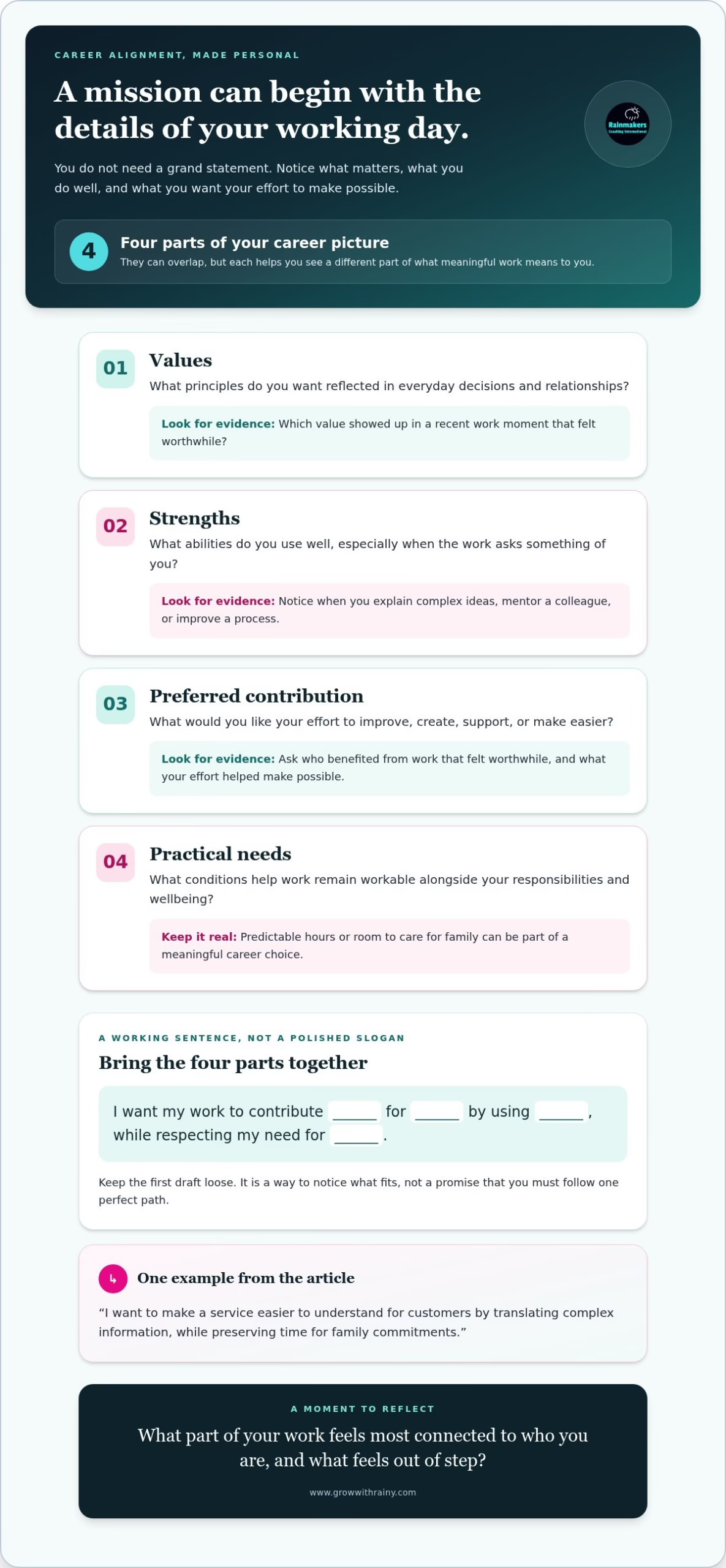
Try separating four parts of your career picture. They can overlap, but each asks a different question:
- Values: What principles do you want reflected in everyday decisions and relationships?
- Strengths: What abilities do you use well, especially when the work asks something of you?
- Preferred contribution: What would you like your effort to improve, create, support, or make easier?
- Practical needs: What conditions help work remain workable alongside your responsibilities and wellbeing?
Keeping these distinct can bring clarity. You might value collaboration, draw on careful listening, and want to help a team work through complex decisions. At the same time, you may need predictable hours or room to care for family. Practical needs don’t make a mission less meaningful. They’re part of the reality any career choice has to meet.
Use values and strengths as evidence, not abstract labels
A value becomes clearer when you see it in action. Think of a recent work moment that felt worthwhile, even if it was demanding. What were you doing? Who benefited? Which strength did you use? Then recall a moment that drained you. Was a value being overlooked, or were you spending much of your energy on work that rarely uses your strengths? For prompts, explore these examples of personal values, then choose words that match your own experience.
Look for patterns across several moments instead of treating one difficult day as a verdict. Perhaps you feel most engaged when you explain complicated ideas, mentor a colleague, or improve a process. Those details offer more useful evidence than a broad label such as “impact” on its own.
Turn a broad sense of purpose into a clear working statement
Try completing this sentence privately: I want my work to contribute ______ for ______ by using ______, while respecting my need for ______. For instance, you might write that you want to make a service easier to understand for customers by translating complex information, while preserving time for family commitments.
Keep the first draft loose. Revisit it after noticing more work experiences, and change the wording if it doesn’t fit. A personal mission can guide your choices without dictating one job. It may help you assess a project, shape a conversation with your manager, or compare future options without turning one sentence into a rigid rule. As you explore aligning your career with your personal mission, which real work moment best shows what matters to you?
How to assess whether your current career reflects your mission
A mission becomes easier to assess when you compare it with what your work actually asks of you. Look beyond your job title and your organisation’s stated values. Consider an ordinary week: the tasks you do, the decisions you influence, the relationships you build, and the contribution your work makes. Where do your priorities show up in practice?
Use this table to notice evidence, not to grade yourself or your career. A blank or uncertain answer is something to explore.
| Mission priority | Current evidence | Friction | Open questions |
|---|---|---|---|
| Helping people develop | I coach a colleague through a challenge | Most of my week is spent on reporting | Could mentoring become part of my responsibilities? |
| Working with care and honesty | I can raise concerns in team discussions | Some decisions are made without my input | Where could I contribute earlier? |
| Protecting time for family | My schedule is usually predictable | Urgent requests sometimes extend the day | What boundary or expectation needs a conversation? |
What signs suggest your work is aligned with what matters to you?
Look for repeated evidence. Do your values influence actual choices and working relationships, or do they appear mainly in the organisation’s public language? Do recurring responsibilities use strengths you want to develop? Is there a clear connection between your effort and a contribution you care about? Consider practical needs, too. A role may feel meaningful but still be difficult to sustain if its demands repeatedly conflict with important boundaries.
For a broader way to consider where career fit is strong or strained, explore the 4-Fit Model for career alignment. Use any framework as a prompt for honest observation, not a verdict on whether you belong in your role.
What if your job title looks right but the work feels wrong?
Separate the parts of the experience before drawing a conclusion. Is the strain tied to a particular task, a difficult working relationship, the way decisions are made, or the wider direction of the role? A specific frustration may call for a practical adjustment. A recurring gap across several parts of the work may point to a bigger question.
Notice what might be reshaped. Could you discuss priorities with your manager, take on a responsibility that uses your strengths, or change how you organise part of the work? If one difficult week is colouring your view, give yourself time to see whether the pattern continues. If the same friction returns across ordinary weeks, take it seriously without treating resignation as the only answer. Aligning your career with your personal mission starts with seeing the pattern clearly. What evidence from your working life deserves your attention?
How to take a grounded next step toward career alignment
Clarity doesn’t have to arrive before you act. A small, thoughtful experiment can help you learn what fits without requiring an immediate career change. The aim isn’t to prove that a role is right or wrong. It’s to gather better evidence and make your next choice with more self-trust.
Try this sequence:
- Choose one priority. Pick a value or contribution that matters to you now, such as helping colleagues grow or having more space for focused work.
- Review what happens today. Look at your ordinary responsibilities and note where that priority is already present, and where it has little room.
- Name the gap. Be specific. Is the issue a particular task, a lack of influence, unclear expectations, or a recurring conflict with your practical needs?
- Test one small change. Choose an action that could offer useful information, such as taking on a defined responsibility or having a focused conversation about how your work is organised.
Keep your real circumstances in view. Energy, care responsibilities, finances, and timing can all shape what is workable. A grounded decision respects those needs without letting fear make the decision for you. If a large change isn’t practical right now, you can still learn something or make a smaller adjustment.
Test alignment through small career experiments
Before trying a change, write down what you expect to learn. Afterward, ask: Did this work hold my interest? What happened to my energy? What felt meaningful, and where did friction remain? For example, if you’re drawn to mentoring, you might volunteer to support a colleague on a specific project and notice how the experience feels alongside your other responsibilities.
Give the experiment a clear beginning and a review point that suit the work involved. The result is information, not a guarantee about future career satisfaction. You may discover that the activity matters to you, but the way it’s currently arranged doesn’t feel sustainable. That insight can help you shape a more precise next step.
When is it time to consider a larger career change?
Look for patterns across different weeks and responsibilities, not just one exhausting stretch. If the same conflict keeps appearing in your tasks, working conditions, and opportunities to contribute, consider whether a broader change deserves attention. Compare possible directions with the priorities you identified earlier, and include practical needs in that comparison. You don’t need certainty to explore; you need enough evidence to ask a clearer question.
If structured reflection would help you weigh your options, Career Coaching at Rainmakers can support you as you explore career direction and professional development. As you consider aligning your career with your personal mission, what small experiment feels both meaningful and workable now?
How career coaching can support a more aligned direction
Sometimes the hard part isn’t a lack of options. It’s trusting yourself to choose when each option carries something valuable, whether that’s stability, growth, contribution, or time for the rest of your life. Career coaching can give you room to explore that tension without rushing towards a decision.
Rainmakers Career Coaching focuses on career direction and professional development. The work is reflective: clarifying what matters, examining the choices in front of you, and strengthening self-trust as you decide what to do next. You remain the decision-maker.
What career coaching can help you explore
Coaching can help you look at the priorities competing for your attention. Perhaps you want greater responsibility, but not at the cost of work that feels useful. Perhaps you value collaboration, yet your current role leaves little space to learn from others. You can explore these tensions alongside your values, strengths, practical needs, and the evidence you’ve noticed in your working life.
At times, hesitation may be connected to a familiar way of protecting yourself, such as avoiding a choice because the outcome feels uncertain. That may or may not fit your experience. If it does, coaching can help you examine the pattern with curiosity, without treating it as a diagnosis or assuming it explains every decision. The aim is to see your options more clearly and choose with greater self-trust.
Rainmakers Career Coaching uses the Rainmakers Transformation System™, with three stages: Release, Reprogram, and Recondition. The process supports inner reflection as you consider tangible choices, without promising a particular career outcome.
Choose a next step that respects your readiness
Coaching doesn’t have to be your immediate next step. You might keep a brief record of moments that feel meaningful or draining, revisit your priorities, or try a small change in your current role. Give yourself time to see what the experience shows you. Reflection is a valid step, especially if you’re still gathering evidence or balancing responsibilities that make a major decision feel weighty.
If you’re ready for support, you can schedule a conversation with Rainy to discuss whether coaching fits the question you’re facing. There’s no need to arrive with a finished plan. You can begin with uncertainty and explore what feels grounded for you.
Whether you reflect on your own or with support, aligning your career with your personal mission means making choices that fit your life as it is, while staying open to what may change. What one change would bring your work closer to your mission?
Let your next choice begin with what matters
You don’t need to map out your whole career before moving closer to work that feels meaningful. Start with one choice you can make with care: a conversation, a boundary, or a responsibility that better reflects what you value. Then notice what changes. Small steps can help you build clarity and self-trust as you decide what comes next.
Aligning your career with your personal mission isn’t about finding a flawless role. It’s about making choices that feel more connected to who you are, while respecting the life you’re living now. If you’d like space to think through your career direction, Rainmakers Career Coaching can help you explore your options.
What is one grounded step you feel ready to take?
Schedule a conversation with Rainy to explore your career direction
Frequently Asked Questions
How do I define my personal mission for my career?
Start by looking for themes in choices you’ve felt proud to make, not by searching for a perfect phrase. Write down a few moments when your work felt worthwhile, then note the actions you took and who benefited. Do you see a pattern, such as making complex ideas clearer or helping a team through change? Use that pattern as a working guide, and revise it as your experience grows.
Can I align my career with my personal mission without changing jobs?
Yes. You might bring more of what matters to you into your current role by changing how you approach a task, asking to contribute to a project, or making time to mentor someone. For example, if you value thoughtful problem-solving, you could suggest a short review before a recurring team decision. Notice whether the adjustment makes your work feel more connected and whether it fits your existing responsibilities.
What should I do if my values do not match my workplace?
First, get specific about the moments that concern you. Is there a difference in style, such as preferring collaboration in a fast-moving team, or does the situation ask you to act against a principle you consider essential? Record what happened and how often. If a respectful conversation could help, describe the practical impact and ask what might change. If not, consider what boundaries or options you can realistically pursue.
How do I know whether I need a career change or a change in my current role?
Look at where the difficulty sits. If particular duties or working arrangements are draining, but other parts of your field still interest you, a role adjustment may be worth exploring. If the work itself no longer connects with your priorities across different settings, broader change may deserve consideration. As you think about aligning your career with your personal mission, compare more than one possible path before treating a strong feeling as a final answer.
Is it realistic to find work that feels meaningful and meets practical needs?
It can be, though meaningful work doesn’t have to meet every ideal at once. Identify the conditions you need for work to remain sustainable, such as dependable income, manageable hours, or room for caregiving. Then distinguish essentials from preferences. A role might offer a valued contribution while still requiring compromises elsewhere. Naming those trade-offs clearly helps you assess opportunities without dismissing either your sense of purpose or your responsibilities.
Can career coaching help me clarify my direction?
Career coaching can help you organise competing priorities, question assumptions, and make space to consider choices you may be avoiding or overlooking. You might bring a specific decision, such as whether to pursue a leadership opportunity, and explore what draws you to it, what gives you pause, and what information would help. Coaching won’t decide for you, but it can support a more considered choice that feels like your own. What decision would you like to explore with greater clarity?

Article by
Rainy Rainmaker
Rainy Rainmaker is the founder of Rainmakers Coaching International and a transformational coach for confidence, self-trust, and authentic leadership. Based in Singapore, she helps high-achieving professionals, managers, and leaders who appear capable on the outside but feel quietly held back by self-doubt, overthinking, imposter feelings, burnout, or a loss of direction. Through her signature Rainmaker Transformation Journey™, Rainy helps clients uncover the insights already within them and turn inner clarity into aligned action that creates lasting change in how they work, lead and live.
