What if the best career coach isn’t the one with the most impressive framework, but the one who helps you see what’s clouding your direction? If you’re considering whether to hire a coach for career growth, start with the change you want, not just the title you hope to reach.
It makes sense to want clarity before investing your time and trust. Career coaching can help you define meaningful goals, recognise strengths you may be overlooking, and explore the patterns that make decisions feel difficult. The right fit should leave you feeling understood and better able to choose your next step, not pressured to follow someone else’s plan.
This guide will help you clarify what you want from coaching, compare a coach’s approach and credentials, and understand how costs, sessions and timelines can vary in Singapore. It also explores why executive and career-transition coaching may need to look beyond strategy alone. As you read, ask yourself: what would feel different in your work and life if your next move came from self-trust?
Key Takeaways
- Clarify what you want to change in your career before choosing a coach, so your goals can guide the work.
- Look for coaching that helps you recognise your strengths, communicate your value and build relevant soft skills.
- Compare a coach’s credentials, approach and costs, and consider whether their style helps you feel understood and focused.
- Use early sessions to turn broad ambitions into practical next steps; the pace of progress depends on your goals and circumstances.
- For a career pivot or leadership challenge, consider how inside-out coaching can support change that reaches beyond work.
What is a Career Coach?
A career coach helps you make clearer choices about your working life. If you’re aiming for career growth or promotion, coaching can help you identify your strengths, clarify the capabilities a next role requires, and practise communicating your contribution. The decisions and actions remain yours.
In Singapore, career guidance practitioners work in career centres, schools and career guidance organisations, according to the Skills and Workforce Development Agency (SWDA). Their roles and settings differ. A coach may focus on your career direction, while an education and career guidance counsellor may support students exploring study and work options.
Practical support can include reviewing how you present your experience. A coach may help you identify achievements that demonstrate leadership, problem-solving or collaboration. For example, instead of listing “managed projects,” describe the challenge, your contribution and the result. This can strengthen your personal brand without asking a coach to write your résumé for you.
Soft skills matter when your next step involves influencing colleagues, managing change or leading a team. Coaching can help you notice how you communicate under pressure and practise a more grounded response. A promotion conversation, team disagreement or presentation can provide a useful example to explore.
Career planning can also include learning. If a skills gap points to a course, consider whether SkillsFuture Credit may apply. Check the course’s eligibility and credit-use conditions before deciding. A coach can help connect your learning choice to a career goal, rather than treating training as progress in itself.
Careers and skills advisory appointments can help you explore career direction, transferable skills and possible training pathways. Prepare a decision you’re facing, such as whether to deepen your current specialisation or consider another field. A clear starting point makes the conversation more focused.
Skills workshops offer a different kind of support: a group setting for practising or developing specific capabilities. Job matching focuses on connecting people with roles, while coaching focuses on your goals, choices and readiness. These supports can complement each other, but they meet different needs.
A useful first step is to name the question behind your uncertainty. Is it “What work fits me?”, “How do I make my contribution visible?” or “What skill should I build next?” The answer can shape a personal-development coaching approach that connects career choices with self-trust and the way you want to work and live.
Career interests and goal setting
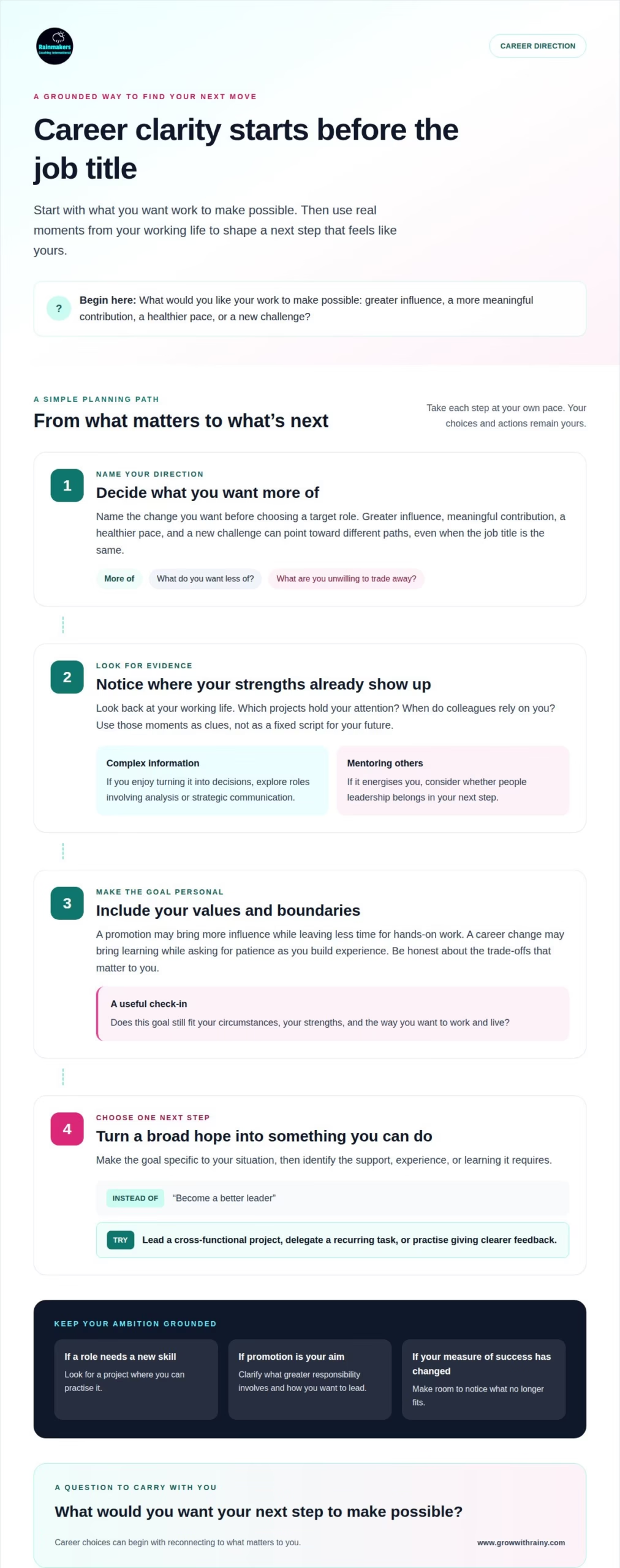
A clear career goal starts with understanding what you want your work to make possible. Is it greater influence, a more meaningful contribution, a healthier pace or a new challenge? Those answers can point in different directions, even when the desired job title is the same. Name the change you want before choosing a target role.
Then look for evidence in your working life. Which projects hold your attention? When do colleagues rely on you? For example, if you enjoy turning complex information into decisions, roles involving analysis or strategic communication may be worth exploring. If mentoring energises you, consider whether people leadership belongs in your next step.
Interests matter, but so do values and boundaries. A promotion may bring more influence while reducing time for hands-on work. A career change may offer learning while requiring patience as you build experience. Write down what you want more of, what you want less of, and what you’re unwilling to trade away. This makes your ambition more personal and grounded.
Structured career planning sessions can guide employees’ career development, according to Singapore’s Ministry of Manpower. A useful planning conversation connects your interests with your current strengths, skills to develop, and opportunities within your organisation or wider field. It can also help you notice when an old measure of success no longer fits.
Turn your direction into a goal you can act on. Instead of “become a better leader,” define what that means in your situation: lead a cross-functional project, delegate a recurring task or practise giving clearer feedback. Then identify the support, experience or learning each action requires. A grounded approach to career goals keeps ambition connected to daily choices.
- Direction: Choose the kind of contribution you want to make.
- Evidence: Name a project or moment that reflects your strengths.
- Next step: Select one action that moves you toward the direction.
Review the goal against your circumstances. If a new role requires a skill you haven’t used, identify a project where you can practise it. If promotion is your aim, clarify what greater responsibility involves and how you want to lead. These examples turn a broad hope into a conversation and a practical plan.
If you want to hire a coach for career growth, bring the question you’re wrestling with, whether it’s a career transition, leadership move, or change in what success means to you. A conversation about your career direction can help you explore what feels aligned. What would you want your next step to make possible?
Choosing a coach by cost, credentials and customer service
Warning signs include guaranteed promotions, pressure to buy immediately, or advice that ignores your goals. If a coach dismisses your concerns or promises a specific job outcome, pause before committing.
Start with fit, not the most impressive biography. A coach experienced in helping senior leaders may suit an executive facing team or promotion challenges. Someone focused on career transitions may better understand a move into a new field. Match the coach’s experience to the decision you’re facing.
Credentials can show training, but they don’t tell the whole story. Check out their coaching stories, ask how they would approach your goal. Listen for a clear explanation, not a string of impressive titles. A good conversation should help you understand how the process supports your decisions and growth.
Cost is easier to assess when you compare the full engagement, not just one session. Consider session length and frequency, the overall scope, and whether the work includes follow-up or agreed exercises, the experience of the coach, the genuine coaching testimonials from their clients. A short-term goal and a complex career transition may call for different levels of support. In Singapore, compare what each programme includes before weighing its fee.
Customer service shows up in small moments. Notice whether the coach listens carefully, answers your questions directly and respects your pace. If you explain that promotion is your goal, do they explore what leadership means in your workplace or jump straight to a standard plan? Their response can show whether the work will be tailored to you.
A trial conversation can help you assess the fit. Share a real challenge, such as feeling overlooked despite strong contributions. Notice whether the coach asks thoughtful questions, reflects your situation accurately and leaves space for your own insight. A useful first discussion should clarify the work, not create pressure.
- Approach: Can the coach explain how sessions connect to your goal?
- Boundaries: Are expectations, confidentiality and responsibilities discussed clearly?
- Fit: Do you feel heard while remaining responsible for your choices?
These checks can help distinguish grounded support from a polished sales pitch. If you want a coach to make decisions for you, coaching may not meet that expectation. If you want space to examine your assumptions, build self-trust and choose deliberate actions, look for a working relationship that supports those aims.
Expected coaching sessions and timelines
Get more from career coaching by arriving with one clear concern and a real example. Agree on a practical action, then return with what happened and what you learned.
The timeline depends on the change you’re working toward. Clarifying a decision, preparing for a promotion conversation and changing careers involve different demands. A conversation about whether to pursue leadership, for example, may centre on your priorities and readiness. A career pivot may involve exploring roles, testing assumptions and building relevant experience over time.
Use each session to move from reflection toward action. A useful conversation might explore what made a recent project satisfying, what felt draining and what those experiences reveal about your next step. Bring specific moments rather than broad statements such as “I feel stuck.” Concrete examples give you and your coach something meaningful to examine.
Between sessions, turn an insight into a small experiment. If you want to lead more effectively, for example, invite feedback after a meeting or delegate a task you usually hold onto. In your next discussion, consider what you noticed, what felt uncomfortable and what you might adjust. This keeps coaching connected to your actual work.
At the outset, agree on how you’ll recognise progress. Choose markers that fit your goal, such as making a decision, having a direct conversation with your manager or taking on a stretch assignment. These are signs of movement, not promises of a promotion. If your goal changes, revisit the markers with your coach.
- Before a session: Bring one question and an example from work.
- During a session: Name the decision or pattern you want to understand.
- After a session: Choose one action you can practise in your real context.
- At the next session: Review what happened and decide what to carry forward.
Progress may feel uneven. A conversation can bring clarity, while putting a new behaviour into practice may take repeated attention. Speaking up in a leadership meeting, for instance, may feel different from identifying why you’ve been holding back. Both reflections can inform a grounded next step.
If you’re considering a career change, make room for exploration as well as action. Researching a role, speaking with someone in that field and assessing your transferable strengths each answer different questions. Your timeline should reflect the decisions and learning involved, not pressure you into an artificial deadline.
At each review, ask what has shifted in your thinking, choices or daily work. If sessions aren’t helping you move toward the agreed goal, raise that directly and discuss whether the focus or approach needs to change.
Executive and career-transition coaching
In Singapore, career guidance includes career coaches in career centres, education and career guidance counsellors in schools, and practitioners in career guidance organisations, according to the Skills and Workforce Development Agency (SWDA). For senior professionals, executive coaching can focus on leadership challenges, while career-transition coaching supports decisions about a different role or field.
A promotion changes more than your title. You may need to delegate work you once owned, influence peers or lead through uncertainty. A newly promoted manager, for example, might be technically capable but hesitant to give direct feedback. Coaching can help explore what makes that conversation difficult and practise a response aligned with the leader they want to become.
That inner work matters because a new strategy alone may not shift an old protective pattern. If avoiding disagreement once helped you feel safe, it may now limit your ability to lead. Coaching can help you notice that response, reconnect with your values and choose a different action. As your perspective changes, so may the way you work with colleagues and make decisions.
A career transition raises different questions. Are you moving toward meaningful work, away from burnout or into a role that better uses your strengths? An experienced specialist considering people leadership, for example, may need to explore whether mentoring energises them rather than assuming promotion is the only measure of progress.
A career pivot can take several months of consistent work and coaching. That time may involve clarifying direction, learning about a new field, identifying transferable strengths and testing assumptions through practical steps. The aim isn’t to rush a decision, but to make choices with more self-trust and a clearer sense of what the transition requires.
Executive and transition coaching can connect professional goals with the rest of your life. A role that looks attractive on paper may involve demands that conflict with your priorities. A leadership opportunity, for instance, may offer greater influence but less time for family or creative work. Naming that tension helps you assess the whole decision.
To make the work concrete, coaching can help you:
- Identify the specific leadership or transition challenge.
- Notice strengths and patterns shaping your current choices.
- Choose a practical step, such as seeking a stretch assignment.
- Reflect on what the action reveals about your next direction.
Consider what needs to shift within you as well as around you. If you’re weighing a leadership move or career pivot, a coaching conversation can help you explore that next chapter with intention.
Rainmakers Coaching International
Rainmakers Coaching International helps you explore career growth through inside-out coaching. Rather than adding another framework, the work focuses on reconnecting with your truth, recognising your innate gifts and hidden resources, and noticing protective patterns that may no longer serve you. This can support clearer choices about how you want to work, lead and live.
Career or career development coaching may suit you when you’re weighing a next step, feeling disconnected from your direction or seeking change that reaches beyond a job title. Executive coaching can help you reflect on how your inner experience shapes your leadership and workplace relationships. The aim is to build self-trust and make more sustainable choices at a pace that respects your circumstances.
If you’d like to explore whether this approach fits your career question, contact Rainmakers Coaching International.
Take Your Next Step with Greater Clarity
Your next career move doesn’t need to be fully mapped before you begin. Start by noticing what feels ready to change and what you want your working life to make room for. One honest conversation with yourself can bring a quieter, more grounded direction into view.
If you choose to hire a coach for career growth, let the first conversation be about fit as much as goals. Share the question you’re carrying and notice whether the approach helps you think with more clarity and self-trust. The right support should leave you connected to your own choices, not dependent on someone else’s answers.
You’re allowed to choose a path that reflects who you are now, not only who you’ve been expected to become. Take the next step when you feel ready.
Frequently Asked Questions
How Do You Know It’s The Best?
The best coach for you is someone whose approach fits your goal and helps you think clearly. Notice whether the conversation makes room for your perspective or pushes a ready-made answer. If you’re deciding between a promotion and a career change, for example, the coach should help you explore what matters in each choice. A strong fit supports your judgment rather than replacing it.
What is Career Guidance?
Career guidance helps people understand their interests, skills and possible work or learning directions. In Singapore, practitioners include career coaches in career centres, education and career guidance counsellors in schools, and practitioners in career guidance organisations, according to the Skills and Workforce Development Agency (SWDA). Someone considering a new field, for example, might explore transferable skills and relevant training before deciding which direction to pursue.
How much does career coaching cost in Singapore?
Career coaching fees in Singapore vary according to the coach, session format and scope of support. A short discussion about one decision differs from sustained work on leadership or a career transition. Compare what the fee covers, including session length, follow-up and any agreed work between meetings. A clear explanation of the arrangement helps you assess whether the support fits your needs and budget.
How do I choose a qualified career coach in Singapore?
Choose a coach whose experience and approach relate to your challenge. If you’re preparing to lead a larger team, look for relevant executive or leadership coaching experience; if you’re reconsidering your direction, focus on career development. Ask how the coach would work with your specific goal and what role you’ll play in the process. Their answer should be clear and centred on your situation.
What credentials or certifications should a career coach have?
Look for clear information about a coach’s training, professional background and approach, then consider how these relate to your needs. Credentials can help you understand someone’s preparation, but they don’t guarantee a good personal fit or a particular result. Ask how the coach’s experience informs their work with a situation like yours. Notice whether they explain their method plainly and welcome thoughtful questions.
What does career coaching typically include?
Career coaching may include clarifying priorities, exploring work options, identifying areas for development and reflecting on workplace challenges. The focus depends on your goal. Someone who feels overlooked in meetings, for instance, may explore what makes speaking up difficult and choose a practical way to contribute more visibly. Coaching is a reflective partnership, not a promise of a job offer or a substitute for making your own decisions.
How do I compare career coaching services and packages in Singapore?
Compare the stated scope, session format, coach’s relevant experience and how progress will be reviewed. A programme focused on career direction may differ from support for an executive taking on broader leadership responsibilities. Check that the proposed work addresses your actual question, rather than simply offering more sessions or tools. A useful comparison makes the purpose, responsibilities and fee arrangements easy to understand.
What questions should I ask before hiring a career coach?
Ask how the coach would approach your specific goal, what a session involves and how you’ll review progress together. You might say, “I’m considering a move into people leadership. How would you help me explore whether it fits?” Also clarify the fee arrangement, session format and expectations between sessions. These questions can help you decide whether the coach’s style feels respectful, relevant and grounded.

Article by
Rainy Rainmaker
Rainy Rainmaker is the founder of Rainmakers Coaching International and a transformational coach for confidence, self-trust, and authentic leadership. Based in Singapore, she helps high-achieving professionals, managers, and leaders who appear capable on the outside but feel quietly held back by self-doubt, overthinking, imposter feelings, burnout, or a loss of direction. Through her signature Rainmaker Transformation Journey™, Rainy helps clients uncover the insights already within them and turn inner clarity into aligned action that creates lasting change in how they work, lead and live.
