
What if feeling lost after success isn’t a sign that you’ve failed, but a signal that achievement has taken you away from what matters to you? If promotions haven’t quieted imposter feelings, or every big decision feels heavy, personal coaching for self-discovery can help you look beneath expectations and reconnect with your own values and direction.
You may believe you should feel fulfilled by the career you’ve worked hard to build. Yet success can feel strangely empty when it doesn’t reflect who you are. The answer isn’t necessarily another goal or a more impressive title. Sometimes it begins with understanding the learned strategies that helped you achieve but now make it harder to trust yourself.
In this article, you’ll learn how personal coaching supports self-discovery, what the process can look like, and how greater self-trust can help you approach decisions and career direction. Start with a practical question: where are you choosing from genuine interest, and where are you mainly trying to meet an expectation? Your answer can help you identify what you want to explore.
Key Takeaways
- Self-discovery coaching is less about inventing a new identity and more about noticing learned strategies that may no longer reflect who you are.
- Personal coaching for self-discovery can help you notice the gap between outward success and your own sense of direction.
- The seven protective patterns are coaching constructs, not clinical diagnoses. They can help you reflect on how learned responses may shape your choices.
- The Rainmakers Transformation System™ uses Release, Reprogram, and Recondition to support movement from insight toward meaningful change.
- Reconnecting with yourself can help you consider what matters at work and in the rest of your life.
What Is the Real Purpose of Personal Coaching for Self-Discovery?
What if you don’t need to find yourself at all? You may not be missing a better identity or a more impressive version of you. You may be ready to question expectations and protective habits that make it harder to hear your own voice. That’s the heart of personal coaching for self-discovery: reconnecting with what matters to you beneath the roles you’ve learned to perform.
There’s a difference between finding yourself and reclaiming yourself. Finding can sound like inventing someone new. Reclaiming is noticing what no longer fits and making room for your own wisdom, courage, and sense of purpose. A personal coaching relationship can offer space to reflect, examine assumptions, and turn insight into choices that feel more grounded.
For high-achievers, this reflection can be especially useful. Competence and recognition often reward adapting to expectations: reading the room, staying composed, and delivering under pressure. Those abilities can serve you well, but they can also create distance from what you genuinely want. If success has left you questioning your direction, transformation life coaching can create room to explore that tension without assuming you need to start over.
The Difference Between Repairing and Releasing
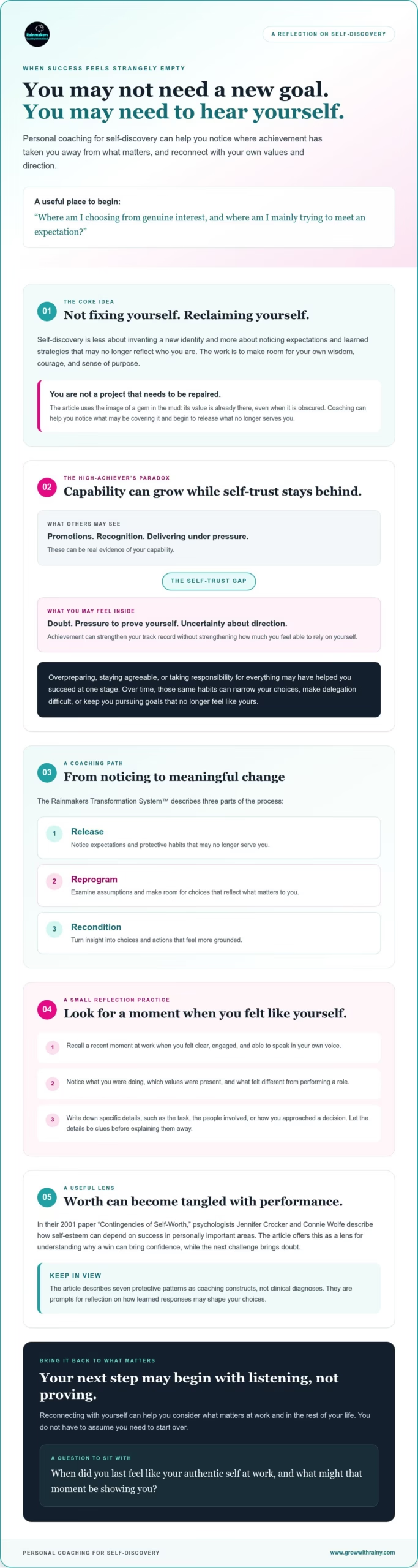
You are not a project that needs to be repaired. The Rainmakers Coaching Manual™ uses the image of a gem in the mud: the gem’s value is already there, even when it’s obscured. In coaching, the work is not to manufacture worth, but to notice what may be covering it and begin to release what no longer serves you. Transformation is not only about what you achieve. It is also about who you become as you act with greater honesty and self-trust.
Why Capability Isn’t the Problem
You may already have evidence that you can lead, solve difficult problems, and make consequential decisions. The challenge may be trusting that evidence instead of continually searching for more proof. Self-discovery can help you hear your own judgment more clearly, so your choices aren’t guided only by pressure, approval, or fear of getting it wrong.
Try this brief reflection. Think of a recent moment at work when you felt clear, engaged, and able to speak in your own voice. What were you doing? Which values were present? What felt different from moments when you were performing a role? Write down a few details before explaining them away. Look for specifics, such as the kind of task, the people involved, or how you approached a decision. These details can offer useful clues about the conditions in which you feel most like yourself.
When did you last feel like your authentic self at work, and what might that moment be showing you?
The High-Achiever’s Paradox: Why Success Often Hides the True Self
You reach a promotion, earn your team’s trust, and deliver under pressure. So why can success still leave you wondering whether you belong? Achievement can strengthen your track record without strengthening your self-trust. If your confidence depends on the next result, each new level may bring fresh pressure to prove you deserve to be there.
The High-Achiever Self-Trust Gap describes the disconnect between visible evidence of your capability and how much you feel able to rely on yourself internally. Habits like overpreparing, staying agreeable, or taking responsibility for everything may have helped you succeed at one stage. Over time, the same habits can narrow your choices, make delegation difficult, or keep you pursuing goals that no longer feel like yours.
Identity Enmeshment in Leadership
When your sense of worth becomes tied to performance, a difficult review can feel like a verdict on your value, rather than feedback about one part of your work. In their 2001 paper “Contingencies of Self-Worth,” psychologists Jennifer Crocker and Connie Wolfe describe how self-esteem can depend on success in personally important areas. This can be a useful lens for leaders who feel confident after a win, then doubtful when the next challenge appears.
Overachievement can become a way to prove your value when you’re unsure you have permission to belong without the next accomplishment.
The effect can reach beyond your inner life. A leader who feels unsettled may second-guess a decision, avoid an honest conversation, or interpret uncertainty as a reason to work harder. That doesn’t mean every workplace challenge comes from within. It does mean your state of mind can influence how you meet a challenge. If this experience feels familiar, you may find it useful to explore imposter syndrome after promotion.
The Cost of Living a “Bonsai” Life
Picture a bonsai carefully pruned to fit its pot. Its shape may be admired, but it has been constrained to suit its surroundings. In a career, you might keep editing your ideas, preferences, or ambitions to fit the role that earned approval. The hidden treasures you’ve set aside, perhaps creativity, courage, or a different sense of purpose, don’t disappear. They may simply have had little room to grow.
More success isn’t always the answer to career confusion. Another title can bring more responsibility without answering whether the direction feels meaningful. Personal coaching for self-discovery can help you examine which habits still serve you and which may be limiting your choices. To explore that question with a coach, you can schedule a coaching conversation. What might become possible if you stopped pruning yourself to fit?
Identifying the Seven Protective Patterns That Cloud Your Clarity
Some habits that look like strengths can also have a cost. Perfectionism can be a way to guard against criticism. Approval-Seeking may help you maintain harmony. Overthinking can feel like preparation, while Control can seem like a way to keep important work on track. These responses may have helped you feel safer or succeed in the past. But if they start shaping every decision, they can make it harder to hear what you actually think and want.
Rainmakers Coaching describes seven patterns as coaching constructs, not clinical diagnoses: Perfectionism, Approval-Seeking, People-Pleasing, Over-Responsibility, Overthinking, Control, and Overachievement. They are ways to notice learned protective strategies, not labels that define you. The patterns can point toward strengths they may be obscuring, such as courage, wisdom, or purpose. The aim isn’t to judge the strategy. It’s to understand what it may be protecting, then consider whether it still serves you.
In personal coaching for self-discovery, awareness can create a pause between an old response and a more grounded choice. Start by noticing the pattern in a real situation, especially when the stakes feel high. What happened just before the response? What did you do next? What were you trying to prevent or secure? These questions help turn a broad idea into something you can examine in your own experience.
Perfectionism and Approval-Seeking
Perfectionism may be a strategy for protecting love, acceptance, and worthiness: if your work is flawless, perhaps no one can question your value. Approval-Seeking can carry a similar hope, making your sense of worth depend on praise, agreement, or a stakeholder’s reaction. In a meeting, that might mean polishing a presentation long after it is clear, or softening a recommendation because someone influential may disagree.
Try asking: “What am I afraid this response would mean about me?” The answer can help you separate the quality of your work from your worth as a person. If building self-trust is part of your focus, explore the Building Rock Solid Confidence Program.
Overthinking and the Need for Control
Overthinking can be an attempt to remove uncertainty before you act. But important decisions rarely come with complete information. Rechecking every scenario or trying to manage each detail may delay a decision and limit your team’s contribution. A more grounded approach is to identify what you know, name what remains uncertain, and decide what information is enough to take a considered next step.
- Notice the trigger: what decision or response brings the pattern forward?
- Name the strategy: are you responding with Perfectionism, Approval-Seeking, Overthinking, or Control?
- Choose one grounded next step based on your values and the information available.
Which strategy shows up most often for you, and what might it be trying to protect?
The Rainmaker Transformation System™: A Path to Reconnecting with Your Truth
Insight can show you what’s happening, but recognizing a pattern is not the same as changing how you respond when pressure returns. The Rainmakers Transformation System™ uses three stages: Release, Reprogram, and Recondition. Each stage supports a different part of the process, helping you move from recognizing an old response toward choices that better reflect who you want to be.
In personal coaching for self-discovery, the aim isn’t to become someone else. It’s to become more fully yourself. That means bringing awareness, new ways of thinking, and everyday action together, rather than treating insight as the finish line.
Stage 1: Release and Reprogram
Begin by noticing which protective pattern tends to take over. Does a mistake send you into Perfectionism? Do you look for reassurance before trusting a decision? Identify what happened, the response that followed, and what you feared might happen if you responded differently.
Release means loosening the belief that you must keep performing to prove your value. Reprogram means making room for a more grounded belief, one that recognizes your worth isn’t dependent on getting every decision right. You can start by writing down the belief that seems to drive the response, then asking whether it helps you make the choice you want to make now.
Stage 2: Recondition and Reconnect
New insight becomes useful when you practise it in daily life. Recondition means building habits that support self-trust, such as stating your view in a meeting before seeking approval, or making a decision with the information available instead of waiting for certainty. Small actions matter because they give you opportunities to respond differently in real situations.
For example, after noticing that you tend to overprepare for a presentation, you might decide in advance what preparation is necessary, then focus on communicating your message. You’re not aiming for flawless performance. You’re practising a response that leaves room for your judgment and voice.
Transformation Life Coaching offers a way to explore this kind of personal change. The three stages work together: release what no longer fits, reprogram the beliefs beneath it, and recondition through grounded action. What is one small choice you could make this week from self-trust rather than pressure?
Explore a coaching conversation
Finding Meaning Beyond the Boardroom: Living More Fully as Yourself
A career decision rarely stays neatly at work. If you’re carrying frustration home, replaying conversations at night, or feeling too depleted to be present with people you care about, it may be time to look beyond your next professional goal. Your work matters, but it is one part of a life that also includes relationships, rest, and the things that give your days meaning.
The Whole-Life Success & Fulfilment pillar starts with that wider view. Rather than measuring success only by title or performance, ask whether the way you’re working supports the life you want to live. Personal coaching for self-discovery can help you notice where your choices feel aligned and where they’re being shaped by expectations. Reflection may help you identify a direction grounded in your values rather than outside approval.
Beyond Career Goals: A Fuller Life Vision
Self-discovery can influence how you show up beyond the office. If you feel less driven to prove your worth, you may have more room to listen, set boundaries, and be present in your relationships. Paying attention to your energy and limits can also help you consider choices that respect your wellbeing as well as your ambitions. For individuals seeking non-clinical support in these areas, Flourish Holistic Coaching provides guidance designed to enhance emotional regulation, mindset, and day-to-day focus.
Authentic leadership isn’t about having the loudest voice in the room. It involves knowing what matters to you, staying grounded when others disagree, and acting with care and conviction. Take a moment to consider this question: If you stopped performing, what would remain? Your answer may point toward the parts of yourself that need more space.
Taking the First Step Toward Transformation
If you’re weighing up what coaching involves, read about life coaching benefits and misconceptions. And if achievement has stopped feeling meaningful, explore what may be behind that feeling. Reconnecting with your truth can inform how you lead, at work and in the rest of your life.
Choose a More Meaningful Way Forward
You don’t have to achieve more to become more yourself. Self-discovery can begin by noticing the protective patterns that affect your choices, building self-trust, and making room for a direction that feels meaningful at work and beyond it.
Personal coaching for self-discovery offers a space to explore those questions. Rainmakers Coaching International supports leaders, professionals, and individuals through tailored coaching, using the Rainmakers Transformation System™: Release, Reprogram, and Recondition. The focus is on reflection and change, not labelling who you are. The goal is not a perfect performance. It’s to lead and live more fully as yourself.
What might shift if you trusted what you already know about your own capability? If you’re ready to explore that question, begin a coaching conversation.
Your next chapter doesn’t need to look like anyone else’s. It can begin with reconnecting with what matters to you, one grounded choice at a time.
Frequently Asked Questions
What is the purpose of life coaching in the context of self-discovery?
Life coaching can help you understand what matters to you and make choices that better reflect it. In personal coaching for self-discovery, the focus is not on inventing a new identity, but on noticing learned strategies or expectations that may be obscuring your values and strengths. You might explore what feels meaningful, identify a pattern affecting your decisions, and choose one grounded action to take next.
How is self-discovery coaching different from psychotherapy?
Self-discovery coaching generally focuses on goals, present choices, and steps toward a desired future. A coach can help you reflect on values, habits, and career or leadership direction. Psychotherapy is a separate form of professional support that can address mental health concerns and emotional distress. Coaching is not a substitute for psychotherapy or clinical care. If you need support with mental health symptoms, consider speaking with a qualified mental health professional.
How long does the self-discovery process typically take?
There isn’t one timeline that fits everyone. The process can depend on what you want to explore, the changes you’re considering, and how you apply insights in everyday life. Recognizing a pattern may happen before you feel ready to respond differently in a high-pressure moment. Rather than looking for a fixed finish line, consider what progress would look like for you, such as making a decision with greater self-trust.
Can personal coaching help with career stagnation?
Coaching can help you examine what may be contributing to a sense of career stagnation and clarify what you want from your next chapter. You might consider whether your current role still fits your values, what parts of your work give you energy, and which assumptions make change feel difficult. Coaching can support reflection and direction-setting, but it isn’t recruitment, job placement, or job-search advice.
What should I expect from a life coach during a transformation session?
Expect a focused conversation about what matters to you, what feels stuck, and what you’d like to change. A coach may ask questions to help you examine your assumptions, recognize patterns, and decide on a practical next step. You bring your experience and choices; the coach supports reflection and forward movement. You can also ask about the coach’s approach and discuss what you hope to get from the work.
How do I know if I have a “protective pattern” affecting my success?
Notice whether a repeated response seems to help you feel safe while limiting your choices. For example, you may overthink a decision, seek approval before speaking, or feel compelled to make every detail perfect. Rainmakers describes Perfectionism, Approval-Seeking, People-Pleasing, Over-Responsibility, Overthinking, Control, and Overachievement as coaching constructs, not clinical diagnoses. Consider when the response appears, what it may protect, and whether it still serves you.
Is it too late to start a journey of self-discovery after 40 or 50?
No. There’s no age limit on reflecting on what matters and choosing a more aligned direction. Your experience may help you see which roles, expectations, and habits feel right for you now, and which no longer fit. You don’t need to dismiss your past or make an immediate life change. Start by asking what you want more of in this next chapter and what small step feels possible.
What is the “High-Achiever Self-Trust Gap”?
The High-Achiever Self-Trust Gap describes the disconnect between having evidence of your capability and feeling able to trust your own judgment. You may have handled complex responsibilities successfully, yet still second-guess a decision or feel you must prove yourself again. The idea isn’t a diagnosis. It’s a coaching lens for exploring how achievement, self-doubt, and learned protective patterns may affect the way you lead and choose. Where do you notice this gap in your own decisions?

Article by
Rainy Rainmaker
Rainy Rainmaker is the founder of Rainmakers Coaching International and a transformational coach for confidence, self-trust, and authentic leadership. Based in Singapore, she helps high-achieving professionals, managers, and leaders who appear capable on the outside but feel quietly held back by self-doubt, overthinking, imposter feelings, burnout, or a loss of direction. Through her signature Rainmaker Transformation Journey™, Rainy helps clients uncover the insights already within them and turn inner clarity into aligned action that creates lasting change in how they work, lead and live.
