

You want to be supportive and accessible to your team. But somewhere along the way, being available can turn into being available for everything. You answer messages after hours. Take on work because it feels easier than pushing back. Or say yes to request when your own priorities are already stretched.
This is why setting professional boundaries with your team matters. Healthy boundaries are not about becoming distant or less supportive. They help create clarity around what you are responsible for, what your team is responsible for, and where ownership needs to sit. Without those boundaries, you can easily become the person everyone depends on, while your own workload, energy and attention become increasingly difficult to protect.
In this guide, we’ll explore how to set clearer professional boundaries without damaging trust, how to recognise when over-responsibility may be keeping you too involved, and how to create more space for your team to take ownership.
Key Takeaways
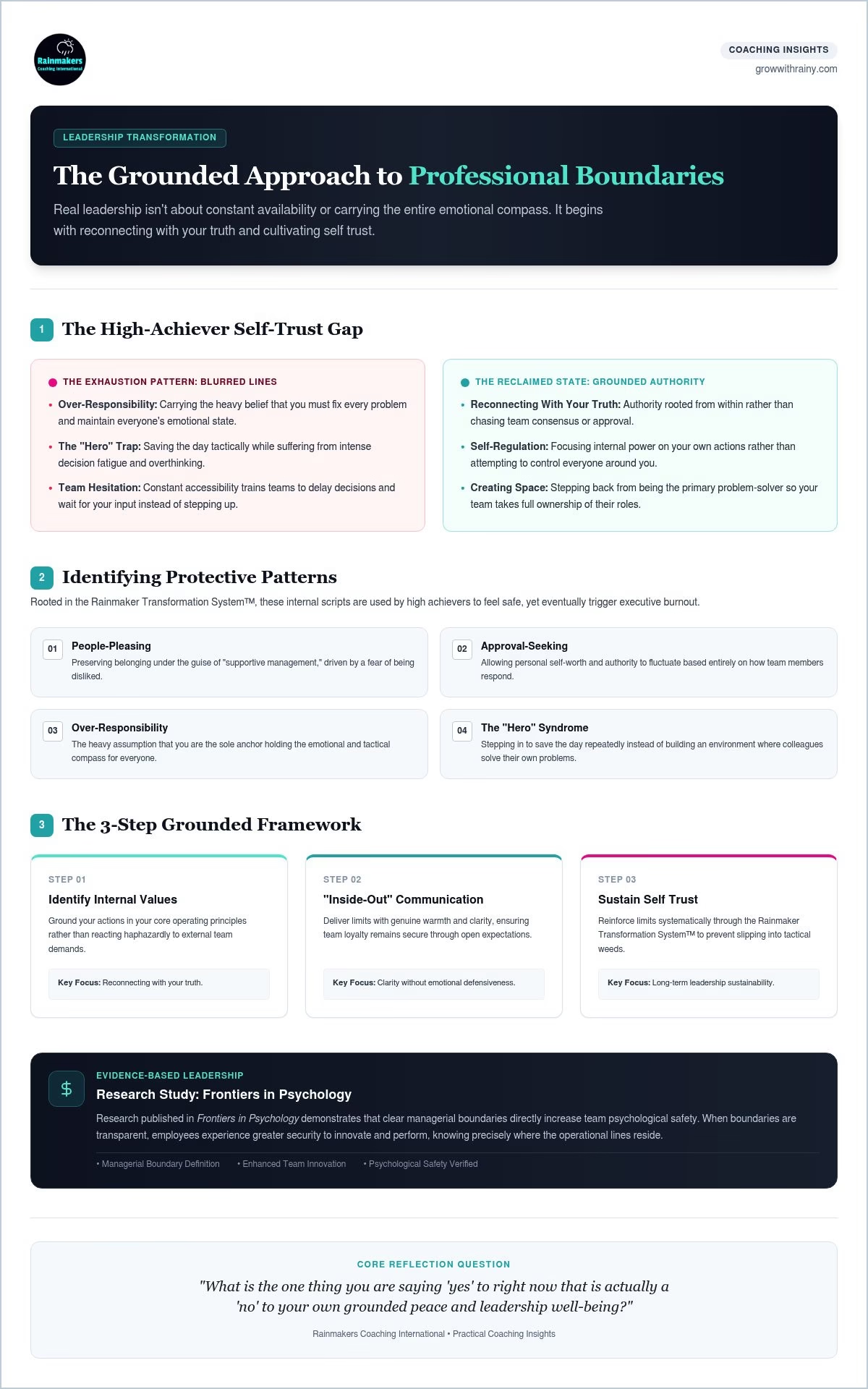
- Identify the seven protective patterns, such as People-Pleasing, that often blur the lines between being a supportive leader and reconnecting with your truth.
- Learn why setting professional boundaries with your team is an act of self trust that actually increases team psychological safety and performance.
- Discover a three step grounded framework for aligning your leadership actions with your internal values instead of just managing external rules.
- Master the “Inside-Out” communication method to share your needs with warmth and clarity without the fear of losing team loyalty.
- Reflect on your current leadership rhythm: which of your current “yeses” is actually a “no” to your own grounded peace?
Why High Achievers Struggle with Setting Professional Boundaries
For years, your ability to say "yes" was likely your superpower. It’s what earned you the promotion, the accolades, and the reputation for being the person who gets things done. But as you move into senior leadership, that same "yes" can become a cage.
Setting professional boundaries with your team isn’t about being "tough" or "distant." It is a grounded reflection of your self trust. When these lines are missing, you fall into the "High-Achiever Self-Trust Gap," where your external capability is high, but your internal permission to protect your own space is low.
Your capability isn’t the problem here. You are more than qualified to lead. The issue is the pattern of over-responsibility that suggests you are the only one who can carry the weight. This is a common hurdle in high achiever mental health, where the drive to perform masks a deeper hesitation to let go of control.
The High Cost of Blurred Professional Lines
If you don’t have clear lines, your team feels the friction even if they can’t name it. They may hesitate to make decisions, waiting for your input because you’ve always been available. This creates "leaky" boundaries that lead to intense decision fatigue and overthinking for you. You end up playing the "hero" who saves the day, but a hero is often just a leader who hasn’t yet learned how to be grounded.
True leadership requires a shift from being the primary problem-solver to being the person who creates the space for others to solve their own problems. This shift is rooted in the concept of personal boundaries, which focuses on self-regulation rather than trying to control the actions of those around you.
Recognizing the Self-Trust Gap
You don’t need more evidence of your capability; you have a decade of results behind you. You simply need more trust in the evidence you already have. The "Rainmaker Principle" suggests that over-responsibility often begins when we feel we must keep everyone okay.
If you believe your team’s emotional state is your personal burden, you’ll never feel safe setting the limits you need. This inability to set boundaries limits your next stage of growth because it keeps you tied to the tactical weeds instead of the vision.
Interestingly, research published in Frontiers in Psychology suggests that clear managerial boundaries actually increase team psychological safety. When people know exactly where the lines are, they feel more secure to perform and innovate without fear of overstepping.
Which "yes" are you giving to your team today that is actually a "no" to your own grounded leadership growth?
Identifying the Patterns That Blur Your Professional Lines
Setting professional boundaries with your team often feels difficult because we aren’t just fighting a calendar; we’re fighting our own protective patterns. These are the internal scripts we’ve used for more than a decade to navigate success. When you feel the urge to say "yes" to an unreasonable request, it’s rarely about the task itself. It’s about an internal pattern like People-Pleasing or Approval-Seeking that is trying to keep you safe.
In my work with the Rainmakers Transformation System™, I’ve identified seven specific patterns that high achievers use to protect themselves, but these eventually become the very things that cause burnout.
People-Pleasing vs. Empathetic Leadership
People-Pleasing is a strategy for preserving belonging in a team. In a leadership context, this often masks itself as "being a supportive manager." You might think you’re being empathetic, but if your decision is driven by a fear of being disliked, you’ve moved from heart-centered authority into a protective state. Learning the art of setting better boundaries at work involves distinguishing between genuine care and the need for external validation.
If you find that your sense of worth fluctuates based on how your team responds to you, you are likely operating from an Approval-Seeking pattern. Transitioning to a leadership style rooted in reconnecting with your truth means your authority comes from within, not from the consensus of the room.
The Trap of Over-Responsibility
The most common boundary-killer for senior executives is Over-Responsibility. This is the heavy belief that you must carry both the tactical and emotional burdens of everyone on your team. You aren’t just managing projects; you’re trying to manage how everyone feels. The Rainmaker Principle reminds us that this pattern begins with the need to keep everyone okay.
However, when you "fix" every problem, you rob your team of the chance to grow. You become a bottleneck rather than a catalyst. This isn’t just about time management. It’s about your leadership style and whether you are coaching your team or carrying them.
When you take on tasks that belong to others, you create a cycle of dependency. Breaking this cycle requires you to release the old pattern and reprogram your response to pressure. To move from exhaustion to excellence, you must stop assuming that everyone’s "okay-ness" is your job.
If you’re ready to look deeper at these scripts, a focused coaching conversation can help you identify which specific pattern is currently in the driver’s seat.
Which protective pattern, People-Pleasing, Approval-Seeking, or Over-Responsibility, feels most familiar to you right now?
Reconnecting with Your Truth: The Grounded Approach to Boundaries
Setting professional boundaries with your team is not about building walls to keep people out. It is about removing the "mud" of old protective patterns that obscure your leadership treasures. For more than a decade, I’ve watched high achievers try to solve boundary issues by applying more rules or "fixing" others.
Real transformation doesn’t work that way. It begins when you stop looking at the external friction and start looking at your internal alignment. Reconnecting with your truth is the only way to ensure your "no" carries weight and your "yes" has value.
The American Psychological Association emphasizes that establishing clear work boundaries to manage stress is essential for long term performance. However, to make these boundaries stick, you need a grounded framework. Within the Rainmakers Transformation System™, we use a three step methodology: Release, Reprogram, and Recondition. This process moves you from a state of constant reaction to a state of calm, decisive leadership.
Stage 1: Release the Protective Strategy
The first step is to identify the exact moment a protective pattern, like Approval-Seeking or Over-Responsibility, takes the wheel. When a team member asks for "just five minutes" that you don’t have, what is your immediate internal response? If you feel a tighten in your chest or a rush to accommodate, you’re likely trying to protect your image as the "all-knowing" or "always-available" executive.
Releasing this means letting go of the need to be the hero. It requires a quiet admission that you cannot be everything to everyone. Ask yourself: "What am I trying to protect by not setting this boundary?" Often, it’s not the team’s success you’re guarding, but your own sense of belonging.
Stage 2 & 3: Reprogram and Recondition
Once you’ve identified the pattern, you must reprogram the response. This involves building new neural pathways that associate boundaries with safety rather than conflict. You aren’t being "strict"; you’re being clear. Clarity is a form of kindness that creates psychological safety for everyone.
As part of your leadership development plan for 2026, consider creating a grounded routine for checking in with your values before you commit to new tasks. Reconditioning is the practice of repeating these new choices until they become your natural state. It’s about staying in your truth even when the pressure to revert to old habits is high. This consistency is what builds lasting self trust.
What is one boundary you’ve been hesitant to set because you’re afraid it might change how your team perceives your capability?
How to Communicate Boundaries Without Losing Your Team’s Trust
Does the thought of saying "no" to your team make your stomach drop? You aren’t alone. Many leaders fear that being firm means being unfeeling, but setting professional boundaries with your team is actually an act of radical transparency. It’s the difference between a fence that traps people and a lighthouse that guides them. When you lead from your truth, your boundaries don’t feel like rejection; they feel like a roadmap for how to work with you successfully.
Research published by the Harvard Business Review suggests that managers who establish clear expectations and limits actually foster higher levels of psychological safety. When a team knows exactly where your limits are, they don’t have to waste energy guessing your mood or navigating your burnout. They can focus on their work because the "rules of engagement" are visible and consistent. This clarity is the foundation of a healthy, high-performing culture.
The Language of a Heart-Centered Authority
Communication fails when it’s just a rule. It succeeds when it’s a shared truth. Instead of using "I can’t" or "You shouldn’t," which can trigger defensiveness, try using the "Inside-Out" method.
This means you share the value behind the boundary. For example, replacing "I can’t look at this now" with "I am choosing to focus on the board report so I can give your project my full attention tomorrow" changes the energy of the conversation. You are choosing to be a better version of yourself by owning your time rather than apologising for it. You don’t have to be loud to be heard; you just have to be grounded.
Establishing New Team Rhythms
Boundaries are most effective when they are woven into the rhythm of the team. This might mean setting specific "deep work" hours where you are unavailable for Slack, or modeling a grounded leadership style by not sending emails on weekends.
Grounded leadership is a state of being fully yourself when the stakes are high. When you model this, you give your team permission to do the same. This reduces the mental clutter of the entire organization.
If you find yourself falling back into an Approval-Seeking pattern when a team member pushes back, take a breath. Reconnect with the truth that your boundary is what allows you to lead them well over the long term.
If you were to set one boundary today that felt like a "gift" to your team’s clarity, what would it be?
Sustaining Grounded Leadership Through the Rainmakers Transformation System™
Knowing the theory of setting professional boundaries with your team is the first step, but the real work lies in the daily practice. Insight is merely the spark; transformation is the steady, enduring flame.
Many high achievers find that their new boundaries start to slip after a few weeks because they haven’t established a grounded rhythm to support them. If you don’t have a system to reinforce your new choices, your old protective patterns will eventually find their way back into the driver’s seat.
In the Rainmakers Transformation System™, we treat leadership as a living practice. Just as we use a methodical rhythm for content distribution, your team communication needs a predictable cadence. This consistency builds trust because your team no longer has to guess which version of you will show up to the meeting.
Executive coaching is essential in this phase to help you spot the "bonsai" patterns. These are the small, restrictive habits that keep your influence contained. When you identify these with a mentor, you can finally move from hesitation to a state of clear, decisive action.
Beyond the Boardroom: Whole-Life Boundaries
A professional struggle with limits is rarely just about work. If you are leaking energy at the office, you are likely doing the same in your private life. Reconnecting with your truth is a holistic process.
When you master executive presence and reclaiming self-trust, you’ll notice a profound shift in your personal fulfilment. You stop being the "fixer" at home, just as you stopped being the "hero" at work. This alignment brings a sense of quiet strength that allows you to be fully present for the people who matter most without the heavy weight of over-responsibility.
Next Steps for the High-Achieving Leader
True growth isn’t about fixing what is broken; it is about uncovering what is already there. If you feel ready to move beyond management tactics and into a leadership style that feels authentic, I invite you to explore the Building Rock Solid Confidence Program.
This journey is designed to help you release the patterns that no longer serve you, allowing your natural treasures to emerge. You don’t need to work harder to be a better leader. You simply need to trust the evidence of your own capability and stay grounded in your truth.
If you trusted yourself fully today, what is the one boundary you would set immediately?
Reclaiming Your Leadership Space
Leadership is often a journey of unlearning the very habits that once made us successful. By identifying the protective patterns that keep you over-extended, you can begin the process of setting professional boundaries with your team from a place of calm, grounded authority.
We’ve explored how these limits aren’t just tactical rules; they are the external evidence of your internal self trust. When you lead from your truth, you create a culture where others feel safe to do the same.
With more than a decade of experience and the proprietary Rainmakers Transformation System™, I focus on the inner transformation that leads to outer impact. You deserve a leadership style that feels as good on the inside as it looks on the outside. It’s time to move from the friction of over-responsibility to the clarity of authentic connection. You have the capability; now it’s time to own the space to use it.
If you stopped feeling responsible for everyone’s emotional state today, what is the very first thing you would do with your reclaimed time?
Frequently Asked Questions
How do I set boundaries with my team without sounding bossy or cold?
You set warm limits by sharing the value behind the boundary rather than just stating a rule. This is the "Inside-Out" method. Instead of saying you’re unavailable, explain that you are protecting time for deep work so you can support them better later. Setting professional boundaries with your team becomes a form of clarity, not coldness. When you are grounded in your truth, your tone remains empathetic while your limits stay firm.
What should I do if a team member repeatedly ignores the boundaries I’ve set?
If boundaries are ignored, it’s a sign that the "rules of engagement" need a grounded conversation. Revisit the boundary with calm authority. Ask if there is a friction point preventing them from respecting the limit. Sometimes, we unconsciously signal that our boundaries are flexible through our own People-Pleasing patterns. Reconditioning the relationship requires you to stay consistent in your "no" until the new rhythm becomes the team’s standard operating procedure.
Is it possible to be an empathetic leader while maintaining strict professional boundaries?
Yes, empathy and boundaries are actually partners in healthy leadership. Real empathy involves understanding a team member’s needs without taking on their emotional weight. This is where the pattern of Over-Responsibility often confuses leaders. By maintaining clear limits, you provide the grounded presence your team needs to feel safe. Research suggests that clear managerial boundaries increase team psychological safety, allowing everyone to innovate without the fear of accidentally overstepping invisible lines.
How can I stop feeling guilty after saying "no" to a team request?
Guilt often stems from the People-Pleasing pattern, where we use "yes" to protect our sense of belonging. To stop the guilt, you must release the belief that you are responsible for everyone’s "okay-ness." Every time you say "no" to a request that crosses a line, you are saying "yes" to your own grounded leadership. Trust the evidence of your capability. You aren’t being "mean"; you are protecting the energy required to lead effectively.
What are the first signs that my professional boundaries are starting to blur?
The first signs are usually internal. You might feel a heavy weight of over-responsibility for a team member’s emotional state or notice yourself working late because you couldn’t say no during the day. If you find yourself overthinking simple interactions or feeling resentful about "constant" interruptions, your boundaries are likely leaking. These are signals that you need to pause and focus on reconnecting with your truth before burnout sets in.
How do I handle a boss who doesn’t respect the boundaries I set with my own team?
Handling a superior requires you to lead with your results and your truth. Explain how setting professional boundaries with your team has improved performance and reduced mental clutter. If a boss pushes back, frame your limits as a tool for sustaining high-level output. This isn’t about defiance; it is about protecting the grounded environment your team needs to succeed. Stand firm in the evidence that your methodology produces better long-term outcomes.
Can setting boundaries actually improve team performance and accountability?
Absolutely. When you stop "fixing" every problem, you remove the bottleneck that prevents team growth. Boundaries force a shift from dependency to ownership. By releasing the need to be the hero, you allow your team’s hidden treasures, like creativity and courage, to emerge. Clear limits define the space where they are expected to lead. This grounded approach naturally increases accountability because everyone knows exactly what they are responsible for and where your support begins.
What is the "High-Achiever Self-Trust Gap" and how does it affect my boundaries?
The High-Achiever Self-Trust Gap is the space between your external capability and your internal trust in that capability. You have the skills to lead, but you may not trust yourself enough to set the boundaries that protect your well-being. This gap often leads to Approval-Seeking or Over-Responsibility. You use constant availability to prove your worth. Closing this gap through the Rainmaker Transformation System™ allows you to lead from a place of authentic self trust.

Article by
Rainy Rainmaker
Rainy Rainmaker is the founder of Rainmakers Coaching International and a transformational coach for confidence, self-trust, and authentic leadership.
Based in Singapore, she helps high-achieving professionals, managers, and leaders who appear capable on the outside but feel quietly held back by self-doubt, overthinking, imposter feelings, burnout, or a loss of direction. Through her signature Rainmaker Transformation Journey™: Release, Reprogram, Recondition – Rainy helps clients uncover the insights already within them and turn inner clarity into aligned action that creates lasting change in life, career, and leadership.
