The higher you rise, the less your success depends on how much you can do yourself. As you move into senior management, the expectations change. You’re no longer valued primarily for solving problems or delivering results personally. You’re expected to think strategically, influence key stakeholders, make difficult decisions and achieve results through others. Yet the habits that helped you succeed earlier in your career may not always serve you at this level.
Understanding the skills needed for senior management means recognising that technical expertise and management experience are only part of the equation. You also need the judgement, communication skills and confidence to lead through uncertainty, navigate competing priorities and empower others. And this is where self-trust becomes important. You may have the necessary capabilities, yet still second-guess important decisions, struggle to delegate or hesitate to assert your views when the stakes are high. In this guide, we’ll explore the essential skills needed for senior management and the internal barriers that may prevent you from using them fully, so you can lead with greater confidence, clarity and authenticity.
Key Takeaways
- Understand why senior leadership requires a shift from tactical execution to a grounded authority that no longer seeks constant external validation.
- Identify the core strategic skills needed for senior management, including the ability to recognize long-term potential within complex, high-stakes environments.
- Recognize the seven protective patterns, such as over-responsibility and perfectionism, that often create internal friction and limit your growth as a leader.
- Learn how to lead with authentic presence by mastering active listening and showing up as yourself rather than a corporate caricature.
- Discover how to bridge the high-achiever self-trust gap by reconnecting with your truth through a proven transformational framework.
The Internal Shift: From Tactical Execution to Grounded Authority
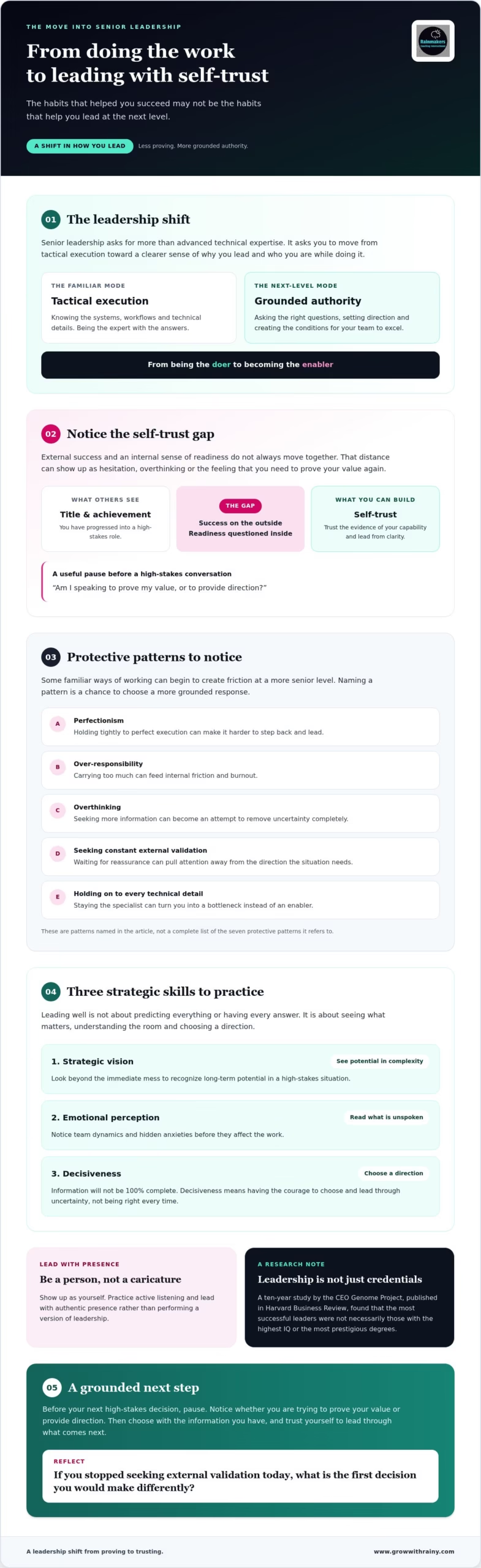
You have spent years perfecting the "how" of your role. You know the systems, the workflows, and the technical nuances better than anyone. Now, the rules have changed. Middle management is often a game of execution and tactical "how-to." In contrast, the most vital skills needed for senior management are less about what you do and more about "why" you do it and "who" you are while leading. It’s a move from being the person with all the answers to being the person who asks the right questions.
Many high-performers believe that another certification or a more prestigious title will finally provide the confidence they seek. However, readiness isn’t a credential you earn from the outside. It is a state of grounded authority. This is the ability to lead without a constant need for external validation.
At Rainmakers, we see it often: you don’t need more evidence that you are capable. You need to trust the evidence you already have. This internal alignment is the cornerstone of strategic leadership; it allows you to make high-stakes decisions based on clarity rather than a desire to please others.
Why Technical Mastery is No Longer Enough
Being a specialist is comfortable. It provides a sense of safety because you are the expert. Yet, in senior roles, this specialist mindset can become a trap. If you remain the "doer," you fail to become the "enabler." You might feel like you’re supervising at a higher pay grade instead of leading.
Reconnecting with your truth is the first step in this transition. It requires you to release the grip on technical details so you can focus on shaping the environment where your team can excel. If you don’t make this shift, you risk becoming a bottleneck for your own organization.
The High-Achiever Self-Trust Gap in Senior Leadership
We often talk about the "Self-Trust Gap." This is the painful space between your external success and your internal sense of readiness. It is exactly why many professionals feel like an imposter after a promotion. This gap creates a subtle hesitation. When the stakes are high, that split second of doubt can lead to career confusion or burnout from carrying the weight of over-responsibility. You aren’t lacking talent; you are experiencing a lack of self trust.
Research from the Global Leadership Forecast suggests that only a small fraction of organizations have a leadership bench they consider "strong." This isn’t due to a lack of technical skills needed for senior management.
It’s because few leaders are taught how to manage their internal state. To bridge this gap, try a simple practice called "decisive reflection." Before your next board meeting, ask yourself: "Am I speaking to prove my value, or to provide direction?"**
If you stopped seeking external validation today, what is the first decision you would make differently?
Core Strategic Skills: Vision, Perception, and Decisiveness
Strategic vision is often misunderstood as the ability to predict the future. In reality, it is more like seeing the "bonsai" within the "mud." You are training yourself to recognize long-term potential hidden inside messy, high-stakes situations. This level of insight is among the most vital skills needed for senior management. While others get lost in the noise of daily fires, a grounded leader looks beyond the surface. You must develop emotional perception, which goes deeper than simple empathy. It is the ability to sense the unspoken dynamics and hidden anxieties within your team before they impact the bottom line.
We often assume that more information leads to safer choices. This is a common trap for high-achievers. In the Rainmakers Transformation System™, we recognize that patterns like overthinking is often an attempt to create a sense of safety by trying to eliminate uncertainty. It feels like "due diligence," but it’s often just a protective pattern that keeps you stuck. Reclaiming your self trust means accepting that information will never be 100% complete. True decisiveness isn’t about being right every time; it’s about the courage to choose a direction and lead your team through it.
Data supports this shift in focus. A ten-year study by the CEO Genome Project, published in Harvard Business Review, found that the most successful leaders weren’t necessarily those with the highest IQ or the most prestigious degrees. Instead, they were the ones who were most decisive. Leaders who were described as decisive were twelve times more likely to be high-performing CEOs. They didn’t wait for perfect clarity. They trusted their ability to navigate whatever the decision produced.
Developing a Personal Leadership Philosophy
To lead with authority, you need a "North Star" to guide your choices. Without one, you’ll find yourself swayed by every corporate trend or loud opinion in the boardroom. A grounded leadership philosophy provides the foundation you need to stay firm when the environment feels shaky. It isn’t just a list of corporate values. It is a deeply personal commitment to how you show up as your most authentic self. When your philosophy is clear, the "right" skills needed for senior management begin to flow from your character rather than a checklist.
The Skill of Grounded Decision Making
Making choices under pressure requires you to quiet your inner critic. This is where the "Release" phase of our methodology becomes essential. You must release the heavy burden of needing to be perfect. By learning how to make better decisions under pressure, you are effectively learning how to trust yourself again. If you’re feeling stuck in a cycle of hesitation, a coaching conversation can help you identify the internal friction holding you back from your next level of mastery.
What is one decision you are delaying right now because you are waiting for more certainty?
Identifying the Hidden Barriers: The 7 Protective Patterns
Many leaders believe they lack the technical skills needed for senior management when the real barrier is internal. The very patterns that helped you climb the ladder, like overachievement, can become the weights that hold you back. These aren’t personality flaws or clinical diagnoses. They are learned strategies.
At Rainmakers, we identify seven protective patterns that high-performers use to navigate pressure. For example, Overachievement often begins when a person learns to use performance as proof of their value. While this drive gets you noticed, it eventually creates a glass ceiling of internal friction.
How Over-Responsibility Leads to Manager Burnout
Do you feel like it’s your job to keep everyone on your team "okay"? This is the hallmark of over-responsibility. There is a vital difference between being responsible to your team and being responsible for them. When you take on the emotional weight of everyone else’s performance and happiness, you lose the clarity needed for high-level direction. Over-responsibility begins when you feel you must carry the weight of the entire organization on your shoulders. It isn’t sustainable, and it certainly isn’t leadership.
To shift this, look at your current to-do list. Ask yourself: "Am I doing this because I’m the only one who can, or because I’m afraid of what happens if I let someone else fail?" Reclaiming your self trust involves letting others own their outcomes. This is one of the most difficult yet essential skills needed for senior management.
Perfectionism vs. Excellence in Senior Roles
Perfectionism is often a protective strategy for worthiness. It is a shield used to avoid criticism; however, in senior roles, it simply slows down executive action. Moving from a "perfect" mindset to a "grounded" one means accepting the messy, unpredictable reality of leadership.
If you find yourself obsessing over minor details to avoid making a "wrong" choice, you are likely experiencing Imposter Syndrome in Senior Leaders. You are trying to use perfection to bridge the gap between your success and your self trust.
A meta-analysis published in the Psychological Bulletin found that perfectionism is significantly linked to burnout and work-related stress. The data shows that the quest for perfection actually decreases productivity because it leads to procrastination and over-analysis. Grounded leaders prioritize impact over flawless execution. They understand that excellence is a standard, while perfectionism is a trap.
What are you currently carrying that isn’t yours to hold?
Practical Strategies for Leading with Authentic Presence
Confidence is not about becoming louder; it’s about being yourself when the stakes are high. Leading with authentic presence is often the most elusive of the skills needed for senior management. It requires you to step away from the "corporate caricature" – that polished, untouchable version of a leader you think you should be, and show up as yourself.
This visibility is terrifying for many because it feels like exposure. Yet, it is the only way to build genuine trust with your board and your team. Authentic leadership relies on active listening; it is the quiet ability to hear what is not being said in the boardroom. Are you sensing the hesitation behind a "yes"? This perception is a superpower.
In our work at Rainmakers, we use the 3R Integration to make this shift permanent. You must first Release the old protective pattern, Reprogram the belief that you aren’t enough, and finally Recondition the daily habit.
Insight alone is not transformation. You can understand why you overthink, but without reconditioning the behavior, you will still hesitate when the pressure is on. True change happens in the moments between the decisions, where you choose a new way of being.
Building Grounded Confidence from Within
Before your next major presentation, try a five-minute reflection ritual. Sit quietly and focus on reconnecting with your truth. Instead of rehearsing your slides, use the "Rainmakers Change Sequence" to shift your internal state from anxiety to presence. This is the foundation of building rock solid confidence that doesn’t crumble under scrutiny. It is about finding a sense of calm that allows your expertise to shine through naturally without the need for performance.
Leading Through Uncertainty with Self-Trust
When information is incomplete, your mind will try to find safety in more data. Instead, try the "Trust the evidence you already have" exercise. List three high-stakes situations where you succeeded despite missing pieces of the puzzle. This builds the muscle of self trust.
A study published in Harvard Business Review highlights that leaders with high levels of self-trust are significantly more resilient in the face of volatility. They don’t wait for certainty; they create it through their own grounded presence. This resilience is one of the most practical skills needed for senior management.
If you stopped performing the role of a leader, what part of your true self would finally show up in the room?
The Journey to Senior Leadership Mastery
The journey to the top isn’t about adding more layers of armor. It’s about removing them. We often get stuck in the "mud" of daily fires and corporate politics, forgetting that the "gem" of our innate wisdom is already there.
The most essential skills needed for senior management aren’t found in a textbook; they are found by reconnecting with your truth. True mastery isn’t simply about achieving more success; it’s about becoming more fully yourself in every room you enter.
The Rainmakers Transformation System™ provides a roadmap for this evolution. Through the process of Release, Reprogram, and Recondition, you move beyond the "High-Achiever Self-Trust Gap." This isn’t a quick fix for a temporary problem. It is a path to sustainable leadership that allows you to lead with authentic authority rather than performed confidence. You are moving from a state of internal friction to a state of grounded alignment. When you lead from this place, the skills needed for senior management become an extension of your character rather than a checklist of tasks.
When Insight Needs Support
Reading about leadership is a good start, but it’s rarely enough to create a lasting shift. There is a profound difference between intellectual understanding and embodied change. Executive coaching provides the safe, confidential space required to Release the protective patterns we discussed earlier. It is the difference between knowing you should trust yourself and actually doing it when the stakes are at their highest.
If you are looking for a partner in this transition, our Executive Coaching in Singapore offers a grounded approach to high-level development.
Your Next Step Toward Authentic Leadership
Transformation is a process of subtraction. It is about removing the habits and beliefs that prevent you from becoming more fully yourself. To start this process, you need to know which protective patterns are currently steering your ship and this is the deeper work coaching can do. By naming these patterns, you begin to reclaim the power they once held over your decisions.
Data from the International Coaching Federation (ICF) indicates that 70% of individuals who receive coaching see improved work performance and more effective communication skills. This isn’t just about feeling better; it’s about the tangible impact you have on your organization’s health. Grounded leaders create grounded teams. By choosing to invest in your own growth, you are signaling that you value authentic authority over corporate masks.
If you fully trusted your own capability today, what is the first decision you would make for your team?
Stepping into Your Authentic Authority
Moving into the highest levels of leadership isn’t just about technical mastery. It is a process of reconnecting with your truth and releasing the protective patterns that once felt like safety but now feel like a cage. By bridging the self trust gap, you transition from a manager who performs to a leader who inspires. The most vital skills needed for senior management are the internal ones: vision, perception, and the courage to be decisive when information is incomplete.
With over a decade of experience coaching senior leaders, we’ve seen that sustainable change requires more than just advice. Our proprietary Rainmakers Transformation System™ helps you move from internal friction to a state of calm, grounded authority. You don’t have to carry the weight of over-responsibility alone. You can lead with a presence that is both powerful and deeply human.
Your team doesn’t need a perfect caricature of a leader. They need you. When you trust your own capability, you give others the permission to do the same.
Frequently Asked Questions
What are the top 5 skills needed for senior management?
The top five skills needed for senior management include strategic vision, emotional perception, decisiveness under pressure, active listening, and self trust. While technical mastery matters earlier in your career, senior roles require a shift toward grounded authority. You must learn to see long-term potential in complex situations and lead without needing constant external validation. These skills allow you to navigate the high-stakes environment with a sense of calm reassurance and authentic presence.
How do I transition from middle management to a senior leadership role?
Transitioning requires a fundamental shift from tactical execution to grounded leadership. Middle management is often about the "how" of a task, but senior leadership focuses on the "why" and the "who." You must release the need to be the primary "doer" and instead become the "enabler" for your team. This involves identifying and letting go of protective patterns like over-responsibility that might have served you well in previous roles but now limit your growth.
Is an MBA necessary for a senior management position in 2026?
While an MBA can provide valuable frameworks, it is not strictly necessary for senior management in 2026. Many organizations now prioritize emotional intelligence and the ability to lead through uncertainty over academic credentials. If you find yourself chasing more degrees, then it might be time to look at the internal gap instead. True leadership mastery comes from reconnecting with your truth and developing the internal groundedness required to handle high-stakes decisions with authentic authority.
How can I overcome imposter syndrome as a new senior manager?
Overcoming imposter syndrome starts with recognizing the "High-Achiever Self-Trust Gap." This is the space between your external success and your internal sense of readiness. Instead of seeking more external proof of your worth, focus on the Rainmakers Transformation System™ to release the protective patterns causing these feelings. By reprogramming your beliefs and reconditioning your daily habits, you can move from feeling like a "promoted fraud" to leading with a sense of quiet strength.
What is the difference between leadership and management at the senior level?
At the senior level, management involves the grounded oversight of systems and execution, while leadership is about vision and influence. Management ensures the work is done correctly; leadership ensures the organization is moving in the right direction. Senior leaders must balance both by maintaining operational integrity while fostering an environment of psychological safety. The shift involves moving away from controlling every outcome and toward inspiring your team to own their specific results.
How do I develop strategic thinking skills if I’ve always been a tactical manager?
Developing strategic thinking requires you to look beyond the daily tactical fires to see the long-term potential. Start by carving out non-negotiable time for reflection rather than just reaction. Ask yourself questions that challenge your current assumptions about the business. As you develop these skills needed for senior management, you’ll learn to recognize unspoken dynamics and hidden needs that inform better, more grounded decisions for the future of your organization.
Can coaching help me develop the skills needed for senior management?
Yes, executive coaching is a powerful tool for developing the necessary skills for high-level leadership. It provides a safe, confidential space to identify and release the protective patterns, such as perfectionism or overthinking, that create internal friction. Through our proprietary framework, we help you bridge the self-trust gap. This allows you to transition from a capable manager to a grounded senior leader who leads with authentic authority and sustainable, rock-solid confidence.
How do I handle the increased pressure and overthinking at the senior level?
Handling pressure starts with understanding that overthinking is often an attempt to create safety by eliminating uncertainty. If you feel the weight of every decision, then you are likely trying to create safety through control. To manage this, you must learn to trust the evidence of your own capability that you already have. Use the "Release" phase of our system to let go of the need for 100% certainty before acting.

Article by
Rainy Rainmaker
Rainy Rainmaker is the founder of Rainmakers Coaching International and a transformational coach for confidence, self-trust, and authentic leadership. Based in Singapore, she helps high-achieving professionals, managers, and leaders who appear capable on the outside but feel quietly held back by self-doubt, overthinking, imposter feelings, burnout, or a loss of direction. Through her signature Rainmaker Transformation Journey™, Rainy helps clients uncover the insights already within them and turn inner clarity into aligned action that creates lasting change in how they work, lead and live.
