What if the next step in your career isn’t another framework, but a clearer understanding of what’s driving your choices? Life coaching for professionals in Singapore can create space to examine your goals, recurring patterns and sources of hesitation, then turn insight into more deliberate decisions. When your inner world shifts, the way you work, lead and live can shift too.
It makes sense to be discerning. Coaching is a personal investment, and a polished title alone cannot tell you whether a coach understands the demands of senior responsibilities. The quality of the conversation matters: you need room to think honestly, reconnect with your own perspective and draw on strengths you may have set aside.
This guide explains how coaching works, what an experienced coach may bring to conversations about leadership and career direction, and how to assess whether the process is worth its cost for you. You’ll also find a grounded way to think about fit, so the decision isn’t driven by hype or pressure. What would feel different in your work and life if your next move came from self-trust?
Key Takeaways
- Distinguish coaching that supports meaningful career development from promises that sound impressive but lack substance.
- Consider how a coach’s experience with senior professionals can shape conversations about leadership, pressure and career direction.
- Learn how coaching tools can support reflection and action without replacing your own judgement or adding unnecessary frameworks.
- Assess value by connecting the coaching process to the changes you want to see in your work and life.
- Explore how inside-out coaching can help you reconnect with your strengths and make more grounded professional choices.
Life coaching: Help, hype or hustle?
Life coaching for professionals in Singapore can support career development and professional growth, but its value depends on the work behind the conversation. The title “coach” is not protected, so consider a coach’s experience, approach and professional boundaries.
Career and Performance Development
Career coaching can help clarify direction, while workplace coaching may focus on leadership, communication and challenges such as handling difficult relationships. For example, a senior professional preparing to lead a larger team might explore the thought patterns shaping their decisions, then practise more grounded responses. Look for a programme that connects reflection to specific professional goals, rather than offering frameworks without context.
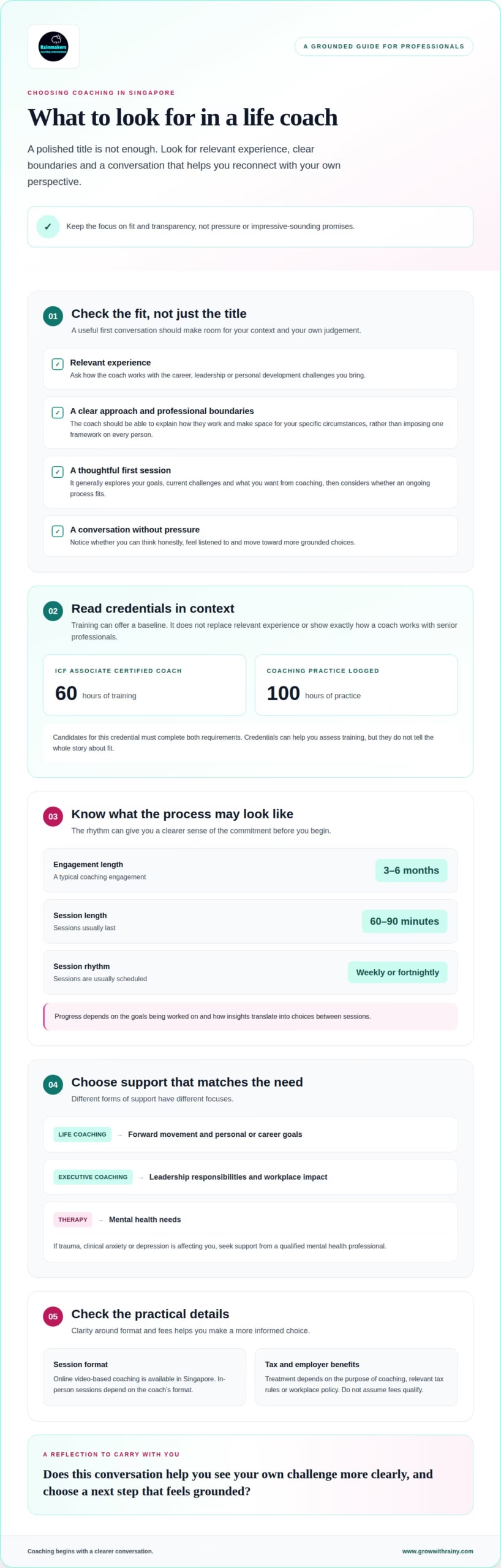
Online sessions are available in Singapore, including video-based coaching; whether in-person sessions are offered depends on the coach’s format. Tax treatment and employer benefits depend on the purpose of the coaching and the relevant tax rules or workplace policy, so don’t assume fees qualify for either.
Career Transitions and Self-Development
A career transition can bring personal questions into sharper focus: what matters now, which strengths feel underused, and what kind of work fits your values? Reflective practice gives those questions room, helping you notice recurring patterns before choosing a next step. A useful conversation links self-development with professional development, rather than treating them as separate tracks. This is one way to approach personal development coaching.
Life coaching and executive coaching both support forward movement, but executive coaching focuses more directly on leadership responsibilities and workplace impact. Therapy is distinct: it addresses mental health needs, while coaching focuses on goals and change. If trauma, clinical anxiety or depression is affecting you, seek support from a qualified mental health professional.
A typical coaching engagement lasts three to six months, with sessions usually lasting 60 to 90 minutes weekly or fortnightly. Progress depends on the goals being worked on and how insights translate into choices between sessions.
Choosing a Singapore Life Coach
To choose a life coach in Singapore, look for relevant experience, a clear coaching approach and boundaries that fit your needs. Ask how the coach works with career, leadership or personal development challenges, and notice whether the conversation feels thoughtful rather than pressuring. There is no single reputable-coach list that suits every professional; fit and transparency are useful signals.
Credentials can help you assess training, but they don’t replace relevant experience. Candidates for the ICF Associate Certified Coach credential must complete 60 hours of training and log 100 hours of coaching practice. A first session generally explores your goals, current challenges and what you want from coaching, then considers whether an ongoing process fits.
Coach experience with senior professionals
Senior professionals often make decisions that affect teams, budgets and long-term direction. A coach who understands executive environments can explore those pressures without reducing them to another productivity problem. For example, a newly promoted director may need to consider how confidence, authority and relationships shift together. That context helps connect awareness with action.
Coaching may be useful for leaders facing a promotion, experienced specialists reconsidering their career direction, and managers navigating team challenges. It can also help a high-performing professional whose work looks successful but feels misaligned. A useful starting point is a specific tension, such as avoiding difficult conversations or struggling to delegate.
A coach’s experience shows in the questions they ask. If a leader describes conflict between a regional team and local priorities, an experienced coach can help them notice assumptions, clarify what they can influence and consider a response. The coach should make room for the client’s context rather than impose the same framework on every executive.
A credential can indicate formal training, but it does not show how a coach works with senior professionals. Look for a clear explanation of their approach, relevant coaching experience and professional boundaries. Training may offer a useful baseline; a conversation can reveal whether the coach listens closely and understands the challenge you bring.
In executive coaching, practical goals might include leading through uncertainty, communicating a decision or rebuilding trust after a tense exchange. The coach can help you examine your response to each situation, then identify a grounded action. This is different from handing over a script. The insight should help you choose how to lead.
A coach’s experience also shows in how they handle complexity. If a leader describes pressure from senior stakeholders, team concerns and personal doubt, the coach should help separate those threads without dismissing their connection. A useful session moves from the immediate event to the thinking beneath it, then toward an action you can try at work.
Before beginning, bring one real leadership challenge into the conversation. Notice whether the coach helps you think more clearly, respects your pace and can explain how sessions support your goal. If you want to explore what an inside-out coaching conversation could bring to your leadership, schedule a conversation about your goals.
Coaching models, tools and techniques
A useful coaching model gives a conversation direction without deciding the answer for you. For example, the GROW model moves through Goal, Reality, Options and Will. A professional might define a leadership goal, examine current constraints, consider responses and choose an action. The model is a map, not a formula. Its value depends on whether it helps you think clearly about your situation.
Tools can make reflection specific. A values exercise may help a manager understand why a promotion feels uncomfortable, while a role-mapping exercise can clarify competing responsibilities. A journal prompt after a difficult meeting can surface the thought behind a recurring reaction. These practices support awareness and growth when they connect inner insight with a decision at work.
Some coaches use visualisation, reframing or strengths-based questions. For instance, a leader who avoids delegating might explore what they fear could happen, then consider evidence of their team’s capabilities. That process can reveal an outdated protective pattern and make room for a more considered choice. Give yourself credit for noticing the pattern, not only for changing it.
Tools should serve your aims. An executive coach may use a stakeholder map to explore relationships around a major decision, while a career conversation may focus on values and direction. If a technique feels like a worksheet detached from your experience, return to the situation itself. The conversation should help you choose an action to try, then reflect on what happened.
Coaching approaches vary, so ask how a coach selects tools and adapts them to your needs. A mentor may share their perspective, but coaching should leave space for your own judgement. Understanding different approaches can help you see why one method may suit a particular goal better than another.
Training courses also differ from coaching tools. The Singapore University of Social Sciences Graduate Diploma in Professional Life-Coaching describes career and executive coaching among possible career paths for graduates. That distinction matters: completing a course does not tell you how a coach will approach your specific challenge. Focus on the conversation, the coach’s reasoning and how each session connects insight to action.
Before coaching begins, a capable coach can clarify the goal, explain their approach and agree how you will review progress. You might aim to speak with greater confidence in leadership meetings or make a career decision with less inner conflict. The measure is not how many tools appear, but whether the work supports changes that feel grounded and sustainable.
Evaluating whether coaching is worth the investment
Coaching is worth considering when it addresses a meaningful challenge, not simply because a programme sounds impressive. For a professional weighing a career change, the value may lie in clearer decisions, stronger self-trust or a more grounded way of leading. Define what you hope will change before deciding whether the investment fits.
Coaching fees vary by provider, format, programme scope and frequency. At Rainmakers Coaching International, fees depend on the case and are provided after a quote request. Consider what the arrangement includes, such as session length, continuity and how progress will be reviewed. A lower fee does not automatically mean a better fit, just as a higher fee does not prove stronger coaching.
Think in terms of value, not a guaranteed return. If a leadership challenge affects team communication, identify what improvement would look like in a real meeting. If career uncertainty is draining your attention, consider what a clearer direction could change in your daily work. These examples offer a grounded basis for weighing the commitment.
Coach quality is another part of the equation. An accredited credential from the International Coaching Federation can indicate training, but it cannot show how thoughtfully a coach will work with your situation. A university diploma or coaching courses may offer relevant preparation, yet experience, listening and clear boundaries also shape the process.
Format affects whether coaching fits your working life. Online sessions can avoid travel, while in-person conversations may suit people who value a shared physical space. Either way, consider the time needed between sessions to reflect and apply insights. A process that fits your calendar is easier to integrate than one that adds pressure.
Keep coaching distinct from therapy. Coaching focuses on goals and forward movement; therapy addresses mental health needs. If trauma, clinical anxiety or depression is affecting daily life, prioritise support from a qualified mental health professional. This distinction can help you decide whether coaching is the right support for the question you are bringing.
A practical evaluation can start with three points: name the change you want, clarify how the coach will support it, and agree how you will recognise progress. For example, a senior manager might notice whether they are delegating more deliberately and having clearer conversations with colleagues. Progress can include inner shifts, but it should connect to choices you can observe.
Before committing to an extended process, discuss your goals, session format and review points with the coach. If your needs centre on leadership responsibilities, executive coaching may be a closer fit. What change would make this investment feel worthwhile to you?
What does life coaching for professionals in Singapore cover?
For a professional, coaching can connect career decisions with the person making them. A conversation might begin with a promotion that looks right on paper but feels wrong internally. The coach helps you explore what matters, what feels difficult and which strengths you have set aside. This inside-out focus can shift how you work, lead and live, because external choices often reflect inner beliefs and patterns.
Career direction is one possible focus. Someone considering a move from a specialist role into management might examine what they want to contribute, which responsibilities they value and what they fear losing. Coaching supports clearer thinking about those questions. Coaching can help you clarify your perspective, priorities and decisions as you consider your next step. The work centres on your perspective, priorities and decisions.
Leadership conversations can include confidence, communication, delegation and workplace relationships. For example, a manager who takes on every difficult task might explore the belief that asking for support signals weakness. Noticing that pattern can open up a different response, such as trusting colleagues with meaningful responsibility. A shift in how you lead can also shape how you communicate with your team.
Personal challenges can also affect professional choices. People-pleasing may make it hard to set boundaries with colleagues; perfectionism may delay a decision that needs to move forward. Coaching gives you space to notice a pattern, consider what it protects and reconnect with your own judgement. The focus is not another framework for its own sake, but insight that supports a grounded next step.
Life coaching can bring career, leadership and personal growth into one conversation. A professional may want more than a new role: they may want work that aligns with their values and relationships that feel less strained. Exploring those connections can reveal where a change in the internal world might influence external choices. Transformation-focused coaching takes this inside-out perspective.
The process should stay connected to what you bring into each session. A coach may help you clarify a goal, explore what makes it difficult and identify an action that reflects your values. In a career transition, that might mean having an honest conversation about the work you want to do. In a leadership challenge, it might mean responding differently in a meeting. The aim is sustainable change, not a temporary burst of motivation.
What would you want to feel, choose or do differently at work and beyond? Explore your coaching goals
Rainmakers Coaching International: Life Coaching
Rainmakers Coaching International offers Life Coaching, Career Coaching , Executive Coaching and Career Development Coaching for professionals seeking a more grounded way forward. Its inside-out approach focuses on reconnecting with yourself, recognising your strengths and releasing outdated protective patterns. Rather than adding an external framework for its own sake, coaching explores how your inner world shapes the way you work, lead and live.
If career uncertainty, leadership pressure or a sense of disconnection is affecting your choices, coaching can help you explore what is happening beneath the surface. Rainmakers Coaching International’s coaching supports self-trust and sustainable change, helping new actions grow from a clearer understanding of yourself.
Contact Rainmakers Coaching International to explore whether coaching fits what you’re facing.
Choose a next step that feels true to you
The next move does not have to be dramatic. You could begin by noticing where your work no longer reflects what matters to you, or where an old protective pattern is shaping a decision. Life coaching for professionals in Singapore can begin by making space to see those patterns clearly and reconnect with your own judgement.
From there, change can become more grounded. You might approach a conversation differently, make a career choice with greater self-trust, or lead without relying on habits that no longer serve you. The aim isn’t to become someone else. It’s to bring more of your innate strengths and hidden resources into the way you work and live.
If you’re ready to explore what that shift could mean for you, take a thoughtful next step.
You can move forward at a pace that respects where you are, while staying open to what might become possible.
Frequently Asked Questions
How much does life coaching cost in Singapore?
There is no single standard fee for life coaching in Singapore. Costs can depend on the coach’s experience, session format and whether you are considering a single conversation or an ongoing programme. Compare what each arrangement covers, not just the headline fee. Rainmakers Coaching International’s fees depend on the case and are provided after a quote request.
Is coaching worth it?
Coaching may feel worthwhile if it helps you make a decision or respond differently to a recurring challenge. For example, you might notice whether you are speaking more openly in meetings or making career choices with greater clarity. Set a practical marker before starting, then revisit it as the work progresses. Inside-out coaching can help you reconnect with your truth and change how you work and live. What change would matter most to you?
Does a higher price mean a better coach?
No. A higher fee does not by itself show that a coach’s approach, experience or communication style suits your needs. Consider how clearly the coach explains their work and whether they understand the challenge you bring. A thoughtful conversation about your goals can tell you more about fit than price alone. Look for a grounded match, not a prestige signal.
What do cheap and expensive coaches each risk?
A low fee may come with a format or level of support that does not meet your needs; a high fee may reflect features that are not important to your goals. Neither price point guarantees a good experience. Before deciding, understand the session arrangement and what you are committing to. If the explanation feels unclear or the decision feels pressured, pause and consider whether the fit feels right.
What does the price actually pay for?
A fee may reflect the coach’s time, experience, session format and the design of an ongoing programme. What is included can differ between arrangements, so focus on the service being offered rather than assuming every fee covers the same things. For instance, a single conversation and a programme may involve different levels of continuity. A clear description helps you judge what you are paying for.
What is the difference between a single session and a coaching programme?
A single session gives you space to focus on one question or decision. A programme creates continuity, allowing conversations to build as you notice patterns and apply insights over time. For example, one meeting could help clarify a difficult choice, while ongoing coaching may support you as you practise new ways of responding. The better format depends on the nature of your goal.
What risks or warning signs should I look for when hiring a life coach?
Be cautious of guaranteed outcomes, pressure to commit quickly, or claims that coaching replaces mental health care. In Singapore, the title “coach” isn’t protected, so a title alone doesn’t establish someone’s preparation. The Consumers Association of Singapore received 19 complaints about life coaches and self-help programme providers during 2024. What would help you feel clear about the coach and process before deciding?
Who are the reputable life coaches and coaching firms in Singapore?
There is no single coach who suits every professional. Look for relevant experience, a clear approach and boundaries, and notice whether the conversation feels thoughtful rather than pressuring. What would help you trust your choice?

Article by
Rainy Rainmaker
Rainy Rainmaker is the founder of Rainmakers Coaching International and a transformational coach for confidence, self-trust, and authentic leadership. Based in Singapore, she helps high-achieving professionals, managers, and leaders who appear capable on the outside but feel quietly held back by self-doubt, overthinking, imposter feelings, burnout, or a loss of direction. Through her signature Rainmaker Transformation Journey™, Rainy helps clients uncover the insights already within them and turn inner clarity into aligned action that creates lasting change in how they work, lead and live.
