

Learning how to handle difficult conversations with your boss starts with preparing your core message, choosing an intentional moment, and opening with curiosity rather than confrontation. Clarify the specific work impact, invite your manager’s perspective, and listen actively before proposing a collaborative next step. While addressing high-stakes tension can feel uncomfortable, avoiding the discussion often magnifies workplace friction and erodes mutual trust.
Most experienced professionals recognise that composure is essential during challenging discussions. The true difficulty lies in speaking with authentic clarity without triggering defensive reactions from leadership. This guide explains how to approach high-stakes dialogue through an inside-out perspective: clarifying your internal grounding, reading leadership communication styles, and stepping into difficult conversations with calm executive presence.
When you shift your internal posture from self-protection to collaborative problem-solving, you can approach the conversation with grounded self-trust. Navigating these moments effectively is not about scripting a flawless confrontation or forcing your manager to agree. It is about communicating with grounded self-trust, addressing the real issues affecting performance, and establishing a professional baseline where both parties can work toward sustainable solutions.
Key Takeaways
- Identify your manager’s communication preferences and adapt your delivery without compromising your core message.
- Distinguish between emotional reactions and verifiable facts before entering any high-stakes discussion.
- Acknowledge internal discomfort briefly to defuse conversational tension and establish mutual empathy.
- Engage your supervisor’s strategic perspective by asking open-ended questions that invite joint problem-solving.
- Lead with curiosity and shared organisational goals to keep complex workplace conversations constructive.
- Anchor yourself in self-trust rather than relying on reactive protective habits during high-pressure exchanges.
1. Understanding your boss’s personality and communication preferences
Navigating an upward professional conversation requires evaluating how your executive or direct manager absorbs information. Every corporate leader operates with a preferred cognitive filter and decision-making style. Some executives prioritise high-level commercial outcomes and want key points delivered in three concise bullet points. Others require comprehensive data sets, historical project logs, and detailed risk analyses before making any commitment. If you present emotional narratives to an analytical leader, your core message often gets dismissed. Observe how your manager interacts during regular executive committee updates or team reviews. Match their preferred level of detail so that your perspective can be heard clearly.
Selecting the appropriate channel is just as vital as adjusting your level of technical detail. Sensitive topics such as performance ratings, boundary disputes, or strategic misalignment should never be hashed out over fragmented instant messages. Instead, use a succinct email to outline the meeting purpose and request dedicated calendar time. You might say: “I would like to set aside twenty minutes this week to align on project deliverables and resource allocation.” This gives your manager advance notice and context. It also prevents them from feeling caught off guard during an already demanding business day.
When you present your case, communicate succinctly and directly. Open by describing the specific situation, explain its measurable impact on business deliverables, and state your proposed action. For example: “In the recent client rollout, task responsibilities overlapped between two squads, causing a 48-hour delivery delay. I recommend we formalise sign-off ownership to keep the next sprint on schedule.” This approach frames the issue around operational clarity rather than personal criticism. When communicating directly, maintain a steady tone and allow intentional silence so your manager has room to process the statement.
Active listening serves as your primary stabilising tool when addressing workplace tension. Rather than mentally rehearsing your rebuttal while your manager speaks, focus entirely on what they are saying and what business constraints they face. Paraphrase their key points before responding: “It sounds like client delivery dates cannot shift, but the technical scope can be adjusted.” Reflecting their position demonstrates that you respect their operational responsibilities. This practice also prevents misunderstandings across diverse cross-cultural working environments where direct feedback might otherwise be interpreted as friction.
How should I respond if my boss becomes defensive or angry? Lower your vocal pace and volume, keep your physical posture steady, and return to objective operational facts. You can say: “I want to make sure we achieve this project goal together; let us look at the timeline constraints and explore workable options.” Refrain from matching an elevated emotional tone or raising historical grievances. If the exchange stops being productive, suggest pausing the conversation and agreeing on a follow-up time once both parties have had space to review the details.
How do I discuss workload, pay, performance, or workplace boundaries with my boss? Name the topic directly, present concrete evidence such as delivered project metrics or capacity limits, and connect your request to sustainable performance. When addressing compensation or scope, focus on documented business value rather than personal expenses or comparisons to peers. Propose a clear path forward, such as realigning weekly deliverables or establishing an official performance review date.
What should I do if my boss bullies or harasses me in Singapore? Document specific incidents, including dates, times, witnesses, and communications, and report the matter through your company’s established grievance channels. Keep your records factual and organised so you can clearly explain what occurred and the steps you have taken.
When should I involve HR or a higher manager in Singapore? Escalate the issue to Human Resources or senior leadership when informal attempts at resolution have failed, when contractual or legal violations occur, or when your manager is directly involved in persistent misconduct. Provide factual records of the incidents and the steps you have already taken to resolve them internally. Continue through the established organisational channels so the issue can be addressed appropriately.
2. Preparing and practising what to say
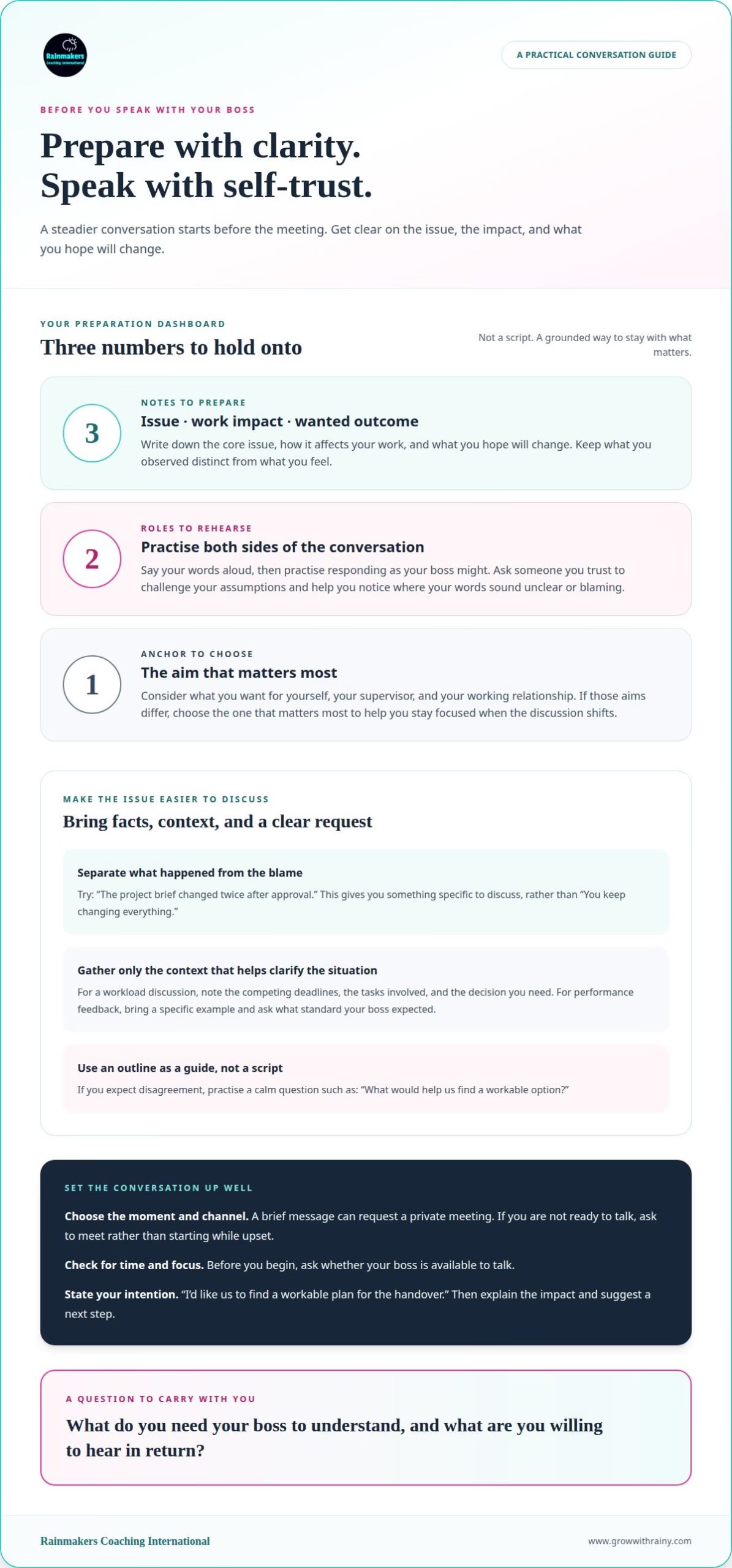
Strategic preparation separates a reactive argument from a constructive leadership dialogue. Before scheduling time with your manager, write down the objective operational facts, the observable consequences on the workflow, and your desired outcome. Separate your internal feelings from the external events. Stating “The timeline shifted three times after final sign-off, creating an eighty-hour resourcing deficit” provides a grounded basis for problem-solving. In contrast, stating “You never respect my team’s time” inevitably provokes a defensive response. Clarifying these details in advance keeps the dialogue focused on organizational outcomes.
How do I prepare for a difficult conversation with my boss? Identify the core issue, anticipate potential objections, and define what you want for yourself, your supervisor, and the broader business partnership. High-performing professionals often carry hidden patterns such as Over-Responsibility or Approval-Seeking, which can compel them to over-explain or concede vital boundaries. Ground yourself in self-trust before entering the room. Write out your primary message in two or three sentences so you can articulate your position without getting distracted by conversational friction.
Gather supporting documentation that illustrates your talking points without overwhelming your manager with unnecessary paperwork. If your discussion involves excessive workload, outline competing deadlines, resource allocations, and operational trade-offs across current initiatives. If the subject is performance evaluation, compile documented results, stakeholder commendations, and key performance indicators. Use these materials as an objective reference rather than reading from a script. Having organized facts readily accessible reinforces your executive presence and keeps your discussion structured.
Rehearsing your message with a trusted colleague, executive mentor, or coach allows you to refine your delivery. Practice articulating your position aloud, role-playing both sides of the exchange. Ask your practice partner to adopt your manager’s typical communication style, including interruptions or skeptical questioning. Practice replying with grounded composure: “I understand that risk is top of mind; here is how our proposed adjustment mitigates that concern.” Practising out loud helps you notice where your wording sounds hesitant or overly defensive, enabling you to step into the actual meeting with quiet confidence.
Scheduling the meeting requires professional discernment and awareness of your organization’s operating rhythm. Avoid cornering your manager during peak budget reviews, ten minutes before high-stakes client pitches, or at the end of an exhausting business week. Send a clear, neutral calendar invite with an agenda that frames the session around shared success: “Strategic alignment on Q3 deliverables and capacity planning.” If an urgent conflict emerges unexpectedly, do not attempt to resolve complex dynamics while emotional. It is far more effective to request a short recess: “I want to give this issue the focus it deserves; let us book twenty minutes tomorrow morning to review the options.”
Guidance from the University of Texas at Austin on difficult conversations with a supervisor emphasizes clarifying what you want for yourself, your manager, and your relationship prior to speaking. This proactive preparation helps professionals focus on facts rather than heightened emotional states. By framing the discussion around shared workplace outcomes, you build psychological safety. You can also explore proven emotional regulation techniques for leaders to maintain executive presence when internal pressure begins to mount.
3. Acknowledging discomfort to encourage empathy
In high-stakes corporate settings, professionals often believe they must project complete invulnerability. Yet complete invulnerability is not required for an effective conversation. Acknowledging internal discomfort does not mean abdicating authority; it demonstrates grounded self-awareness. When you recognise that a difficult discussion feels uncomfortable, you can choose how to act rather than defaulting to unconscious protective patterns like People-Pleasing or Control.
A brief, transparent opening can immediately disarm conversational tension. Consider opening with: “I want to be transparent that initiating this discussion is somewhat uncomfortable for me, but I care deeply about our team’s operational success and want to ensure we address this roadblock early.” This approach accomplishes two things: it frames your vulnerability as dedication to high standards, and it clarifies that your intention is organizational alignment rather than personal conflict. By naming the dynamic calmly, you make it safe for your supervisor to engage without posturing.
Once you have acknowledged the tension, anchor the discussion in observable realities. For example: “I am feeling stretched regarding our team’s delivery capacity because three major client milestones were consolidated into the same sprint. I want to agree on how we can sequence these priorities to maintain output quality.” Stating your concern this way provides tangible points for your manager to respond to. It replaces vague frustration with an invitation to solve a practical business challenge.
During challenging discussions, regulate your vocal tone, pace, and physical presence. Monitor your vocal energy, aiming to keep your emotional intensity around two or three out of ten. If you notice your breathing becoming shallow or your speech speeding up, pause deliberately and take a grounding breath before continuing. If your supervisor expresses impatience or frustration, avoid matching their elevated tone. A measured response such as “I recognize this timeline shift is frustrating for leadership; let us look at what adjustments are possible” neutralizes tension while keeping the conversation focused on solutions.
Empathy should never be confused with abandoning your workplace boundaries or conceding vital points. Grounded empathy means holding space for your manager’s strategic pressures while maintaining clarity on your own operational reality. If your executive states that resource adjustments are out of the question, respond calmly: “I understand that headcounts are frozen across the business unit. Because total team hours are fixed, we will need to decide which secondary deliverables can be deferred.” You validate their institutional constraints without taking on unsustainable expectations yourself.
When receiving critical feedback during a dialogue, resist the impulse to justify or deflect immediately. Take a moment, summarize what you heard, and separate factual performance observations from emotional commentary. For example: “I hear that the financial models were delivered behind schedule last week. I was waiting on external audit verifications, but I recognize I should have flagged that dependency earlier.” Acknowledging your part preserves your professional credibility while establishing a foundation for mutual respect. Leaders who wish to strengthen their authentic communication can review our guide on communication skills coaching for leaders to communicate with clear authority.
4. Asking a boss for advice and perspective
Transforming a confrontation into a collaborative problem-solving session often hinges on how effectively you invite your manager’s strategic counsel. Rather than presenting your point of view as an immutable verdict, ask for their perspective on the situation. For instance: “I would value your insight on how we can manage the growing technical debt while meeting our product delivery targets. How are you evaluating our current team velocity?” This opening signals that you respect their broader organizational perspective and are focused on shared goals rather than winning an argument.
Describe your operational observations using objective terms before asking for guidance. Detail what has transpired, provide measurable examples, and explain the downstream impact on performance: “Over the past three weeks, our senior engineers have spent roughly 40 percent of their capacity responding to unplanned urgent requests. As a result, core development work for the primary platform migration is falling behind schedule. How do you view this balance?” Posing the question this way allows your manager to provide context you might not see, such as executive board directives or urgent commercial negotiations.
Frame questions to invite strategic reflection rather than simple binary answers. Closed questions like “Do you think this workload is unfair?” force managers into defensive positions. Open-ended inquiries such as “What factors should we weigh when choosing between these two competing deadlines?” create space for productive dialogue. If you are discussing career development or boundary alignment, ask: “What competencies or business outcomes are most critical for me to demonstrate over the next six months?” This focuses the conversation on clear expectations and measurable growth.
Listen closely for new institutional information that could adjust your perspective. Your manager might reveal that an enterprise client renegotiation is imminent or that internal reorganizations are already underway. Paraphrase their points to ensure alignment: “So the primary deliverable for June cannot be modified due to shareholder commitments, but the regional rollout in August has some scheduling flexibility?” Confirming these points helps both of you work from the same operational facts and prevents misunderstandings from derailing your working relationship.
Seeking advice does not require you to abandon your own strategic viewpoint. If your manager suggests a short-term workaround that fails to address the root issue, outline the operational trade-offs with composure: “We could ask the team to work through this weekend to hit the target, but that leaves our underlying staffing shortage unresolved for the next release. How can we build a sustainable resourcing plan moving forward?” This approach keeps the discussion centered on long-term organizational health.
Conclude the conversation by inviting your supervisor to help identify practical next steps, while examining your own role in the solution. You might ask: “Is there anything I can adjust in my communication cadence or project management approach to provide better visibility?” When they propose adjustments, define what success looks like in practice. For leaders working to expand their influence within matrixed organizations, exploring strategies for mastering executive presence offers valuable tools for leading upward with composure.
5. Opening difficult conversations with curiosity
The first thirty seconds of a high-stakes discussion often set the tone for the entire exchange. An accusatory opening can make constructive problem-solving more difficult. Conversely, when you open with curiosity grounded in a shared organisational objective, you invite constructive problem-solving. Consider beginning with: “We both want our division to hit its annual operational targets cleanly. I have observed some friction in our current approval workflow, and I want to explore how we can optimise it together.”
Curiosity is not a passive technique designed to dilute difficult realities. It is an intentional leadership stance that helps you gather essential context while addressing core business challenges. If priorities were suddenly shifted without your consultation, resist the impulse to complain. Instead, ask: “Could you walk me through the strategic priorities that led to the revised project roadmap?” Once you understand their operational perspective, you can explain the capacity constraints and collaborate on a realistic delivery plan.
A major obstacle to curious dialogue is the internal pressure to fill every silence. When you ask a thoughtful question, give your manager time to reflect. High-achieving professionals often default to over-explaining when met with silence, inadvertently undermining their own points. By pausing, you give your manager space to process the inquiry and respond thoughtfully. If they initially push back, acknowledge their response with composure: “I see that this adjustment is difficult given our division’s headcount limits. What other options could we consider?”
Executives often process messages differently depending on broader market pressures, board expectations, or competing demands across business units. If your opening sparks an unexpected defensive reaction, pause and clarify your intent: “I want to clarify my purpose here. My goal is not to question your leadership decisions; I want to ensure our project delivery remains resilient and our resources are sustainable.” Reframing your message this way helps lower conversational defenses without conceding your point.
How can I document a difficult conversation and agree on follow-up actions? Following the meeting, draft a concise, objective email summarizing the key items discussed, agreed solutions, and individual ownership. You might write: “Thank you for the time today. To ensure alignment, we agreed that Deliverable A takes priority for Q3, while Deliverable B is paused pending additional resource allocation. I will provide an updated status report by Friday.” Conclude by inviting confirmation: “Please let me know if I have captured our next steps accurately.” This provides a clear, shared record of the agreement.
What should I do if a difficult conversation with my boss does not resolve the issue? If the initial dialogue does not resolve the operational friction, evaluate what factors remain unaddressed and request a targeted follow-up meeting after gathering further data. If the problem stems from persistent interpersonal friction, micromanagement, or ongoing disregard for agreed boundaries, evaluate your broader career trajectory and internal support structures. When organizational gridlock threatens your career progression or well-being, working with an experienced executive coach can help you assess next steps, evaluate organizational culture, and make strategic career decisions.
Rainmakers Coaching International: Executive Coaching
Rainmakers Coaching International provides specialized Executive Coaching in Singapore for senior managers, directors, heads of business units, and corporate leaders navigating high-stakes organizational dynamics. When difficult upward conversations trigger persistent anxiety or communication friction, the root challenge rarely stems from technical capability. More often, it reflects deeper internal protective patterns such as Perfectionism, Approval-Seeking, People-Pleasing, or Over-Responsibility.
Led by Rainy Rainmaker, Rainmakers Coaching International focuses on inside-out executive transformation rather than offering superficial scripts or generic frameworks. By helping corporate leaders uncover the internal patterns beneath their professional choices, clients can reconnect with grounded self-trust and tap into their innate strengths. Transforming your internal mindset reshapes how you communicate, make decisions, and lead under pressure. For high-achievers seeking greater leadership impact, our tailored Executive Coaching and Career Coaching programs provide the insight needed to excel across competitive corporate environments.
To explore how targeted executive coaching can enhance your leadership presence and help you navigate complex organizational conversations, visit growwithrainy.com to get in touch with Rainmakers Coaching International.
Leading upward with grounded self-trust
Mastering difficult conversations with your manager is fundamentally an exercise in authentic leadership and internal composure. It is not about executing a rigid conversational tactic or forcing an immediate concession. It requires understanding your internal reactions when stakes are high, noticing when old self-protective habits emerge, and intentionally choosing to communicate with clarity, empathy, and conviction.
When you shift your mindset from defending your position to solving shared business challenges, you can focus the conversation on strategic outcomes rather than reacting to pressure. You do not need absolute certainty before speaking up; you simply need a commitment to clarity, mutual respect, and your own professional value. By entering high-stakes meetings with structured preparation and genuine curiosity, you create a stronger foundation for clear leadership communication and executive coaching growth.
Frequently Asked Questions
How should I open a difficult conversation with my manager?
Open by outlining the meeting’s purpose and connecting it to a shared business priority. For instance: “I asked for time today to discuss our project workflows so we can meet our quarterly milestones without burning out the team.” Stating your intentions clearly at the outset creates psychological safety and establishes a collaborative tone for the rest of the conversation.
What communication techniques help during a conflict with your boss?
Focus on objective “I” statements, paraphrase your manager’s core messages to confirm alignment, and maintain a calm, measured vocal pace. When disagreements emerge, focus on verifiable facts and their operational impact rather than subjective intentions. If emotional tension rises, suggest taking a brief pause and resuming the discussion once both parties have had space to review the data calmly.
How does executive coaching help with managing upward relationships?
Executive coaching helps senior professionals recognize the internal patterns, such as Approval-Seeking or Over-Responsibility, that often hinder clear communication with leadership. By identifying these patterns, executives develop grounded self-trust, refine their executive presence, and approach challenging workplace dialogues with composure and strategic clarity.
Can challenging conversations with leadership damage career advancement?
When handled with emotional maturity, objective preparation, and a focus on shared organizational goals, challenging conversations typically enhance your professional credibility. Senior leaders value team members who can surface operational risks early, offer constructive solutions, and navigate high-pressure situations with calm authority.

Article by
Rainy Rainmaker
Rainy Rainmaker is the founder of Rainmakers Coaching International and a transformational coach for confidence, self-trust, and authentic leadership. Based in Singapore, she helps high-achieving professionals, managers, and leaders who appear capable on the outside but feel quietly held back by self-doubt, overthinking, imposter feelings, burnout, or a loss of direction. Through her signature Rainmaker Transformation Journey™, Rainy helps clients uncover the insights already within them and turn inner clarity into aligned action that creates lasting change in how they work, lead and live.
