
What if low performance is a signal to understand before it becomes a problem to correct? Motivating an underperforming team starts with finding what’s getting in the way, then clarifying expectations and providing support. Pressure alone can widen the distance between people and their work.
You may already know that missed goals need attention. But before tightening oversight or offering bigger incentives, pause and listen. Are priorities unclear? Is there a skills gap, low confidence, too much work, or another obstacle? A calm, honest conversation can help you find a useful starting point.
This article offers a practical way forward: identify what’s behind low performance, set achievable goals, give constructive feedback, and recognise progress. You’ll also learn how to make incentives inclusive, so motivation isn’t reserved for those already performing at the highest level. The aim isn’t to force change. It’s to help your team reconnect with meaningful work and take the next step with greater clarity and self-trust.
Key Takeaways
- Look beyond missed targets to understand whether unclear expectations, skill gaps, low motivation or obstacles are affecting performance.
- Build a shared improvement plan with clear goals, practical support and regular progress check-ins.
- Make feedback specific and constructive, and recognise meaningful progress as it happens.
- Respond to recurring signs of underperformance with curiosity and clear expectations rather than assumptions or blame.
- Choose inclusive incentives that recognise different contributions, not only top performers.
1. What Goes Into Human Performance?
Set clear goals by naming the result, measure, deadline and support available. For example, a sales representative might aim to improve their close rate from 15% to 20% within a quarter. A goal is useful when the employee understands what success looks like and has a fair opportunity to reach it.
Before setting targets, clarify the role’s expectations. Describe the work to be completed, its quality standard, priorities and how progress will be measured. If a team member is responsible for responding to inbound leads, “respond promptly” leaves room for different interpretations. A defined target, such as responding within 1 hour, gives both manager and employee a shared reference point.
Then create the performance-improvement plan together. Start with an observed gap, not a label such as “unmotivated.” Ask what’s making the target difficult, then agree on a specific goal, practical resources, and progress checkpoints. If a team member needs product knowledge, support might include guided practice or time with an experienced colleague. Let the employee help shape actions they can genuinely own.
A useful plan records:
- The outcome and measure, such as at least 8 qualified meetings per week.
- The employee’s actions and the manager’s support, such as practice sessions and protected preparation time.
- Checkpoints for reviewing progress and adjusting support.
- The next step if performance remains below the agreed standard.
Keep expectations consistent across the team, while tailoring support to the person’s needs. Establishing shared norms and being transparent about decisions can help make expectations clearer; the National Center for Biotechnology Information discusses these practices in relation to team expectations. A consistent setting helps employees understand how decisions are made, including what happens when priorities change.
If progress stalls, use the next checkpoint to compare the agreed measure with the work delivered. Ask what has changed, whether the support was provided, and what obstacle remains. Then decide together whether to adjust the plan, clarify an expectation, or set another review point. If expectations have been clear, support appropriate, and the employee given a fair chance, explain the performance gap and next management step directly.
Performance plans are not only documents. They are working agreements that connect goals with daily actions. Leaders considering support for their own role can explore what type of coach may suit their needs. In a team, the same principle applies: make the target visible, keep check-ins consistent and correct the plan when evidence shows it needs to change.
2. Identifying causes through manager-employee conversations
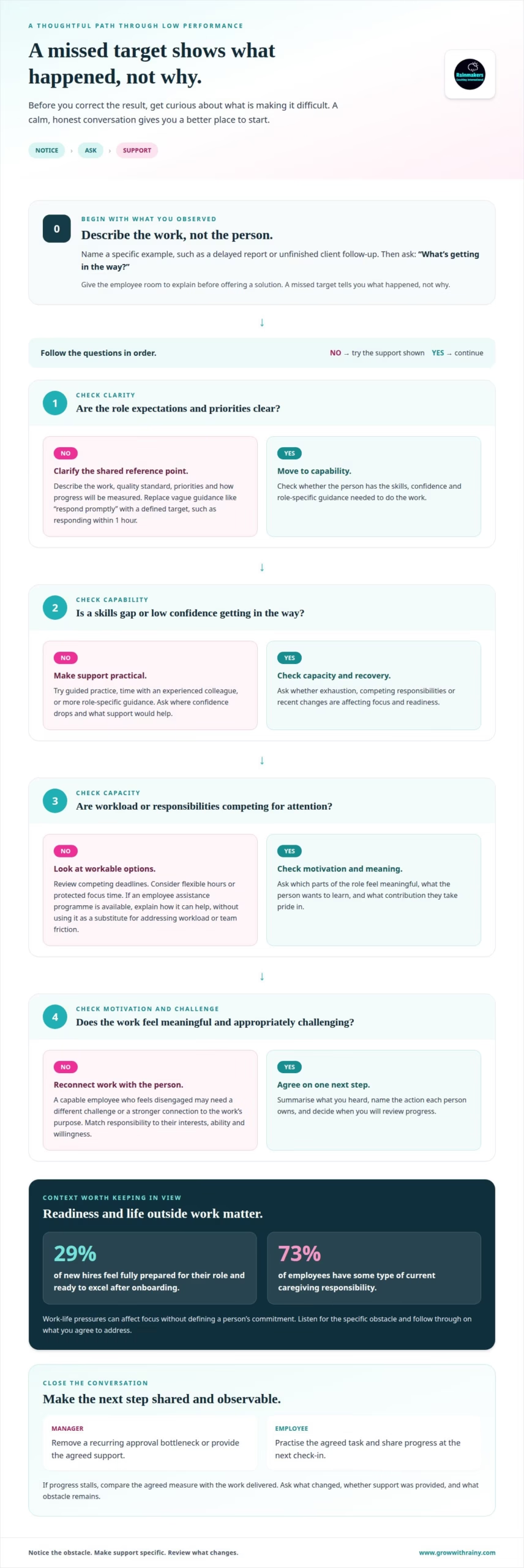
A missed target shows what happened, not why. Begin a one-to-one by describing a specific observation, such as a delayed report or unfinished client follow-up. Then ask, “What’s getting in the way?” Give the employee room to explain before offering a solution. This shifts the conversation from blame to useful feedback and gives you a clearer basis for action.
Use open questions to distinguish a skills gap from low motivation or unclear priorities. Ask which tasks feel straightforward, where confidence drops, and what support would help. A skill-and-will assessment can guide your response: someone who wants to contribute but lacks a capability may need practice, while a capable employee who feels disengaged may need a different challenge or a stronger connection to the work’s purpose.
Readiness and recovery matter, too. Only 29% of new hires feel fully prepared for their role and ready to excel after onboarding. Ask whether the person received enough role-specific guidance, and whether recent changes have left them uncertain. If they describe exhaustion or competing responsibilities, discuss workable options such as flexible hours or protected focus time. Harvard Business School’s The Caring Company study found that 73% of employees have some type of current caregiving responsibility.
Work-life pressures can affect focus without defining a person’s commitment. Listen for specific obstacles, then agree on a practical response. If the organisation has an employee assistance programme, explain how it can support the employee. Don’t treat it as a substitute for addressing workload, unclear priorities, or team friction. Follow through on concerns raised rather than simply recording them.
Use the conversation to reconnect effort with values and goals. Ask which parts of the role feel meaningful, what the employee wants to learn, and what contribution they take pride in. If a capable team member is under-stretched, offer responsibility that matches their interests. If they’re overwhelmed, review competing deadlines before assigning more. Delegate according to both ability and willingness, not just the manager’s need to redistribute tasks.
Close by summarising what you heard and agreeing on one next step. For example, a manager might remove a recurring approval bottleneck, while the employee practises a specific task and shares progress at the next check-in. Keep the tone curious and direct. If you’re a leader working through a difficult conversation, talk through your leadership challenge with Rainy.
3. Recognising progress and giving constructive feedback
Recognition works best when it names what changed and why it matters. Instead of saying “good job,” a manager might say, “You updated the client before the deadline, which gave the team time to resolve the issue.” This specific example connects effort with impact. It also helps an employee see progress while the final result is still developing.
Look for small, observable steps along the way. A team member might submit a clearer draft, ask for input earlier, or complete a task with less rework. Acknowledge the behaviour soon after it happens. Specific, timely recognition makes expectations visible, while generic praise can feel disconnected from the work.
For corrective feedback, use the SBI model: Situation, Behaviour, Impact. Describe the moment, the action you observed, and its effect. For example: “During Monday’s handover, the project risks weren’t included, so the next shift couldn’t prioritise them.” Keep the description factual. Don’t turn one action into a judgement about someone’s character.
Then make the feedback useful by inviting the employee’s perspective and agreeing on a next step. Ask, “What was happening from your perspective?” Listen before responding. If a handover missed key details, you might agree that the employee will use a shared checklist next time. Recognise the new behaviour when it appears. This keeps accountability clear without making feedback feel like punishment.
Feedback should move in both directions. Managers can ask, “What could I do differently to help you meet this expectation?” The answer may reveal an unclear priority, a delayed decision, or a process that creates unnecessary friction. Listen without defending every choice. If you remove an obstacle, name the action you took and check whether it made the work easier.
Don’t save meaningful feedback for quarterly or annual reviews. Regular conversations allow managers to reinforce progress and address a concern while details are still clear. A brief check-in after a completed task can cover what worked, what needs attention, and one next action. Ongoing coaching is associated with sales representatives achieving 27% higher win rates than those who do not receive it. That figure points to the value of continued support, not a promise for every team.
Recognition should also feel fair. Notice contributions that don’t always show up in headline metrics, such as sharing knowledge, helping a colleague resolve a blocker, or raising a risk early. Ask whether your praise reflects behaviour the whole team can learn from. What progress deserves recognition this week, and what feedback would make the next step clearer?
4. Recognising signs of underperformance
One late task is a signal to understand, not a verdict on someone’s ability. Look for patterns across agreed responsibilities: missed handovers, repeated errors, delayed responses, or work that needs frequent correction. Compare the evidence with the role’s expectations and the support available. If the same issue appears across different tasks, explore whether one obstacle is affecting several parts of the job.
Performance can also change in quieter ways. A previously engaged employee may stop contributing in meetings, avoid asking for help, or decline opportunities they once welcomed. These signs don’t prove low motivation. They do give you a reason to check in, ask what has shifted, and listen for workload, confidence, role clarity, or team dynamics.
Use specific examples to separate impact from assumption. If a colleague’s reports arrive late, note which deadlines were missed and what work depended on them. If the employee speaks less in meetings, consider whether decisions are being made before they have a chance to contribute. A grounded view considers behaviour, context, and consequences together.
Recognition gaps can contribute to disengagement. If an organisation notices only visible wins, employees who prevent errors, support colleagues, or steadily improve may feel their work doesn’t count. Identify contributions that help the team meet its goals, then recognise them genuinely. A quiet thank-you after someone shares useful knowledge can make that contribution visible without turning praise into a performance.
Non-monetary recognition can be meaningful when it matches what the person values. Depending on the workplace and the employee’s circumstances, options may include:
- Offering greater flexibility around working hours.
- Recognising a contribution in a team meeting, with the employee’s comfort in mind.
- Giving someone a relevant opportunity to lead a task or share expertise.
- Providing extra paid time off as recognition for a completed contribution.
These gestures work best when they’re fair, specific, and connected to effort or impact. Public recognition may encourage one person and unsettle another, so ask how they prefer their work to be acknowledged. Share opportunities transparently rather than repeatedly offering them to the most visible team members.
Finally, review whether the pattern is individual or shared. If several employees miss the same handover, the process may be unclear. If one person’s work has changed while others remain steady, a private conversation may reveal a personal barrier or unmet support need. What observable sign are you seeing, and what else could explain it before you decide how to respond?
5. Inclusive incentives and gamification
Recognition and rewards can show team members which contributions matter and encourage them to keep building useful skills. Broad claims that incentives increase performance by 44%, motivate 66% of employees to stay, or that gamification improves engagement at 90% of companies need context to be meaningful. What matters is whether a reward supports clear expectations and practical support, rather than substituting for addressing poor performance.
Start by choosing a behaviour the team can influence. A customer support team might aim to share accurate handover notes, while a project team might recognise early risk reporting. Explain the goal, how progress will be measured, and which contributions count. Clarity reduces guesswork and helps people see how their efforts connect to shared results.
Then make recognition broad enough to include different strengths. A sales contest that rewards only the top 2-3 representatives can leave the rest feeling that their effort has little value. Instead, recognise progress against individual goals, team collaboration, customer care, or improvement in a skill. If someone is developing confidence in presentations, acknowledge a clear, well-prepared update, not only the most polished delivery.
Gamification can add visible momentum when the activity supports real work. A shared progress board, team challenge or milestone tracker can make effort easier to notice. Set rules that reward learning and cooperation, rather than encouraging employees to compete in ways that harm trust. Engagement is useful when the game reinforces work the organization genuinely values.
Choose a reward that fits the contribution and the person. Non-monetary incentives might include flexible working hours, extra paid time off, or sincere recognition. A bonus may suit a completed task, while someone else may value the trust to lead a project or share expertise. Ask what feels meaningful, and keep access to rewards fair and transparent.
Before launching a scheme, check that its measures don’t reward speed at the expense of quality. If a team is recognised only for closing tasks quickly, unfinished details may create extra work later. Pair a completion measure with a quality check, or recognise individual progress alongside shared outcomes. Review participation and feedback, then adjust the rules if some roles have fewer chances to succeed.
Keep incentives supportive, not coercive. If performance remains low, return to the underlying barriers, expectations, and support rather than increasing prizes. A well-designed reward can recognise progress and strengthen belonging. What contribution could your team celebrate that feels meaningful, fair, and within its control?
Rainmakers Coaching International
Rainmakers Coaching International offers coaching for leaders navigating pressure across work, career, and life. Executive Coaching can help you notice underlying patterns that shape how you lead, then reconnect with your values and inner resources. The work isn’t about becoming someone else. It’s about making room for more grounded choices and sustainable change.
As your inner relationship with yourself shifts, your choices at work and in life can shift too. If you’re ready to explore what may be influencing your leadership, contact Rainmakers Coaching International.
Lead with greater self-trust
Motivating an underperforming team isn’t a test you have to pass alone or perfectly. Before your next leadership conversation, consider what you want the other person to understand about their contribution and next step.
Choose one intention to carry into that conversation, such as staying curious, being direct or listening without rushing to solve the problem. A small, deliberate shift can help you lead with greater steadiness.
If you’d like space to reflect on your leadership and what you want to practise next, start a conversation with Rainmakers Coaching International.
Let your next step begin with intention, not pressure.
Frequently Asked Questions
How do you deal with low-performance employees?
First, establish whether the issue concerns results, conduct, or a mismatch between the role and the employee’s strengths. Each calls for a different response. A capable person may struggle when work depends on decisions they cannot control, while repeated carelessness may call for clearer accountability. Keep a factual record of relevant work examples and agreed next steps, so future decisions rely on evidence rather than a recent impression.
What is underperformance?
Underperformance describes a sustained gap between what a role requires and what the employee delivers. The gap might concern output, quality, reliability, or collaboration. Assess it against responsibilities the person can reasonably influence. For example, a delayed deliverable caused by a late dependency differs from a delay caused by repeatedly neglecting an agreed task.
What are common causes of team underperformance?
Team performance can suffer not only from individual skills or motivation, but also from competing incentives, poor handoffs, or decisions that arrive too late for work to proceed. A team rewarded for speed may overlook quality; unclear ownership may lead to duplicated effort. Look at how work moves between people and which behaviours the organisation rewards. These conditions can shape results even when individuals are capable.
How can managers diagnose why a team is underperforming?
Trace one piece of work from request to completion. Note where it slows, who needs to act, what information is missing, and whether priorities change along the way. Then compare that path with a completed task. The comparison can reveal a recurring handoff or approval delay that individual performance measures alone might miss. Discuss the pattern with the people closest to the work.
What are effective ways to motivate an underperforming team?
Offer meaningful choice where the work allows it. For example, let team members suggest how to divide a shared project or choose which relevant skill to practise first. Autonomy can help people feel ownership rather than simply receiving another demand. Keep the choice connected to team responsibilities, and give quieter contributors a genuine opportunity to shape how the work gets done.
How can managers give constructive feedback without damaging morale?
Choose a private setting for sensitive feedback, and don’t raise it in front of colleagues. Before speaking, take a moment to separate frustration from the point you need to communicate. After explaining the concern, ask the employee what they understood and what remains unclear. This can surface misunderstandings early and keep the conversation practical, without requiring the person to agree with every interpretation.
How can managers address low engagement, burnout, or workplace conflict?
If engagement is low, explore whether people understand how their work connects to a decision or customer outcome. If you notice signs of exhaustion, review what can be paused, reassigned, or made less fragmented. With conflict, set a respectful boundary around behaviour and give each person space to explain their concern separately before arranging a shared discussion. Don’t force quick agreement while the underlying issue is still unclear.
How can managers create an employee performance improvement plan?
Make the plan usable by recording the starting point and the evidence that will show whether work is improving. Include what the manager will provide, such as access to a subject-matter expert or clearer decision-making authority. Ask the employee to explain the plan in their own words, then resolve any differences in understanding. This makes the agreement clearer than relying on a signed document alone.

Article by
Rainy Rainmaker
Rainy Rainmaker is the founder of Rainmakers Coaching International and a transformational coach for confidence, self-trust, and authentic leadership. Based in Singapore, she helps high-achieving professionals, managers, and leaders who appear capable on the outside but feel quietly held back by self-doubt, overthinking, imposter feelings, burnout, or a loss of direction. Through her signature Rainmaker Transformation Journey™, Rainy helps clients uncover the insights already within them and turn inner clarity into aligned action that creates lasting change in how they work, lead and live.
