
Career clarity isn’t about finding one perfect job; it’s about understanding what fits you and choosing a direction you can sustain. To understand how to achieve career clarity, assess what energises you, where your strengths show up, and what your current work asks of you. Then weigh those insights against practical needs and explore growth options before making a change.
If your career looks successful on paper but feels heavy in practice, it makes sense to ask whether it still fits. You don’t have to dismiss what you’ve built or rush towards a new title. Start by noticing which parts of your work feel meaningful, where you use your strengths, and whether the cost to your wellbeing is growing.
This article offers practical ways to assess whether your career feels sustainable, identify your strengths, and balance purpose with practical needs. You’ll also learn how to explore possible directions, from reshaping your current role to considering a different path. Treating uncertainty as information, rather than proof that you’re behind, can help you see what to examine next.
Key Takeaways
- Assess whether your work still supports your wellbeing, values, and preferred way of working, not just your professional goals.
- Look for strengths in the activities that energise you and the problems others trust you to solve.
- Use a future-focused letter to clarify what you want your working life to feel like and what you may want to change.
- Balance meaningful work with practical needs by exploring possibilities before making a major career decision.
- Growth can come from reshaping your current role, developing a skill, or exploring a new direction.
Assessing whether your career is sustainable
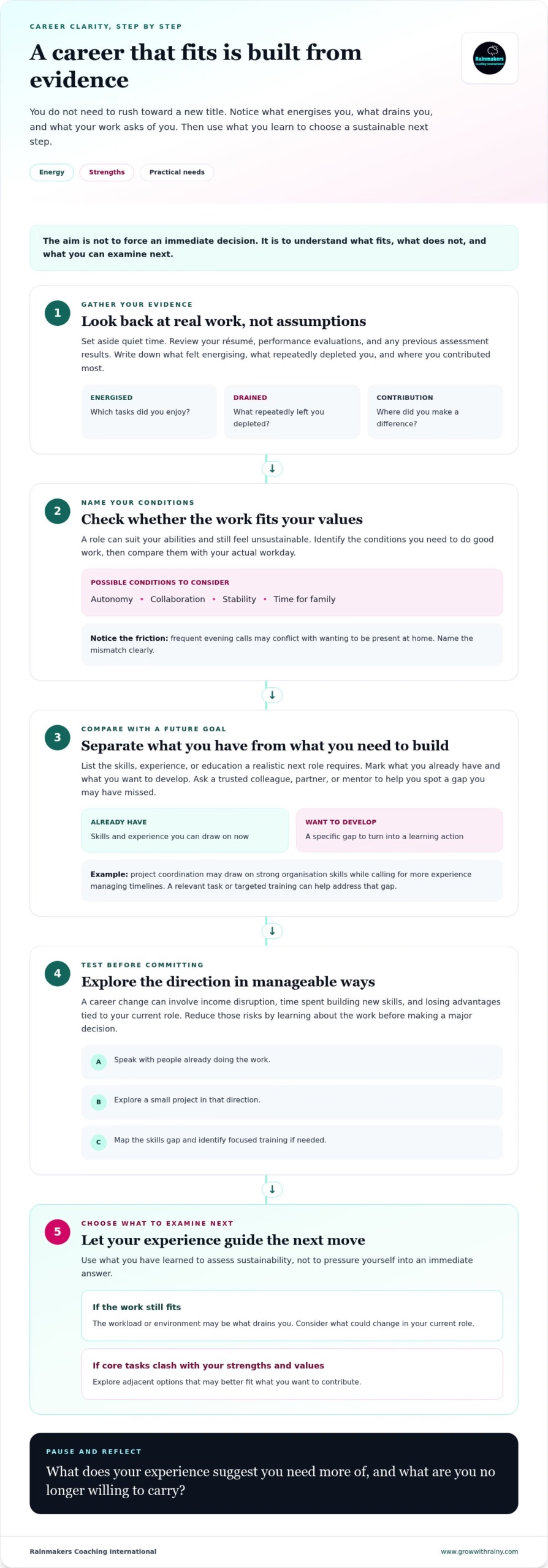
A sustainable career supports more than your next promotion. It also leaves room for your health, values, relationships, and the way you want to live. Career clarity can take time, so treat uncertainty as a reason to examine your current fit, not as proof you have failed. Set aside quiet time and write down what feels energising, draining, and important in your work.
Start with evidence from your own experience. Review your résumé, performance evaluations, and any previous assessment results. Note which tasks you enjoyed, where you contributed most, and what repeatedly left you depleted. You might, for instance, be good at presenting but prefer focused analysis to frequent client meetings. That difference can reveal both strengths and work preferences. Use personality and strengths assessments as prompts for reflection, not fixed instructions for your career.
Values matter because a role can suit your abilities and still feel unsustainable. Identify the conditions you need to do good work, such as autonomy, collaboration, stability, or time for family. Then compare those priorities with your actual workday. If frequent evening calls conflict with a value of being present at home, name that friction clearly. To explore what matters to you, use this personal development coaching guide.
Next, compare your current position with a realistic future goal. List the skills, experience, or education the role requires, then mark what you already have and what you need to develop. If you’re considering project coordination, you might have strong organisation skills but little experience managing timelines. A trusted colleague, partner, or mentor may help you spot a gap you’ve missed. Turn each gap into a learning action, such as taking on a relevant task or pursuing targeted training.
Changing careers can involve income disruption, time spent building new skills, and losing advantages tied to your current role. Reduce those risks by testing the direction before committing: speak with people doing the work, explore a small project, and map the skills gap. In Singapore, career guidance can include conversations with a professional career coach or mentor; skills development can focus on training that addresses a specific gap in your chosen direction.
Use what you learn to assess sustainability, not to force an immediate decision. If the work still fits but the workload or environment drains you, consider what could change in your current role. If the core tasks clash with your strengths and values, explore adjacent options. What does your experience suggest you need more of, and what are you no longer willing to carry?
Defining your career through problems you solve
A job title says where you work, but not what changes because of your contribution. To describe your value, name the problem, the action you take, and the difference it makes. An operations manager might say, “I help teams reduce handover delays by making responsibilities clearer.” This gives colleagues a concrete sense of the contribution behind the title.
Try this three-part reflection on a recent project. First, identify who needed help, such as a customer, colleague, or leadership team. Next, describe the friction they faced, such as unclear information or repeated manual tasks. Then explain what you did and what became easier. This shifts your focus from a list of duties to the human or business need your work addresses.
Keep your description grounded in evidence. Instead of saying, “I’m a strategic thinker,” recall a time you helped a team choose between competing priorities. Instead of claiming you’re “good with people,” describe how you helped a frustrated client explain what they needed. Specific examples make your strengths clearer to you and your contribution easier for others to understand.
- Problem: New staff struggled to understand an internal process.
- Action: You created a clear onboarding guide and answered questions.
- Relief: Colleagues could find key information without repeated explanations.
Look for patterns across your projects. Perhaps colleagues often ask you to clarify complex information, calm tense conversations, or coordinate work across teams. Those requests can point to problems people already trust you to solve. They may also suggest adjacent roles to explore, even when the job titles differ from your current one.
This way of describing your work can support career conversations and referrals. Someone who hears, “I help small teams make customer feedback useful for product decisions,” can picture your contribution more easily than someone who shares only a broad job title. Describe the problem you solve, the people you help, and the challenges you want more of. Keep your example accurate, not inflated.
If the pattern is hard to see, ask a trusted colleague what they rely on you for, then compare their answer with your own examples. Career Coaching can help you examine those themes and connect them to possible directions. Explore a career path and direction coaching program if you want support turning your observations into a clearer next step.
Once you can name the problems that engage you, use that language to explore roles, projects, and conversations more intentionally. Which problem do you keep returning to, and what does solving it reveal about the contribution you want to make?
Writing a letter to your future self
A letter to your future self can turn a hazy career wish into a picture you can examine. Imagine your working life five years from now and describe an ordinary Tuesday. What kind of work fills your morning? Who do you work with? How do you want to feel when you close your laptop? Specific details can reveal what matters beyond a job title.
Keep the vision realistic enough to guide you, but open enough to allow change. You might picture leading a team, working with greater autonomy, or using your expertise in a different field. Include the parts of life your career needs to make room for, such as caring responsibilities, meaningful relationships, or time to rest. A future role that looks impressive but leaves no space for what matters may not feel like progress.
Write about what you want to contribute, not only what you hope to achieve. For example, “I want to help teams make clearer decisions” says more about your preferred impact than “I want a senior title.” Add the conditions that would help you do that work well, such as thoughtful collaboration or fewer competing priorities. This gives your vision a practical shape and helps you spot opportunities that fit.
- Work: What responsibilities would you welcome in five years?
- Contribution: Whose experience or work would you hope to improve?
- Life: What would a satisfying week leave room for?
- Growth: What would you like to understand or practise more deeply?
After writing, read the letter once for what feels energising and again for what feels uncomfortable. If “managing a large team” sounds appealing but “being available at all hours” does not, separate your leadership ambition from an assumption about the role. That distinction can help you move forward without accepting every expectation attached to a title.
Then write a shorter vision for the next three years. Choose a direction to explore, a capability to develop, and a work condition to protect. Keep the letter somewhere you can revisit it and compare it with your choices as your priorities evolve. The aim isn’t to hold your future self to a rigid script. It’s to have a grounded reference point when new options appear.
When you revisit the letter, notice what has changed and what still feels true. Which detail gives you the clearest sense of the working life you want to build?
Balancing passion with pragmatism
Passion can point towards meaningful work, but it doesn’t answer every practical question. You might love mentoring colleagues while also needing dependable income and predictable evenings. A grounded career decision takes both desires seriously. It considers what you want more of, what your life requires, and which options could accommodate both. You don’t have to choose between purpose and responsibility before exploring the details.
Separate the appeal of an idea from the reality of doing it. If you’re drawn to opening a café, for example, list the everyday tasks: managing suppliers, serving customers, and handling business operations. Ask whether those responsibilities appeal as much as the imagined outcome. A role can look inspiring from the outside while its daily work feels draining. This distinction helps you test the work itself, not just the story around it.
Then compare possible directions against the needs your decision must meet. A simple table can make the trade-offs easier to see:
- Interest: Would the day-to-day tasks hold your attention?
- Practicality: How would the change affect income, time, or family commitments?
- Fit: Could you use existing strengths while developing new skills?
- Evidence: What small experience could test your assumptions?
A communications professional who enjoys teaching might explore internal training before leaving their field. They could guide colleagues through a new process or contribute to a learning project. This offers a closer look at the work without requiring a full career change. If the experience energises them, they gain useful evidence. If it doesn’t, they learn something without building a whole plan around an assumption.
Keep the experiment manageable. Turn one promising idea into an activity for the next 30 to 90 days, such as talking with someone in that role or taking on a related project. Give the experiment a clear question: do I enjoy the actual work, and can it fit my practical needs? Record what you notice, then review your priorities every three months. A change in direction can be thoughtful, not impulsive.
Practical considerations needn’t be a reason to dismiss every meaningful possibility, and passion doesn’t require you to ignore important responsibilities. If you can test an idea in your current role, start there. If the evidence points elsewhere, consider a gradual transition. Which practical need must your next direction respect, and what small experiment could help you learn more?
Exploring career growth options
Growth doesn’t always mean leaving your employer or pursuing a promotion. Small, deliberate actions can help you explore options and discover what fits.
Options That Match Strengths and Values
Career options are more likely to fit your strengths and values when their everyday responsibilities draw on what you do well and what matters to you. A title may sound appealing even when the daily work doesn’t. Draft a description of your future role using responsibilities you enjoyed in previous jobs, then compare it with relevant job listings.
For instance, if you value collaboration and enjoy explaining complex ideas, consider roles involving team learning or client education. Compare each option with your preferred work conditions and the problems you want to help solve. A list of 30 or more contacts can also help you explore different paths through conversations with people familiar with those roles.
Short-Term Goals and Action Plans
A short-term career goal turns a broad intention into an activity you can complete and review. It matters because “find more meaningful work” offers little guidance for your next decision. Break that aim into activities for the next 30 to 90 days, such as documenting achievements or arranging conversations about a role.
Choose a clear action, a realistic deadline, and a way to notice what you learn. For example, if you’re interested in project coordination, set a 90-day plan to explore the work and identify relevant skills. Reserve one focused hour every fortnight for career development, then review your actions and changing priorities every three months.
Testing a Career Path
Testing a career path means trying some of its work before making a larger commitment. The day-to-day reality may differ from what you expect. If project coordination interests you, ask to support a suitable internal project or observe how a coordinator manages timelines and handovers.
An internal project lasting six weeks can help you test a specific skills gap while contributing at work. Afterward, note which tasks energised you, what challenged you, and what you’d like to learn next. A mentor or career coach can help you reflect on what you observed and consider practical next steps.
Career plans may change as your interests, opportunities, and circumstances shift. Acting on early insights helps you choose your next move more intentionally, whether that means reshaping your current role, mentoring someone, or exploring a new direction. What small action could give you clearer evidence about the growth you want?
Rainmakers Coaching International: Life Coaching
Rainmakers Coaching International offers Life Coaching for people seeking greater self-trust and alignment in work and life. If career decisions feel tangled with self-doubt, competing expectations, or familiar patterns, coaching can help you explore what may be shaping your choices.
Rather than adding another external framework, the coaching process centres on reconnecting with your truth, recognising innate gifts, and drawing on resources you may have overlooked. As your inner perspective shifts, you can make choices that change how you work, lead, and live. Career Coaching , Career development Coaching, and Executive Coaching can also support professionals working through questions about direction and growth.
To explore support for your next move, contact Rainmakers Coaching International or visit growwithrainy.com.
Choose a Next Step That Builds Self-Trust
You don’t need to settle your entire career direction today. Choose one small action that helps you learn more, such as asking for a new responsibility or arranging a conversation about a role that interests you. A useful next step creates movement without demanding certainty.
Think about how to achieve career clarity by treating your next decision as a question to explore. What would you like to understand better? Write down one action, then notice what you learn by doing it. You can adjust your direction as your priorities and experience evolve.
If you’d like a thoughtful space to explore your next move, connect with coach Rainy Rainmaker.
Take your next step at a pace that feels considered and genuinely yours.
Frequently Asked Questions
Why Is It Important to Define Your Career and Professional Strengths?
Defining your strengths helps you make career decisions based on evidence rather than comparison. If you know you’re skilled at translating complex information for clients, you can look for roles where that ability matters. It can also help you explain your contribution in performance discussions or project planning. The aim isn’t to fit yourself into a label, but to recognise where your abilities create value and feel worthwhile.
What does career clarity mean and why is it important?
Career clarity means understanding yourself and your work preferences well enough to choose a direction deliberately. It doesn’t require certainty about every future role. You might know you want more autonomy and fewer client-facing tasks before you’ve decided on a job title. That insight can help you compare opportunities more thoughtfully. If you’re wondering how to achieve career clarity, begin by identifying what your next decision needs to respect.
What steps can help you identify your strengths, skills, values, and interests?
Use recent experiences as evidence. Choose a project that went well and write down the specific tasks you handled, the skills involved, and what you found satisfying. Then compare it with a difficult project: which parts felt draining, and why? Ask someone who worked closely with you what they noticed. Together, these examples can reveal recurring strengths and interests more clearly than a broad self-description alone.
What career assessment tools are available, and how reliable are they?
Career assessments include personality questionnaires, strengths inventories, interest surveys, and values exercises. They can offer useful prompts, but their results are snapshots, not verdicts. A profile might suggest you prefer independent work, while your experience shows you enjoy purposeful collaboration. Compare assessment results with real examples from your work, and avoid making a major decision based on a single questionnaire.
How can informational interviews and job shadowing help clarify career choices?
Informational interviews help you understand how a role works in practice, beyond its title or public description. Ask someone in the field about typical responsibilities, recurring challenges, and what surprised them about the work. Job shadowing can show you how those tasks unfold during an ordinary workday. Afterward, note which duties interest you and which seem less compatible with your preferred working style.
How do you distinguish temporary job dissatisfaction from a need for a career change?
Look for the pattern behind your dissatisfaction. If your frustration centres on a recent change of manager, a demanding project, or unclear priorities, the role itself may still fit. If the core work has felt consistently misaligned across different teams or workplaces, a broader change may be worth considering. Record specific moments that drain or engage you, then ask whether changing your work conditions or choosing a different kind of work would address the pattern.

Article by
Rainy Rainmaker
Rainy Rainmaker is the founder of Rainmakers Coaching International and a transformational coach for confidence, self-trust, and authentic leadership. Based in Singapore, she helps high-achieving professionals, managers, and leaders who appear capable on the outside but feel quietly held back by self-doubt, overthinking, imposter feelings, burnout, or a loss of direction. Through her signature Rainmaker Transformation Journey™, Rainy helps clients uncover the insights already within them and turn inner clarity into aligned action that creates lasting change in how they work, lead and live.
