
An opportunity can be something you want and still bring up the question: “Am I good enough for this?” Whether you’re considering a bigger role, starting something new or putting your work forward, that uncertainty may make it harder to take the next step.
Overcoming the fear of not being good enough begins with recognising that feeling inadequate is not the same as being incapable. The fear may lead you to dismiss your strengths, set demanding conditions for feeling ready or give more weight to possible criticism than to what you could contribute.
In this article, you’ll learn what may contribute to this fear and practical ways to respond when it arises. You’ll also consider how coaching could help you recognise your strengths, build self-trust and move towards what matters to you, even while some uncertainty remains.
Key Takeaways
- Explore how learned strategies such as Perfectionism or Overachievement may once have felt protective but now contribute to pressure or hesitation.
- Distinguish a broad feeling of inadequacy from imposter feelings by noticing when the doubt appears and what it focuses on.
- For overcoming the fear of not being good enough, name the moment, separate facts from your interpretation, and choose one next action.
- Use past evidence of your capability as a steady reminder, not as a demand to prove your worth or wait for perfect certainty.
- Coaching can help you explore patterns, reconnect with your strengths, and practise different responses through Release, Reprogram, and Recondition.
Why does the fear of not being good enough persist, even when you are capable?
You receive praise and quickly explain it away. A decision is yours to make, but you keep waiting for more certainty. After a success, instead of taking it in, you wonder whether others will expect more from you next time.
These moments can feel convincing, but they don’t prove you lack ability or worth. A feeling of inadequacy is an inner experience, not evidence that you’re incapable. That distinction lets you take the feeling seriously without treating it as a final verdict on who you are.
Comparison can sharpen the doubt, especially when you see someone else’s polished result but not the uncertainty or effort behind it. High standards can make capable work seem unfinished. A decision with meaningful consequences can begin to feel like a test of your entire competence. The useful question is not “Why am I like this?” but “What feels at risk for me here?”
What can the fear sound like in everyday professional life?
You might replay a meeting afterwards, focusing on one sentence you wish you’d phrased differently. Perhaps you have an idea but hold it back until it feels fully formed. When someone recognises your contribution, you may point to timing, team support, or luck rather than letting the acknowledgement land.
Pause at the moment of hesitation. What do you fear might happen if you make an ordinary mistake? Could someone disagree, ask a difficult question, or notice something you still need to learn? Naming the feared consequence helps separate the task in front of you from the larger meaning your mind may have attached to it.
Why can achievement fail to quiet self-doubt?
External evidence and internal self-evaluation don’t always move together. You may have completed a demanding project or taken on greater responsibility, yet still feel exposed when the next challenge arrives. Achievement reflects what you’ve done. It may not settle the deeper question of whether you trust yourself to respond when things are uncertain.
For some people, proving themselves becomes a repeated protective strategy: prepare more, check again, take on extra work, and hope the next result will finally feel convincing. That can bring short-term reassurance while keeping self-worth tied to performance. Overcoming the fear of not being good enough may begin with noticing the cycle, rather than demanding another achievement from yourself.
Some achievement-related self-doubt overlaps with what’s commonly called imposter syndrome, though not every experience of inadequacy is the same. If your concern is about leadership capability, you may also find this guide to describing leadership effectively useful.
What might shift if you treated doubt as a signal to understand, rather than a verdict to obey?
How can you understand the pattern beneath feeling not good enough?
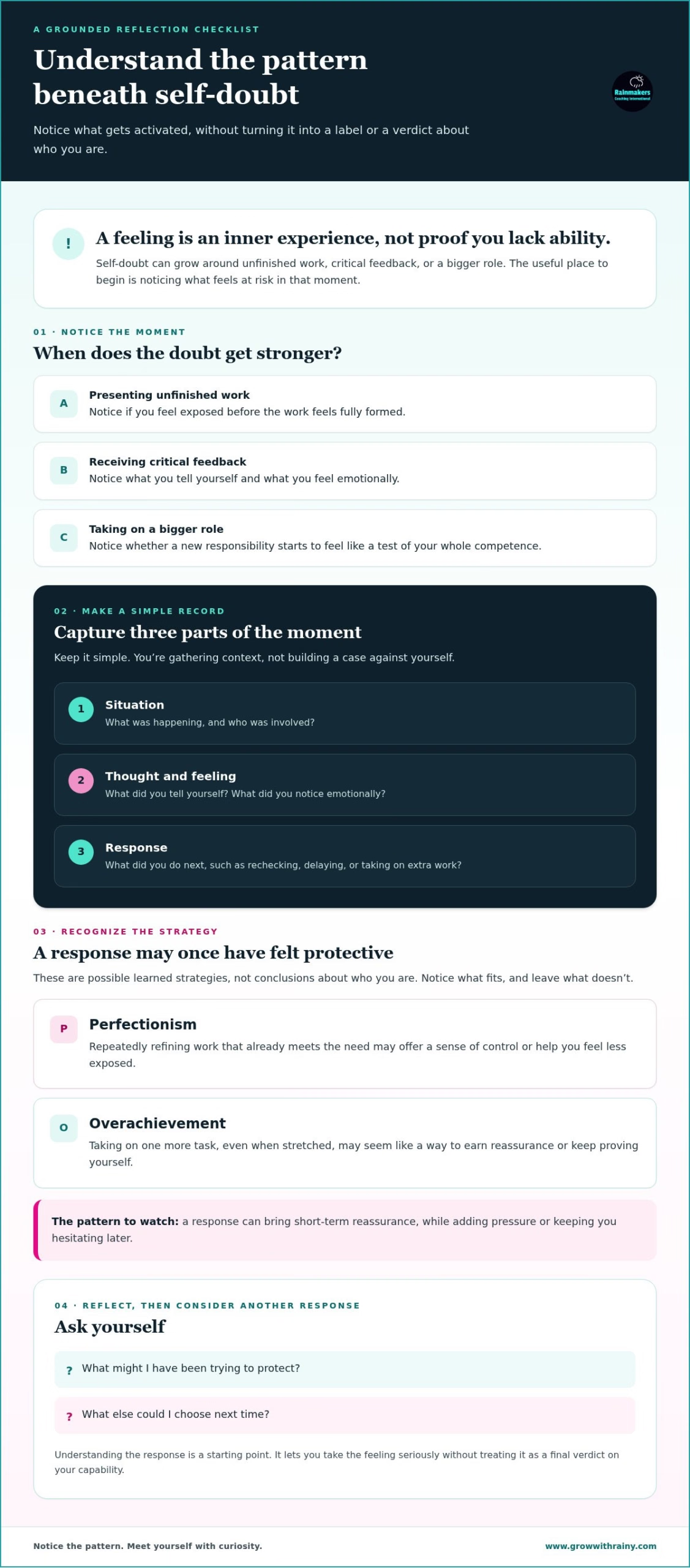
Self-doubt can follow a pattern. Perhaps it grows when you’re asked to present unfinished work, receive critical feedback, or take on a bigger role. You might respond by perfecting every detail or continually raising your own performance bar. In coaching, Perfectionism and Overachievement can be useful names for possible learned strategies, not conclusions about who you are.
A strategy may once have felt protective. Careful preparation might help you feel less exposed; doing more might seem like a way to earn reassurance. But when a response becomes automatic, it can add pressure or keep you hesitating even when the task is manageable. These patterns won’t explain everyone’s experience. Notice what fits without turning an observation into a label.
Could Perfectionism or Overachievement be part of the picture?
Perfectionism may show up as repeatedly refining work that already meets the need. Overachievement may look like taking on one more task, even when you’re stretched, because stopping feels uncomfortable. Either response can bring a sense of control or reassurance in the moment. Later, you may feel tired or unsure whether your effort reflects what matters to you, or a need to keep proving yourself.
For background on the term and its origins, see this history and definition of imposter syndrome. It may help you consider whether achievement-related doubt is part of your experience, without treating a label as a diagnosis.
How do you observe a pattern without labelling yourself?
Try noting a few moments when self-doubt becomes stronger. Keep the record simple:
- Situation: What was happening, and who was involved?
- Thought and feeling: What did you tell yourself, and what did you notice emotionally?
- Response: What did you do next, such as rechecking, delaying, or taking on extra work?
Then ask: What might I have been trying to protect, and what else could I choose next time? You’re gathering context, not building a case against yourself. If this pattern resonates, read more about high-achiever perfectionism and self-doubt. Overcoming the fear of not being good enough can begin with this kind of honest noticing.
If a reflective coaching conversation would help you explore what you’re seeing, you can schedule a conversation with Rainy.
Is feeling not good enough the same as imposter syndrome?
They can overlap, but they aren’t automatically the same. A general sense of inadequacy may touch different areas of life, while imposter feelings are usually discussed in relation to achievement and doubts about whether you deserve your success. Neither description, on its own, is a diagnosis. Start by understanding what you’re experiencing and how it affects your choices.
What is the useful difference between inadequacy and imposter feelings?
“I’m not good enough” is a broad self-evaluation. It may arise in work, relationships, or decisions about your future. Imposter feelings are more specifically connected to accomplishment: you may question whether your success reflects your ability or worry that others will discover you’re less capable than they believe.
These descriptions can help you find language for an experience, but one moment of doubt doesn’t establish a fixed label. Consider the concern underneath: Are you questioning your worth across different parts of life, or do the doubts centre on achievement and recognition? For more context, read this professional guidance on imposter syndrome.
| Reader’s concern | Common context | Useful reflection |
|---|---|---|
| “I’m not good enough.” | A broader judgement about yourself that may arise in different areas of life. | Where does this belief show up, and what does it lead you to avoid or doubt? |
| “I don’t deserve this success.” | Doubt connected to achievement, recognition, or the possibility of being exposed as less capable. | What evidence am I overlooking, and what am I afraid others might see? |
Use the distinction as a prompt, not a test. You don’t need to settle on a label before taking your concern seriously. Notice where the doubt appears and whether it is narrowing your choices, affecting your wellbeing, or making it difficult to act in ways that matter to you.
When might the fear need support beyond self-guided reflection?
Reflection can be a helpful starting point. If distress feels persistent, severe, or disruptive to daily life, consider seeking support from a qualified mental health professional. Coaching has a different purpose: it offers space to explore patterns, strengths, and possible responses as you work towards development. It isn’t psychotherapy or clinical counselling.
There’s no need to turn ordinary doubt into a crisis, and you don’t have to manage significant distress alone. When overcoming the fear of not being good enough, a grounded next step is to ask what kind of support fits the concern you’re facing. What is the doubt affecting most right now?
What practical steps help when you feel you are not good enough?
You don’t have to wait until self-doubt disappears before taking a useful step. Try this brief practice when your inner critic gets loud. The aim isn’t to force confidence. It’s to make room between the thought and your response.
- Name the moment. What just happened? Write down the exact self-critical thought and the situation that triggered it.
- Separate facts from interpretation. What do you know for certain? What are you assuming or predicting? Look for evidence that supports the thought and evidence that complicates it.
- Choose one next action. Replace a sweeping verdict such as “I can’t do this” with a specific step you can take now.
How can you respond to the inner critic in the moment?
Suppose you’ve drafted an idea for a meeting and think, “It isn’t good enough to share.” The fact might be that the idea still needs discussion. The interpretation might be that asking for feedback will expose you as unprepared. You could choose one grounded action: share the central point and invite a response. You’re not claiming to know everything. You’re contributing what you know so far.
Existing evidence of capability can help you stay balanced. Recall a relevant skill you’ve used, a decision you’ve made, or feedback you’ve received. Let that evidence inform your next move, rather than turning it into another standard you must keep proving. Overcoming the fear of not being good enough doesn’t require perfect certainty before every action.
How can you practise self-trust through small actions?
Choose a manageable action that reflects your capability, even if it feels a little uncomfortable. Share a considered idea before you’ve polished every sentence. Ask a clarifying question instead of pretending you have no doubts. Afterwards, notice what happened and what you learned. Resist grading the effort as a total success or failure. You’re practising a different response, not sitting an exam on your worth.
For more ideas, explore these confidence practices for high-achieving leaders. If you’d like to explore support with self-confidence, Rainmakers Coaching International offers the Building Rock Solid Confidence Program. What is one small action you could take before you feel completely ready?
How can coaching support overcoming the fear of not being good enough?
Understanding a pattern can bring clarity, but insight alone may not change what happens the next time you’re invited to speak up, take on responsibility, or make a decision without complete certainty. Coaching gives you a reflective space to notice what gets activated, reconnect with your strengths, and practise a response that feels more aligned with who you want to be.
This isn’t about being told what to do or promised a particular career outcome. It’s a chance to slow down and look honestly at the choices in front of you. What do you want to do, and what does fear make you do instead?
What might coaching help you explore?
You might explore when self-doubt appears, how it shapes your decisions, and whether it affects your visibility or professional relationships. Do you hold back a perspective, avoid asking for support, or agree to more than you can manage because you’re worried about how you’ll be perceived?
From there, insights can connect to a behaviour you choose to practise. You might share a considered view in a meeting, ask a direct question, or set a boundary around your workload. The aim is not to force confidence, but to build self-trust through choices that reflect your values and capabilities. You can read more about how Rainmakers approaches transformational life coaching .
Rainmakers Coaching International offers Life Coaching, Career Coaching , and Executive / Leadership Coaching through the Rainmakers Transformation System™: Release, Reprogram, and Recondition. The system provides guidance for deeper coaching work, with a focus on recognising inner patterns and practising different responses in a way that supports a more authentic sense of self and self-expression.
What is a grounded next step if you want support?
You might begin by asking yourself whether you want space to explore this pattern with a coach. If you do, bring one situation where the fear tends to show up. Together, you can look at what you’re telling yourself, what matters to you, and what small response you want to try. Coaching supports reflection and development. It isn’t a promise that a particular role, promotion, or external outcome will follow.
What might you try if you trusted the evidence of capability you already have, even without feeling completely certain?
Take your next step with greater self-trust
The fear of not being good enough can feel persuasive, but it isn’t proof that you lack capability or worth. Notice what triggers the doubt and whether strategies like perfectionism or overworking are adding pressure. Then separate what you know from what you’re assuming, and choose one meaningful action without waiting for complete certainty.
That is one grounded way to approach overcoming the fear of not being good enough: build self-trust through small choices, not constant proof. Coaching can offer space to explore those patterns and practise different responses.
Rainmakers Coaching International has more than a decade of experience coaching leaders, professionals, and individuals. Its Rainmakers Transformation System™ follows Release, Reprogram, and Recondition, providing a structure for reflective work without promising a particular outcome.
If you’d like support exploring what your next step could be, start a conversation with Rainy. You don’t need to feel completely ready to move forward. Let your next step be a chance to practise trusting what you already know about your capability.
Frequently Asked Questions
Why do I feel like I am not good enough even when I succeed?
Success and self-evaluation don’t always move together. You may complete a demanding project and still focus on what could have gone wrong, or explain away praise rather than taking it in. High standards, comparison, or worry about what others expect next can add to the doubt. Try naming what you achieved and what you’re telling yourself about it. What might the evidence say if you viewed it more fairly?
How can I stop feeling like I am not good enough at work?
You may not be able to stop the feeling on demand, but you can practise responding to it differently. Name the situation, write down the self-critical thought, then separate observable facts from predictions. Choose one manageable work action, such as sharing a considered idea or asking a clarifying question, without waiting to feel completely certain. Overcoming the fear of not being good enough can begin with acting on evidence, not on the demand to prove yourself again.
Can perfectionism make you feel like you are not good enough?
It can contribute to that feeling for some people. If your standard is flawless work, a strong result may still seem unfinished, and praise may not feel like enough. In coaching, Perfectionism is understood as a possible learned strategy, not a diagnosis or a complete explanation of your experience. Ask yourself whether the extra checking is improving the work or mainly delaying the moment you share it.
How do I build self-trust when I keep doubting myself?
Build self-trust through small choices you can follow through on, rather than waiting for doubt to disappear. Choose one manageable action, such as contributing a point in a meeting, then notice what happened and what you learned. Keep relevant evidence of your capability in view, but don’t turn it into another test you must pass. What would you try if you trusted what you already know?
What happens if I make a mistake while trying to prove myself?
A mistake may call for a correction, a conversation, or a lesson for next time. It doesn’t automatically define your ability or worth. First, identify what happened without turning it into a sweeping judgement about yourself. Then take responsibility for any practical impact and decide what you’ll do differently. You’re allowed to learn while contributing. Consider whether the mistake is a specific problem to address or a story that says you’re incapable.
Can coaching help with the fear of not being good enough?
Coaching can offer space to notice when the fear arises, reconnect with your strengths, and practise different responses in your work or life. Rainmakers Coaching International offers Life Coaching, Career Coaching, and Executive / Leadership Coaching through the Rainmakers Transformation System™: Release, Reprogram, and Recondition. Coaching supports reflection and development, keeps you accountable for your goals. What kind of support might help you take your next step?

Article by
Rainy Rainmaker
Rainy Rainmaker is the founder of Rainmakers Coaching International and a transformational coach for confidence, self-trust, and authentic leadership. Based in Singapore, she helps high-achieving professionals, managers, and leaders who appear capable on the outside but feel quietly held back by self-doubt, overthinking, imposter feelings, burnout, or a loss of direction. Through her signature Rainmaker Transformation Journey™, Rainy helps clients uncover the insights already within them and turn inner clarity into aligned action that creates lasting change in how they work, lead and live.
