
What if the clarity you’re looking for doesn’t come from another framework, but from understanding what’s creating friction in the first place? If you’re asking, “Is it worth getting a life coach?” it may be, when you want focused support to find direction, reconnect with your own judgment, and turn insight into meaningful change. Coaching isn’t a shortcut or a promise of instant answers. It offers space to think more clearly and move with intention.
It makes sense to weigh the commitment. Your time, money, and trust matter, especially when you’re balancing career decisions, leadership responsibilities, or a sense that your current path no longer fits. If you’re wondering whether it’s worth getting a life coach, consider whether support could help you work through a decision you’ve been carrying alone. The value depends on whether the work addresses what you genuinely want to change and feels relevant and useful to you.
This article explores what life coaches do, what coaching may ask of you in time and money, and what research says about client outcomes and satisfaction. You’ll also find a way to think about return on investment beyond a single career milestone: greater clarity, self-trust and the way you work, lead and live.
Key Takeaways
- Understand how career coaching can help you find direction, work with your strengths, and navigate a mid-career change.
- Weigh the time and financial commitment against the clarity and support you want from coaching.
- Notice how internal patterns can shape the way you work, lead, and make career decisions.
- Use research on coaching outcomes as context, while recognising that trust, chemistry, and your own independence matter too.
- Explore how reconnecting with self-trust can help you make choices that feel more grounded and sustainable.
What Is a Career Coach?
A career coach helps you examine work-related choices and move towards goals that reflect your values. For a mid-career professional, that may mean exploring a role change, rebuilding confidence, or deciding whether life coaching could offer useful support. Coaching creates space to understand what matters before choosing your next move.
Common Coaching Topics
Career coaching focuses on professional decisions, development, and your experience of work. You might bring questions about returning after a career break, taking on leadership, or feeling unchallenged in a role you once wanted.
For example, if your work feels disconnected from your strengths, a coach can help you explore what you want to contribute next. A career direction coaching program may help clarify what kind of work feels meaningful to you.
Session Format and Engagement Length
A coaching session is a focused conversation shaped around your goals and current concerns. The coach listens, asks questions, and helps you examine possible choices rather than prescribing a career path.
You can expect to discuss what has changed, what you want to move towards, and what might be holding you back. For instance, a conversation about a promotion could explore whether the role fits your priorities, not just whether you meet its requirements. Reflection between sessions can help you notice how those insights apply at work.
Coaches Compared with Other Support Roles
A coach generally supports goal-focused reflection, while a therapist or counsellor can help with emotional distress and mental health concerns. A mentor usually shares advice drawn from personal experience in a particular field.
For example, a mentor might describe how they handled a career transition. A coach would help you consider which direction fits your values and circumstances. These forms of support serve different needs, so it helps to identify the kind of conversation that would be useful to you.
Coaching Scope and Limitations
A life coach can help you clarify goals, explore decisions, and notice habits affecting your confidence or work relationships. Coaching doesn’t diagnose mental health conditions, provide therapy, or make choices on your behalf.
If you need clinical support, coaching isn’t a substitute. It is most useful when you’re ready to reflect and take responsibility for your decisions. What kind of support would help you move forward with greater self-trust?
Evaluating the Time and Cost of Career Coaching
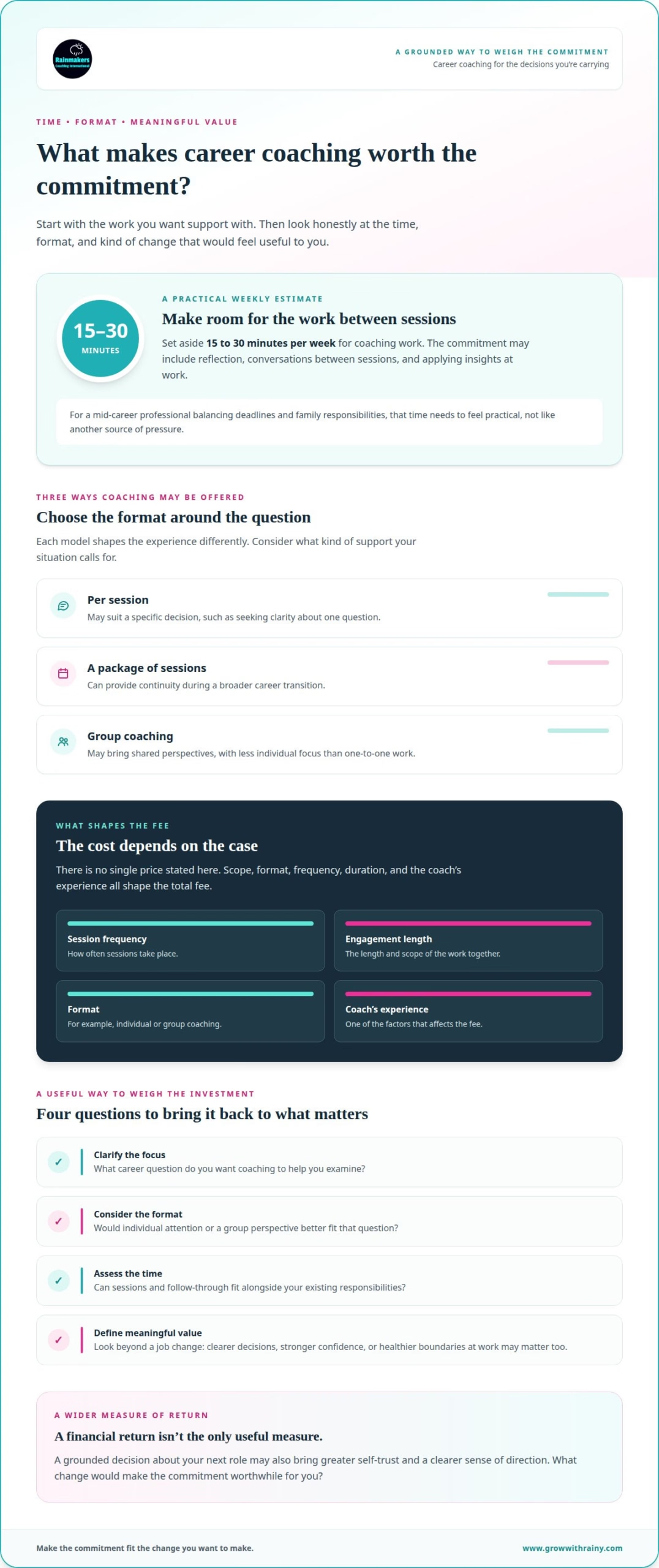
Career coaching asks for more than the time spent in a session. The full commitment may include reflection, conversations between sessions, and applying insights at work. One estimate suggests setting aside 15 to 30 minutes per week for coaching work. For a mid-career professional balancing deadlines and family responsibilities, that time needs to feel practical, not like another source of pressure.
Coaching may be offered through payment per session, a package covering several sessions, or a group programme. Each model shapes the experience differently. Paying per session may suit a specific decision, such as seeking clarity for a particular decision. A package can provide continuity during a broader career transition. Group coaching may bring shared perspectives, with less individual focus than one-to-one work.
The total fee depends on factors such as session frequency, engagement length, format, and the coach’s experience. A defined scope helps clarify what the commitment covers. For example, someone working through a change in direction may need a different focus from a professional preparing to take on greater leadership responsibility. The price for coaching depends on the case and is given after a quote request; scope, format, frequency, and duration shape the cost.
Weighing the Investment
To judge whether coaching fits, connect the commitment to a specific work-related need. If you’re considering a career pivot, identify what you hope to understand or change, such as the values you want reflected in your next role. Then consider whether you can make time for sessions and follow-through alongside your existing responsibilities.
- Clarify the focus: Name the career question you want coaching to help you examine.
- Consider the format: Decide whether individual attention or a group perspective better fits that question.
- Assess the time: Include session time and reflection in your weekly calendar.
- Define meaningful value: Look beyond a job change to outcomes such as stronger confidence, clearer decisions, or healthier boundaries at work.
A financial return isn’t the only useful measure. If coaching helps you make a grounded decision about your next role, its value may include greater self-trust and a clearer sense of direction. What change would make the commitment worthwhile for you?
Potential Benefits of Career Coaching
Career coaching can shift more than a job decision; it can change how you respond to work. For a mid-career professional, that shift may begin with noticing what drives their choices and what no longer fits.
Imagine a capable manager who avoids speaking up, then feels overlooked for leadership opportunities. Coaching can help explore the pattern behind that silence, such as fear of criticism, and make room for a different response. The change starts internally, but may show up in clearer communication, stronger boundaries, and more intentional leadership. Those shifts can also affect relationships outside work.
Possible Outcomes of Coaching
Coaching outcomes are the changes clients experience in their thinking, behaviour, or work. They matter because a career goal becomes more sustainable when the choices behind it reflect your values, not only external expectations.
The International Coaching Federation reported that 80% of coaching clients improved their self-confidence, while 73% improved their relationships. It also reported improved communication skills for 72% of clients and improved work-life balance for 67%. These outcomes point to areas that can support career growth, from contributing more directly in meetings to setting clearer limits on after-hours work.
For example, a senior specialist considering management may discover that their strongest contribution comes through mentoring, not managing a larger team. That insight can reshape their next career move. The benefits and methods of coaching become more meaningful when connected to a real decision and a change you can practise.
Who May Benefit from Coaching
Coaching may suit people ready to examine a specific work or life question and take an active role in change. This can matter for mid-career professionals whose established success no longer feels aligned with their values or strengths.
A professional returning after a career break, navigating a promotion, or feeling stuck in a familiar role may benefit from space to reflect. If the same pattern appears across different jobs, such as overcommitting to earn approval, coaching can help explore what the pattern does for you and consider new choices. The aim isn’t to follow a coach’s script. It is to draw on your own resources, build self-trust, and make decisions you can carry into work, leadership, and life.
Research on Coaching Outcomes and Client Satisfaction
Research can offer useful context, but satisfaction figures don’t tell you whether a particular coach suits you. The International Coaching Federation reported that 98.5% of coaching clients found coaching valuable or very valuable, and 99% were satisfied or very satisfied. Those results describe surveyed clients, not a guaranteed outcome for every person.
The International Coaching Federation has also identified brainstorming, an independent perspective, encouragement, accountability, and feeling listened to as valuable parts of coaching. For a mid-career professional weighing a promotion, these can help separate personal priorities from pressure to keep advancing. The value lies in having space to think, not in handing your decisions to someone else.
Credentials and Fit in Singapore
In Singapore, consider coach-specific training, supervised practice, and relevant experience when assessing a coach’s credentials. For example, the Associate Certified Coach credential includes 60 hours of coach-specific training, 100 hours of client work, and 10 hours of supervised mentoring. Credentials offer one reference point; they don’t tell you whether the coach understands your goals or working context.
Trust and chemistry matter too. In an initial conversation, notice whether the coach listens closely, welcomes honest disagreement, and helps define a focus for your sessions. A red flag is pressure to accept the coach’s interpretation, promises of a specific career result, or advice that dismisses your values. If you leave feeling less able to trust your own judgment, pay attention to that response.
Support Without Dependence
Good coaching should strengthen your ability to make decisions, rather than make you dependent on the coach. For example, a coach can help you explore how to respond to a difficult colleague, then invite you to choose and evaluate your own approach. Over time, you should be better able to reflect without needing approval at every step.
Ask how progress will be reviewed and how the work supports your independence. A useful measure might be making a career decision with greater confidence, then explaining your reasoning in your own words. If every next move depends on the coach’s direction, the relationship may not be building the self-trust you need. The aim is support that helps you apply new insight at work and in life.
Finding Clarity, Focus, and Direction in Your Career
Career clarity isn’t always about choosing between two job titles. A mid-career professional may know they want change but feel unsure whether to leave, seek a promotion, or reshape their current role. Coaching can help bring the real question into focus: what do you want your work to make possible now?
Patterns often reveal more than a single difficult week. Perhaps you accept extra work to prove your value, then feel resentful when your own priorities slip. Or you consistently choose roles for status while meaningful work takes a back seat. A coach can help you notice what repeats, explore what it protects, and consider whether that response still serves you.
That reflection can reconnect you with self-trust. For example, a leader who doubts their readiness for a broader role may begin to distinguish genuine skill gaps from fear of being judged. The aim isn’t to ignore practical realities. It’s to see them clearly alongside your strengths, values, and capacity for growth. A clearer view can change how you work, lead, and make choices beyond the office.
In career coaching, the conversation can move from a vague sense of being stuck to a grounded decision. A coach may help you examine:
- Energy: Which responsibilities leave you engaged, and which consistently drain you?
- Values: Does your current role reflect what matters to you, such as autonomy, contribution, or stability?
- Strengths: What do colleagues rely on you for, and do you have room to use those abilities?
- Patterns: Are you repeating a familiar choice, such as staying quiet when your perspective could help?
These questions matter because focus isn’t simply a longer task list. If autonomy matters more than title, a lateral move may fit better than a promotion. If you value contribution, a role with more mentoring could feel more meaningful than another individual achievement. Exploring personal values and career choices can help bring those priorities into view.
Direction emerges when your next move reflects both inner truth and external realities. A coach can help you weigh a possible change against responsibilities, relationships, and the kind of life you want your career to support. The takeaway is simple: clearer choices begin when you understand the pattern beneath the decision. What might change if your next career move came from self-trust rather than pressure?
Rainmakers Coaching International: Career, Life, and Executive Coaching
Rainmakers Coaching International offers Life Coaching, Career Coaching, Executive Coaching, and Career development Coaching. This inside-out support may help when career success looks right on paper but no longer feels connected to who you are. The work begins with your inner world, then explores how a shift in self-understanding can change how you work, lead, and live.
Rather than focusing only on strategies or another external framework, coaching helps you notice what is already within reach. A mid-career professional who keeps accepting work to prove their value, for example, may uncover an outdated protective pattern. Exploring what that pattern once offered can make space for a more grounded response.
Career Coaching can support someone who feels uncertain about their direction or wants to use their strengths more fully at work. A client might recognise that colleagues value their ability to bring people together, even though they have focused mainly on individual achievement. Naming that strength can help them consider work that better reflects their contribution.
For changes that reach beyond work, Life Coaching creates room to explore personal values, confidence, and choices. If a demanding role has narrowed your life around work, coaching can help you reconnect with what matters outside the office. The focus isn’t on following someone else’s definition of balance, but on finding a way of living that feels true to you.
Executive Coaching supports leaders examining how their internal patterns shape decisions, communication, and relationships with their teams. A leader who avoids difficult conversations, for instance, can explore what makes those moments feel risky and practise responding with greater clarity. The aim is change that carries into real leadership situations, not just insight in a session.
Career development Coaching can help you recognise hidden resources and approach growth more intentionally. That might mean using a strength you have overlooked or releasing a belief that you must earn respect by doing everything yourself. As your inner perspective shifts, your choices and behaviour at work can shift too.
These offerings suit different questions, but share a focus on reconnecting with your own truth. Sustainable change can begin when you understand a pattern, access your strengths, and choose a new response. What might become possible if your next career step reflected self-trust as well as ambition?
Contact Rainmakers Coaching International to explore whether coaching fits the change you want to make.
Frequently Asked Questions
What will you gain from coaching?
Coaching can help you turn a broad concern into a clearer decision and a practical way forward. Before a performance review, for example, you might clarify what feedback you want to raise, how you want to contribute, and what support would help. You can also notice the assumptions shaping your choices and reconnect with your own judgment. That inner shift can change how you work, lead, and live, with insight you can carry beyond the conversation.
How can I tell whether life coaching is worth the cost for my goals?
Compare the commitment with a change you genuinely want to make, not an outcome someone else expects. Name the decision or pattern you want help with, then consider what progress would look like in daily life. Success might mean choosing a career direction with less second-guessing, for example, not securing a particular role. If your goal is clear and the work feels relevant, you have a stronger basis for weighing its value.
What evidence is there that life coaching improves outcomes?
Evidence includes client surveys reporting perceived value and satisfaction, alongside research into coaching outcomes. These findings can inform your decision, but they don’t show that coaching alone caused every reported change or predict your individual experience. For a career goal, distinguish an internal outcome, such as making a decision with greater self-trust, from an external result, such as receiving a promotion. That distinction keeps expectations grounded.
How do I choose and vet a life coach in Singapore?
Look for relevant coach-specific training, experience with concerns like yours, and a clear explanation of how sessions are conducted. Ask how the coach will help you define goals and review progress. Notice whether the conversation feels respectful and whether you can disagree without pressure. In Singapore, don’t assume a title alone tells you how a coach works. Choose someone who helps you reconnect with your own truth and supports your judgment rather than replacing it.
What should I expect in a life coaching session, and how many sessions are typical?
Expect a focused conversation about what matters to you, what is getting in the way, and what you want to explore next. You may leave with a question to reflect on or an action to consider at work. The number of sessions depends on your goals and how much support you find useful. Agree on a focus, then review whether the conversations are helping you understand yourself and act more independently.
What are the risks or warning signs of an unqualified or unethical life coach?
Be cautious if a coach promises a guaranteed promotion, pressures you to continue, or treats disagreement as resistance. A sound working relationship should include clear boundaries, an agreed purpose, and openness about confidentiality and its limits. You should understand how personal information is handled before sharing sensitive details. If you feel pushed to disclose more than you want or follow instructions that conflict with your values, pause and reconsider the fit. What would help you feel grounded and able to trust your own judgment as you consider coaching?

Article by
Rainy Rainmaker
Rainy Rainmaker is the founder of Rainmakers Coaching International and a transformational coach for confidence, self-trust, and authentic leadership. Based in Singapore, she helps high-achieving professionals, managers, and leaders who appear capable on the outside but feel quietly held back by self-doubt, overthinking, imposter feelings, burnout, or a loss of direction. Through her signature Rainmaker Transformation Journey™, Rainy helps clients uncover the insights already within them and turn inner clarity into aligned action that creates lasting change in how they work, lead and live.
