


You sit down to set your New Year goals for 2027. You’d like to do more meaningful work, have some energy left at the end of the day and see friends you’ve been meaning to call. All three matter. Then you look at your calendar and see how little time you have left once work and other commitments are accounted for.
To set New Year goals you can start working on, look back at what last year taught you, pick one goal that matters now and put its first action on your calendar. Give yourself a week, then review what happened and adjust.
When I work with people who are rethinking what they want, I often ask which goal they would still choose if nobody else had an opinion. Once you can answer that, it becomes easier to decide what deserves your time and what you can set aside for now.
Table of contents
- Look back at what 2026 taught you
- Choose one New Year goal
- Give the goal a place in your week
- Review after one week
- New Year goal-setting template
1. Look back at what 2026 taught you
Think of a few ordinary weeks from the past year. Look at what you made time for and what you kept moving to later. If the year feels like a blur, open your calendar or look through your photos.
- What do I want more of? Think of a moment you’d happily repeat, even if it looked insignificant from the outside.
- What kept crowding it out? Look at what tended to take that time. It might have been an urgent commitment, a habit of staying available or simply the difficulty of getting several people together.
January can make it easier to begin. In research on the fresh start effect, people were more likely to begin pursuing goals around milestones such as the start of a week, month or year. Use that moment to make a choice you’ll recognise in an ordinary week. For a fuller review, try my year-end reflection questions.
2. Choose one New Year goal that matters to you
Write down two or three things you’d like to change. Ask these questions about each one before deciding where to start.
- Would I still want this if nobody else knew I was working on it?
- What would change in an ordinary week if I made progress?
- What could I make less room for so this goal gets some time?
Suppose you’re weighing a promotion, better evenings and more time with friends. As you look back, the moments you miss most are the conversations you used to have over dinner. A goal that fits what you want might be to make plans to see friends once a month from January to March. That’s specific enough to act on, and you can revisit it after March.
If you’re still looking for ideas, start with these life goals for busy professionals. If work is the area you want to focus on, use my 2027 career goals guide to think through what you want next.
3. Give the goal a place in your week
Choose an action you can start yourself and give it a time. For the friendship goal, write: On Tuesday after dinner, I’ll message two friends and suggest a date. That’s something you can do this week, even if finding a date takes longer.
Plan for one interruption you can already see coming. If I’m still working after dinner on Tuesday, I’ll send the messages at Wednesday lunch. Researchers call this an if–then plan. It connects a specific situation to an action so you know what to do when the situation comes up.
4. Review after one week and adjust
Give yourself five minutes at the end of the week. Ask what you did, what got in the way and what you’ll try next. If you sent the messages and nobody could make the date, your next step might be to suggest two other times. If you never sent them, think about what was happening when you meant to.
Sometimes the obstacle is practical. You picked a bad time. Other times you notice a pattern, such as keeping evenings open for work even when nobody has asked you to be available. Use this goal progress checklist if you want more ways to see what’s working and get back on track.
If you missed a week and want to try again, here’s how to restart a New Year’s resolution after a setback.
5. New Year goal-setting template
Copy these six prompts into a notebook or the notes app you already use. Fill them in for the one goal you’ve chosen.
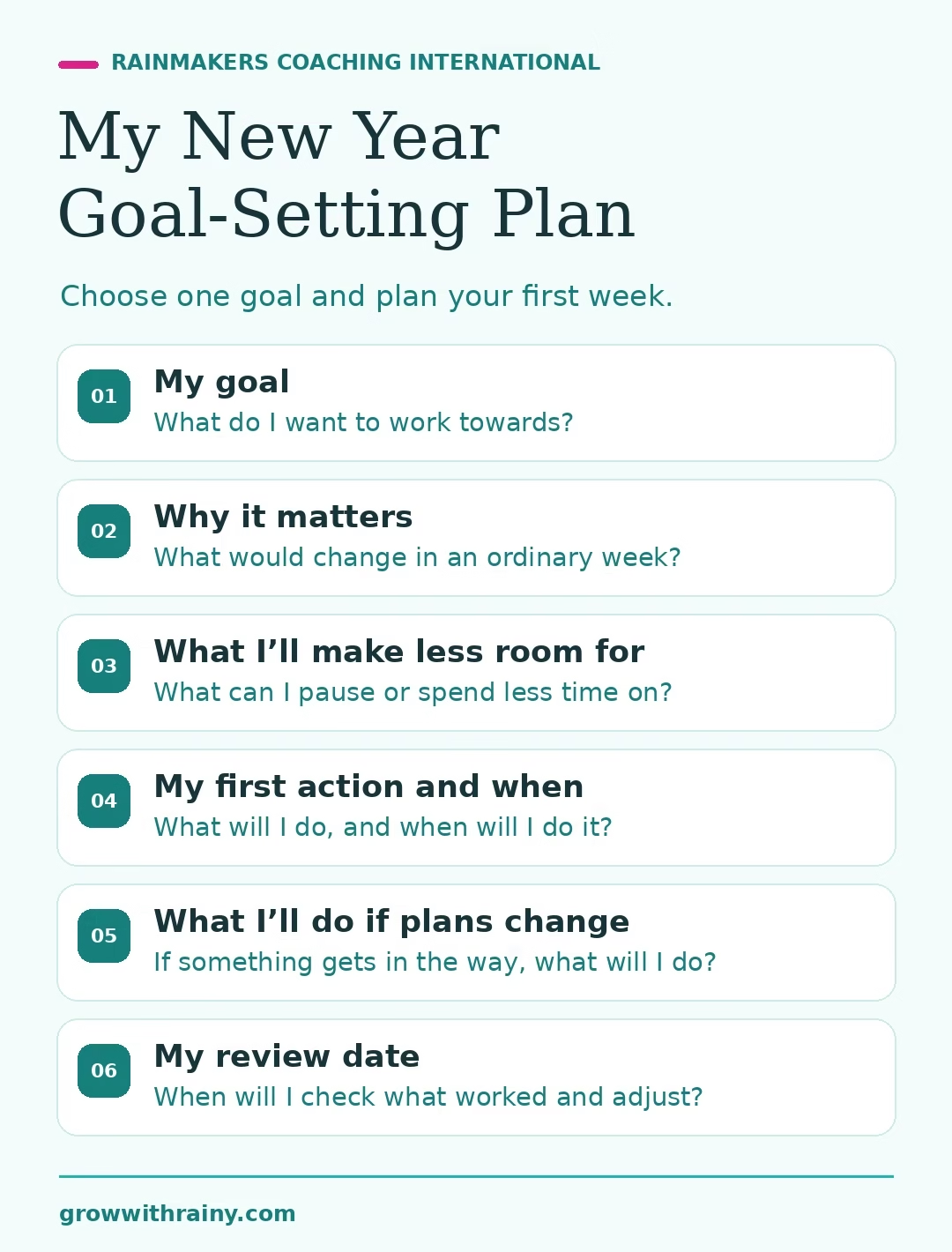
- My goal — What do I want to work towards?
- Why it matters — What would change in an ordinary week?
- What I’ll make less room for — What can I pause or spend less time on?
- My first action and when — What will I do, and when will I do it?
- What I’ll do if plans change — If something gets in the way, what will I do?
- My review date — When will I check what worked and adjust?
When the same goal keeps coming back
If a goal keeps returning to your New Year’s resolutions, it can help to look at what happens just before you put it aside. In Life Coaching, we can explore what you want, what keeps getting in the way and what a realistic next step would look like in your life. Request a Complimentary Session.
