
What if the self-doubt holding you back isn’t proof that you’re unready, but an old way of trying to stay safe? You may have years of evidence that you’re capable and still hesitate before speaking up, taking on a visible role, or making a career move. Coaching for overcoming limiting beliefs can help you explore why that doubt keeps returning, even when you understand intellectually that it may not be true.
If fear of judgment makes important work decisions harder, it can be tempting to tell yourself to be more confident. But confidence doesn’t always follow an instruction. The belief may be connected to a protective pattern that once helped you succeed, but now narrows your choices.
In this guide, you’ll learn how coaching can help you recognise the pattern beneath a recurring thought and respond to uncertainty with greater self-trust. We’ll look at what happens in real workplace moments, how to practise a more grounded response, and how an inside-out shift can influence the way you work, lead, and live. What might change if you met doubt with curiosity instead of letting it make the decision?
Key Takeaways
- Notice when a recurring thought is narrowing your choices, then ask what situation brings it up and what it may be trying to protect.
- Coaching for overcoming limiting beliefs can help you explore the pattern behind self-doubt and practise a response grounded in self-trust.
- Rather than forcing a positive affirmation, examine the belief with curiosity and look for a more balanced, believable perspective.
- In a challenging work moment, separate observable facts from predictions and assumptions about your worth before choosing how to respond.
- Inside-out coaching can help you reconnect with your strengths and make career and leadership choices that feel more aligned.
What Are Limiting Beliefs, and When Can Coaching Help?
You know your work. You’ve built experience, handled responsibility, and earned trust. Yet when there’s a chance to speak in a senior meeting, put yourself forward for a role, or make a career decision, you hesitate. The question may not be whether you’re capable. It may be what you’ve come to believe about what’s safe or possible for you.
A limiting belief is an assumption that narrows the choices you believe are available to you, not a fact about who you are. It isn’t a diagnosis, and noticing one doesn’t mean your concern is unfounded. It means there may be a thought worth examining before it directs your next move.
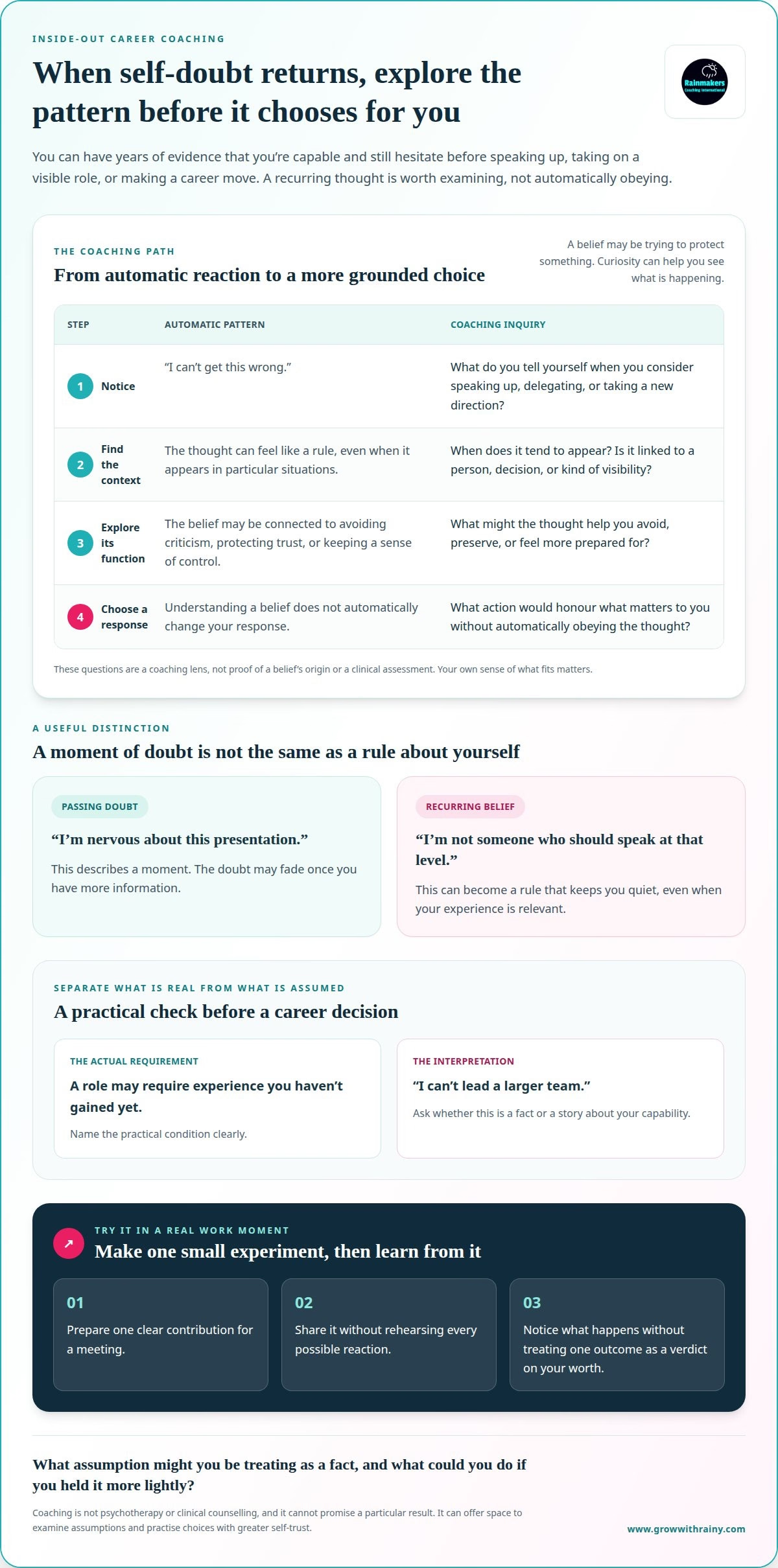
A passing doubt can arise around a difficult task and fade once you have more information. A recurring belief tends to return in familiar situations and shape what you do. “I’m nervous about this presentation” describes a moment. “I’m not someone who should speak at that level” may become a rule that keeps you quiet, even when your experience is relevant.
How a limiting belief can show up in a professional’s choices
At mid-career, the pattern can be subtle. You might prepare long after the work is ready, avoid visibility by letting others present your ideas, or delay a meaningful move because you don’t feel fully qualified. These choices can have different causes, so none is proof of a limiting belief on its own. The useful question is whether the same assumption keeps narrowing your options.
Some limits are real: a role may require experience you haven’t gained, or a decision may depend on practical responsibilities. Other limits are interpretations about personal capability, such as “I can’t lead a larger team” or “If I ask for support, I’ll lose credibility.” Separating the actual requirement from the story attached to it can reveal where you have room to choose.
When coaching may be useful
Coaching may help if you understand a thought intellectually but still find yourself responding to it in the same way. In coaching for overcoming limiting beliefs, a coach can help you notice when the thought appears, explore what it may be protecting, and consider a response that better reflects your values and capabilities.
This work can include practical experimentation. You might prepare one clear contribution for a meeting, then observe what happens when you share it without rehearsing every possible reaction. A coach can support reflection and help you learn from the experience without treating one outcome as a verdict on your worth.
This is coaching, not psychotherapy or clinical counselling, and it can’t promise a particular result. It can offer a thoughtful space to examine your assumptions and practise making choices with greater self-trust. Approaches such as cognitive restructuring also describe ways of examining and reframing thoughts, rather than accepting them automatically as facts.
If a recurring belief is affecting your career direction, life coaching that explores change from within can help connect reflection with choices at work and in life. What assumption might you be treating as a fact, and what could you do if you held it more lightly?
How Coaching Explores the Pattern Beneath a Limiting Belief
A recurring belief often makes more sense when you look beyond the words themselves. “I can’t get this wrong” might appear to be about quality. In a particular work situation, it may also reflect a wish to avoid criticism, protect trust, or keep a sense of control. These are possibilities to explore, not conclusions about where a belief came from.
In coaching for overcoming limiting beliefs, the conversation can follow a clear path:
- Notice the thought. What do you tell yourself when you consider speaking up, delegating, or taking a new direction?
- Identify its context. When does it tend to appear? Is it linked to a particular person, decision, or kind of visibility?
- Explore its function. What might the thought help you avoid, preserve, or feel more prepared for?
- Consider a response. What action would honour what matters to you without automatically obeying the thought?
This is a coaching lens, not proof of a belief’s origin or a clinical assessment. Your own sense of what fits matters. Understanding why a belief may be present can create room for choice, but understanding alone doesn’t automatically change your response.
Ask what the belief is trying to protect
Curiosity can soften the inner argument. You might ask: “What feels at risk if I act differently?” “What am I hoping to prevent?” “What would help me feel grounded enough to take one step?” A belief may once have helped you seek safety, acceptance, or predictability. That doesn’t mean it has one fixed origin, or that you need to find an explanation in childhood. You decide what feels accurate.
A coach can ask questions and reflect what they hear, while leaving interpretation with you. If an explanation doesn’t fit, it doesn’t need to become your story. The aim is to understand your experience more clearly, not to impose a hidden meaning on it.
Explore learned protective patterns without labels
In coaching, patterns such as Perfectionism, Approval-Seeking, People-Pleasing, and Overthinking can offer language for repeated ways of responding. They are learned coaching constructs, not diagnoses or fixed identities. For example, someone may notice they polish a proposal repeatedly when they expect scrutiny. Exploring a perfectionist mindset at work can help separate care for quality from the pressure to make every detail flawless.
Connect insight with a different response
Once a pattern feels clearer, choose a small action that reflects your values. If you tend to wait until you feel completely ready, you might share an early idea with a trusted colleague and notice what the experience teaches you. The point isn’t to force confidence or prove the thought wrong. It’s to gather your own experience and practise responding with greater self-trust. One conversation may offer insight, but it doesn’t guarantee lasting change.
If you’d value a reflective space to explore what sits beneath a recurring work or career pattern, you can arrange a conversation with Rainy. What small, values-aligned response could you try the next time this belief appears?
Coaching Versus Positive Thinking: What Actually Helps Beliefs Shift?
You may have tried telling yourself, “I’m completely confident,” before a high-stakes presentation or career conversation. If the words feel far from what you believe, repeating them may feel hollow rather than reassuring. That doesn’t mean you’re resistant to change. It may mean the thought needs to be understood before a new perspective feels believable.
Shifting a belief doesn’t require replacing every difficult thought with an upbeat phrase. A more grounded response might be: “I feel uncertain, and I can still prepare and contribute.” It acknowledges your experience while leaving space for choice.
Why a positive phrase may not feel convincing
There can be a gap between a statement and your current experience. In a 2009 study published in Psychological Science, Joanne V. Wood, W. Q. Elaine Perunovic, and John W. Lee found that repeating positive self-statements made some participants with low self-regard feel worse. The finding doesn’t mean affirmations are unhelpful for everyone. It does suggest that, for some people, a phrase that feels far from their experience may not offer reassurance. You might instead ask what supports the thought, what complicates it, and what a more believable response could be.
A simple comparison: Each approach can have a place, depending on what you need.
| Approach | What it can offer | What to keep in mind |
|---|---|---|
| Forced affirmations | A brief attempt to encourage or reassure yourself | A phrase that feels untrue may not address the thought underneath |
| Solitary reflection | Time to write, consider evidence, and notice your own perspective | It can be harder to spot assumptions you take for granted |
| Coaching | A guided conversation that connects reflection with practical choices | The coach invites exploration; you decide what fits and what to try |
What coaching adds to self-reflection
Thinking alone can be valuable. Yet when you’re close to a situation, one interpretation may feel like the only interpretation. A thoughtful coach can listen for assumptions, ask what else might be true, and help you consider possible responses without deciding for you. You’re not there to be analysed, labelled, or told what to think. You remain the authority on your experience.
In coaching for overcoming limiting beliefs, the practical question is not simply, “How do I think positively?” It’s, “What would I choose if I didn’t have to treat this thought as the whole truth?” You might try sharing a considered view in a meeting, then reflect on what happened and what you learned. That is an experiment, not a test of your worth or a promise of a particular outcome.
If self-doubt is affecting how you show up at work, building rock-solid confidence can begin with understanding what makes confidence difficult to trust, rather than demanding that you feel certain first. What would be a more believable, self-supporting response to the thought you’re carrying?
If you’d like support exploring that question in relation to your career or leadership, you can arrange a conversation with Rainy.
How to Work With a Limiting Belief in a Real Work Situation
Choose one current moment, not your whole career. Perhaps you’re considering putting your name forward to lead a project, but the thought “I’m not ready” keeps stopping you. Rather than argue with the thought or make a dramatic decision, use the moment to understand what you know, what you’re assuming, and what small action could give you more information.
Name the thought and the situation
Write the thought in your own words. Then note when it appears and what happened immediately before it. Keep to what you observed: a role was discussed, a colleague asked for volunteers, or you read the project brief. You don’t need to guess at the deeper cause. Start with the moment in front of you.
- Record the observable facts. What was said or done? For example, the project needs a lead, and you have relevant experience in part of its work.
- Separate predictions from facts. “They’ll think I’m out of my depth” is a prediction, not something you know has happened.
- Notice the interpretation. “I’m not ready” is one way of making sense of the situation. Ask what “ready” means here, and whether the expectation is clear.
- Keep personal worth out of the verdict. A question about a specific skill doesn’t prove you’re incapable or unworthy of the opportunity.
Evidence tells you what happened; the story attached to it tells you what you think it means. Both deserve attention, but they aren’t the same thing.
Examine the evidence and choose a small experiment
Look at the thought with care, not forced optimism. Ask what supports it, what complicates it, and what you still don’t know. Perhaps you haven’t led this type of project before, but you have coordinated similar work or guided colleagues through a complex task. A balanced possibility could be: “I have some relevant experience, and I can learn more about what the role requires before deciding.”
Now choose a manageable action. You could ask the project sponsor what the lead role involves, offer to outline an initial approach, or speak with someone familiar with the work. This isn’t a test you must pass. It’s a way to gather information while acting in line with what matters to you.
Afterward, pause and reflect. What did you learn? Which part of your prediction came true, if any? What felt uncomfortable, and what felt possible? Don’t use one response from another person as a final judgement on your capability. Let it be one piece of information, alongside your skills, values, and practical constraints.
If the question is less about one project and more about where your experience could take you next, career direction coaching can support reflection on the beliefs and priorities shaping that choice. What small action could help you learn more without asking you to have everything figured out first?
How Rainmakers Coaching Supports Change From the Inside Out
You’ve reflected on the thought, considered what the evidence says, and identified a small action you could take. But what if the same hesitation keeps returning in different parts of your career or life? That may be a cue to look beyond the immediate decision and explore the beliefs shaping your responses.
Rainmakers Coaching International offers Career Coaching and Executive Coaching with Rainy, who has more than a decade of coaching experience. This inside-out approach explores the assumptions and learned protective patterns that influence how you work, lead, and live. The intention is to help you reconnect with your self-trust, innate strengths, and resources, so your choices can become more aligned with what matters to you.
What inside-out coaching means in practice
An internal shift can change how you approach an external situation. You might notice a familiar thought before a leadership conversation, consider what it’s asking you to avoid, and choose how you want to participate. Coaching doesn’t control how others respond or promise a particular career outcome. It can support a more grounded way of meeting decisions, relationships, and transitions.
For Rainy, this is not about supplying a ready-made answer or treating doubt as a flaw to remove. It’s about reconnecting with your truth and making room for resources you may not be drawing on when an old protective response takes over. This inside-out perspective also informs transformational life coaching, where reflection can connect personal choices with the way you want to live and work.
The approach is grounded in the Rainmakers Transformation System™: Release, Reprogram, Recondition. These are its three stages. They provide a process for working with underlying beliefs and learned patterns, rather than relying only on surface-level advice. The focus is not simply on knowing more about yourself. It’s on the person you are becoming as you practise new ways of responding.
When to consider a conversation with Rainy
A coaching conversation may be worth considering if self-doubt continues to shape an important career choice, if you’re approaching a transition, or if understanding the thought hasn’t changed how you respond. You don’t need to prove that you have a particular pattern or arrive with a perfectly defined goal. You can begin with what feels present and explore whether coaching fits your situation.
That conversation can include both career and wider life questions. A decision about visibility, responsibility, or direction at work may connect with what you value beyond your role. The aim is to explore those connections with care, not to promise that one insight will transform everything at once.
What might become possible if you trusted your own judgement a little more?
Make Your Next Choice From Self-Trust
You don’t have to wait until doubt disappears before making a meaningful choice. You can notice the hesitation, give yourself room to question its certainty, and decide what matters enough to take one considered step. That’s a different relationship with uncertainty, one where it can be present without making every decision for you.
If the same inner conflict continues to shape your work or career choices, coaching for overcoming limiting beliefs may offer space to explore what’s underneath and practise a response that feels more like you. A conversation doesn’t require you to arrive with a polished goal or a clear explanation. You can begin with the decision that feels difficult now.
Your next step can be small. Let it be honest, grounded, and guided by the person you’re choosing to become.
Frequently Asked Questions
Is coaching for overcoming limiting beliefs the same as therapy?
No. Coaching is a reflective process focused on your assumptions, choices, and responses in situations such as leading a team or weighing a career move. A coach doesn’t diagnose you or provide mental health treatment. Rainmakers describes protective patterns as coaching constructs, not clinical diagnoses. Therapy and coaching have different purposes, and one shouldn’t be treated as a substitute for the other. The kind of support that fits depends on your needs.
Can coaching help if I already know my limiting belief?
Yes. Naming a thought is a useful start, but it may not explain why it keeps influencing your choices. Coaching for overcoming limiting beliefs can help you look at when the thought arises, how you tend to respond, and what alternative response you want to practise. For instance, you might know you fear disappointing colleagues, yet still find yourself agreeing to work you can’t realistically take on.
How long does coaching take to change a limiting belief?
There’s no single timeframe that applies to everyone. The process depends on your situation, what you want to explore, and what feels manageable to practise. You might notice a new perspective before your responses feel different in everyday situations. Coaching isn’t a quick fix, and no particular number of sessions can guarantee that a belief will disappear. You and your coach can reflect on what feels useful as the work develops.
Can coaching help with self-doubt about a career decision?
Yes. Coaching can help you clarify what matters in a career choice and examine concerns that make one option feel difficult to trust. For example, you might compare a role’s responsibilities with the kind of contribution you want to make, while noticing which concerns are practical and which are assumptions about your ability. The decision remains yours. Coaching isn’t job placement, and it can’t guarantee that a particular option will succeed.
What if my limiting belief feels completely true?
A thought can feel convincing without being the only interpretation available. Instead of forcing yourself to think positively, ask what experience supports the thought, what doesn’t quite fit, and what you still need to learn. If you’re unsure whether you’re ready for a responsibility, you could identify one relevant skill you already use and one area you’d want to develop. Reflect on what that information changes, without demanding certainty.
Do all professionals have protective patterns?
No. A recurring response may be worth exploring, but it doesn’t mean you have a particular pattern. Names such as Perfectionism or Overthinking can describe coaching constructs when they feel relevant to your experience. They aren’t diagnoses or fixed identities, and a job title or record of achievement doesn’t tell someone which pattern applies. You can use the language that helps you understand your own choices, and leave aside what doesn’t fit.
How do I prepare for a coaching conversation about limiting beliefs?
Bring one situation you’d like to understand better, such as a conversation you’re avoiding or a choice that feels difficult to make. You could jot down what happened, the thought that followed, and how you responded. There’s no need to prepare a complete history or arrive with a polished goal. Starting with what feels important now can help keep the conversation connected to the decision or experience you want to explore.

Article by
Rainy Rainmaker
Rainy Rainmaker is the founder of Rainmakers Coaching International and a transformational coach for confidence, self-trust, and authentic leadership. Based in Singapore, she helps high-achieving professionals, managers, and leaders who appear capable on the outside but feel quietly held back by self-doubt, overthinking, imposter feelings, burnout, or a loss of direction. Through her signature Rainmaker Transformation Journey™, Rainy helps clients uncover the insights already within them and turn inner clarity into aligned action that creates lasting change in how they work, lead and live.
