
Knowing that you want something to change is one thing. Deciding what that change should look like can be harder, especially when work, relationships and personal priorities pull in different directions. Life coaching for professionals in Singapore offers space to clarify what matters to you and find a way forward.
The starting point might be a career crossroads, difficulty setting boundaries or a desire for greater fulfilment. Coaching can help you consider your circumstances alongside the beliefs and expectations that may influence your choices. At Rainmakers Coaching International, this inside-out work focuses on recognising what may be getting in your way and drawing more fully on your strengths.
In this guide, you’ll learn how life coaching can support clarity and self-trust, what working with a coach may involve and how to decide whether it suits the change you want to make.
Key Takeaways
- Life coaching for professionals in Singapore can help you examine what feels uncertain and clarify a meaningful next step.
- Inside-out coaching explores how your inner patterns may shape the way you work, lead and make choices.
- Insight becomes more useful when you connect it to actions that matter in your life.
- Try a simple reflection: name the situation, the change you want and what keeps you hesitating.
- Coaching supports personal and professional development. Job placement and CV writing are different needs.
What Life Coaching for Professionals in Singapore Can Help You See
You can be capable, trusted and accomplished at work, yet unsure what you want next. Perhaps your role has changed, a familiar goal no longer feels compelling, or you keep delaying a decision that matters. That tension doesn’t mean you’re ungrateful or that something is wrong with you. It may be a sign that the question needs more space than a quick answer.
Life coaching is a reflective, forward-looking process that supports personal and professional development. Rather than telling you what to do, a coach helps you examine your perspective, clarify what matters and consider choices you can own. For a general overview of the field, see What is Life Coaching? The value of coaching, though, depends on how the conversation connects to your situation and what you choose to do with it.
When professional success does not settle the bigger questions
A transition can bring uncertainty, even when it’s welcome. You may be considering a new responsibility, wondering whether to stay in a role, or noticing that a once-clear career direction feels less certain. Sometimes there isn’t one dramatic problem. There’s a recurring hesitation, or a sense that the choices in front of you no longer reflect what matters.
Work and personal life can influence each other. Pressure at work may affect how present you feel outside it; a personal change may shift what you want from your career. There isn’t one explanation for that experience, and feeling unsettled doesn’t automatically mean coaching is the right step. It can help to pause and name what feels unclear before rushing to solve it.
What a professional life coach helps you explore
A coach can help you separate the situation itself from the assumptions, expectations or competing priorities around it. What do you want to be different? What matters most in this decision? What are you hesitating to acknowledge? These questions aren’t a script for finding a perfect answer. They make room for you to hear your own perspective more clearly.
In life coaching for professionals in Singapore, reflection can connect to a choice or action that feels meaningful to you. That might mean having a guided conversation, reconsidering a goal or setting a boundary. The coach doesn’t make the decision on your behalf. You remain responsible for the direction, with space to consider it more intentionally.
An inside-out perspective also makes room to explore how your inner experience may shape the way you work, lead and live. Rainmakers’ approach to transformation life coaching focuses on reconnecting with your truth, rather than relying only on external tactics.
Start with one practical question: what do you want to understand more clearly before deciding what comes next?
How Inside-Out Life Coaching Works for Singapore Professionals
Sometimes the challenge isn’t a lack of knowledge. You may already know the options, have a plan and understand what others expect. Yet an important choice can still feel difficult. Inside-out coaching creates space to explore what’s happening beneath the surface, then consider how that awareness might inform the way you work, lead and live.
Inside-out coaching begins with your inner experience and brings that awareness into your choices and actions. It isn’t a promise that changing your mindset will produce a particular result. It’s a way to notice what influences your responses, reconnect with your own perspective and make choices with greater intention.
Release, Reprogram and Recondition in coaching
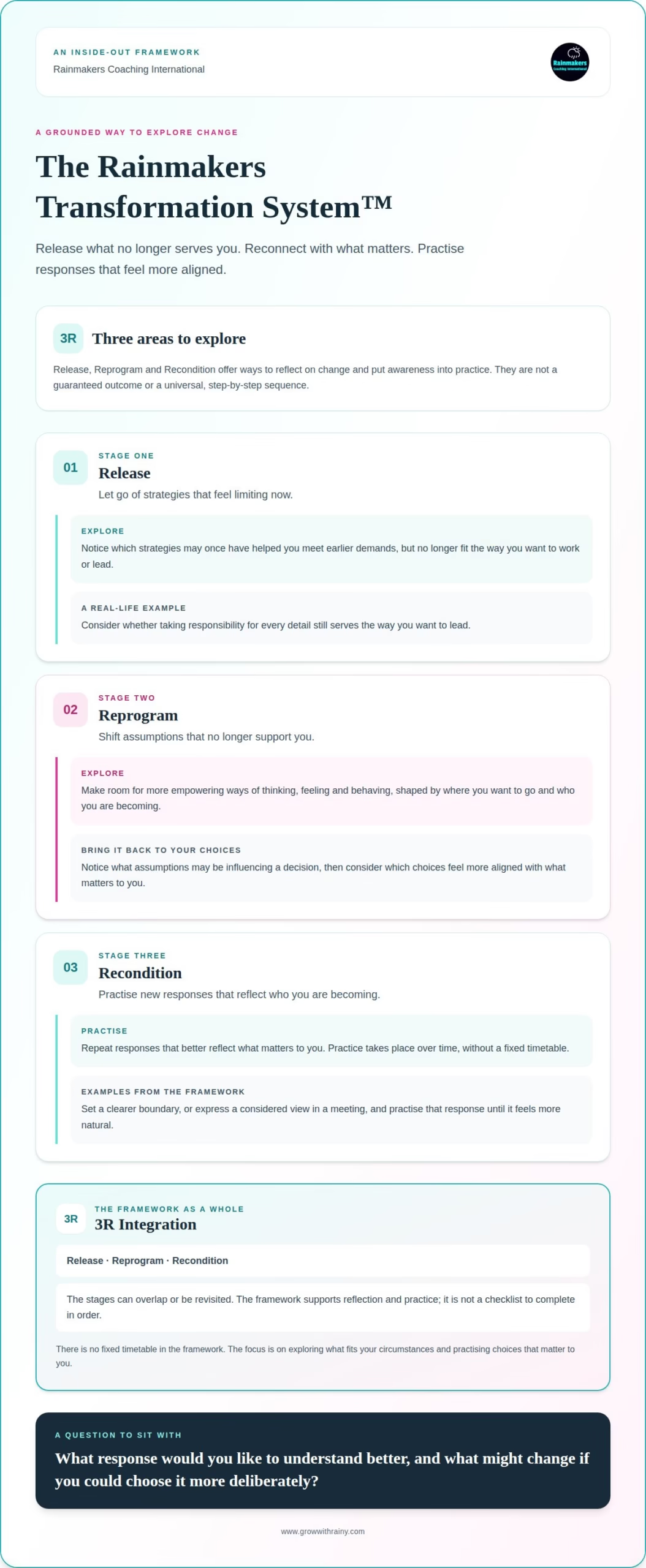
The Rainmakers Transformation System™ provides a framework for this work: Release, Reprogram and Recondition, with 3R Integration. These stages offer ways to explore change, not a universal sequence or guaranteed outcome.
- Release: Letting go of strategies that may have helped you meet earlier demands but feel limiting now. For instance, you might consider whether taking responsibility for every detail still serves the way you want to lead.
- Reprogram: Shift the assumptions that no longer supports you and create new empowering way of thinking, feeling and behaving – shaping your new choices that are aligned with where you want to go and who you are becoming.
- Recondition: Practise new responses that better reflect who you are becoming and what matters to you. This could mean setting a clearer boundary or expressing a considered view in a meeting, over and over again, until it becomes a natural part of you. Practice takes place over time, without a fixed timetable.
The stages can overlap or be revisited. The framework supports reflection and practice; it isn’t a checklist for personal development.
Patterns as coaching constructs, not diagnoses
In life coaching for professionals in Singapore, terms such as Overthinking or Overachievement can describe familiar ways of responding. These are coaching constructs, not clinical diagnoses, and they won’t fit everyone. A strategy may once have helped you meet expectations. The useful question is whether it still fits what you want now.
For example, if you notice Overthinking, you might explore what the habit is trying to protect, then identify one small decision you can make with the information you have. The aim isn’t to judge the pattern or force it away. It’s to make room for other resources, including your strengths, values and considered judgement.
Consider one response you’d like to understand better. What might change in how you work, lead or live if you could choose your response more deliberately? If a conversation would help you explore that question, you can schedule a conversation with Rainy.
Is Life Coaching for Professionals Practical, or Just More Talk?
It’s fair to ask whether a thoughtful conversation can help with decisions you face at work. Insight alone isn’t the same as change. A useful coaching conversation connects what you notice to a choice or action that matters to you. It doesn’t make the choice for you or guarantee what happens next.
For life coaching for professionals in Singapore to feel practical, the focus needs to stay connected to your real circumstances. What are you facing? What would you like to approach differently? What is one action you’re willing to take, or one question you need to explore before acting? Questions like these keep reflection grounded rather than abstract.
How coaching differs from advice, mentoring and consulting
Coaching is generally a client-centred exploration. The coach helps you examine your perspective, values and options instead of prescribing a standard answer. Mentoring may draw more directly on someone’s experience, while consulting may offer specialist analysis or recommendations. Advice can also be useful when you need a clear answer or practical expertise.
These approaches aren’t rivals, and one isn’t automatically better than another. You might seek a mentor’s perspective on a role, a consultant’s expertise on a work problem and coaching to explore what you want from a decision. Coaching is most useful when you want space to develop your own judgement, rather than simply receive a plan to follow.
Clinical support has a different purpose from professional development coaching. Coaching isn’t a way to diagnose or treat mental health conditions. If your needs involve clinical assessment or treatment, coaching may not be the appropriate support for that concern. Being clear about the kind of help you’re seeking is part of making a considered choice.
Turning reflection into grounded professional choices
Imagine you’re considering whether to accept a consequential work responsibility. You might first focus on visible factors: the workload, the title or how others could view the decision. In coaching, you could also pause to notice your response. Are you interested in the challenge, hesitant about its demands, or agreeing mainly because you feel you should?
That awareness doesn’t dictate the answer. It can help you identify what information you need, which questions to raise and what matters most in your decision. You might clarify the role’s expectations before responding, or decide that the opportunity aligns with your priorities. Either way, the next step comes from your considered choice, not a promised outcome.
Practical coaching should leave you with something you can carry into daily life: a clearer question, a decision to weigh or an action that feels relevant. If you’d like to explore what that kind of conversation could look like for your situation, explore a coaching conversation with Rainy.
What would you want to understand more clearly?
How to Decide Whether Life Coaching Fits Your Next Step in Singapore
You don’t need to arrive with a perfect goal or a crisis to consider coaching. Start with a question that keeps returning: a decision you’re postponing, a change you want but can’t yet define, or a sense that your current direction deserves a closer look. The question isn’t whether you’re ready to change everything. It’s whether you’re willing to explore one part of your life with care.
As you consider life coaching for professionals in Singapore, separate the support you want from the result you hope for. Coaching can help you explore your perspective and consider actions within your control. It can’t promise a promotion, a particular job or a specific external outcome.
A reflection exercise for a current work or life question
Take a few quiet minutes with one situation. Write without trying to sound certain or impressive. This isn’t a test, and you don’t need to solve everything on the page. The aim is to make the question clearer and notice what you may already sense beneath the noise.
- Name the situation. What feels unclear or difficult right now? Describe what’s happening without judging yourself for how you feel about it.
- Describe the change you want. If this situation felt different, what would you notice in your work or life? Focus on what matters to you, not what you think you’re supposed to want.
- Notice the hesitation. What makes this difficult to face or decide? What do you already know, but find hard to trust or act on?
Your answers don’t need to point to a dramatic action. Perhaps they show that you need more information, a conversation, time to reflect or a clearer sense of your priorities. If you’re curious about how different coaching methods approach reflection and change, explore these life coaching approaches.
Signs the work may be relevant now
Coaching may be worth considering if you’re willing to stay with a meaningful question, reflect honestly and take responsibility for the choices that follow. You don’t need to be in crisis or have everything worked out. Curiosity about how you want to work, lead or live can be enough reason to pause and explore.
It also helps to be clear about what you’re seeking. If your primary request is for someone to place you in a job or write your CV, that’s different from a coaching goal. Coaching focuses on your development, perspective and choices, rather than job placement or CV writing. Knowing the difference can help you name the support you want.
If coaching doesn’t feel timely, you can revisit the question later. Readiness isn’t a deadline, and choosing to wait can be a considered decision. For now, ask yourself: what would I be willing to explore, even if I don’t yet know the answer?
Rainmakers Life Coaching for Professionals: A Grounded Next Step
You may know how to meet expectations and still feel unsure whether your choices reflect what matters to you. That’s the space Rainmakers Coaching International explores through inside-out coaching. Led by Rainy Rainmaker, the practice draws on more than a decade of coaching leaders, professionals and individuals. The focus is not simply on adding another strategy or set of mechanics. It’s on understanding the inner experience that may shape how you work, lead and live.
A coaching approach centred on self-trust
Inside-out coaching makes room to notice assumptions and learned responses that may no longer fit, while reconnecting with your innate gifts and hidden resources. As your understanding of yourself changes, it can inform how you approach professional and personal choices. This is an invitation to build self-trust, not a promise of a specific result or a claim that every challenge has an inner cause.
Practical goals still matter. You may want to make a career decision, handle a leadership responsibility differently or feel clearer about how work fits with the rest of your life. Coaching can hold those questions alongside reflection. The aim isn’t to dismiss external realities, but to consider them with a clearer sense of your values, perspective and choices.
Choose the coaching focus that matches your question
If you’re working through career direction or development, Career Coaching can help you explore what you want from your next professional chapter. It isn’t job placement. If your question centres on how you lead, make decisions or show up with others, Executive / Leadership Coaching may be a closer focus. You can explore executive coaching in Singapore for leadership development.
Life Coaching can hold questions that touch more than one area. A decision about work may connect with personal priorities, confidence or how you want to spend your time. Start with the question that feels most important to you, rather than a label you think you should choose. These forms of coaching offer different points of focus while keeping attention on the person making the choices.
For professionals considering life coaching for professionals in Singapore, Rainmakers’ work centres on inner transformation and self-trust. The intention is to help you explore what may be holding you back, reconnect with your strengths and consider a more grounded response. Change in your inner world can influence how you engage with your outer world, but coaching cannot guarantee a particular promotion, role, relationship or life outcome.
You don’t need to have everything figured out before beginning a conversation. Bring the question you’re carrying, even if it still feels unfinished. What would you like to understand more clearly about the way you work, lead or live?
Let Your Next Step Begin With One Honest Question
You don’t have to map out an entirely different future before you begin. Sometimes the meaningful next step is to give one persistent question your attention without rushing to turn it into a plan. What do you want your working life to make room for now? What might you choose if you trusted that your priorities are allowed to change?
For professionals considering life coaching for professionals in Singapore, clarity can begin with an honest pause. Write down the question you keep returning to, then note what you hope will feel different. You don’t need a perfect answer. The exercise can help you see where your attention is asking to go.
You remain the one who chooses what to do next. Coaching can offer space to explore your question and reconnect with your perspective, but there’s no need to force a decision before you’re ready. If you feel drawn to explore, bring the question as it is. It doesn’t need to be polished or fully answered. A grounded beginning is enough.
Your next step can be thoughtful, personal and entirely your own.
Frequently Asked Questions
Can life coaching help professionals with career decisions?
It can help you examine a decision from more than one angle before you act. If you’re weighing a role change, for example, compare what each option asks of you, what you’d be giving up and what questions remain unanswered. Coaching doesn’t decide which path is right. It gives you room to test your assumptions and consider what you’re prepared to take responsibility for.
Is life coaching in Singapore only for people going through a crisis?
No. Many capable professionals use coaching to be more intentional about a chapter that is already going reasonably well. You might want to understand how you show up in meetings, make more space for a personal priority or prepare thoughtfully for a change in responsibility. The focus can be growth, not repair. Consider whether there’s a question you’d value exploring, even if nothing feels urgent.
How is life coaching different from executive coaching?
The focus often depends on the question you bring. If you want to explore how a leadership role fits with your wider values or personal priorities, Life Coaching may offer room for that broader context. If you want to work on a responsibility such as communicating a decision to your team, Executive / Leadership Coaching may keep attention closer to your leadership practice. The goals can overlap, so the focus is shaped by what you want to examine.
Can life coaching help with self-doubt at work?
It can help you look at a specific moment when self-doubt affects how you work. After holding back an idea in a meeting, for instance, you might explore what you were concerned would happen, what evidence you had and what you’d like to try next time. This reflection doesn’t label or diagnose you. It helps you understand your response and consider a more deliberate way to participate.
What happens in a first life coaching conversation?
You can bring forward the situation that feels most important and share what makes it significant to you. If it helps, jot down when the question tends to arise, how it affects your day and what you’ve already tried. You can also notice what feels comfortable to discuss. There’s no need to prepare a polished story; a few honest details can give the conversation a place to begin.
How long does life coaching take to make a difference?
Progress can look different from one person to another. Rather than measuring it only by a major external change, notice whether you can describe your concern more clearly, recognise what influences your response or follow through on an action you chose. Those observations can help you discuss what is useful and what you want to explore next. The work can continue as your questions and development needs evolve. To explore whether coaching fits the question you’re carrying, schedule a conversation with Rainy.

Article by
Rainy Rainmaker
Rainy Rainmaker is the founder of Rainmakers Coaching International and a transformational coach for confidence, self-trust, and authentic leadership. Based in Singapore, she helps high-achieving professionals, managers, and leaders who appear capable on the outside but feel quietly held back by self-doubt, overthinking, imposter feelings, burnout, or a loss of direction. Through her signature Rainmaker Transformation Journey™, Rainy helps clients uncover the insights already within them and turn inner clarity into aligned action that creates lasting change in how they work, lead and live.
