
At senior levels, people are not only listening to what you say. They are also reading how you carry uncertainty, pressure and challenge. That is where executive presence becomes visible. You may have the experience, judgement and technical capability, yet still find yourself becoming more cautious in senior meetings, over-preparing for difficult conversations, or losing confidence when someone challenges your point of view.
Executive presence is not about sounding louder, appearing more polished or copying the style of another leader. It is about how steadily you show up when the stakes are high – how clearly you communicate, how confidently you hold your position, and how you respond when the conversation does not go according to plan.
In this guide, we’ll explore how to strengthen executive presence in a way that feels grounded and authentic – by building greater self-trust, communicating with clarity, and developing the composure to lead without constantly proving that you belong.
Key Takeaways
- Build executive presence by staying grounded and true to yourself, rather than trying to become louder or imitate another person’s leadership style.
- Notice when Approval-Seeking makes you wait for permission to lead, then practise expressing your perspective clearly.
- Compare habits focused on looking like a leader with grounded choices that help you communicate with clarity and connection.
- The Rainmakers Transformation System™ uses Release, Reprogram and Recondition to help you explore learned patterns and practise new responses.
- Rainmakers Coaching International offers Life Coaching, Career Coaching and Executive / Leadership Coaching for professionals and leaders seeking self-trust and inner transformation.
What is Executive Presence? Moving Beyond the Performative Mask
In a high-stakes meeting, do you find yourself monitoring how you sound, where you place your hands, or whether you’re taking up enough space? That self-monitoring can pull your attention away from the decision, the people in the room, and the judgment you’ve built through experience.
Executive presence isn’t a demand to become louder, faster or more polished. It’s the ability to stay connected to your thinking and values when pressure rises. You can be measured rather than forceful and still be clear about what you believe and what the moment requires. Confidence isn’t about putting on a bigger performance. It’s about trusting your capability and expressing your perspective in your own way.
The idea of gravitas as a foundational virtue offers a useful lens: seriousness and self-discipline don’t require a show of dominance. In leadership, they can be expressed through thoughtful judgment, steadiness and respect for the people affected by a decision.
The Difference Between Performative and Grounded Presence
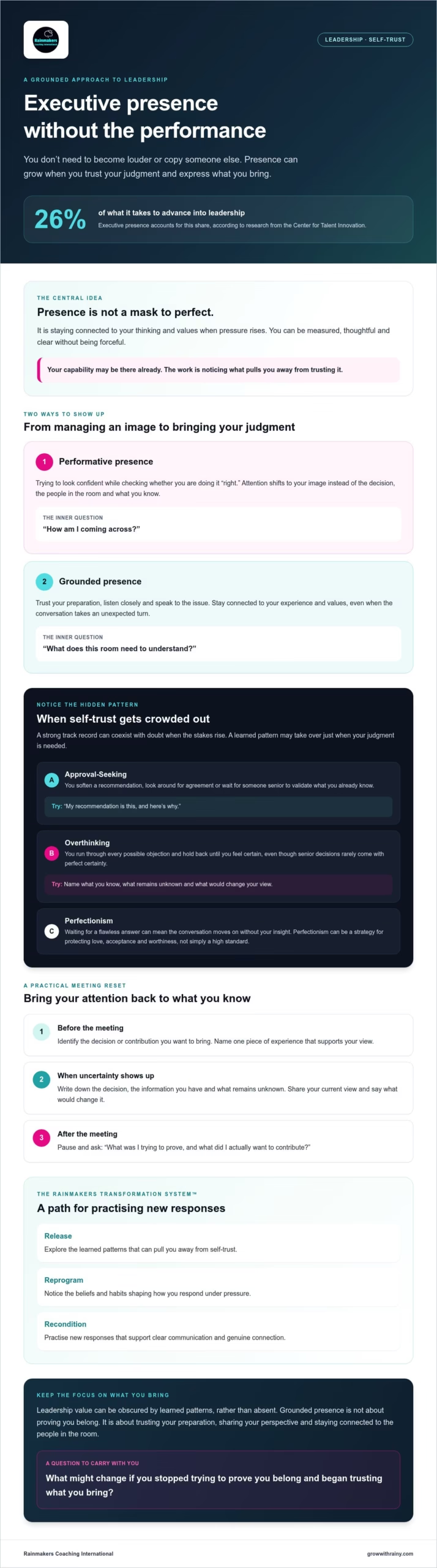
Performative presence can feel like a mask. You’re trying to look confident while privately checking whether you’re doing it “right.” That effort can be tiring, and the gap between what you feel and what you show may make connection harder.
Grounded presence starts elsewhere. You trust your preparation, listen closely and speak to the issue instead of managing an image. What might shift if you stopped rehearsing how to appear and focused on what you want the room to understand?
Before your next meeting, identify the decision or contribution you want to bring. Then name one piece of experience that supports your view. This isn’t a script to perform. It’s a way to bring your attention back to what you know and what the discussion needs from you.
Why Traditional ‘Tactics’ Often Fail High Achievers
Body-language advice can be useful, but for a high achiever it can quickly become one more standard to perfect. If you’re already worried about being judged, remembering to hold eye contact, sit a certain way and control your voice may increase the pressure. A power pose won’t address the self-doubt underneath, and the mismatch may feel inauthentic to you and the people around you.
Your capability may not be the problem. A protective pattern such as Perfectionism may be pulling your focus toward avoiding mistakes instead of sharing your judgment. If that feels familiar, pause after a meeting and ask: “What was I trying to prove, and what did I actually want to contribute?” The answer can help you notice where you might reconnect with your perspective.
Rainmakers Coaching International’s approach focuses on the inner patterns that can undermine self-trust. You can also explore this personal development coaching guide for more on reconnecting with yourself.
Why High Achievers Struggle with Presence: The Hidden Pattern Lens
You can have a strong track record and still question whether you’ve earned the right to lead the conversation. The distance between what you’re capable of and how much you trust that capability when the stakes rise is sometimes described as the High-Achiever Self-Trust Gap. It doesn’t mean you lack leadership ability. It may point to a learned pattern that takes over just when your judgment is needed.
Approval-Seeking can make this pattern visible. You soften a recommendation, look around for agreement, or wait for someone more senior to validate what you already know. Try replacing “Would everyone be okay if we…” with “My recommendation is this, and here’s why.” You can invite discussion without asking permission to contribute.
Overthinking can work similarly. It may be an attempt to create safety by eliminating uncertainty: you run through every possible objection, then hold back until you feel certain. But senior decisions rarely come with perfect certainty. If you notice yourself looping, write down the decision in front of you, the information you have and what remains unknown. Then share your current view and name what would change it. This makes your reasoning visible without pretending to know everything.
Perfectionism as a Barrier to Visibility
If you wait until your answer feels flawless, the conversation may move on without your insight. Perfectionism can be a strategy for protecting love, acceptance and worthiness, not simply a high standard. Yet that strategy can also hide strengths developed through experience, including wisdom and creativity. Try offering a considered thought before it feels perfectly polished. You can refine it with the room.
The Pattern of Over-Responsibility in Leadership
Do you find yourself trying to keep everyone okay, even when the group needs you to make a call? Carrying other people’s reactions can shift your attention from leading toward managing emotions. Care matters, but it doesn’t require taking responsibility for how everyone feels.
Harvard Business Review’s The New Rules of Executive Presence offers a contemporary lens on presence and leadership. If you recognize these patterns in yourself, this impostor syndrome guide for senior leaders may help you reflect further.
If you’d like support exploring what sits beneath these patterns, you can learn about a coaching conversation with Rainy .
Which of the seven protective patterns feels most like a shield you use at work?
Performative vs. Grounded Presence: Evaluating Your Leadership Style
Two leaders can give the same recommendation and leave very different impressions. One is focused on looking authoritative. The other is focused on making the clearest contribution they can. That difference matters. Performative presence is about looking the part; grounded presence is about being the part, with your values, judgment and words pulling in the same direction.
- Performative presence: You monitor how you appear, push to win the room and may leave feeling depleted from maintaining the image.
- Grounded presence: You speak with intention, stay open to other views and can hold your position without needing to dominate.
The first can create internal friction. If every meeting becomes a test of whether you look confident enough, leadership starts to feel like a role you have to keep playing. The second can make it easier to focus on the work rather than managing impressions. Influence isn’t something you do to people. It grows through the clarity and consistency they experience in you.
Reconnecting with Your Truth in the Boardroom
Reconnecting with your truth means aligning your values with your voice. If you value candour, for example, you can raise a concern respectfully instead of disguising it as a string of hints. If you’re grounded, disagreement doesn’t have to become a verdict on your worth. You can listen, explain your reasoning and let the best decision matter more than winning every argument.
Self-Verification Theory, associated with psychologist William Swann, explores how people seek experiences that confirm their understanding of themselves. It isn’t a leadership study or proof that authenticity alone earns trust. But it offers a useful question: does the way you show up reflect what you actually believe? When your words and actions are consistent, colleagues have a clearer basis for understanding you and your position.
The Role of Self-Trust in Influence
You don’t always need more evidence that you’re capable. Sometimes you need to trust the evidence you already have. Before your next meeting, name one relevant experience or decision that supports your perspective. Then choose the point you most need to make. This gives your attention somewhere useful to land, rather than leaving it caught in self-monitoring.
Self-trust also makes room for decisive silence. You don’t have to fill every pause, defend each point repeatedly or answer before you’ve thought. A moment of quiet can give you space to listen, consider new information and choose your response. That steadiness is part of executive presence, not an absence of it.
If you trusted your current evidence of capability 10% more, how would you walk into your next meeting?
How to Build Executive Presence Through Reconnecting with Your Truth
You don’t build grounded authority by adding another performance to perfect. You build it by noticing what pulls you away from your judgment, then practising a different response. The Rainmakers Transformation System™ offers a three-part path: Release, Reprogram, Recondition. It’s not about becoming someone else. It’s about making room for more of your capability and character to come forward.
Release and Reprogram the Need for Approval
Start by noticing a protective pattern such as Perfectionism or Approval-Seeking. Where do you hold back, over-explain or wait for someone else to endorse your view? Choose a relatively safe meeting and share your perspective in a clear sentence, without adding a hedge like “I might be wrong, but…” You can remain open to discussion without making other people’s responses the measure of your worth.
Transformation is about removing what prevents us from becoming more fully ourselves, not about becoming someone else.
Next, question the belief that presence is a performance you have to get right. If you catch yourself monitoring every gesture, redirect your attention to the value you want to bring to the conversation. That shift gives your voice room to sound like yours.
Recondition Your Response to Pressure
When the stakes rise, notice your feet on the floor and take an unhurried breath. Then leave a short pause before you respond. Use that space to reconnect with what you know, consider what the question is really asking and choose your next words. The pause isn’t a tactic to look powerful. It’s a way to stay present instead of reacting from pressure.
Amy Cuddy and colleagues’ research on “power posing” brought attention to how posture may relate to our experience of pressure. Later replication efforts questioned some of the study’s physiological claims, so a pose shouldn’t be treated as a shortcut to confidence. For this practice, keep the useful focus on awareness: notice what’s happening in your body, then choose a response that feels honest and steady.
If you’re facing Imposter Syndrome after a promotion , try shifting the question from “Do I know everything yet?” to “Who am I becoming as I take on this role?” You don’t need to have every answer to lead well. Reconnecting with your perspective can help bring your judgment, curiosity and creativity into view. For more on this work, explore Closing the High-Achiever Self-Trust Gap in Leadership.
What might change in your next high-stakes moment if you gave yourself a moment to reconnect before speaking?
Explore a coaching conversation with Rainy
What could you bring to your next important conversation if you trusted yourself to pause before responding?
Leading from Within: The Rainmaker Path to Executive Authority
Leadership growth isn’t simply about achieving more. It can also mean becoming more fully yourself in the role you hold. Executive presence can feel more natural when your authority comes from self-trust, rather than the effort of keeping up a version of leadership you think others expect.
Executive coaching isn’t about treating you as if you’re flawed. It’s a space to notice what may be obscuring your strengths and reconnect with the judgment, perspective and creativity you already bring. Rainmakers Coaching International uses the Rainmakers Transformation System™ to help clients explore the patterns that can get in the way of self-trust.
Leadership confidence doesn’t have to mean becoming the most forceful person in the room. It can mean trusting yourself enough to contribute clearly, make decisions and remain open to others without abandoning your own perspective.
When to Seek Deeper Support
You might consider deeper support if you’re repeatedly passed over for promotion despite strong performance, or if you leave important meetings feeling you held back what you really thought. These experiences don’t prove that something is wrong with you. They may be an invitation to explore whether a learned pattern is affecting how you express your leadership.
The Rainmakers Transformation System™ offers a framework for this work: Release, Reprogram, Recondition. Rather than asking you to perform confidence, the process invites you to understand what may be getting in its way and practise responding from a more grounded place.
Learn more about Executive Coaching: Releasing Your Hidden Leadership Treasures.
A Final Reflection for the Aspiring Leader
Take a moment to name one protective pattern you may be ready to put down. Perhaps you over-prepare to avoid criticism, or soften your point to keep everyone comfortable. You don’t have to change everything at once. Simply noticing the pattern creates room to choose a response that better reflects who you want to be as a leader.
What would change in your leadership if you stopped trying to be “right” and started being “real”? Does your current presence feel like a burden to maintain, or a natural expression of self-trust? If you’re ready to explore those questions, executive coaching can offer a space for reflection and growth.
What is one small step you could take toward leading more fully as yourself?
Lead with More Trust in Yourself
Executive presence doesn’t ask you to become louder or more polished. It grows as you trust your judgment, notice the protective patterns that hold you back and reconnect with the strengths you already bring to the room. When your actions align with your values, leadership can feel less like a mask and more like a natural expression of who you are.
The Rainmakers Transformation System™ offers a framework for inner transformation that supports professionals and leaders seeking self-trust and more authentic ways of leading. The focus is on understanding what may be obscuring your strengths, not treating you as someone who needs to be changed into a different person.
If your presence has started to feel like a burden to maintain, you don’t have to figure it out alone. A thoughtful conversation can be a first step toward exploring a more grounded way of leading.
Your leadership has value now. Keep reconnecting with it, one honest moment at a time.
Frequently Asked Questions
What is the true definition of executive presence in a modern workplace?
Executive presence is the way you communicate judgment, steadiness and trustworthiness when your contribution matters. It isn’t about being the loudest person or adopting a fixed leadership persona. In a modern workplace, presence can mean stating your recommendation clearly, listening with care and adapting to the moment without losing touch with your values. The goal is to help others understand your thinking, not to perform authority.
Can executive presence be learned, or is it an innate trait?
Executive presence can be developed; it isn’t a trait reserved for a select few. You can practise observable behaviours such as explaining your reasoning, listening without preparing a rebuttal and responding thoughtfully when you don’t have an immediate answer. The deeper work is building trust in your own judgment so these behaviours feel genuine rather than rehearsed. Progress comes through reflection and practice, not by copying another leader’s mannerisms.
How do I build executive presence without sounding arrogant or fake?
Be clear about what you think, and stay open to what you may not yet know. For example, say, “Based on what we know, I recommend this approach. I’d like to hear what I may be missing.” That communicates conviction without shutting down discussion. Avoiding arrogance doesn’t mean shrinking your point or filling it with apologies. Let your reasoning be direct, respectful and grounded in the issue at hand.
Why does my confidence drop in meetings with senior executives?
Your confidence may dip because the stakes feel higher, or because you’re closely monitoring how others judge you. That response doesn’t erase your experience or capability. Before the meeting, identify the decision or perspective you can contribute and one piece of evidence from your work that supports it. If nerves rise, pause, listen to the question and answer what’s being asked rather than trying to prove your whole worth.
Is there a difference between executive presence and leadership style?
Yes. Leadership style describes your characteristic way of guiding people and making decisions, such as being collaborative or more directive. Executive presence is how others experience your communication, judgment and steadiness, especially when the stakes are high. They influence each other, but they aren’t identical. You can keep your natural style while becoming clearer and more grounded in how you express your perspective.
How can I overcome imposter syndrome to improve my professional presence?
Start by separating a genuine learning edge from the conclusion that you don’t belong. After a challenging meeting, note what you handled well, what you’re still learning and one next step. If you’ve recently taken on a bigger role, focus not only on what you already know, but on who you’re becoming as you grow into it. You don’t need perfect certainty to contribute; you can share your current thinking and keep learning.
What role does self-trust play in how others perceive my authority?
Self-trust helps you express your judgment without constantly seeking permission or over-explaining. It doesn’t control how others see you, but it can support clearer, more consistent choices: state your view, explain your reasoning and remain open to new information. That combination gives colleagues a more direct sense of where you stand. Authority doesn’t require certainty about everything; it includes knowing what you know and being honest about what you don’t.

Article by
Rainy Rainmaker
Rainy Rainmaker is the founder of Rainmakers Coaching International and a transformational coach for confidence, self-trust, and authentic leadership. Based in Singapore, she helps high-achieving professionals, managers, and leaders who appear capable on the outside but feel quietly held back by self-doubt, overthinking, imposter feelings, burnout, or a loss of direction. Through her signature Rainmaker Transformation Journey™, Rainy helps clients uncover the insights already within them and turn inner clarity into aligned action that creates lasting change in how they work, lead and live.
