A personality measure can clarify a pattern, but it shouldn’t become a verdict about who you are. Personal coaching for self-discovery combines guided reflection with tools that can help you understand your values, needs, passions and strengths, then turn those insights into practical choices. The aim isn’t to fit yourself into a type. It’s to reconnect with what feels true and make decisions with greater self-trust.
If you’ve ever wondered why a successful career still feels misaligned, or why the same tension keeps surfacing in your relationships, it makes sense to seek a clearer picture of yourself. Reflection can help, but it’s often hard to see your own habits and assumptions from the inside.
This guide explores how coaching and personality measures can bring those patterns into focus, where their limits are, and how insight can become a small, meaningful action. You’ll also see how understanding yourself more clearly can shape the way you work, lead and relate to others.
Key Takeaways
- Use personality measures as prompts for reflection, not fixed labels that define your choices.
- Notice what gives you energy, what feels misaligned, and which values you want guiding your decisions.
- Close reflection with one small, clear action so an insight can begin to shape daily life.
- Recognise how self-understanding can change the way you communicate, work, lead, and relate to others.
- Inside-out coaching can help you reconnect with your innate strengths and move beyond protective patterns that no longer serve you.
Coaching for Self Awareness: Why Measure Personality?
Personality measures can offer a starting point for noticing your preferences, but they can’t define your whole identity. Their value lies in comparing the results with your own experiences and choices.
Reflection and Value Clarification
Reflection means examining your reactions and decisions to understand what matters to you. Consider a recent choice: what motivated it, what felt uncomfortable, and which value did it honour? For example, accepting extra work may let you contribute but leave too little room to rest. Naming that tension can help you decide how you want your priorities to look in practice.
Self-Awareness and Leadership Effectiveness
Self-awareness in leadership means noticing how your actions affect others. If you interrupt during a tense meeting, ask yourself what prompted you to respond quickly and what the team needed from you. Reflecting regularly on decisions and outcomes can help you see where your intentions differ from their impact. Colleagues’ feedback can add perspective, especially when you treat it as information to consider rather than a verdict.
Self-Awareness and Personal Growth
Personal growth means recognising a pattern and choosing how to respond next. If you avoid a difficult conversation, consider what the avoidance protects and what it costs. You might prepare one clear opening sentence, then notice how it feels to use it. Small experiments help you learn from experience without treating one imperfect attempt as proof that you can’t change.
A personality assessment can give you language for preferences and common reactions. Treat its results as prompts, then compare them with specific situations: how you respond under pressure, what kind of work engages you, and what feedback you hear. The measure is only useful if it helps you think more clearly, not if it becomes a fixed label. A life coaching approach to personal growth can make space to explore those questions.
There’s no single number of sessions that suits every self-discovery goal. The focus, pace, and changes you want to make all matter. Coaching also has limits: an assessment can oversimplify you, and insight alone won’t change a habit. Coaching may suit you if you want to examine your choices and practise new responses. If you need clinical support, seek that instead.
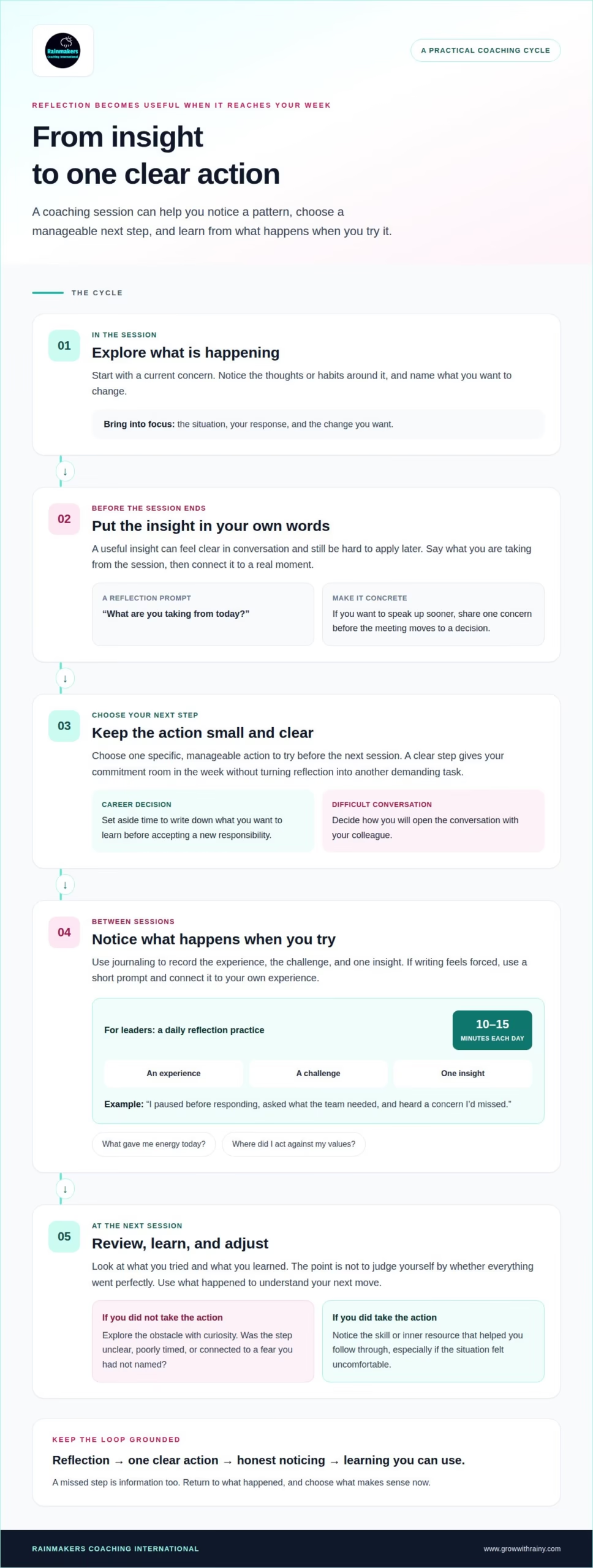
Closing coaching sessions with reflection and action
A coaching session usually explores a current concern, the thoughts or habits surrounding it, and what you want to change. Before it ends, you and the coach can identify a useful insight and agree on an action to try before the next session.
The closing minutes matter because an insight can feel clear in conversation but be difficult to apply later. A coach might ask, “What are you taking from today?” or “What will you do differently in your next team meeting?” These questions help you put the learning into your own words. If your answer is “I need to speak up sooner,” make it concrete: share one concern before the meeting moves to a decision.
Choose one action that feels specific and manageable. For example, if you’re working through a career decision, set aside time to write down what you want to learn before accepting a new responsibility. If a conversation with a colleague feels difficult, decide how you’ll open it. One clear step makes room for your commitment in the week without turning reflection into another demanding task.
Between sessions, journaling can help you notice what happened when you tried that action. Leaders can spend 10-15 minutes each day recording an experience, a challenge, and one insight. A short entry might note, “I paused before responding, asked what the team needed, and heard a concern I’d missed.” That detail can develop awareness of what works, rather than reducing the day to whether everything went perfectly.
Keep the practice flexible. If writing feels forced, try a prompt such as “What gave me energy today?” or “Where did I act against my values?” You can also reflect on a relevant book, podcast, or video by noting one idea that shifted your perspective. The point is to connect the material to your own experience, not to collect advice without applying it.
At the next session, review what you tried and what you learned. If you didn’t take the action, look at the obstacle with curiosity: was the step unclear, poorly timed, or tied to a fear you hadn’t named? This turns a missed commitment into useful information. If you did take it, identify the skill or inner resource that helped you follow through, especially if the situation felt uncomfortable.
Over time, these small cycles of reflection and action can help positive changes take root in your work and life. If you want support turning a recurring insight into a grounded next step, talk through what you want to change. What one action would move you toward the change you’re ready to make?
Identifying values, needs, passions, and strengths
Self-discovery becomes practical when you can name what matters to you, what you need, and what you bring. In coaching, focused questions can uncover the motivations behind your choices, including decisions that look successful but feel draining. For example, a promotion may bring recognition while leaving less time for creative work. Naming that tension can clarify what you want your next step to support.
Start by identifying three values that guide your life. These might include learning, contribution, independence, or connection. Then consider a recent decision: which value did it honour, and which did it leave aside? If connection matters but your calendar leaves no room for important relationships, that mismatch offers useful information. Values are not simply ideals; they help explain why some choices feel meaningful and others create inner friction.
Needs and passions add another layer. A need is a condition that helps you function well, such as focused time or collaborative work. A passion draws your interest toward an activity or subject. Think of a project that held your attention: did you enjoy solving the problem, bringing people together, or shaping the final idea? That distinction can reveal what you want more of in your work or personal life.
Other people may notice your strengths before you do. A task that feels natural to you may seem easy for everyone, so you might overlook the skill involved. A strengths assessment can give you language for those abilities; reviewing the results with a coach or mentor can help you turn them into a practical plan. For example, if colleagues often ask you to explain complex ideas, communication may be a strength to use more deliberately.
Growth also means recognising the limits of your current approach. A strength can become less helpful when overused: careful planning may delay a decision, while independence may make it hard to ask for support. Rather than treating a weakness as a fixed identity, explore when it appears and what motivates it. That understanding can point to a specific skill to develop while preserving your resilience.
Bring your values, needs, passions, and strengths together when facing a choice. If you’re considering a management role, ask whether leading projects energises you, whether the role supports your priorities, and which capabilities it would draw on. Then weigh the option against your long-term direction, not just its immediate reward. In coaching, this kind of values-based decision-making can turn a broad sense of purpose into a choice you can explain and own.
In coaching, carefully chosen questions can help you clarify your desires, values, and motivations. A coach might invite you to identify three important values, then use a decision-making framework that considers those values alongside your long-term objectives. Self-discovery can help you recognise strengths and areas for growth. A coach can also help you identify and express your strengths by drawing out your own insights. Many people underestimate their qualities, strengths, and skills.
Authentic living and personal empowerment
Authentic living means making choices that reflect who you are, rather than relying only on roles or expectations. You might be known as the dependable manager who always says yes, while privately feeling depleted. That gap is worth exploring. Ask what an automatic yes protects you from and what a more honest response could sound like. Small moments of truth can change how you work, lead, and live.
Coaching questions can help you develop your own solutions instead of waiting for someone else to prescribe them. If you believe you must be perfect before sharing an idea, ask what evidence supports that belief and what it costs you. Then consider one lower-risk action, such as sharing an early draft with a trusted colleague. The aim isn’t to force confidence. It’s to practise acting with care while uncertainty is still present.
That distinction matters because an old protective pattern may once have helped you belong or avoid criticism. For example, staying quiet in meetings might have felt safer earlier in your career, but now it may keep your perspective out of the discussion. Notice the trigger, your response, and its effect. This deeper awareness can help you choose a response that fits your present circumstances instead of automatically repeating an outdated strategy.
To explore your direction, picture where you’d like to be in five years. Rather than searching for one perfect answer, describe an ordinary day: the work you do, the people around you, and how you feel at the end. A wheel of life exercise can also help you notice which areas feel undernourished and where you’d like more. These tools are prompts, not tests you need to pass.
Mindfulness can help by creating a pause between a strong feeling and your next choice. Try a few slow breaths before replying to a challenging message. In the morning, set an intention such as “I will speak clearly in today’s discussion,” then reflect on it that evening. If the intention slipped, notice what happened without treating it as proof that you can’t change.
Personal empowerment grows as you recognise your capacity to respond, learn, and adjust. Coaching questions can help you challenge limiting beliefs, solve problems independently, and build confidence through decisions you own. Progress may look like setting a boundary, asking for help, or choosing a direction that feels more authentic, even if others expected something else. What belief would you question if you trusted yourself to take one honest step?
The author was 40 when she questioned what to do next in life, showing that reflection can begin at a turning point. Coaching questions can help people develop their own solutions and take ownership of them, so choices remain self-directed rather than imposed. Self-discovery may bring five benefits, and 11 tips can offer starting points for a self-discovery journey.
Mindfulness practices, such as meditation or mindful breathing, can create space for reflection in your daily routine. Alongside imagining where you’d like to be in five years, these practices can help you notice what matters and consider a next step that feels genuinely yours.
Benefits for relationships and social health
Self-understanding can change how you interpret a colleague’s silence, a partner’s short reply, or a friend’s repeated request. If you tend to assume disapproval, pause and separate what you observed from the thought you attached to it. A colleague who says little during a meeting may be concentrating, not rejecting your idea. That distinction can interrupt familiar patterns and leave more room for a direct, respectful conversation.
Coaching questions can shift attention from immediate advice to the other person’s experience. In a tense discussion, try asking, “What matters most to you here?” before defending your position. Then listen for the need beneath their words, such as clarity about a deadline or reassurance about a decision. This doesn’t mean abandoning your perspective. It helps both people understand the concern before deciding what to do.
At work, a leader who notices their impact can respond more deliberately. If team members go quiet after a fast-paced update, ask what information would help them contribute. You might discover that your urgency is closing down discussion, even though your intention was to keep the project moving. Naming that gap gives you a chance to adjust your approach and create a more open exchange across the team.
Personal stories can build connection when shared with care. For example, a manager might explain that they once struggled to ask for help, then describe what made that conversation easier. The story offers context without asking others to share the same details. Authenticity means speaking truthfully and respecting boundaries, not sharing everything. In a team, that balance can make it easier for people to show up as themselves.
Some memories or feelings may be difficult to revisit alone. If an old conflict keeps shaping a current relationship, consider asking a trusted friend or family member to listen while you describe what happened. Be specific: “I’d like you to hear me out, not solve it yet.” If the conversation feels too charged, pause and return when you feel more grounded. Support can help you reflect without forcing a conclusion.
Healthier relationships don’t require you to get every response right. They grow through small choices: checking an assumption, naming a need clearly, listening without preparing a rebuttal, or repairing a misunderstanding. As you notice what you bring to each interaction, you can make room for more mutual trust and connection. That awareness helps you contribute more fully without expecting another person to meet every need.
Rainmakers Coaching International
Rainmakers Coaching International helps you explore what shapes your choices and reconnect with resources you may have overlooked. Its inside-out coaching focuses on releasing outdated protective patterns and making room for your innate strengths, rather than adding another external framework. As your inner responses shift, you can bring that change into how you work, lead, and live.
If career decisions or leadership challenges keep bringing you back to the same uncertainty, coaching can help you explore what lies beneath it and practise new ways of responding. Life Coaching, Career Coaching, Executive Coaching, and career development coaching offer support in the areas that matter to you, with a focus on lasting change.
Contact Rainmakers Coaching International to explore what you’re ready to shift.
Choose one step that feels true to you
You don’t need a complete map before moving forward. Start with one choice that feels more aligned: a boundary you want to hold, a conversation you’ve been avoiding, or a direction you want to explore. Notice why that step feels important. Your answer can point towards the change you’re ready to make.
Personal coaching for self-discovery can help you stay curious about what’s happening within you, especially when familiar expectations pull you away from your own priorities. The work is not about becoming someone else. It’s about building self-trust, recognising the resources you already carry, and choosing how you want to show up in the life you have.
Let your next move be honest rather than perfect. You can begin before every doubt has disappeared.
Your next step can be small and still matter. Trust yourself to take it.
Frequently Asked Questions
What is personal coaching for self-discovery?
Personal coaching for self-discovery is a reflective partnership that helps you understand how your assumptions shape everyday choices. Rather than giving you a personality label or deciding what you should do, a coach helps you examine situations you bring to the conversation. For example, if you keep postponing a decision about further study, you might explore what feels uncertain, what matters to you, and which option deserves a closer look.
What can a self-discovery coach help with?
A self-discovery coach can help you make sense of recurring questions and consider options that fit your priorities. You might bring a situation such as feeling ready for more responsibility but unsure what kind. The coach can help you explore what “more” means to you, which trade-offs you’re willing to make, and what conversation or experiment could offer useful information. You remain responsible for choosing your direction and actions. What question would you like to explore first?

Article by
Rainy Rainmaker
Rainy Rainmaker is the founder of Rainmakers Coaching International and a transformational coach for confidence, self-trust, and authentic leadership. Based in Singapore, she helps high-achieving professionals, managers, and leaders who appear capable on the outside but feel quietly held back by self-doubt, overthinking, imposter feelings, burnout, or a loss of direction. Through her signature Rainmaker Transformation Journey™, Rainy helps clients uncover the insights already within them and turn inner clarity into aligned action that creates lasting change in how they work, lead and live.
