
Manager burnout often starts when responsibility keeps expanding, but recovery time does not. You are expected to deliver your own work, support your team, solve problems, absorb pressure from above and stay available when something goes wrong. Over time, that can make constant strain feel like part of the job.
Learning how to prevent manager burnout is not about becoming better at tolerating pressure. It is about recognising which demands are unsustainable, where boundaries have become blurred, and what support or changes may be needed before exhaustion becomes the norm.
Burnout is different from having a difficult week. When stress becomes chronic, recovery gets harder and work can begin to feel heavier, more distant or less effective.
In this article, we’ll explore practical ways to review workload, boundaries, expectations and support, and consider the patterns that may be keeping too much responsibility on your shoulders.
Key Takeaways
- Learn how to prevent manager burnout by looking at workload, boundaries, recovery and support, not just personal coping.
- Separate changes you can make yourself from issues that need team discussion or wider organisational action.
- Test one grounded adjustment at a time, then notice whether it eases pressure or reveals a constraint.
- Recognise when learned responses such as Over-Responsibility may make it harder to step back or ask for support.
- Consider coaching as a reflective space to examine recurring pressure patterns and reconnect with self-trust.
How to Prevent Manager Burnout: Start by Seeing the Whole Picture
The workday ends, but your mind is still in the meeting. You’re replaying a decision, anticipating what your team might need tomorrow and holding details no one else seems to see. If that feels familiar, look beyond how well you’re coping. Notice what the pressure is asking of you.
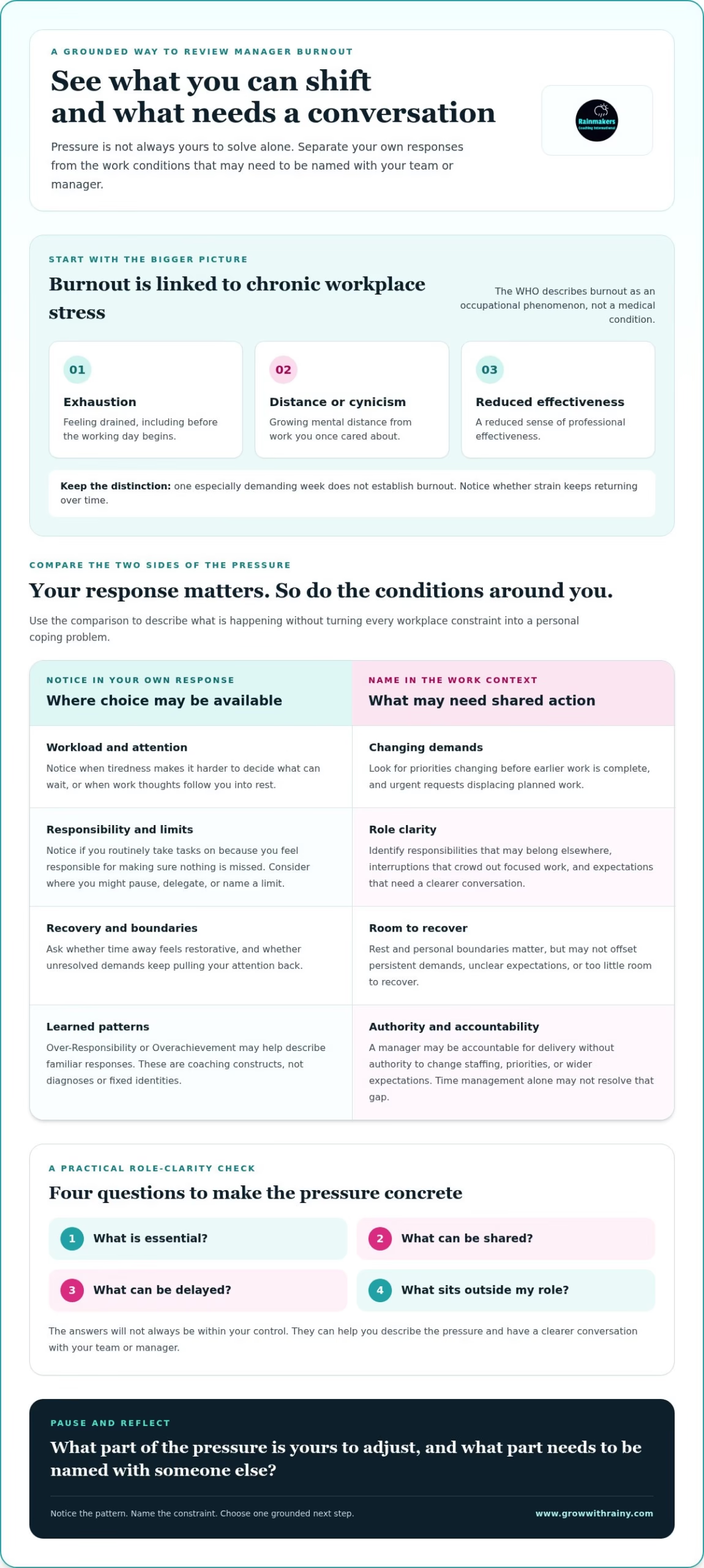
The World Health Organization describes burnout in the ICD-11 as an occupational phenomenon resulting from chronic workplace stress that hasn’t been successfully managed. It has three dimensions: exhaustion, increased mental distance or cynicism about work, and reduced professional efficacy. You can read this overview of occupational burnout for the definition and its dimensions. Burnout isn’t a character flaw, and the WHO does not classify it as a medical condition. It also isn’t the same as feeling stretched during one difficult week.
So, how can you prevent manager burnout? Look at work conditions and your responses to them together. Rest and personal boundaries matter, but they can’t always offset persistent demands, unclear expectations or too little room to recover.
What manager burnout can look like before it feels unavoidable
Notice changes over time, not as a checklist or diagnosis. You might feel drained before the day begins, find it harder to concentrate, become more detached from work you once cared about, or struggle to feel restored after time away. One demanding week doesn’t establish burnout, and people experience sustained pressure differently.
Ask yourself: “What has shifted in my energy, patience or attention, and when does it happen?” Notice whether work thoughts follow you into rest, relationships or activities that usually help you feel like yourself. If the pattern keeps returning, that’s useful information, not evidence that you’ve failed.
Why prevention involves more than personal resilience
A manager’s experience of pressure can be shaped by workload, decision-making demands, competing expectations and opportunities to recover. These conditions can interact. When urgent requests keep displacing planned work, for example, there may be less time to think, support others and switch off. Becoming more organised or resilient won’t necessarily resolve that strain.
The WHO’s definition connects burnout with chronic workplace stress, placing work conditions in the picture alongside how a person responds. That doesn’t mean every manager faces the same demands or that one factor explains every experience. It does mean prevention should include an honest look at what you can change in your own habits and what may require a conversation about expectations or workload. For a related reflection on high achievement and burnout, explore perfectionism, imposter feelings and burnout.
What part of the pressure is yours to adjust, and what part needs to be named with someone else?
What Keeps Manager Burnout Going: Workload, Boundaries, and Learned Patterns
Pressure can persist in a loop: demands keep arriving, recovery gets interrupted, and tiredness makes it harder to decide what can wait. A manager may be accountable for delivery without having authority to change staffing, priorities or wider expectations. Seeing that gap clearly matters. Not every source of pressure can be solved by managing your time differently.
When workload and role expectations leave little room to recover
Look for what repeats across your working weeks. Do priorities change before earlier work is complete? Are you carrying responsibilities that belong elsewhere, or responding to interruptions that leave no space for focused work? When you step away, does that time feel restorative, or do unresolved demands keep pulling your attention back?
Role clarity can start with four questions: What’s essential? What can be shared? What can be delayed? What sits outside my role? The answers won’t always be within your control. But these questions can help you describe the pressure concretely and have a clearer conversation with your team or manager.
The World Health Organization’s burnout definition connects the experience to chronic workplace stress that hasn’t been successfully managed. That doesn’t mean workload alone causes burnout or that every manager faces the same pressures. It does reinforce why prevention shouldn’t rest on personal resilience alone.
When familiar patterns make it hard to reduce pressure
Sometimes the workload is real, and a learned response adds another layer. If you routinely take on tasks because you feel responsible for making sure nothing is missed, Over-Responsibility may be a useful coaching construct to reflect on. If you keep pushing for more despite depleted energy, Overachievement may fit the pattern you’re noticing. These aren’t diagnoses or fixed identities. They’re ways of responding that may once have helped you meet expectations, but may now make it harder to pause, delegate or name a limit.
This reflection isn’t about blaming yourself for the workload. It’s about noticing where choice may be available, even when some conditions are outside your control. For a closer look at how high standards can interact with pressure, read about high-achiever stress, perfectionism and burnout.
Harvard Business School Working Knowledge offers a framework for leaders that includes trust, reflection, introspection, articulation and listening. These themes can support a more open conversation about what’s creating pressure, rather than treating exhaustion as an individual shortcoming. If you’d value a reflective space to explore your own responses and possible next steps, you can schedule a conversation with Rainy.
Which demand needs a clearer boundary, and which part of your response might you be ready to reconsider?
Can Managers Prevent Burnout Without Changing Jobs? Assess What Can Shift
Leaving your role isn’t the only possible first step. But staying doesn’t mean you can solve every source of pressure with better boundaries or a more disciplined routine. If workload, staffing or expectations sit beyond your authority, personal changes may help you respond differently, but they can’t make an unsustainable demand disappear.
A more grounded question is: What can I adjust, what needs discussion, and what currently sits outside my influence? That keeps the focus on realistic choices instead of making you responsible for solving every source of pressure alone.
Separate what you can influence from what needs wider support
Take stock of the demands shaping your working week. Consider priorities, meeting load, decision ownership, delegation options and whether you have real opportunities to recover. Then sort each pressure point by the kind of action it may need:
| Where it sits | What you might examine | Possible next step |
|---|---|---|
| Changes you can try | Your focus time, how you plan tasks, or whether you accept extra work automatically. | Test a small adjustment, such as protecting time for priority work or pausing before agreeing to an additional task. |
| Changes needing team discussion | Competing deadlines, unclear ownership, recurring meeting demands, or work that could be shared. | Describe the trade-off plainly: if this becomes the priority, what should move or be reassigned? |
| Constraints needing broader action | Staffing levels, persistent workload, or expectations set beyond your decision-making authority. | Name the impact and the decision or support needed. Consider which conversation feels appropriate and safe in your circumstances. |
This isn’t a test of how resourceful you are. It’s a way to see where individual choice ends and where shared or wider action may be needed. Not every workplace makes these conversations easy, so choose an approach that fits your context rather than assuming one process works for everyone.
Notice whether coping habits are helping or adding pressure
Are you routinely working longer, staying available at all hours, or taking on extra tasks to keep things moving? Before judging the habit, ask what it protects. Perhaps it helps you meet a deadline or avoid letting others down. Then ask what it costs: time to recover, focus for important decisions, or trust that the work can be shared.
If the habit feels hard to change, start by noticing when it appears and what you’re trying to prevent. You don’t have to make a dramatic decision today. A reflective conversation can help you explore what’s adjustable and what needs support. If you’d like to consider that with a coach, you can schedule a conversation with Rainy.
Which pressure point is adjustable, negotiable, shared, or outside your influence right now?
How to Prevent Manager Burnout With Practical Changes You Can Test
You don’t need to redesign your whole working life before making a useful change. Start with one pressure point that keeps returning, then test a response that fits your role and authority. Preventing manager burnout becomes more practical when you notice, adjust and review one pressure point at a time.
Start with one pressure point, not a complete life overhaul
Think of the moment that drains the most energy or follows you home mentally. Is it a recurring meeting with no clear decisions? An urgent task that repeatedly pushes planned work aside? A responsibility with no obvious owner?
Use this sequence to choose a next step:
- Notice the pattern: What keeps happening, and when does the pressure rise?
- Identify the demand: Is the issue unclear ownership, conflicting priorities, interruptions or too little recovery time?
- Choose one grounded adjustment: Change what’s within your control, such as setting aside focused work time. If the issue depends on others, plan one conversation about priorities or ownership.
- Review the effect: Notice what changed in your energy, attention or ability to switch off. Ask whether the adjustment feels useful and sustainable alongside your responsibilities.
You’re gathering information, not grading yourself. If one adjustment doesn’t ease the pressure, that may show that the demand needs shared support rather than more effort from you.
Build boundaries that are clear and workable
A boundary communicates expectations. It can’t guarantee that others will respond as you hope. Depending on your role and workplace, a boundary might mean agreeing on response windows, limiting meetings that don’t need your input, clarifying who owns a decision, or making the trade-off between two deadlines explicit.
For example, you might say, “I can complete this today, but I’ll need to move the other task. Which should take priority?” If you lead a team, you can help clarify ownership, renegotiate priorities together and protect recovery periods where possible. The wording and approach will depend on your responsibilities and workplace context. Choose language that feels clear and appropriate, rather than relying on one script.
Keep a brief note of what you tried and what you noticed. Did the adjustment reduce interruptions? Did a conversation about priorities clarify a decision, or reveal a constraint that needs broader attention? The aim is to make the pressure more visible, so your next step is grounded in what’s actually happening.
As you review your leadership development, ask what feels essential, what can wait and what support would make a change possible.
What is one pressure point you could name, and what small adjustment or conversation might help?
When Coaching Can Help a Manager Reconnect With Self-Trust
You may understand that your workload needs attention and still feel unsure how to act. Perhaps you struggle to name your priorities, set a limit, or make a considered change even when you can see the options. That doesn’t mean you need coaching, or that there’s a hidden pattern to uncover. But if you keep circling the same questions, a guided conversation may help you hear your own judgement more clearly.
Signs that a coaching conversation may be useful
Coaching can offer space to examine the choices in front of you, the expectations you’re carrying and how you respond when pressure rises. If you often take on more than your role requires, Over-Responsibility may be a useful coaching construct to explore. If you keep striving despite feeling depleted, Overachievement might be relevant. These are learned strategies to reflect on, not diagnoses or fixed identities.
Rainmakers Coaching International provides Executive / Leadership Coaching through the Rainmakers Transformation System™, with the stages Release, Reprogram, Recondition and 3R Integration. This approach offers a way to explore recurring responses and reconnect with self-trust, without promising a particular result. If you want to reflect specifically on leadership choices and challenges, learn more about executive coaching support.
Choose a next step that matches your current need
Sometimes a small workplace adjustment or an honest conversation about priorities is enough for now. You might also take time to write down what feels essential, what can wait and what support would make a change possible. If you want a thoughtful space to explore why a limit feels difficult to hold, coaching can help you examine that question and consider your next step. It isn’t a guaranteed burnout treatment, and it doesn’t replace changes to difficult work conditions.
Coaching is distinct from psychotherapy and clinical counselling. It doesn’t diagnose or treat health conditions, and it isn’t a substitute for healthcare. If distress is affecting your health or you have concerns about your wellbeing, seek support from a qualified healthcare professional.
If you’d like to explore your leadership choices and what feels sustainable, you can schedule a conversation with Rainy.
What might you change if you trusted your limits and priorities?
Lead With More Clarity and Room to Recover
Preventing manager burnout isn’t about asking yourself to carry pressure more gracefully. It means noticing what keeps draining your energy, choosing one realistic adjustment, and recognising when workload or expectations need a wider conversation. Small changes can help you respond with more intention, but some demands need support beyond your control.
If you’re still unsure what to change, reflection can help you reconnect with your priorities and self-trust. Rainmakers Coaching International provides executive and leadership coaching through the Rainmakers Transformation System™. Use that space to explore your responses to pressure and consider a grounded next step, not as a substitute for healthcare.
If you’re considering how to prevent manager burnout in a sustainable way, you don’t have to work it all out alone.
Schedule a conversation with Rainy to explore your leadership choices and next step.
You can begin with one honest reflection and one next step that honours both your leadership and your wellbeing.
Frequently Asked Questions
How can a manager prevent burnout?
Start by noticing which demands keep returning and whether you have enough room to recover. Name the pressure point, then choose one realistic change, such as clarifying who owns a task or discussing which priority can move. If the issue sits beyond your authority, identify what support or decision you need. Learning how to prevent manager burnout means looking at both work conditions and your responses, not expecting yourself to simply cope better.
Can managers prevent burnout without changing jobs?
Changing jobs doesn’t have to be the first step. A manager may be able to clarify priorities, adjust meeting expectations or share decision-making within their role. Other pressures, such as staffing or organisation-wide expectations, may require wider support. If manageable changes and conversations don’t shift ongoing conditions, reflect on what options are realistically available without blaming yourself for what you can’t control.
What are early signs of burnout in a manager?
Possible signs include ongoing exhaustion, increasing detachment or cynicism about work, difficulty concentrating, and feeling less effective in your role. These changes matter most as a pattern over time, not as proof based on one hard week. The World Health Organization describes burnout as an occupational phenomenon linked to chronic workplace stress. Notice whether work pressure is affecting your recovery, relationships or ability to be present outside work.
Can setting boundaries prevent manager burnout?
Boundaries can help make expectations clearer, but they can’t guarantee that others will respond positively or resolve an unsustainable workload on their own. You might agree on response windows, clarify who owns a decision, or ask which task should take priority when deadlines compete. If the pressure depends on team or organisational decisions, a boundary may need to be paired with a conversation about workload, responsibilities or available support.
Is burnout caused by workload alone?
No. Workload can contribute, but burnout is associated with chronic workplace stress and may involve interacting pressures, such as unclear expectations, decision demands, limited control or inadequate recovery. Experiences vary, so one factor won’t explain everyone’s situation. Consider what’s happening around the work as well as how you’ve learned to respond to pressure. That broader view can help identify which changes are within your influence and which need wider support.
Can coaching help with manager burnout?
Coaching may offer a reflective space to examine leadership choices, expectations and recurring responses to pressure. It can help you consider what feels adjustable and where self-trust may be difficult to access. Coaching isn’t a guaranteed burnout treatment, and it can’t replace changes to workplace conditions or clinical care. Rainmakers Coaching International provides Executive / Leadership Coaching through the Rainmakers Transformation System™, with a focus on reflection and personal growth.
When should a manager seek professional help for burnout?
Consider speaking with a qualified healthcare professional if distress is affecting your health, daily functioning or wellbeing, or if you’re unsure what support you need. Burnout is defined by the World Health Organization as an occupational phenomenon, not a medical diagnosis. A healthcare professional can help assess health concerns and discuss appropriate support. Coaching may support reflection on work choices, but it isn’t a substitute for healthcare when clinical care is needed.

Article by
Rainy Rainmaker
Rainy Rainmaker is the founder of Rainmakers Coaching International and a transformational coach for confidence, self-trust, and authentic leadership. Based in Singapore, she helps high-achieving professionals, managers, and leaders who appear capable on the outside but feel quietly held back by self-doubt, overthinking, imposter feelings, burnout, or a loss of direction. Through her signature Rainmaker Transformation Journey™, Rainy helps clients uncover the insights already within them and turn inner clarity into aligned action that creates lasting change in how they work, lead and live.
