
The Role of Self Trust in Identifying Your Value
You cannot see your own treasures if you are constantly looking for flaws to fix. The journey to identifying your strengths begins with self-trust. For many high-achievers, this is the most significant hurdle. You’ve been conditioned to seek external validation – a promotion, a bonus, a word of praise as proof of your value.
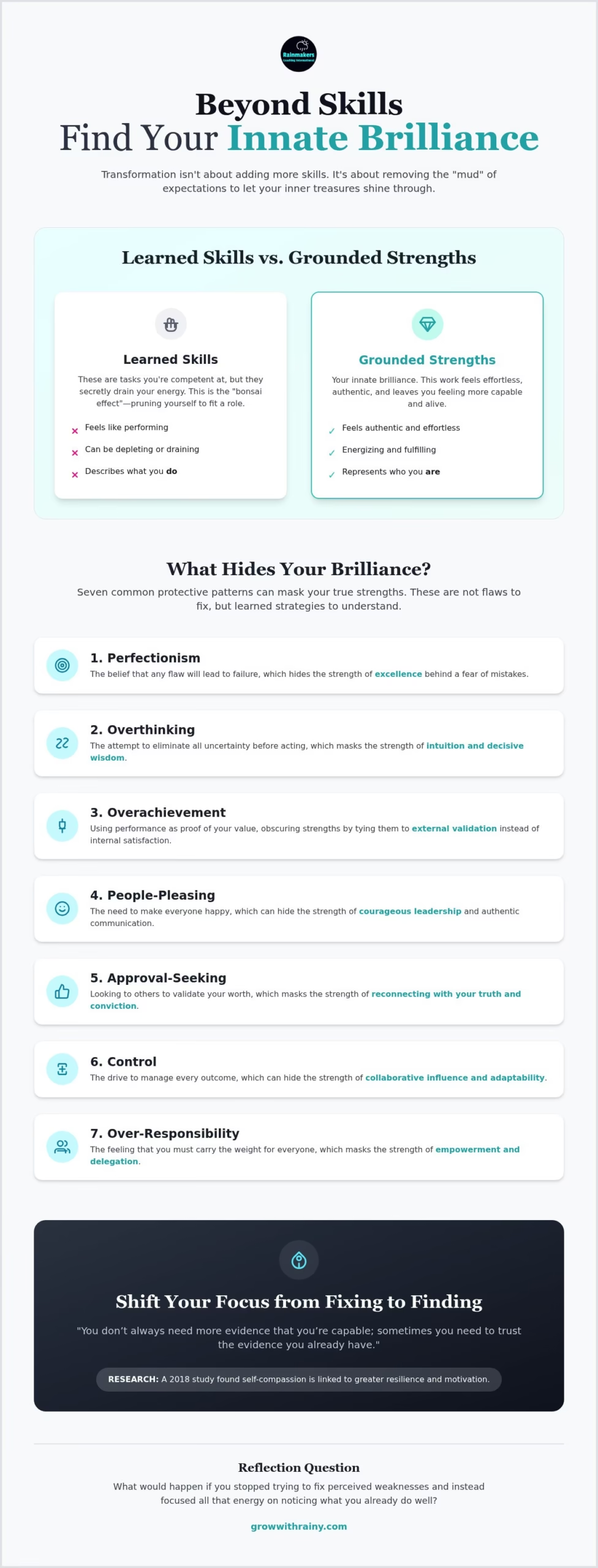
Our coaching perspective is simple: You don’t always need more evidence that you’re capable; sometimes you need to trust the evidence you already have. Your history of successes, the problems you naturally solve, and the moments where you felt “in the zone” are all clues. The work is not to earn more validation, but to learn to see and accept the value that is already present.
Start by practicing the quiet acknowledgment of your “gems” without needing someone else to notice them first. This internal shift is the first step toward building the grounded confidence needed to use your strengths effectively.
Common Barriers to Identifying Your Strengths
If innate strengths are so powerful, why do so many capable people struggle to see them? The answer often lies in the mental and emotional patterns we develop to protect ourselves and ensure our success. These learned strategies, while helpful at one stage of a career, can become the very “mud” that hides our brilliance at the next.
For example, the drive for **Perfectionism ** that helped you earn top grades can later prevent you from taking risks or leading with agility. It creates a fog of self-criticism, making you focus on the 1% you got wrong instead of the 99% that revealed a core strength. Similarly, Overthinking can paralyze you, making you doubt your own judgment even when you have a track record of making excellent decisions.
These patterns are not who you are; they are strategies you learned. Recognizing them is not about finding more flaws to fix. It is about understanding what is getting in the way, so you can gently move it aside and reconnect with the truth of your capabilities.
The 7 Protective Patterns: How They Mask Your Treasures
At Rainmakers, we see seven common protective patterns that can mask your true strengths. These are coaching constructs, not clinical diagnoses, that help us identify the invisible forces holding you back:
- Perfectionism: The belief that any flaw will lead to failure or judgment, which hides the strength of excellence behind a fear of mistakes.
- Overthinking: The attempt to eliminate all uncertainty before acting, which masks the strength of intuition and decisive wisdom.
- Overachievement: As our principle states, “Overachievement often begins when a person learns to use performance as proof of their value.” This can obscure strengths by tying them to external validation rather than internal satisfaction.
- People-Pleasing: The need to make everyone happy, which can hide the strength of courageous leadership and authentic communication.
- Approval-Seeking: The habit of looking to others to validate your worth, which masks the strength of self-trust and conviction.
- Control: The drive to manage every outcome, which can hide the strength of collaborative influence and adaptability.
- Over-Responsibility: The feeling that you must carry the weight for everyone, which masks the strength of empowerment and delegation.
These patterns create a cycle of self-criticism that keeps your focus on your perceived weaknesses. The more you try to “fix” these supposed flaws, the more hidden your true strengths become.
Challenging the “Fixing” Mentality
Coaching is not about fixing people. You are not broken. The goal is to release the patterns that prevent you from being fully yourself. When you shift your focus from fixing weaknesses to identifying and leaning into your strengths, you change the entire equation.
A 2018 study published in the Journal of Personality and Social Psychology explored how self-compassion , the opposite of harsh self-criticism is linked to greater resilience and motivation. Instead of fixing flaws, which fuels a cycle of judgment, a more compassionate approach allows you to see your value with clarity and objectivity.
Reflection Question: What would happen if, for just one week, you stopped trying to fix your perceived weaknesses and instead focused all that energy on noticing what you already do well?
A Grounded Framework for Identifying Your Strengths
Identifying your strengths is not about completing a generic HR checklist. It’s a process of reconnecting with your truth. This requires moving from a reliance on external feedback to a deep sense of internal resonance. The following three-step framework is designed to be a practical map for that journey.
Step 1: Look for Clues in Your Energy and Engagement
Your energy is your most reliable compass. Strengths are not just what you do well; they are the activities that fuel you. A learned skill may be effective, but it will often leave you feeling depleted. A true strength, on the other hand, restores your energy.
- Tool: The “Energy Audit.” For one week, track your daily tasks. At the end of each major activity, note whether you feel energized or drained. Don’t judge the results; just observe. The tasks that consistently leave you feeling engaged, focused, and even excited are powerful clues to your innate strengths.
- Challenge the assumption that work must be hard. Many high-achievers believe that if something feels easy, it isn’t valuable. The truth is often the opposite. The things that feel effortless to you are frequently the very things others find difficult – a clear sign of a unique talent.
Grounded Reflection Question: When do you feel most like yourself at work? What are you doing in those moments?
Step 2: Gather External Evidence and Reframe the Story
Once you have internal clues from your energy levels, it’s time to gather objective, external evidence. This step is about looking for real-life moments where your strengths were on display, even if you didn’t label them as such at the time.
- Look for “Recognisable Real-Life Moments.” Think back over your career. When did you solve a problem that stumped everyone else? When did you receive feedback that truly resonated with you? What accomplishments are you most proud of, and what personal qualities did you use to achieve them?
- Ask for specific feedback. Instead of asking, “What are my strengths?” which can feel awkward, ask trusted colleagues or mentors more targeted questions. For example: “Can you recall a time when you saw me at my best?” or “What kind of problems do you think I’m uniquely suited to solve?”
Grounded Reflection Question: If you had to describe your unique value based only on your past successes, what story would that evidence tell?
Step 3: Define and Test Your Strengths in Action
The final step is to move from passive observation to active application. This is where you translate your insights into a clear statement and begin to use your strengths with intention.
- Create a “Strengths Statement.” Synthesize what you’ve learned into a single, authentic sentence. It should feel grounded, not salesy. For example, instead of a generic “I’m a good leader,” a Strengths Statement might be: “I have a natural ability to see the connections between complex ideas and rally a team around a clear, unified vision.”
- Start small and build momentum. Confidence is about being yourself when the stakes are high. To build that muscle, start small. Identify one opportunity in the coming day to consciously lead from one of your core strengths. It could be as simple as choosing to facilitate a difficult conversation (a strength in diplomacy) instead of avoiding it.
Grounded Reflection Question: What is one small, immediate action you can take to bring more of this core strength into your work tomorrow?
Using Your Strengths to Navigate Your Career
Identifying your strengths is only the beginning. The true transformation comes when you learn to use them to solve problems, lead with impact, and shape your career with intention. When you work from your strengths, you stop trying to be “loud” and start being truly influential. You no longer have to wear a “mask” of competency; you can simply be effective.
Strengths in High-Stakes Decision Making
In moments of uncertainty, the temptation is to overthink – an attempt to create safety by eliminating all variables. However, your innate strengths offer a more grounded compass. If one of your strengths is deep analytical thinking, use it to cut through the noise. If it’s building consensus, use it to gather diverse perspectives.
Instead of asking, “What is the right answer?” ask, “Which of my strengths is best suited to navigating this challenge?” This shifts the focus from finding a perfect, risk-free solution to applying your most reliable tools to the situation at hand. Your core values, guided by your strengths, become your most trustworthy guide for making hard choices.
Strengths as a Tool for Team Leadership
True leadership is not about having all the answers. It’s about creating an environment where others can contribute their best. When you are clear on your own strengths, you are better equipped to see and cultivate the “hidden gems” in your team members.
This allows you to move from a “command and control” style to being an “Empathetic Catalyst.” You can delegate tasks not just based on role, but based on who is most energized and equipped to handle them. This builds a more resilient, engaged, and effective team. Research from Gallup has consistently shown that teams whose leaders focus on strengths are more engaged and productive.
Reflection Question: How would your leadership style change if you trusted your innate wisdom as much as you trust your technical skills?
Reconditioning Your Career Around Self Trust
Ultimately, the goal of this work isn’t just to be more successful in your current role. It’s to build a career that is a true expression of who you are. A professional problem like feeling misaligned or undervalued, rarely stays at work. It’s an invitation to engage in a deeper transformation.
The pattern that helped you succeed at one stage can become the pattern that limits your next stage of growth. By consciously identifying and using your strengths, you begin to recondition your professional life around authenticity and self-trust, not just performance.
From Insight to Transformation
Insight alone is not enough. Knowing your strengths is one thing; consistently acting from them is another. This is the reconditioning phase of our Rainmakers Transformation System™. It requires daily practice – choosing to lead with a core strength, even when it feels vulnerable, and observing the positive impact it creates.
Start today. Choose one “treasure” – one core strength you have identified and make a conscious decision to lead with it in a meeting, a project, or a conversation. Notice the shift not just in the external outcome, but in your own internal state. This is how real, lasting change happens.
Your Next Step Toward Authentic Leadership
If you find it difficult to see your own value or feel that invisible patterns are holding you back from using your strengths, you are not alone. This is a common challenge for high-achievers, and it is the exact work we do in our coaching programs.
Deeper support can help you remove the “mud” more effectively and build the grounded self-trust needed to lead with clarity and impact. If you are ready to move from feeling merely capable to feeling truly aligned and confident, exploring a coaching partnership may be your most powerful next step.
If you’re ready to rediscover your strengths, recognise the value you bring, and express more of your potential at work, you can schedule a complimentary 90 min coaching call with me.
Final Reflection Question: If you fully trusted the treasures within you, what is the very next thing you would do?

Article by
Rainy Rainmaker
Rainy Rainmaker is the founder of Rainmakers Coaching International and a transformational coach for confidence, self-trust, and authentic leadership.
Based in Singapore, she helps high-achieving professionals, managers, and leaders who appear capable on the outside but feel quietly held back by self-doubt, overthinking, imposter feelings, burnout, or a loss of direction. Through her signature Rainmaker Transformation Journey™: Release, Reprogram, Recondition – Rainy helps clients uncover the insights already within them and turn inner clarity into aligned action that creates lasting change in life, career, and leadership.
