
You’ve checked all the boxes. The promotions, the successful projects, the respect of your peers – they’re all on your record. Yet, when you sit in a high-stakes meeting or prepare to give your team feedback, a quiet, persistent voice whispers, “What if they find out you don’t really know what you’re doing?”
If this feels familiar, you are not alone. For many high-performers, especially those in management roles, external success rarely translates into internal certainty. The higher you climb, the more intense the self-doubt can become. This isn’t a personal failing; it’s a predictable pattern. And the solution isn’t to work harder or learn more. The path to how to build confidence at work isn’t about adding another skill. It’s about removing the invisible barriers you’ve built to protect yourself.
This checklist is designed for you – the accomplished professional who feels like an imposter. We will move past the hollow advice to “fake it till you make it” and give you a grounded framework for reclaiming the quiet, steady self-trust that already exists within you.
The High-Achiever’s Paradox: Why Success Doesn’t Always Equal Confidence
Why is it that the next rung on the ladder often triggers more doubt, not less? This is the high-achiever’s paradox. With every new level of responsibility, especially in a leadership role, the stakes feel higher and the internal pressure to be flawless intensifies. You’re no longer just responsible for your own work; you’re responsible for the growth and performance of others, which can amplify any pre-existing feelings of inadequacy.
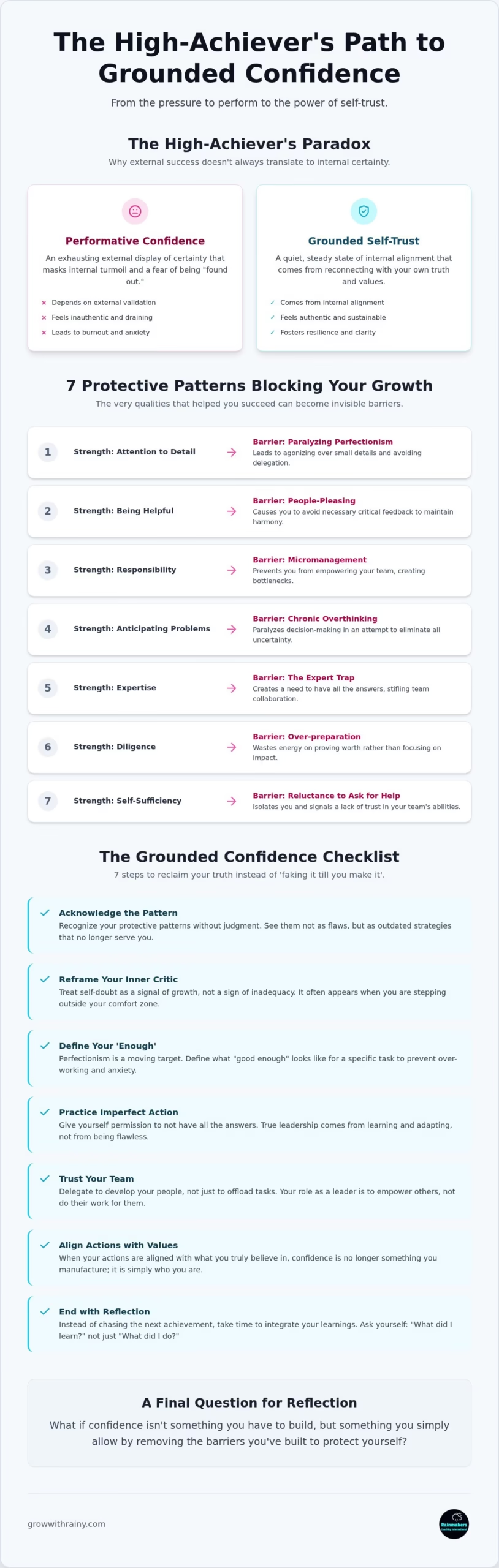
This leads many to adopt what we call ‘performative confidence’ – an exhausting external display of certainty that masks internal turmoil. It’s the forced smile in a tense negotiation or the overly assertive tone used to hide a fear of being questioned. This is fundamentally different from ‘grounded self-trust’, which is not a performance but a state of being.
True confidence isn’t about being the loudest person in the room. It’s the absence of the need to employ invisible protective strategies. Grounded confidence is a state of internal alignment rather than a dependence on external validation.
A Manager’s Story: The Weight of a New Title
I once worked with a client, we’ll call her Priya, who had just been promoted to Director of Transformation. She was brilliant, technically gifted, and universally respected for her work as an individual contributor. But as a Director, she was drowning.
She confessed that she was secretly re-checking her team’s report late at night, spending hours agonizing over the wording of a single email, and avoiding one-on-one conversations where she might be asked a question she couldn’t answer instantly.
Her team felt her anxiety. They saw her as a micromanager, not a leader. Her confidence, once tied to her technical expertise, had evaporated now that her role was about empowering others.
During our coaching, we uncovered the truth: her perfectionism , once a “strength” that helped her excel, had become a barrier. It was a protective pattern designed to prevent failure, but in her new role, it was preventing her from leading.
The breakthrough wasn’t learning a new management technique. It was giving herself permission to not have all the answers. It was learning to trust her team. By releasing the need to be the flawless expert, she was able to step into her role as a grounded, effective leader. Her confidence didn’t come from knowing everything; it came from accepting that she didn’t have to.
The Cost of the ‘Obnoxious Roommate’
That persistent voice of self-doubt is like an obnoxious roommate living in your head, rent-free. It’s your inner critic, and it serves as a misguided protective mechanism. It believes that by pointing out every potential flaw, it can keep you safe from external judgment and failure. The irony is that in its attempt to protect you, it keeps you playing small.
The toll of constantly over-achieving to quiet this voice is immense. It leads to burnout , anxiety, and a persistent fear of being ‘found out’ – a classic symptom of what many call Imposter Syndrome.
But what if you could reframe that self-doubt? Instead of seeing it as a sign of your inadequacy, you can learn to see it as a signal of growth. Doubt often appears when you are stepping outside your comfort zone, which is the prerequisite for any meaningful career development .
Why Traditional ‘Fake It Till You Make It’ Advice Fails
“Fake it till you make it” is perhaps the most common advice for building confidence , and also the most damaging for high-performers. This approach creates immense psychological friction. You are asking your nervous system to act in a way that feels deeply inauthentic, creating a constant, low-level state of internal conflict.
Performative confidence requires a tremendous amount of energy to maintain. It’s a mask that eventually cracks under pressure, leading to exhaustion and burnout. True, lasting stability doesn’t come from pretending.
It comes from reconnecting with your truth – your values, your innate strengths, and your right to be imperfect. When your actions align with your internal state, confidence is no longer something you have to manufacture; it’s simply who you are.
Identifying the 7 Protective Patterns Blocking Your Growth
Your greatest strengths, when overused, can become your biggest barriers. The very qualities that helped you succeed – your attention to detail, your helpful nature, your ability to anticipate problems, can morph into protective patterns that put a ceiling on your leadership potential.
For example, perfectionism and approval-seeking can stop you from giving necessary critical feedback to your team. An over-developed sense of responsibility can prevent you from delegating effectively, creating a bottleneck and disempowering your direct reports.
And chronic overthinking, a strategy to eliminate uncertainty, can paralyze you from making the timely decisions required in high-stakes roles. Recognizing these patterns is the first step toward reclaiming your authority.
When Strengths Become Invisible Barriers
Let’s look at how this transformation happens.
- Attention to detail morphs into paralyzing perfectionism. You start by wanting to deliver high-quality work, but you end up spending an hour on an internal email that should have taken five minutes, paralyzed by the fear of how the message will be received.
- Being a helpful team player becomes people-pleasing. You begin by wanting to be collaborative, but you end up saying “yes” to every request, sacrificing your own priorities and showing others that your boundaries are weak.
- Being a strategic thinker turns into over-analysis. You pride yourself on foresight, but you find yourself stuck in endless research loops, unable to make a decision without 100% certainty – which never comes.
The critical moment is when your protective strategy starts limiting your career trajectory. As a manager, if your perfectionism prevents you from trusting your team, you cannot scale your impact.
If your people-pleasing stops you from setting clear expectations, your team will flounder. These aren’t character flaws; they are outdated strategies that need to be consciously released.
The Rainmakers Lens: Seeing the Gem Within
The core philosophy of our work at Rainmakers is this: you are already worthy, whole, and capable, regardless of your daily output. Your value is not in your productivity. The “gem” of your innate wisdom and talent is already there, but it may be obscured by layers of these protective patterns.
The work is not to build a new you, but to chip away at the patterns that hide your truth. It’s about learning to distinguish between the quiet, steady voice of your innate wisdom and the loud, anxious chatter of your protective patterns. The first step is simple observation, without judgment.
A reflective question for you: Which of these patterns has been running your professional life lately?
The Grounded Confidence Checklist: 7 Steps to Reclaim Your Truth
Building grounded confidence is an active process of un-learning, not just learning. It’s about intentionally choosing new responses to old triggers. This checklist is not about adding more to your to-do list; it’s a framework for integrating small, powerful shifts into your daily work life. Start with one, and practice it with compassion .
- Audit Your Patterns: For one week, simply notice. When you feel a wave of self-doubt, pause and ask: Which protective strategy is at play here? Is it perfectionism, overthinking, people-pleasing? Just naming it reduces its power.
- Release the Need for Certainty: Confidence is not about knowing the outcome; it’s about trusting you can handle the outcome, whatever it is. Practice making small decisions with 70% of the information instead of waiting for 100%. Trust your gut on a minor issue and move on.
- Challenge the ‘Inner Critic’ Narrative: Your inner critic often speaks in absolutes (“I’m going to fail,” “They’ll think I’m an idiot”). Use conditional journaling to deconstruct these fears. Write: “If [the fear] happens, then I will [a specific, concrete action].” This moves you from catastrophic thinking to practical problem-solving.
- Reconnect with Your Truth: Spend five minutes before your first meeting of the day in silence. No phone, no email. Just sit and notice your physical presence – your feet on the floor, your breath. This simple somatic practice grounds you in your body and quiets the mental chatter.
- Set One Clear Boundary: For managers, this is crucial. It could be blocking off “deep work” time in your calendar, saying “Let me get back to you” instead of an immediate “yes,” or ending meetings on time. Boundaries protect your energy and signal self-respect.
- Build Your ‘Evidence Vault’: Your brain is wired to remember threats and failures. You must intentionally counteract this. At the end of each day, write down one thing you did well and the specific strength you used to do it. This isn’t about ego; it’s about training your brain to see objective proof of your competence.
- Practice Compassionate Observation: When you make a mistake, resist the urge to spiral into self-criticism. Instead, treat yourself as you would a valued team member. Acknowledge the error, identify the learning, and move forward. This builds resilience.
For those ready to dive deeper into this framework, our Executive Coaching Program provides a guided path to make these practices a permanent part of your leadership style.
Research-Backed Shifts in Perspective
These practices aren’t just feel-good ideas; they are rooted in science. The concept of neuroplasticity confirms that our brains can and do change. By repeatedly choosing a new response like compassionate observation instead of self-criticism, you are literally rewiring the neural pathways that trigger your stress response at work.
Furthermore, creating psychological safety for your team starts with how you talk to yourself. When you model self-compassion , you create an environment where others feel safe to take risks, admit mistakes, and be innovative.
In fact, research by Dr. Kristin Neff and others has shown a direct correlation between self-compassion and improved performance, as it increases resilience and motivation after a setback. Behavioral studies consistently show that self-compassion, not self-criticism, is a more effective and sustainable motivator for long-term achievement.
Moving from ‘Doing’ to ‘Being’: The Science of Self-Trust
Many professionals build their confidence on a foundation of knowledge. “I am confident because I know more than anyone else about this topic.” This is ‘knowledge-based’ confidence, and it is incredibly fragile. In a constantly shifting corporate landscape, what you know today can be obsolete tomorrow. As soon as you are in a room where you are not the expert, your confidence plummets.
The shift required for long-term career resilience is toward ‘identity-based’ transformation. This means your confidence is rooted not in what you do or what you know, but in who you are. It’s about stopping the over-identification with your job title and starting to identify with your innate value – your integrity, your creativity, your resilience, your capacity for growth.
Releasing the Over-Responsibility Trap
For many managers, the biggest hurdle is the over-responsibility trap. You feel that every success and every failure of your team rests solely on your shoulders. This is not leadership; it’s a recipe for burnout.
The key is to differentiate between what you can control and what you must let go of. You can control the clarity of your communication, the support you provide, and the environment you create. You cannot control how an individual team member performs on a given day.
Cultivating a Grounded Presence in Meetings
High-pressure conversations are often where a lack of confidence is most exposed. When you feel threatened, your body is flooded with cortisol, triggering a fight-or-flight response that makes clear thinking impossible.
Somatic techniques can help. Before a tough meeting, take 60 seconds to take a few slow, deep breaths. This simple act can lower cortisol and activate your parasympathetic nervous system, bringing you back to a state of calm.
Notice the power of the pause. The most confident person in the room is often not the one talking the most, but the one who is comfortable with silence. A pause before you answer a question gives you time to think and signals that you are thoughtful, not reactive.
Reframe “I don’t know” as an opportunity. Instead of seeing it as a failure, present it as an invitation for collaborative wisdom: “That’s an important question. I don’t have the answer right now, but here’s how we can find it together.”
Your Path to Rock Solid Confidence: Next Steps for Transformation
Reading an article is an important first step, but true transformation happens when insight is put into practice with consistent support. The Rainmakers Transformation System™ is a three-step process designed to make your newfound confidence a permanent state:
- Release: We identify and gently release the outdated protective patterns that are holding you back.
- Reprogram: We work together to install new, empowering beliefs and perspectives based on your truth.
- Recondition: Through consistent practice and integration, we make these new ways of being your default state, even under pressure.
This is the core of our work in Executive Coaching. It goes deeper than generic professional development, focusing on the internal shifts that create sustainable external results.
Is Professional Coaching the Right Step for You?
Self-help resources are valuable, but they can sometimes reach their limit. You may recognize your patterns, but feel stuck in breaking them. The common comment I get from my new clients are “I tried applying what I’ve learned from the books and podcasts, but I can’t seem to stay consistent”. This is where personalized coaching can be a powerful catalyst – with feedback, accountability and proven system.
Having a ‘Heart-Centered Authority’ – a guide who combines deep empathy with strategic insight can help you navigate your internal friction safely and effectively. A transformation-focused coaching journey is not about getting advice. It’s a collaborative partnership dedicated to uncovering the wisdom and confidence you already possess. It’s for those who are tired of surface-level tips and are ready for a real, lasting change.
A Final Reflection for the Grounded Leader
The ‘hidden treasures’ of your confidence, wisdom, and leadership presence are already within you. The work is not to create them, but to gently remove the layers of protection that have kept them hidden.
As you finish reading, I invite you to consider one final question:
If you were already 10% more confident today, what is the one conversation you would stop avoiding?
Your answer holds the key to your next step. To explore that step further, I invite you to Take the Self-Confidence Quiz and begin your journey toward grounded, authentic leadership.
Frequently Asked Questions About Building Confidence at Work
Navigating the path to grounded self-trust often brings up specific questions. Here are answers to some of the most common inquiries from high-achieving professionals.
How long does it take to build real confidence at work?
Building grounded confidence is not a one-time event but a continuous practice of un-learning old patterns and integrating new ones. While some clients feel a shift in perspective after just a few coaching sessions, making it a default state can take several months of consistent, intentional effort. The goal isn’t a finish line, but the development of tools to navigate self-doubt with resilience whenever it appears.
Can I be a successful leader if I still feel imposter syndrome?
Absolutely. Many of the most successful leaders in the world admit to feeling imposter syndrome. The key is not to eliminate the feeling entirely, but to change your relationship with it. Instead of letting it dictate your actions, you can learn to see it as a sign that you are challenging yourself. Effective leadership is about acting with courage and conviction despite the feeling of doubt.
What is the fastest way to stop overthinking before a presentation?
The fastest way is to shift your focus from your internal state to your external purpose. Instead of asking, “What will they think of me?” ask, “What is the one thing I want this audience to walk away with?” This moves you from self-consciousness to service. Additionally, a simple grounding exercise like pressing your feet firmly into the floor for 30 seconds can calm your nervous system and pull you out of an anxious thought loop.
Is there a difference between confidence and arrogance in the workplace?
Yes, a significant one. Confidence is quiet and internally sourced; it’s a trust in your own ability to handle challenges. Arrogance is loud and externally focused; it’s a need to prove your superiority over others. Grounded confidence welcomes collaboration and admits to not knowing, while arrogance sees these as weaknesses.
How can I regain my confidence after a major professional setback?
The first step is to practice self-compassion, not self-criticism. Separate the event from your identity: a failed project doesn’t make you a failure. Conduct an objective post-mortem to extract the lessons, focusing on what you can control next time. Then, intentionally use your ‘Evidence Vault’ to remind yourself of past successes and your inherent capabilities to rebuild your self-trust on a foundation of facts, not fear.
Why do I feel less confident now than I did earlier in my career?
This is common for high-achievers. Early in your career, success is often tied to clear, technical skills. As you move into leadership, the metrics for success become more ambiguous and relational. You’re no longer the expert ‘doer,’ but a facilitator and guide. This identity shift can trigger deep-seated insecurities that were masked when your value was easier to measure.
Similarly, significant life changes like motherhood can trigger these identity shifts; many high-performing women in Singapore find that the luxury postpartum care at Singjoy provides the essential support needed to navigate this transition and return to work with a grounded sense of self.
What should I do if my boss is the one making me feel unconfident?
This is a challenging situation. First, differentiate between constructive feedback and destructive criticism. If it’s the latter, it’s crucial to reinforce your own sense of professional worth separate from their opinion. Document your achievements and seek feedback from trusted peers or mentors to maintain an objective view of your performance. It’s also important to establish clear boundaries in your interactions to protect your psychological safety.
Can coaching really help with deep-seated self-doubt?
Yes. While therapy is essential for addressing clinical anxiety or trauma, coaching is uniquely effective for high-functioning individuals whose self-doubt is linked to protective patterns and limiting beliefs. A skilled coach provides a safe, confidential space to challenge those beliefs, design new strategies, and provide the accountability needed to turn insights into lasting behavioral change.

Article by
Rainy Rainmaker
Rainy Rainmaker is the founder of Rainmakers Coaching International and a transformational coach for confidence, self-trust, and authentic leadership. Based in Singapore, she helps high-achieving professionals, managers, and leaders who appear capable on the outside but feel quietly held back by self-doubt, overthinking, imposter feelings, burnout, or a loss of direction.
Through her signature Rainmaker Transformation Journey™: Release, Reprogram, Recondition – Rainy helps clients uncover the insights already within them and turn inner clarity into aligned action that creates lasting change in life, career, and leadership.
