

What if the persistent fear of being “found out” isn’t actually a sign of your inadequacy, but rather a protective pattern that has outlived its usefulness? You’ve likely spent years refining your craft, yet you still find yourself overthinking every sentence of an email or attributing a hard-earned promotion to mere timing. Understanding how to overcome imposter syndrome at work begins with a fundamental shift in perspective. It’s about recognising that your internal noise is often a misguided attempt to keep you safe, not a reflection of your true capability.
It’s exhausting to live in a cycle of over-preparing just to avoid a perceived exposure that never actually comes. You deserve to feel a deep sense of belonging in the role you’ve earned through your own merit. This article explores why your success often feels like a fluke and offers a gentle, research-backed process to help you quiet that inner critic. By reconnecting with your truth and building self-trust, you can move from a state of internal friction to one of grounded authority.
We’ll explore the psychology behind these tricks of the brain and introduce the Rainmaker’s Transformation System™️, a methodology focused on releasing these protective layers. You’ll discover how to transition from hesitation to decisiveness using a specific process to release, reprogram, and recondition your mindset. If you could strip away the fear of being seen as a fraud, what kind of leader would emerge in your place today?
Key Takeaways
- Reframe self-doubt as a protective pattern rather than a personal flaw. This shift allows you to view your achievements through a lens of inherent worth.
- Understand how to overcome imposter syndrome at work by exploring the psychological triggers that cause high-performers to underestimate their own competence.
- Learn to distinguish between a healthy drive for excellence and the “protective perfectionism” that leads to burnout and chronic overthinking.
- Identify the specific “invisible strategies” you use to stay safe. You’ll learn the gentle process of releasing them to reclaim your self-trust and clarity.
- Shift your leadership style from managing internal noise to projecting grounded authority that empowers both you and your team.
What is Imposter Syndrome? Seeing Beyond the “Fraud” Narrative
Imposter syndrome is often misunderstood as a lack of confidence or a simple case of nerves. In reality, it’s the persistent inability to internalise your own success. You might have the degrees, the titles, and a history of successful projects, yet the internal mirror remains blank.
Instead of feeling capable, you feel like an actor on a stage, waiting for the curtain to fall and the audience to see the “real” you. This disconnect creates a heavy sense of internal friction that can make even your greatest wins feel hollow.
Commonly, this manifests as a narrative that your achievements are due to external factors. You might tell yourself, “I was just in the right place at the right time,” or “They only hired me because they were desperate.”
There’s a constant, low-level anxiety that your colleagues will eventually realize you’ve been winging it all along. Learning **how to overcome imposter syndrome at work ** starts with recognising that these thoughts aren’t facts; they’re just a very loud, very tired inner critic trying to protect you from the perceived danger of failure.
This experience is particularly common among high-performers, a phenomenon often called the High-Achiever’s Paradox. The more you accomplish, the more you feel you have to lose. It’s easy to fall into the trap of thinking your value is tied strictly to your latest win.
However, your inherent worth doesn’t vanish when you make a mistake or face a setback. True high-achiever mental health involves understanding that your value is grounded in who you are, not just what you do.
The Seven Faces of Protection at Work
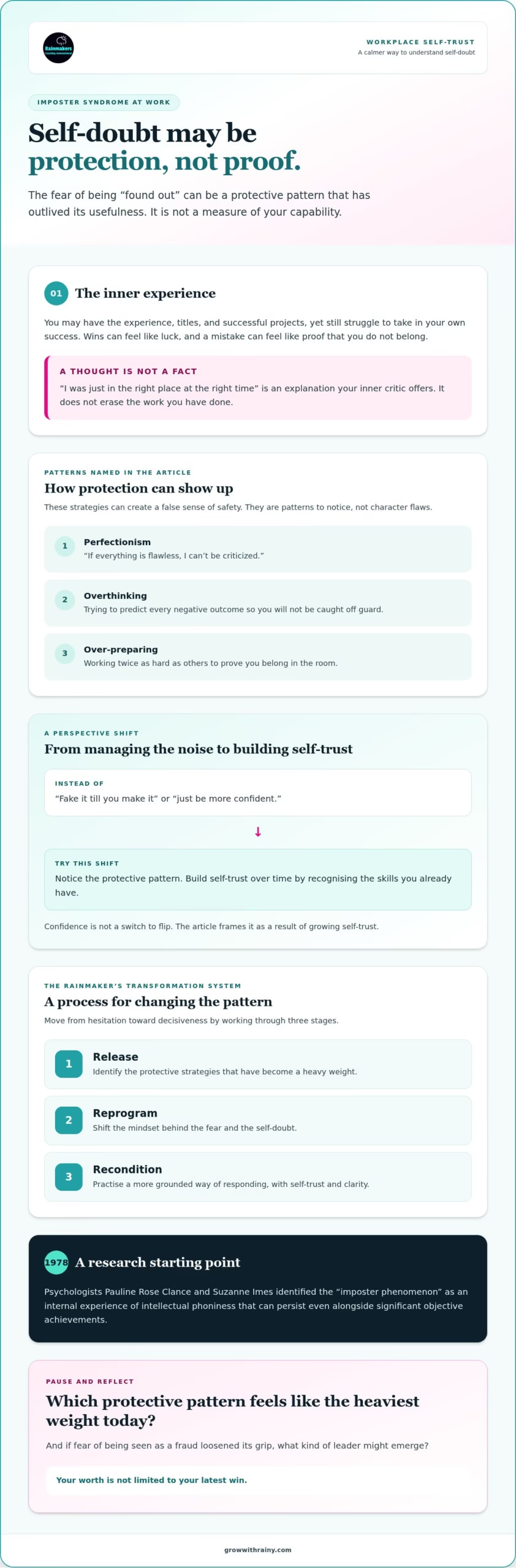
Within the Rainmakers Pattern Library, we view imposter syndrome as a collection of “invisible protective strategies.” These aren’t character flaws; they’re tools your mind uses to eliminate uncertainty and create a false sense of safety. Common patterns include:
- Perfectionism: The belief that if everything is flawless, you can’t be criticized.
- Overthinking: The attempt to predict every possible negative outcome to avoid being “caught off guard.”
- Over-preparing: Working twice as hard as others to prove you belong in the room.
While these strategies might have helped you survive early in your career, they now act as a heavy weight. They keep you in a state of constant “protection mode,” preventing you from actually enjoying the career you’ve built.
Reconnecting with your truth means identifying which of these patterns feels most like a heavy weight on your shoulders today.
Why Conventional Advice Often Fails
Most professional development advice suggests that you should “fake it till you make it.” On the surface, this sounds empowering. In practice, it often backfires. When you “fake it,” you’re essentially agreeing with your inner critic that you are, indeed, a fraud.
This only heightens the fear of being found out. It’s a symptom-level fix that ignores the root cause of your self-doubt and makes understanding how to overcome imposter syndrome at work feel even more out of reach.
Similarly, being told to “just be more confident” is rarely helpful for senior leaders after a promotion. Confidence isn’t a switch you can flip. It’s a result of building self-trust over time. To truly move forward, you need a transformational approach that goes beyond surface-level affirmations.
How would your work day change if you stopped trying to “fix” your confidence and started trusting your existing skills instead?
The Psychology of Self-Doubt: Why Your Brain Plays Tricks
Why does your mind so easily dismiss the evidence of your own success? It isn’t a sign of weakness; it’s a complex interplay of cognitive biases and biological survival mechanisms.
In 1978, psychologists Pauline Rose Clance and Suzanne Imes first identified this “imposter phenomenon” as an internal experience of intellectual phoniness that persists even in the face of significant objective achievements. This research laid the groundwork for our modern understanding of why high-performers often feel like frauds despite their clear capabilities.
One reason for this disconnect is the Dunning-Kruger effect. While we often associate this with people overestimating their abilities, the inverse is true for experts. Because your skills have become second nature, you assume they are easy for everyone else too.
This leads to a chronic underestimation of your own competence. You might think, “Anyone could have done that project,” when in reality, your unique insight was the deciding factor. Learning how to overcome imposter syndrome at work involves recalibrating this internal scale to reflect the truth of your expertise.
Your biology also plays a role. When you’re in a high-stakes leadership moment, your amygdala can trigger “protection mode.” It perceives the risk of a mistake not as a learning opportunity, but as a threat to your social safety.
This floods your system with stress, making it hard to access your grounded confidence. The good news lies in neuroplasticity. Your brain is capable of change. You can literally rewire the neural pathways that favour the inner critic, replacing them with pathways built on self-trust and clarity.
This mental conditioning is a universal skill; for example, high-performers in sports often use similar techniques from Golf State of Mind to overcome psychological barriers and maintain focus under pressure.
From Fear to Self-Trust
The journey toward freedom requires moving from a state of protection to a state of trust. Many professionals over-use a natural strength, like meticulousness, until it transforms into the invisible barrier of perfectionism.
It’s like trying to navigate a ship while being paralyzed by a fear of the water. You cannot steer effectively if your primary goal is simply to avoid the waves. Shifting your focus from “not failing” to “leading with impact ” allows you to release the weight of these protective strategies.
If you feel stuck in this cycle, a 90-minute coaching session can provide the space to map out a new direction.
The Role of the Inner Critic
It’s helpful to view your inner critic as a misguided protector. It isn’t trying to sabotage you; it’s trying to keep you safe from the pain of social rejection. However, its methods are outdated and exhausting.
By using the “Rainmakers Lens,” you can start to see your inherent worth even when the critic is shouting. You can begin silencing the inner critic by acknowledging its intent while choosing to lead from your truth instead.
When was the last time you thanked your inner critic for its concern, then politely asked it to step aside?
Challenging Your Assumptions: A Shift in Perspective
If you’ve spent years telling yourself that your career is a series of lucky breaks, it’s time to look at the evidence with more clarity. Luck might open a door, but it doesn’t keep you in the room, and it certainly doesn’t lead to sustained results.
Understanding how to overcome imposter syndrome at work requires a fundamental shift in how you credit your own contributions. When you attribute your wins to external factors, you’re essentially choosing a narrative of fragility over one of grounded capability. You’re ignoring the late nights, the strategic pivots, and the emotional intelligence you’ve invested in your growth.
It’s also vital to distinguish between healthy striving and protective perfectionism. Healthy striving is fuelled by a genuine desire for excellence and the joy of the process. Protective perfectionism, however, is a shield.
It’s a way of trying to control your environment so that no one can find a reason to criticise you. This shift in perspective is about reconnecting with your truth. It’s about realising that your expertise isn’t a performance you have to maintain; it’s a foundation you already stand on. When you stop trying to prove yourself, you finally have the energy to actually lead.
The Approval-Seeking Trap
Many high-performers fall into the trap of using external validation as their primary source of professional fuel. While a “well done” from a CEO feels good, it’s a short-lived high that leaves you hungry for the next fix. This cycle actually feeds your self-doubt because it reinforces the idea that your worth is determined by others.
The Rainmakers Principle suggests that true worthiness is found within, independent of your latest achievement. A simple way to start this shift is to practice internal validation. At the end of each workday, identify one specific moment where you handled a challenge with integrity or skill, even if no one else was there to see it.
Reframing Failure and Mistakes
For someone struggling with imposter feelings, a mistake feels like a smoking gun; it’s the “proof” that you’re a fraud. Grounded leaders, however, view setbacks differently. They see them as data points for growth rather than indictments of their character.
Reclaiming your authority means building rock solid confidence that isn’t shattered by a single wrong turn. When you release the need to be perfect, you gain the freedom to be effective. You start to see that your value isn’t in never failing, but in how you navigate the complexity of the work itself.
As you reflect on your current role, ask yourself: What would I do today if I didn’t need anyone’s permission to be successful?
The Rainmakers Path: How to Overcome Imposter Syndrome at Work
Many professionals attempt to address self-doubt with surface-level hacks or temporary affirmations. However, lasting change requires a more methodical and transformational approach. Within the Rainmakers Transformation System™, we move beyond managing symptoms to address the root of the issue.
This framework isn’t about adding more pressure to perform; it’s about peeling back the layers of protection that keep you from seeing your own expertise. Understanding how to overcome imposter syndrome at work involves a deliberate journey through three key phases.
The first phase is Release. This involves identifying the invisible protective strategies, such as perfectionism or overthinking, that you’ve used to feel safe. Once you see these patterns for what they are, you can begin to let them go.
The second phase is Reprogram. Here, we challenge the old stories that your wins are flukes and replace them with grounded truths.
Finally, we move to Recondition. This is the practice of navigating high-stakes environments using new, trust-based behaviours. Through this “3R Integration,” these shifts move from being concepts you understand to becoming a natural part of your identity.
Practical Strategies for the Workplace
To support this internal shift, you can implement specific daily practices that build a foundation of self-trust. These strategies help you move from hesitation to decisiveness in real-time:
- The Evidence Vault: Maintain a factual record of your contributions. When your inner critic claims you’re a fraud, look at the data of the problems you’ve solved and the impact you’ve made.
- The Compassionate Observer: Practice witnessing your doubt without letting it drive your actions. Acknowledge the feeling of anxiety, but choose to lead from your expertise anyway.
- Boundaries for Excellence: Recognize that “perfect” is often the enemy of “optimal.” Set boundaries on your preparation time to ensure you’re providing value without falling into the trap of over-preparing.
Implementing these habits is a practical way to learn how to overcome imposter syndrome at work while maintaining your professional standards. It allows you to lead with a quiet strength that doesn’t rely on being flawless.
Building Your Support Network
Self-doubt thrives in isolation. When you keep your feelings of inadequacy a secret, they gain power. Sharing your experience with a trusted coach or mentor can immediately reduce that internal pressure.
This is where Executive Coaching for leaders becomes a catalyst for growth. A professional coach acts as a seasoned guide who helps you navigate these internal shifts with clarity and psychological safety.
For high-achieving men, these feelings of inadequacy often intensify during major life transitions; if you’re navigating the challenges of new parenthood alongside your career, you might want to visit GreatDad.com for specialized support tailored for fathers.
By bringing these “hidden treasures” of your innate strengths to light, you can stop managing your fears and start empowering your team.
What would be possible if you had a dedicated mental space to process your leadership challenges without judgment?
Book a 90-minute coaching conversation to reclaim your grounded confidence
Reclaiming Your Authority: Moving Toward Grounded Leadership
The journey of learning how to overcome imposter syndrome at work eventually leads to a pivotal crossroads. You move from the exhausting task of managing your symptoms to the liberating experience of authentic leadership.
When you are no longer preoccupied with hiding a perceived inadequacy, you gain a massive amount of mental and emotional bandwidth. This energy, previously consumed by overthinking and internal friction, can finally be channeled into your true purpose.
Reclaiming your authority isn’t about becoming a different person; it’s about finally allowing the leader you already are to stand on solid ground. This shift has a profound impact on those you lead. If you are constantly second-guessing your own worth, it’s difficult to fully empower your team.
Grounded leadership creates a culture of psychological safety. When you lead from a place of self-trust, you model resilience and transparency for everyone around you. You begin to see that the “hidden treasures” of your wisdom and intuition.
You noticed that courage were never missing, they were simply obscured by the protective patterns you no longer need. By reconnecting with your truth, you transition from a leader who survives to a leader who inspires.
The Impact of Grounded Confidence
Grounded confidence changes the way you navigate the daily pressures of a high-stakes environment. With increased self-trust, decision-making becomes clearer and less burdened by the fear of making a mistake.
You stop viewing every setback as an indictment of your character and start seeing it as a manageable part of the process. This shift is a core part of the Rainmakers Change Sequence, where we move you from fear-based protection to purpose-led action.
If you’re curious about where your current confidence levels stand, you can take the Self-Confidence Quiz to gain immediate insight into your internal landscape.
Your Next Step Toward Transformation
While understanding the mechanics of self-doubt is helpful, lasting change often requires more than just information. Generic advice can only take you so far. If you are ready for a deeper, more personalised transformation, it’s time to consider a guided path forward.
The Building Rock Solid Confidence Program is designed to help you navigate these internal shifts with the support of a seasoned coach. It’s a space where you can dismantle the old stories of “luck” and “fraudulence” and replace them with a permanent sense of grounded authority.
As you close this chapter and look toward your next meeting or project, take a moment for self reflection.
What part of your true self has been waiting for you to believe in it?
Stepping Into Your Grounded Authority
You’ve spent long enough navigating your career through the lens of protection. By understanding how to overcome imposter syndrome at work, you’re choosing to release the weight of chronic overthinking and protective perfectionism.
This shift isn’t just about feeling better; it’s about reclaiming the mental bandwidth required to lead with impact and clarity. When you stop trying to “fake it” and start trusting the foundation you’ve already built, your leadership becomes a source of steady strength for everyone around you.
With over a decade of experience helping high-achievers, I’ve seen how the trademarked Rainmaker’s Transformation System™ facilitates a deep return to self-trust. This compassionate, result-backed approach allows you to move beyond surface-level fixes and address the root causes of your self-doubt.
You don’t have to navigate these internal shifts alone. It’s time to stop waiting for permission to feel successful and start standing on the truth of your own expertise. If you’re looking for a comprehensive resource on how to build rock solid confidence from the inside out, this guide for high-achieving leaders offers a deeper exploration of releasing the invisible protective strategies that may be holding you back.
Quiet your inner critic and build rock solid confidence today
Your wisdom and courage are not things you need to acquire; they are treasures already within you.
What would change in your life today if you finally believed in the evidence of your own success?
Frequently Asked Questions
Is imposter syndrome a mental health condition?
Imposter syndrome isn’t a clinical diagnosis found in medical manuals. It’s better understood as a psychological phenomenon or a collection of “protective patterns” common among high-performers. While it’s not a disorder, the persistent internal friction it creates can lead to real anxiety or burnout if you don’t address it. Recognizing it as a misguided attempt at safety rather than a personal flaw is the first step toward reclaiming your self-trust.
Can imposter syndrome actually be a good thing for my career?
Some professionals believe that self-doubt keeps them humble or sharp, but using fear as fuel is incredibly exhausting. While it might drive you to work harder in the short term, it prevents you from leading with grounded authority and enjoying the success you’ve earned. You don’t need the heavy weight of imposter feelings to maintain excellence; in fact, you’ll likely find you’re more effective when you’re no longer operating from a place of protection.
How do I know if I have imposter syndrome or if I am actually under-qualified?
The key is to look at the objective data of your career. If you have the degrees, the successful projects, and the positive feedback, yet you still feel like a fraud, that’s imposter syndrome. If you truly lack a skill, you’ll feel a specific gap in your knowledge that can be filled with training. Imposter feelings, however, are a disconnect between your achievements and your internal sense of worth, regardless of how much you’ve accomplished.
What is the fastest way to stop feeling like a fraud in a new role?
The most effective strategy is to build an “Evidence Vault” starting on day one. Document every problem you solve, every insight you contribute, and every piece of positive feedback you receive to counter the narrative that you’re just “winging it.” Understanding how to overcome imposter syndrome at work in a new role requires accepting that a learning curve isn’t a sign of inadequacy, but a natural part of growth that demands self-trust.
How does perfectionism contribute to imposter syndrome at work?
Perfectionism is a shield used to eliminate the risk of criticism or “exposure.” You might believe that if your work is flawless, no one can find a reason to question your presence in the room. This creates a cycle where your successes feel like flukes because they were achieved through unsustainable effort. Reclaiming your grounded leadership means realizing that your value exists independently of your latest mistake or setback.
Can coaching really help me overcome deep-seated self-doubt?
Coaching provides a mirror to your blind spots – helping you see the strengths you’ve been overlooking. Using the Rainmaker’s Transformation System™, we work to release the protective strategies that no longer serve you and reprogram the internal narratives that keep you small. This process moves you beyond temporary fixes, helping you build a lasting sense of self-trust that stands up even in high-stakes environments. For a deeper dive into how to build rock solid confidence as a high-achieving leader, explore this comprehensive guide that walks you through releasing the patterns that keep you stuck.
After reading these answers, which of your current “protective” habits are you most ready to release?

Article by
Rainy Rainmaker
Rainy Rainmaker is the founder of Rainmakers Coaching International and a transformational coach for confidence, self-trust, and authentic leadership. Based in Singapore, she helps high-achieving professionals, managers, and leaders who appear capable on the outside but feel quietly held back by self-doubt, overthinking, imposter feelings, burnout, or a loss of direction. Through her signature Rainmaker Transformation Journey™, Rainy helps clients uncover the insights already within them and turn inner clarity into aligned action that creates lasting change in how they work, lead and live.
