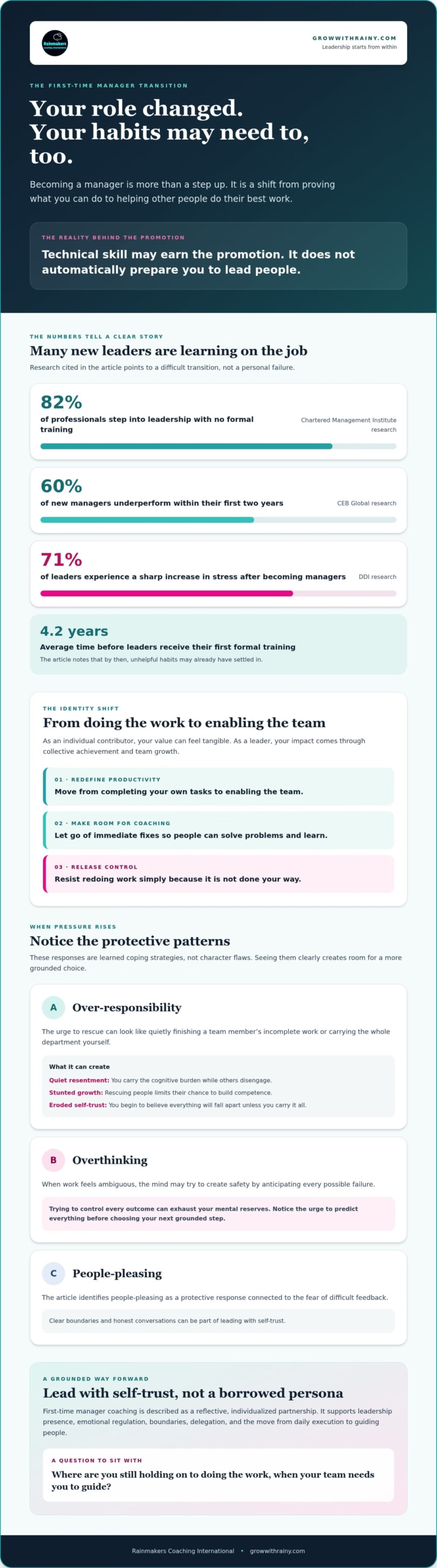
According to research by the Chartered Management Institute, 82% of professionals step into leadership with zero formal training. If you were recently promoted above your former peers, you know the quiet friction of that reality. Yesterday you shared lunch and vented about project deadlines; today, you are expected to assess performance and maintain accountability. It is natural to experience self-doubt, often slipping into over-responsibility simply to keep everyone comfortable. This internal tension is why first time manager coaching begins with reconnecting with your truth rather than forcing rigid corporate scripts.
In this guide, you will discover how first time manager coaching helps you release chronic second-guessing, soften protective patterns like perfectionism, and lead with grounded authority. We will explore practical ways to establish clear boundaries, hold difficult feedback conversations that protect psychological safety, and shift smoothly from daily execution into authentic, trust-centered leadership.
Key Takeaways
- Understand why technical competence alone does not prepare you for leadership, and how to navigate the delicate shift of managing former peers.
- Identify how learned protective patterns such as Over-Responsibility and Overthinking trigger quiet exhaustion and decision paralysis.
- Discover why personalized first time manager coaching creates deep, lasting behavioral change that generic group workshops cannot deliver.
- Establish grounded boundaries and master confident delegation by anchoring your daily leadership choices in genuine self-trust.
- Apply the Rainmaker Transformation System™ to uncover your natural leadership presence from the inside out, rather than wearing an artificial corporate persona.
What Is First-Time Manager Coaching and Why Is It Hard?
Most professionals assume stepping into management is simply a step up in rank. In reality, it is a complete identity shift. First time manager coaching is not about handing you a checklist of administrative duties. It is a reflective, personalised partnership focused on leadership presence, emotional regulation, and self-trust. When you transition from executing tasks to guiding human beings, your internal measure of worth gets tested every day.
Technical competence got you promoted, but it rarely prepares you to lead. CEB Global research shows that 60% of new managers underperform within their first two years. This struggle rarely comes from a lack of intelligence. It stems from the promotion paradox: the exact habits that made you a star individual contributor, like solving every problem alone, become liabilities when you manage others. Suddenly, you must navigate delicate interpersonal dynamics, particularly when leading former peers who used to be your sounding board. That shift creates emotional friction. Working with an external partner gives you the psychological safety to process self-doubt and unlearn high-pressure habits without fearing judgment from internal company stakeholders.
The Shift from Individual Contributor to People Leader
Stepping back from direct execution feels uncomfortable. As a contributor, your value was clear and tangible: completed code, delivered campaigns, or closed sales. As a leader, your output is measured through collective achievement and team growth. To make this shift, consider three necessary changes:
- Redefining productivity: Moving away from personal task completion toward team enablement.
- Creating coaching space: Letting go of immediate fixes so your direct reports learn through their own problem-solving.
- Releasing control: Resisting the urge to quietly redo work that does not match your exact personal style.
Why Traditional Onboarding Fails New Managers
Standard corporate training often addresses policy while ignoring human emotion. Research indicates that leaders receive their first formal training an average of 4.2 years after taking the job. By then, unhelpful habits have already settled in. Generic workshops teach theoretical frameworks, yet they cannot rewire an automatic freeze response when you face team resistance or an awkward performance conversation. Tailored first time manager coaching looks deeper than procedural manuals. It helps you untangle the specific internal pressures you feel under stress, replacing reactive tension with calm, grounded authority.
Where in your work are you still clinging to the safety of doing, rather than stepping into the vulnerability of guiding?
The Hidden Protective Patterns That Challenge New Managers
When the initial excitement of a promotion fades, anxiety often takes its place. DDI research indicates that 71% of leaders experience a sharp increase in stress after stepping into management. What looks like simple burnout on the surface is usually something deeper: learned protective patterns surfacing under pressure. These patterns are not character flaws or clinical disorders; they are coping mechanisms developed earlier in your career to keep you safe and successful.
First time manager coaching treats these responses as learned strategies rather than personal failures. A foundational Rainmakers Coaching International principle reveals that Overthinking is often an attempt to create safety by eliminating uncertainty. When a workplace feels ambiguous, your mind races to anticipate every failure point before it happens. However, trying to control every outcome only exhausts your mental reserves.
Over-Responsibility and the Urge to Rescue
High performers often carry Over-Responsibility. If a team member turns in an incomplete slide deck or struggles with client analysis, your instinct may be to stay late and quietly finish it yourself. This protective habit creates an unsustainable dynamic:
- Quiet resentment: You shoulder the cognitive burden of the entire team while your direct reports disengage.
- Stunted growth: Rescuing colleagues deprives them of the opportunity to learn from grounded setbacks and develop true competence.
- Eroded self-trust: You convince yourself that unless you carry the entire department, everything will fall apart.
People-Pleasing and the Fear of Difficult Feedback
Another core Rainmakers Coaching International principle reminds us that People-Pleasing is often a strategy for preserving love, safety, and belonging. When you suddenly manage former lunch mates, holding firm standards feels risky. You worry that delivering candid feedback will damage friendships or make you seem arrogant. Instead of honest redirection, you soften the truth or avoid hard conversations entirely. Moving from approval-seeking to grounded authority means realizing that clarity is the kindest gift you can offer your team.
Perfectionism and Analysis Paralysis Under Pressure
Perfectionism demands flawless execution as a shield against criticism. In a managerial role, waiting for complete certainty leads directly to decision paralysis. When you feel stuck in this loop, explore your internal drivers during a 90-minute coaching conversation to begin reconnecting with your truth. Building executive presence is not about knowing every answer; it is about trusting yourself to make sound calls amid incomplete data and realigning when circumstances change.
Which protective pattern are you currently using to shield yourself from the vulnerability of leading?
Group Leadership Workshops vs. One-on-One First Time Manager Coaching
When organizations look to support new leaders, the default solution is almost always a group seminar. You sit in a boardroom or join a video call, flipping through slides on delegation models and active listening frameworks. These programs offer helpful conceptual knowledge. Yet, knowing a framework intellectually does not stop your pulse from racing when you must address persistent poor performance with someone who was previously your equal.
This is where tailored first time manager coaching fundamentally differs from group events. Group training assumes leadership challenges are uniform, relying on standardized templates. In contrast, 1:1 leadership coaching focus on the person behind the title. They provide a confidential, high-trust environment where you can safely unpack vulnerable self-doubt without worrying about how your peers or HR leaders perceive you.
Comparing Development Methods for Emerging Leaders
To understand which support model fits your current growth stage, consider how these approaches handle everyday pressures:
| Dimension | Group Leadership Workshops | One-on-One Developmental Coaching |
|---|---|---|
| Depth | Broad frameworks and generalized management theory | Deep inquiry into personal behavioral patterns and inner drivers |
| Confidentiality | Low to moderate; shared in front of organizational peers | Complete; a private container to voice doubts and test ideas |
| Behavioral Shift | Often short-lived once daily deadlines intervene | Sustained reconditioning through real-time practice and accountability |
| Core Focus | Acquiring procedural tactics and administrative skills | Rebuilding genuine self-trust and grounded authority |
Slide decks cannot resolve the nuanced, real-time dilemmas you face on Monday morning. They cannot teach you how to remain calm when a direct report openly challenges your decision during a department meeting. Dedicated coaching bridges that gap by using your actual workplace interactions as live case studies.
When to Choose Individual Executive Coaching
While group seminars work well for basic onboarding policies, certain turning points demand personalized executive coaching. Choose one-on-one support when imposter feelings lead to chronic hesitation, or when you find yourself caught in complex cross-functional politics. If you want to refine your poise and command authority without aggressive posturing, explore our guide on executive presence for senior leadership alignment.
Are you relying on safe, theoretical advice to solve challenges that actually require honest inner work?
Core Capabilities Developed Through First Time Manager Coaching
Theoretical leadership models sound simple in a book. Executing them under pressure is an entirely different experience. First time manager coaching translates conceptual leadership principles into grounded interpersonal capabilities. It focuses on how you manage your internal state so you can lead others without reactive tension or defensive posturing.
According to DDI leadership research, only 19% of rising leaders demonstrate the necessary delegation skills required to operate effectively as managers. This gap exists because letting go feels like losing control. Sustained coaching builds four central capabilities:
- Cultivating self-trust to delegate: Moving from hyper-vigilance to trusting your direct reports with meaningful ownership.
- Grounding performance conversations: Conducting clear evaluations without slipping into artificial harshness or apologetic softness.
- Internal emotional regulation: Staying composed during managerial friction so your team feels grounded and secure.
- Setting sustainable boundaries: Defining work limits that prevent personal burnout while granting your team room to execute.
Empowered Delegation Without Micromanagement
True delegation is not task dumping; it is an intentional developmental opportunity for your team. When you hand off a complex project, define the final outcome clearly, but leave the path to get there open. This requires overcoming the impulse to check in every hour. Read our perspective on building rock solid confidence while stepping into authority to understand how releasing day-to-day control deepens collective capability.
Mastering Crucial Conversations and Honest Feedback
Holding someone accountable does not require an aggressive demeanor. Gallup research demonstrates that managers account for roughly 70% of the variance in team engagement. How you deliver feedback sets the tone for your team’s psychological safety. When you speak with empathetic clarity, you address performance gaps directly without damaging personal trust or resorting to bureaucratic corporate scripts.
What conversation are you currently postponing because you fear disrupting workplace harmony?
Reclaiming Self-Trust: The Rainmaker Transformation System™ for New Leaders
Leadership transformation doesn’t happen by putting on a performance. Many new managers believe they must construct an unshakeable corporate persona to be taken seriously. They mimic the posture of senior executives, hoping it will mask their inner uncertainty. True growth works in the exact opposite direction: from the inside out. Real development isn’t about fixing broken professionals; it’s about uncovering your innate strengths and reconnecting with your truth.
The Three Stages of the Rainmaker Transformation System™
Grounded in more than a decade of coaching leaders, the proprietary Rainmaker Transformation System™ guides emerging leaders through a deliberate three-stage journey:
- Release: You identify and let go of outdated protective patterns like Overthinking, Perfectionism, or Over-Responsibility. These learned strategies helped you succeed as an individual contributor, but they now hinder your ability to empower a team.
- Reprogram: You challenge deep-seated assumptions around authority, personal worth, and control. Instead of feeling that you must carry every answer, you reframe your role as a facilitator of collective capability.
- Recondition: You embody these internal shifts through daily leadership practices. You learn to hold steady boundaries, conduct transparent feedback conversations, and trust your direct reports without hovering.
Moving through these stages frees you from managing out of fear. You cultivate lasting self-trust so your decisions carry quiet, grounded authority. Learn more about our approach to executive coaching with Rainmakers Coaching International for growing professionals ready to step into authentic leadership.
Taking Your First Step Toward Grounded Leadership
Investing in first time manager coaching early in your transition takes real courage. A Gartner study reveals that 75% of HR leaders report managers are overwhelmed by their expanding responsibilities, while 40% of newer managers struggle to support their direct reports. You don’t have to carry that weight alone or wait until chronic exhaustion forces your hand.
Personalized coaching provides a reflective, deeply human partnership tailored to your daily workplace realities. It offers a calm, confidential space where you can dismantle protective habits and step into leadership with genuine presence.
You already have what it takes to guide your people well. Give yourself permission to release the need for flawless certainty, and lead with steady, quiet confidence.
Frequently Asked Questions
How is first time manager coaching different from regular management training?
First time manager coaching focuses on inner behavioral shifts and leadership identity rather than procedural corporate policies. Traditional training teaches administrative rules or high-level models in a classroom. Coaching offers a confidential space to explore real-time interpersonal tension, unseat protective habits like overthinking, and build grounded self-trust. It transforms who you become as a leader instead of merely adding knowledge to your head.
What are the biggest challenges new managers face that coaching helps solve?
New managers struggle most with shifting from doing the work to guiding others, delegating complex projects, and handling difficult feedback conversations. These challenges often trigger learned protective patterns like Over-Responsibility and Perfectionism. Coaching helps you identify these behavioral strategies, step back from hyper-vigilant control, and build clear boundaries without feeling constant guilt or fearing professional judgment from your team.
Can coaching help me if I am struggling to manage former peers?
Yes, coaching directly resolves the emotional friction of managing former peers by helping you establish grounded authority while protecting team trust. When you lead former colleagues, approval-seeking and the fear of creating conflict can paralyze your decision-making. Coaching guides you to reframe boundaries not as cold distance, but as a structure that provides psychological safety, mutual respect, and honest clarity for everyone involved.
How do I know if I need one-on-one leadership coaching or a standard training workshop?
You need one-on-one leadership coaching when your challenges involve personal self-doubt, decision paralysis, or interpersonal friction rather than a basic lack of company policy knowledge. Workshops provide broad, conceptual frameworks that work well for basic onboarding. If you find yourself consistently second-guessing decisions, avoiding performance talks, or feeling like an imposter, a personalized coaching partnership gives you the tailored depth and psychological safety required to transform how you lead.
What is the Rainmaker Transformation System™ and how does it support new leaders?
The Rainmaker Transformation System™ is a proprietary three-stage coaching framework consisting of Release, Reprogram, and Recondition, designed to produce sustainable inner transformation. For new leaders, it works by first identifying and releasing outdated protective habits like over-functioning. Next, you reprogram your beliefs around authority and personal worth. Finally, you recondition your daily habits, embodying grounded presence and self-trust in real team interactions.
How does coaching help first-time managers prevent personal burnout and exhaustion?
Coaching prevents burnout by uncovering the protective patterns that compel you to rescue others and shoulder everyone’s workload. Emerging leaders often carry Over-Responsibility, quietly stepping in to redo tasks or work late to cover team gaps. Coaching helps you break this cycle by cultivating self-trust and delegating effectively. You learn to hold firm standards without absorbing unnecessary emotional weight, protecting both your energy and your team’s autonomy.
What tangible outcomes can I expect from engaging in first time manager coaching?
Engaging in first time manager coaching results in decisive delegation, clearer feedback conversations, and a calm, authentic leadership presence. Rather than managing through reactive anxiety or rigid corporate scripts, you develop the emotional regulation needed to navigate high-stakes crises. You gain the confidence to lead former peers with empathy, make firm choices amid ambiguity, and foster genuine psychological safety across your entire team.

Article by
Rainy Rainmaker
Rainy Rainmaker is the founder of Rainmakers Coaching International and a transformational coach for confidence, self-trust, and authentic leadership. Based in Singapore, she helps high-achieving professionals, managers, and leaders who appear capable on the outside but feel quietly held back by self-doubt, overthinking, imposter feelings, burnout, or a loss of direction. Through her signature Rainmaker Transformation Journey™, Rainy helps clients uncover the insights already within them and turn inner clarity into aligned action that creates lasting change in how they work, lead and live.
