
Should you stay in your current role, move to a different organisation or change direction altogether? A career transition can raise questions about income, identity and what you want from your working life. Career transition coaching can help you make sense of those questions and assess your next move with greater clarity.
That means considering practical realities alongside your strengths, values and priorities. It may also involve recognising how fear of making the wrong choice or expectations from others could influence your decision. Understanding these influences can help you distinguish what you want from what you feel you should do.
In this guide, you’ll learn what career transition coaching can offer, how to clarify what matters in your next chapter and how to decide whether coaching fits your needs. You’ll also consider ways to move forward without needing every detail settled in advance.
Key Takeaways
- Career transition coaching can help you clarify what matters before committing to a new direction.
- Separate what you’re dissatisfied with from what you want more of, less of, and want to preserve.
- Coaching supports reflection and personal clarity. Mentoring, recruitment, and self-guided reflection serve different purposes.
- Rainmakers’ inside-out approach uses Release, Reprogram, and Recondition to explore patterns and reconnect with your innate gifts.
- Use the reflection prompts in this article to consider a next step without waiting for perfect certainty.
Career transition coaching: when a work change needs more than a new plan
Your role looks good on paper. You’ve built experience, earned trust, and may even hold a position you once worked hard to reach. Yet when you picture the next chapter, the answer doesn’t come easily. Is this a passing feeling, a sign that something needs to change, or a question you haven’t had room to consider?
Career transition coaching helps you examine what matters, clarify possible directions, and make choices with greater self-trust. It doesn’t assume you need to resign or promise a particular outcome. The focus is understanding your experience before deciding what action, if any, feels right.
A transition can involve more than changing employers or entering a new industry. It may mean stepping into leadership, shifting responsibilities, returning to work that feels meaningful, or reconsidering a path you’ve followed for years. Sometimes the change is in how you see yourself at work, or in the priorities you want your career to support.
Career counseling is a related field with its own history and practices. For a broader introduction, see this overview of career counseling. This article focuses on reflection: understanding your inner experience as part of making decisions about your working life.
What can count as a career transition?
A transition might be a move from specialist to manager, a return to work after time away, or a renewed search for purpose within your current profession. It could also mean staying with your employer while changing your role, boundaries, or priorities. The first step doesn’t have to be choosing a destination. It can be noticing that your current direction no longer feels settled, then becoming curious about what you want instead.
You may still value your field and colleagues while wanting a different way to contribute. Or you might not know whether the issue is your role, your environment, or the expectations you’ve placed on yourself. That uncertainty doesn’t make your experience less valid. It gives you something useful to explore.
When might coaching be useful?
Coaching may help if you find yourself circling the same decision, repeatedly second-guessing what you want, or noticing a gap between your values and your daily work. These experiences don’t automatically mean something is wrong. They can be invitations to pause and listen more carefully.
Instead of rushing to answer, “What should I do next?”, explore the question beneath it. What are you hoping a new role will give you? What feels difficult to express in your current work? What would you want to keep, even if other things changed? Your answers may reveal whether you’re seeking a new destination or a different relationship with work.
Career choices often touch leadership, identity, and life beyond the workplace, so it can help to look at them together. Rainmakers’ inside-out life coaching approach reflects this connection between your inner experience and how you work, lead, and live. What might become clearer if you gave yourself room to explore before deciding?
How career transition coaching builds clarity from the inside out
It’s tempting to respond to career uncertainty by gathering more options: roles to explore, skills to build, paths to compare. Information can help, but it can also add noise if you haven’t asked what matters to you. Career transition coaching makes space to look beneath the choices and notice what you want your work to express.
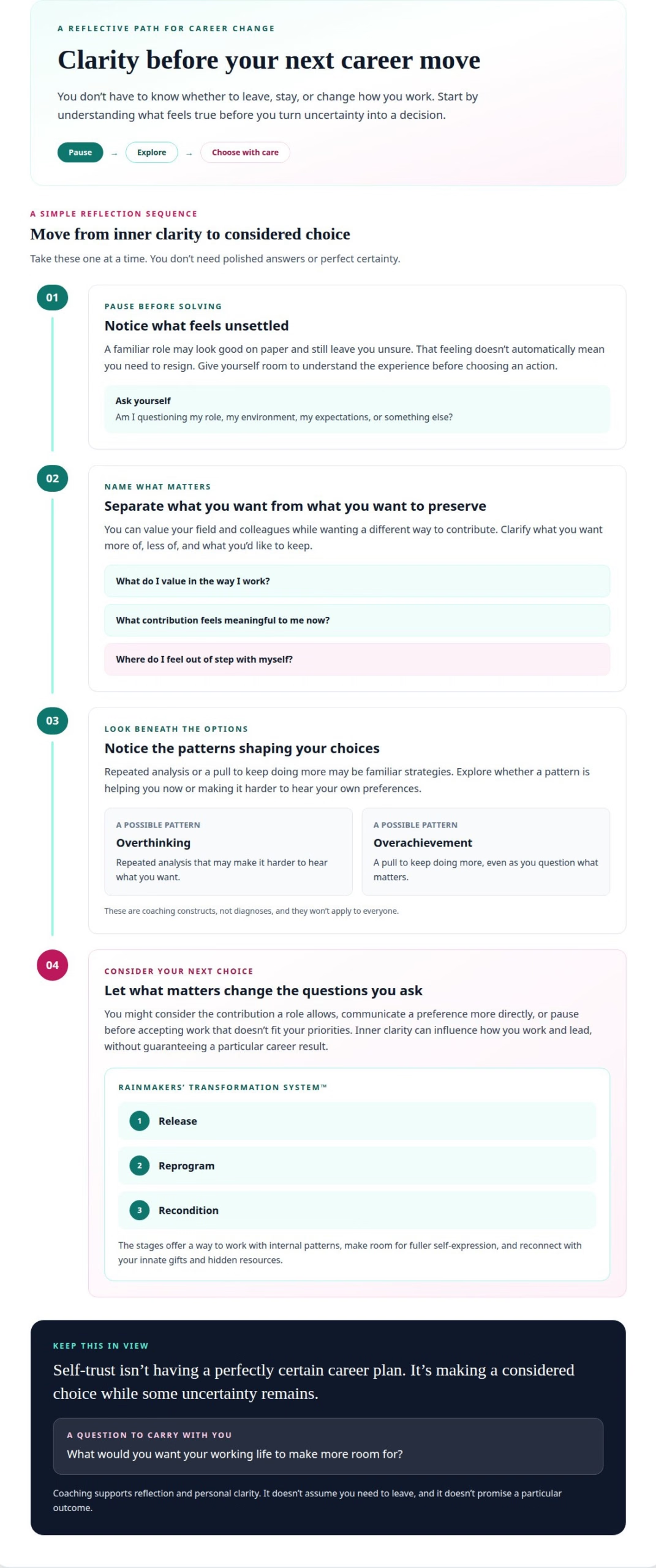
Try starting with three questions: What do I value in the way I work? What contribution feels meaningful to me now? Where do I feel out of step with myself? You don’t need polished answers. Even a small observation, such as wanting more room to create or less pressure to prove yourself, can give your thinking a clearer point of reference.
What does inside-out career coaching explore?
Inside-out coaching considers how your values, expectations, and learned strategies may shape the way you approach work. For example, you might notice Overthinking showing up as repeated analysis, or Overachievement as a pull to keep doing more. These are coaching constructs, not diagnoses, and they won’t apply to everyone. The point is to explore whether a familiar pattern is helping you now or making it harder to hear your own preferences.
Rainmakers’ Transformation System™ names three stages: Release, Reprogram, and Recondition. Together, they offer a way to work with internal patterns rather than simply add another external plan. The focus is making room for fuller self-expression and reconnecting with your innate gifts and hidden resources. For a broader professional perspective on coaching, the National Career Development Association’s discussion of Career Coaching offers useful context about the field.
How can inner change influence external choices?
When you understand what matters to you, the questions you bring to a decision may change. You might weigh a role not only by its title, but by the kind of contribution it allows. You may communicate a preference more directly or pause before accepting work that doesn’t fit your priorities. These shifts can influence how you work and lead, though they don’t guarantee a particular job offer, promotion, or career result.
Self-trust isn’t having a perfectly certain career plan. It’s being able to make a considered choice while some uncertainty remains. The National Career Development Association’s resource can inform your understanding of coaching, while personal reflection can help you notice what feels true in your own situation.
If you’re curious about exploring your transition in conversation, you can explore whether coaching fits your transition. What might become possible if you trusted yourself to take one grounded step before you had the whole path mapped?
Career transition coaching, career advice, or recruitment: what is the difference?
These terms can sound interchangeable when you’re trying to decide what kind of support would help. They aren’t. Coaching helps you understand your direction; mentoring can offer perspective from another person’s experience; recruitment connects candidates with roles. Knowing the difference can help you choose what you need now, without expecting one kind of support to do everything.
Career transition coaching creates space to examine your choices, motivations, and work patterns. At Rainmakers, Career Coaching focuses on self-understanding and direction. It can support your decision-making, but it doesn’t take the decision out of your hands.
What does a career coach do, and what does a recruiter do?
A coach helps you reflect on what you want, what may be influencing your choices, and what feels aligned with your values. A recruiter has a different function: working within a hiring process to connect candidates with roles. These forms of support serve different needs. Career coaching centres on personal reflection and direction, while practical guidance may focus on communicating your experience and exploring opportunities.
Rainmakers Career Coaching focuses on building self-understanding and reconnecting with your own resources so you can consider your direction with greater clarity.
| Type of support | What it can help with |
|---|---|
| Coaching | Exploring direction, choices, values, and inner patterns that may shape your decisions and influence your actions. |
| Mentoring | Learning from another person’s experience and receiving perspective, advice or suggestions based on what has worked from them. |
| Recruitment | Connecting candidates and employers within a hiring process. |
| Self-guided | Considering your priorities independently through journalling, self-reflection, or self-help books, podcasts. |
Is coaching the right support if you are uncertain?
You don’t need to arrive with a clear destination. You might start with a question, a sense of restlessness, or two possible paths that both matter to you. Coaching can help you slow down and examine what sits beneath the options, rather than rushing to choose simply to end the uncertainty.
At another point, you may want practical information or perspective from someone with relevant experience. Different kinds of support can serve you at different moments. The useful question is not which one is best in general, but what would help now.
Coaching can support a decision without making it for you. It offers insights that you can use to guide your decisions making. What kind of support would help you hear your own judgement more clearly?
A practical career transition coaching reflection before your next move
You don’t have to resign or map out your whole future to begin. A few honest questions can help separate what feels difficult now from what you want your working life to become. Set aside some quiet time and write without trying to make your answers sound sensible to anyone else.
What do you want your next chapter to make room for?
Start with what’s happening today, then look beyond the dissatisfaction. For each prompt, write the first answer that feels true, even if it’s incomplete:
- More of: What kind of contribution, working relationships, pace, or responsibility would you welcome?
- Less of: Which expectations, tasks, or conditions are taking more from you than you want to keep giving?
- Keep: What do you value about your current work, profession, team, or accumulated experience?
Now consider what you would miss if you left your current path. Perhaps it’s the people, the subject matter, or the chance to make a meaningful contribution. Naming what you want to preserve can stop a difficult aspect of work from defining the whole picture.
Notice whose expectations appear in your answers. Are you measuring a satisfying working life by a title, a familiar idea of success, or what others would approve of? Those things may matter to you, but they don’t have to decide for you. Write down what a good working life means in your own words, including how you want to feel about the way you spend your time and use your strengths.
What is one grounded next step?
Look over your notes and choose one small action that could help you learn more. You might talk with someone whose work interests you, reflect on your values, or explore whether an internal role could offer a different kind of contribution. If you’re a senior leader, the career misalignment model for senior leaders can offer a lens for considering fit.
Keep the step small enough to take without turning it into a promise to change everything. Ask yourself: What information would genuinely help me decide? That’s different from asking for more proof that you’re capable. You may already have enough evidence of your capability. The question could be what you want to use it for now.
Career transition coaching can help you explore what these answers mean when the next step still feels unclear. You don’t need to force a final decision from one reflection. Let your notes be a starting point, then notice what continues to feel important as you move through your week.
What career transition coaching with Rainmakers can look like
A career question can carry more than a choice between roles. It may touch how you see yourself, what you believe you must prove, or which parts of your experience you haven’t fully used. Rainmakers Career Coaching offers inside-out support for experienced professionals and leaders in transition, creating space to explore those inner influences alongside the decisions in front of you.
Rainy Rainmaker has more than a decade of coaching experience. The focus is not on giving you another strategy to follow or asking you to become someone else. It’s on reconnecting with self-trust, noticing the resources you already carry, and making room for a fuller expression of who you are.
How does the Rainmakers approach support a career transition?
The Rainmakers Transformation System™ brings this work together through Release, Reprogram, and Recondition. Rather than treating the stages as a formula for a particular job outcome, the approach supports your transition journey – exploring what may be influencing your choices and identifying what feels more aligned with your values and pursuing it.
For example, if you notice that an old expectation is shaping what you believe you’re allowed to pursue, you can begin to examine it. That inner shift may influence how you communicate, lead, or consider a different direction. The work is about sustainable change and reconnecting with your own gifts, not following a prescribed version of success.
When might a coaching conversation be a useful next step?
You don’t need to know exactly where you’re going. A willingness to reflect is enough to begin. You might bring a decision you’re weighing, a question you keep returning to, or simply the feeling that your current direction no longer fits as it once did.
There’s no need to arrive with a polished plan. Start with what feels unclear. What are you hoping to understand about yourself and your work? What would you like to trust yourself to explore?
Let your next step begin with what feels true. You don’t need to turn uncertainty into an immediate, life-changing decision. Let it point you towards a question worth listening to. What would you choose if you weren’t trying to satisfy everyone else’s expectations? What small step could help you learn more about the kind of work you want?
Career transition coaching can offer a considered space to explore those questions and reconnect with your judgement. You can bring your doubts, competing priorities, or a possibility you’re not yet ready to name. The aim isn’t to force certainty. It’s to meet yourself honestly and decide what feels grounded enough to explore next. If a conversation would help you hear your own thinking clearly, you can take that step in your own time.
You’re allowed to move at a thoughtful pace. A clearer direction can begin with one honest question and the willingness to stay curious about your answer.
Frequently Asked Questions
Is career transition coaching only for people changing industries?
No. A transition can happen within the same industry or even the same organisation. You might be considering a move into leadership, a different role, or priorities that better reflect your current stage of life. Career transition coaching can help you explore what you want from that change without assuming you need to leave your field. For example, you may want to contribute differently while keeping the expertise and relationships you’ve built.
Can career coaching help if I do not know what I want to do next?
Yes. You can begin with uncertainty, without arriving with a finished career plan. Reflecting on what gives you energy, what feels draining, and which priorities matter now can help you notice possibilities you hadn’t considered. You might start by comparing what you value in a typical workday with what your current routine allows. Coaching supports your own thinking and choices, without promising one final answer.
Is career transition coaching useful if I am not ready to resign?
Yes. Thinking about change doesn’t mean you have to resign. You might use coaching to examine a recurring frustration, identify what you still value in your current role, or clarify which conversations you want to have before making any decisions. For instance, you may want to understand whether a change in responsibilities could address what feels difficult. Reflection can help you move at a considered pace, without deciding prematurely whether to stay or leave.
How is career transition coaching different from career counselling?
The terms and approaches can vary, so there isn’t one universal distinction. Rainmakers Career Coaching focuses on self-understanding, direction, self-trust, and the choices you want to make in your working life. If you’re weighing different forms of support, consider the kind of help you need, such as personal reflection, or support with a different concern.
Can a career coach find me a job or write my CV?
Career Coaching focuses on exploring direction and the inner factors that may shape professional choices, rather than managing a job application. For example, you might reflect on why a certain opportunity appeals to you, or what you want your next role to make room for. This distinction can help you understand what kind of support you’re seeking.
How can I tell whether career coaching is helping?
Notice what’s changing in how you relate to your choices. Are you clearer about which priorities matter? Can you consider an option without immediately dismissing your own judgement? You might also notice yourself expressing a preference more directly at work. These are reflections, not a formal scorecard or guaranteed results. A new title or job offer isn’t the only meaningful sign of movement, and coaching alone can’t determine external outcomes.

Article by
Rainy Rainmaker
Rainy Rainmaker is the founder of Rainmakers Coaching International and a transformational coach for confidence, self-trust, and authentic leadership. Based in Singapore, she helps high-achieving professionals, managers, and leaders who appear capable on the outside but feel quietly held back by self-doubt, overthinking, imposter feelings, burnout, or a loss of direction. Through her signature Rainmaker Transformation Journey™, Rainy helps clients uncover the insights already within them and turn inner clarity into aligned action that creates lasting change in how they work, lead and live.
