

Feeling stuck doesn’t automatically mean you need to leave. Navigating career stagnation in middle management starts with identifying whether the constraint is your role, your organisation, or a growing mismatch between your work and what matters to you. Then you can decide whether to reshape your role, pursue a different one, or plan a career change.
If you’ve been carrying responsibility without gaining energy, influence, or room to grow, it makes sense to question your next move. Being passed over, facing limited opportunities, or losing interest in familiar work can feel personal, but these experiences can also offer useful information. Look clearly at what’s happening before making a decision from frustration or self-doubt.
Here, you’ll learn how to recognise common setbacks and signs of stagnation, reconnect with your interests and aspirations, and assess your resilience as you consider what comes next. You’ll also find practical ways to create more meaningful growth in your current role, so your next step can come from self-trust and clarity rather than pressure.
Key Takeaways
- Separate a difficult career setback from a longer-term plateau by noticing what has changed in your growth, energy, and opportunities.
- Prepare a focused conversation with your manager about the challenges and responsibilities that would help you grow.
- Use your interests and changing definition of success to assess whether your current path still fits.
- If you’ve been overlooked, make your aspirations visible and look for meaningful ways to contribute to new work.
- Understand the causes of stagnation before deciding whether to reshape your role, seek a new one, or change direction.
1. What Are the Types of Career Setbacks?
A setback can be visible, like a demotion or job loss, or quieter, like repeatedly being passed over for promotion. Temporary layoffs, poor performance reviews, and extended time away for personal or health reasons can also interrupt growth. These experiences have different causes. Name what happened before deciding what it means for your future.
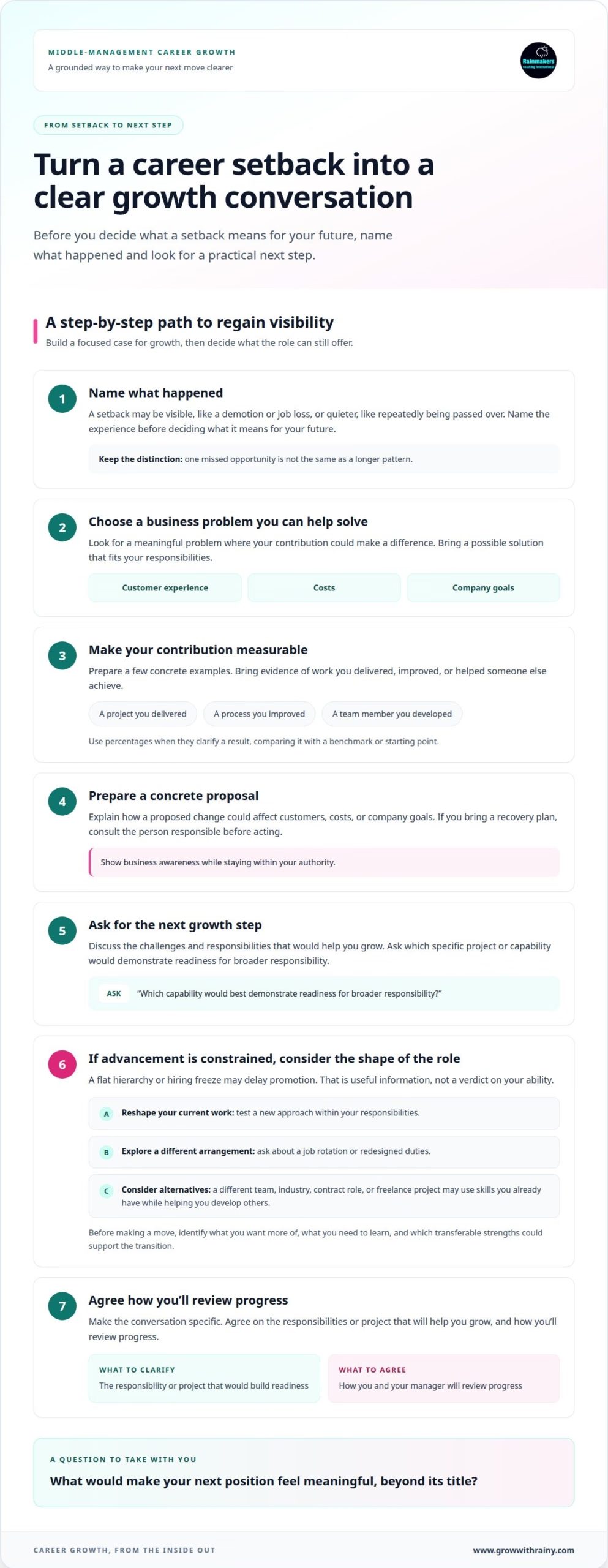
To regain visibility and improve your prospects for advancement, choose a business problem you can help solve, make your contribution measurable, and discuss the next growth step with your manager. Ask for specific responsibilities or projects that would demonstrate readiness, then agree on how you’ll review progress.
Make the conversation concrete. If you lead a team handling delayed projects, explain how a proposed change could affect customers, costs, or company goals. Bring a possible recovery plan, and consult the person responsible before acting. This shows business awareness without stepping outside your authority. Ask your manager which capability would best demonstrate readiness for broader responsibility.
Prepare examples before the meeting. List a project you delivered, a process you improved, or a team member you helped develop. Where percentages clarify the result, use them to compare your achievements with a benchmark or starting point, as the Ministry of Manpower, Singapore, notes. This gives the discussion a useful reference instead of relying on a general claim that you’re ready.
A setback can also reveal that your current role has become too narrow. If a promotion is delayed because your organisation has a flat hierarchy or a hiring freeze, consider what you can still learn or influence. Propose testing a new approach within your responsibilities, or ask about a job rotation or redesigned duties. Treat the experience as information, not a verdict on your ability.
If the role no longer offers a credible path, explore alternatives deliberately. A different team, industry, contract role, or freelance project may use skills you already have while helping you develop others. Before making a move, identify what you want more of, what you need to learn, and which transferable strengths could support the transition. A temporary opportunity can help you test a direction before committing to a larger change.
A mentor can help make a stalled period more manageable. Ask an experienced colleague to help you examine a promotion decision, practise a conversation with your manager, or identify a skill gap. If you mentor others yourself, that contribution can create value beyond a title change. The next step isn’t always a new position. Sometimes it’s a clearer development plan and a role with room to grow.
2. Aligning career goals with interests and aspirations
Middle managers can assess their skills, achievements, and goals by reviewing recent work, naming the strengths each task called on, and deciding what they want to contribute next. For example, leading a complex handover may reveal a stronger interest in developing people than managing processes. That distinction can reshape the next position you pursue.
Career direction can blur when promotion becomes the only measure of progress. If a senior title no longer feels compelling, pause and identify what you hoped it would bring: greater influence, more meaningful work, or a chance to shape decisions. The title and the aspiration behind it aren’t always the same. Knowing the difference helps you move forward with intention.
Try a three-part reflection. First, write down tasks that give you energy and those that leave you depleted. Next, identify the skills and values behind each response. Then picture a workday in a future role: would you rather coach team leaders, improve customer experience, or guide business decisions? Specific examples make broad ambitions easier to explore.
Losing sight of professional goals doesn’t mean you’ve lost your drive. It can signal that an old definition of success no longer fits your life or interests. A manager who once sought a regional leadership role might now value deeper expertise, greater autonomy, or more time for family. Treat that shift as information, not a failure to overcome.
Turn the reflection into a long-term direction, then connect it to a practical next step. If you want to lead across functions, identify an experience that would build your understanding of other teams. If you want to become a specialist, choose a capability to deepen and look for work that uses it. Your career path becomes clearer when each step has a reason.
Researching possible career paths can help you test whether your aspirations match the work itself. Speak with people in roles that interest you, review the responsibilities, and compare them with the strengths you want to use. For a manager considering a move from operations into people development, a conversation with a leader in that area may reveal both the appeal and the everyday demands.
Then choose a direction to explore, not a permanent promise. Set a grounded goal, such as taking on a relevant responsibility or learning more about a different function, and decide what evidence would help you evaluate the fit.
If your next move feels difficult to clarify, a conversation about your career direction can help you reconnect with what matters. What would make your next position feel meaningful, beyond its title?
3. Being overlooked for projects or promotions
Being passed over can sting, especially when you’ve carried responsibility without recognition. Before deciding what it means, separate the outcome from the story forming around it. Was one project assigned elsewhere, or have you repeatedly missed opportunities? Note the roles, decisions, and feedback involved. A pattern gives you clearer ground for a focused conversation than one painful moment.
Ask your manager what they considered when selecting someone for the project or promotion. Keep the question specific: “Which experience would help me be considered for the next cross-functional initiative?” Listen for concrete criteria, such as leading through uncertainty, influencing other teams, or communicating business impact. If the answer remains vague, ask for an example of what readiness would look like in your current role.
Make your interest visible before the next opportunity appears. Tell your manager which responsibilities you want to take on, and connect that goal to a business need. For example, if a customer handover creates repeated confusion, offer to coordinate a focused improvement effort. A clear proposal helps others see your initiative and how your contribution could support the team.
Visibility isn’t about speaking the most in every meeting. It comes from making useful work easy to understand. When updating senior leaders about a project, state the issue, its effect on customers or company goals, and a possible response. If a delivery date is at risk, explain the likely impact and suggest a recovery plan. This shifts the discussion from activity to judgement.
Middle managers aiming for senior leadership can also show readiness through the people they develop. Help team members strengthen their skills, improve how the team works together, and connect its priorities with company goals. For instance, explain how a change in team practice supports a wider objective. These contributions demonstrate leadership beyond personal output, without claiming authority you don’t hold.
If you’re overlooked again, use the feedback to decide what to do next. Identify a capability to practise, an opportunity to pursue, and a time to review progress with your manager. Volunteer for a project that stretches your experience, but don’t accept extra work without understanding its purpose. Focused effort is more sustainable when the assignment builds relevant skills or influence.
A promotion is one form of recognition, not the only measure of meaningful progress. If the same barriers remain after clear conversations and visible contributions, consider whether the role can offer the development you want.
What evidence would help you distinguish a temporary disappointment from a pattern that calls for a different move?
4. Emotional regulation and resilience
A career setback can bring disappointment, anger, or self-doubt before you know what it means. Give yourself space to feel the response without letting it make the decision for you. IQ PARTNERS’ recruiters recommend setting aside a defined period, such as a few days or a week, to process a setback. Use that time to reflect rather than sending an angry message or resigning impulsively.
Try a simple pause after difficult news. Write down what happened, what you’re feeling, and what you still need to understand. For example, after missing out on a promotion, separate the decision itself from the thought, “I’ll never progress here.” The first is a fact; the second is a conclusion. This distinction helps you return to the conversation with clearer questions.
Resilience doesn’t mean carrying every responsibility without support. Choose a trusted person, such as a mentor or former manager, and describe the situation without asking them to solve it immediately. Ask what they notice about your options or assumptions. A mentor can help you see whether a setback points to a skill you can build, an expectation to clarify, or a role that no longer fits.
Protect space for recovery in your actual schedule. Set boundaries around work hours, then identify which responsibilities need your attention first. The Eisenhower Matrix can help sort tasks by urgency and importance. For example, a client issue may need immediate action, while a routine report can wait. This makes priorities visible instead of letting every request feel equally pressing.
Work-life balance is easier to assess across a week or month than through a single demanding day. A late meeting may be manageable if you can recover time elsewhere, but a repeated pattern may leave little room for family, rest, or personal commitments. Review your calendar across the week. Notice where work expands and decide which boundary or conversation could restore a more sustainable rhythm.
Include self-care in that review. It might mean protecting time for sleep, movement, or a meal without work messages. These choices aren’t rewards you earn after completing every task. They help you stay present for the responsibilities you choose to carry. If family demands change, adjust the week’s priorities rather than judging yourself against an unrealistic daily ideal.
Once the first emotional wave has passed, identify a grounded next step. You might request clearer feedback, seek a mentor’s perspective, or set a boundary around an unsustainable workload. Then ask what the setback is showing you about your needs and values. What response would help you act with self-trust rather than from pressure to prove yourself?
5. Signs and causes of career stagnation
Career stagnation is more than a quiet month or a demanding project. It describes a plateau in growth, advancement, or challenge. A sign may be repeating familiar tasks without learning, losing interest in work that once engaged you, or seeing no path to broader responsibility. Glassdoor reports that 65% of professionals feel stuck in their careers, but the reasons behind that feeling can differ.
Look for two distinct forms of plateau. A hierarchical plateau means limited opportunities to move upward; a job-content plateau means the work itself no longer stretches your skills. A manager may enjoy leading a team but face a flat hierarchy. Another may hold a senior title yet repeat the same decisions each week. Each situation calls for a different response.
Organisational conditions can constrain advancement even when your performance is strong. A hiring freeze, budget cuts, or few management levels may reduce promotion opportunities. Ask whether you can gain broader experience through a new assignment, job redesign, or rotation. If the challenge is repetitive work, explore responsibilities that use different strengths or involve another team.
Time in the same role can be a useful prompt for reflection, not a verdict. Remaining in one position for more than three or four years without movement may signal stagnation, especially if your learning and influence have also narrowed. Compare your current work with your earlier responsibilities. Are you building new capabilities or mainly maintaining what you already know?
Notice how the situation is changing your behaviour. If you’re avoiding a project, delaying conversations, or feeling detached from team relationships, ask what those responses might be protecting you from. They could reflect frustration, a lack of development, or uncertainty about your future. Don’t treat one difficult week as proof. Look for a recurring pattern across your work and interactions.
Then separate what you can influence from what depends on the organisation. Write down the work that feels repetitive, the skills you want to use, and the opportunities available within your current team. Compare that picture with feedback from a manager or mentor. The World Economic Forum projects that 39% of existing skill sets will become outdated between 2025 and 2030, making skill development relevant even when a promotion isn’t available.
Your next move depends on the cause. If meaningful work remains available, propose a change that adds challenge and supports business needs. If growth is blocked by role design or company conditions, assess whether another position or career direction better fits your skills and aspirations. The key question isn’t simply, “Am I stuck?” It’s, “What is keeping me here, and what evidence would guide my next step?”
6. Rainmakers Coaching International: Career Coaching
Rainmakers Coaching International offers Career Coaching for middle managers seeking clearer direction, stronger self-trust, or a grounded next step. If you understand the challenges but still feel caught between staying and leaving, coaching can help you explore what may be shaping that uncertainty.
The approach is inside-out. Rather than adding external strategies alone, it helps you reconnect with your innate gifts and hidden resources while releasing outdated protective patterns. As your inner perspective shifts, you can make different choices in how you work, lead, and live. That inner change can support more sustainable transformation in your career and beyond.
If you’d like to explore your next step, contact Rainmakers Coaching International.
Choose a next step that feels true
You don’t need to map your entire career before moving. Choose one next step that helps you learn: a candid conversation, a new responsibility, or time to explore a different direction. Then notice what changes in your energy, confidence, and sense of meaning. That response is useful information, not a final verdict.
Navigating career stagnation in middle management can begin with a quieter question: what would you choose if you trusted your own experience? Let the answer guide a thoughtful action, rather than letting urgency or other people’s expectations decide for you. A grounded move can create room to see your options more clearly.
If you’d like support exploring that next step, start a conversation with Rainmakers Coaching International.
Your next chapter can begin with one honest choice. Take it at a pace that lets you stay connected to yourself.
Frequently Asked Questions
Should You Stay, Change Roles, or Change Careers?
Stay if your current role can still offer meaningful work and learning; explore another role if your organisation has opportunities that fit your direction. Consider a career change if the work itself no longer aligns with your interests, not simply because one decision disappointed you. When navigating career stagnation in middle management, compare each option with your values, financial responsibilities, and appetite for change before committing.
What Are the Types of Career Setbacks?
Career setbacks can affect employment, progression, performance, or personal availability. A project cancellation may interrupt development without reflecting your ability; a performance review may point to feedback you can act on. Time away from work can also change your priorities or confidence when you return. Separate the event from its effect: what changed in your responsibilities, options, or direction, and what can you influence now?
What are common signs and causes of career stagnation in middle management?
Look beyond job title. Ask whether your judgement is being used, your responsibilities are expanding, and your work still connects to meaningful outcomes. A manager may keep the same title while gaining influence, or hold a senior title while repeating familiar tasks. Causes can include limited organisational openings, changing business priorities, or a mismatch between your strengths and daily work. Compare your recent experience with what you want to develop next.
How should middle managers discuss career progression with their manager?
Make the conversation specific and collaborative. You might say, “I’d like to grow toward leading a broader function. What experience would help demonstrate readiness?” Bring an example of relevant work, then ask which capability matters most and how you can practise it. Agree on a follow-up and a way to review progress. If your manager names a gap, clarify what successful evidence would look like in your role.
What career paths can middle managers pursue besides promotion to senior management?
Progress can mean deepening expertise rather than adding direct reports. A manager might move into a specialist role, lead cross-functional programmes, develop people as a mentor, or shift into a function that better uses their strengths. Others may explore a different industry or independent project work. Compare each path’s daily responsibilities with the work you find meaningful, the skills you want to build, and the influence you hope to have.
When should a middle manager consider changing companies or industries?
Consider a move when the conditions limiting your growth seem persistent and conversations haven’t clarified a viable way forward. Before deciding, distinguish a temporary business constraint from a sustained mismatch in work, values, or development. Research the responsibilities and expectations of roles that interest you, and speak with people familiar with those fields. A change is more grounded when it addresses a clear need, not just a wish to escape a difficult period.
What risks and trade-offs come with a lateral move, reskilling, or starting a job search?
A lateral move may broaden your experience without increasing your authority; reskilling takes time and may not lead directly to a new role. A job search can offer useful market insight, yet add demands alongside current responsibilities. Before acting, identify what you might give up, what you hope to gain, and how you’ll manage the transition. A small learning project or exploratory conversation can help test your assumptions first.

Article by
Rainy Rainmaker
Rainy Rainmaker is the founder of Rainmakers Coaching International and a transformational coach for confidence, self-trust, and authentic leadership. Based in Singapore, she helps high-achieving professionals, managers, and leaders who appear capable on the outside but feel quietly held back by self-doubt, overthinking, imposter feelings, burnout, or a loss of direction. Through her signature Rainmaker Transformation Journey™, Rainy helps clients uncover the insights already within them and turn inner clarity into aligned action that creates lasting change in how they work, lead and live.
