A career transition coach helps you make sense of a possible career change, clarify what matters, and decide what to explore next. Career transition coaching is a thinking partnership: rather than telling you what to do, a coach uses questions and observations to help you make choices you can own. It can also help you connect your experience to a new direction without treating your past career as something to discard.
It’s understandable to want a clear answer before making a move. But confidence often grows through clearer thinking, not through forcing certainty too soon. This article explains what a career transition coach does, how career transition coaching can support your job search and career story, and what shapes coaching fees without assuming one price fits every person. You’ll also see how career transition coaching can help you test a new direction before committing to it.
Key Takeaways
- A coach can help you turn uncertainty about changing careers into clearer questions and a decision you can own.
- Coaching fees and formats vary, so understand what the engagement includes and how it supports your goals.
- Present your experience in a way that shows how your strengths connect to the opportunities you want.
- Use your network to explore possible paths and build relationships around your next career move.
- Lasting change can begin with reconnecting with your values and recognising resources you may already have.
What Is a Career Transition Coach?
A career transition coach helps you examine change, clarify your direction, and make decisions that reflect your priorities. Career transition coaching is a thinking partnership: the coach asks questions and offers observations rather than prescribing a career path. This can help you decide what to explore and recognise which strengths and experiences still matter.
Career coaching centres on professional goals and work choices. Career counselling may explore personal concerns alongside career direction, while outplacement supports employees through employer-led job transitions. Understanding the difference helps you choose support that matches your need, whether you’re looking for personal reflection, career direction, or assistance connected with an organisational departure.
Mindset Barriers and Accepting Change
Mindset barriers are thoughts and protective habits that can make a career change feel unsafe or impossible. Fear can sometimes disguise itself as a practical objection. Someone who values financial stability, for example, might dismiss a new field without finding out what the day-to-day work involves. Naming the concern helps separate real constraints from assumptions, so you can explore a change without demanding immediate certainty.
A coach can help you notice what’s underneath hesitation, then explore a decision through reflection and considered choices. You might speak with someone in the field, observe which parts of your current work feel meaningful, or identify what you’d want to preserve in a new role. Accepting change doesn’t mean ignoring risk. It means seeing the concern clearly enough to decide what deserves further exploration.
Who Benefits from Transition Coaching
Transition coaching can support professionals who feel misaligned, face workplace changes, or want to contribute differently. A manager considering independent work, for example, may want to explore which capabilities could transfer and what a new working life would involve. Coaching may also help someone stay in their organisation while adapting to a new leader, team, or responsibility.
Career transition coaching is most useful when you’re ready to reflect and make your own decisions, but feel uncertain about where to begin. In Singapore, choose a coach by considering their experience with your kind of transition, how sessions work, and how progress is discussed. Ask whether the approach fits your goals and gives you room to think, rather than directing you toward a fixed answer.
Look for relevant coach training and a clear ethical approach. The International Coaching Federation sets out ethical principles, core competencies, and quality benchmarks for coach education and practice. Before starting, ask how often sessions take place, what the engagement includes, how confidentiality works, and how you’ll review progress if your priorities change.
Coaching supports reflection and decision-making, but doesn’t promise a job offer or replace counselling when clinical support is needed. During organisational change, it can help you examine your response, identify what remains within your influence, and decide how to communicate with your team. A structured programme may combine reflection, goal-setting, and sessions tailored to your circumstances.
If a career question is tangled with wider questions about meaning or direction, life coaching for personal transformation can support that exploration. What would you want to understand more clearly before choosing your next step?
Career coaching costs and pricing models
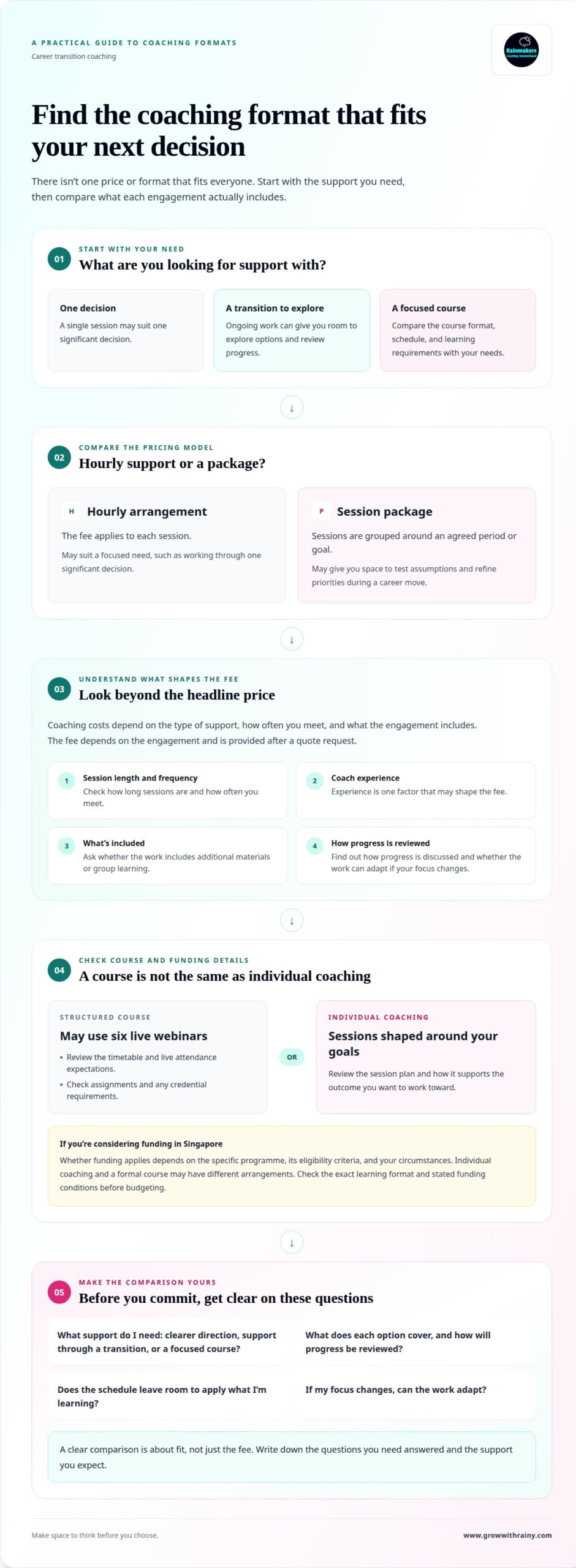
Coaching costs depend on the type of support, how often you meet, and what the engagement includes. A single session may suit one decision, while ongoing work can give you room to explore options and review progress. Before comparing fees, define what you need: clearer direction, support through a transition, or a focused course.
Pricing models commonly reflect the format and scope of support. With an hourly arrangement, the fee applies to each session; a package groups sessions around an agreed period or goal. The coaching fee depends on the engagement and is provided after a quote request. Factors may include session length and frequency, the coach’s experience, and whether the work includes additional materials or group learning.
Compare what each format offers, not just the headline fee. For example, someone considering a move into a new industry may need several conversations to test assumptions and refine priorities. Someone making one significant decision may prefer a shorter engagement. Ask what each option covers, how progress is reviewed, and how the work can adapt if your focus changes.
In Singapore, whether funding applies depends on the specific programme, its eligibility criteria, and your circumstances. Individual coaching and a formal course may have different arrangements, so assess the exact learning format and stated funding conditions before budgeting. Don’t assume that a coaching session and a career-related course qualify in the same way.
Course schedules vary. A structured course may use six live webinars, while individual coaching centres on sessions shaped around the client’s goals. Review the timetable, live attendance expectations, assignments, and any credential requirements. Someone balancing work commitments, for instance, may value predictable session dates, while another learner may need time between sessions to apply new ideas.
Stories and testimonials can show how past participants experienced a course, but they don’t determine what your own engagement will include. Use them as context, then compare practical details: learning format, schedule, access to feedback, and the outcome you want to work toward. A clear comparison can help you decide whether coaching or a course better fits your current needs.
Before committing, write down the questions you need answered and the support you expect. If you’re weighing personal direction alongside a career move, you can talk through what kind of coaching support may fit. Which format would help you take your next step with greater clarity?
Job-search strategy, CVs, networking and interview preparation
A focused job search connects your experience with the work you want to do next. For example, a project manager moving into sustainability can show how their skills relate to roles in that field.
Strategic Job-Search Actions
A job-search strategy helps you decide where to focus and what to do first. Applying broadly can make it harder to judge whether a role fits your strengths and priorities. Compare job descriptions to spot recurring requirements, then identify opportunities where your experience could meet them. If you’re interested in a new field, speak with people who do that work to learn what the role involves.
Use conversations to explore fit, not just to ask about vacancies. A former colleague, for example, may explain how their organisation values experience from another industry. A coach can help you clarify how your background connects to a new opportunity and what you could contribute. That reflection can help you choose which roles deserve your time.
Pause before enrolling in an advanced degree. It may take two years or more, so first consider whether it supports your specific career goal. If a role requires a credential, identify that requirement. If employers prioritise practical experience, a project or relevant responsibility may be a more direct way to test your interest. The aim is deliberate action, not collecting qualifications by default.
Resume and CV Strategies
A resume or CV should make the relevance of your experience clear. For each role you pursue, identify its main requirements and choose examples that demonstrate related skills. A finance professional applying for an operations role might highlight process improvement, stakeholder communication, and decisions involving complex information.
Keep your career story coherent. Rather than presenting each job as an isolated title, show how your responsibilities built transferable capabilities. A short profile can state the direction you’re pursuing, while examples of your achievements provide evidence. Use language from a job description only when it accurately describes your work.
Interview preparation helps you tell that career story clearly. Practise explaining why you’re making the change, what you’ve learned about the role, and how a past example demonstrates your fit. For instance, describe a challenge, the action you took, and the result. Prepare thoughtful questions about the team’s priorities, then listen closely so your answers address what the interviewer asks.
Career transition coaching may help you develop a networking strategy to explore opportunities. It can also help you explain how your experience relates to a new opportunity and what you could contribute.
Building networks and telling a compelling career story
A career story helps people see the thread connecting your past work with your next direction. Your network can help you test that story against real roles, teams, and workplace needs. For example, a finance professional exploring sustainability can speak with people in the field about how financial insight contributes to their work.
Start by mapping your connections, including former colleagues, professional communities, clients, and friends. For each person, note what they know and what you hope to learn. A former colleague might offer insight into a different industry, while a professional association could introduce you to people doing work you’re considering. This makes outreach purposeful rather than transactional.
When you contact someone, make your request clear and easy to answer. You might say, “I’m exploring a move into sustainability roles and would value your perspective on the work.” Then ask about their experience, the problems their team solves, and the capabilities they use. A focused conversation gives you more context than asking someone to find you a job.
Keep your story grounded in a specific turning point, transferable strengths, and the direction you’re exploring. For instance: “I’ve spent years helping teams make complex decisions. I’m now interested in applying that skill to environmental projects.” It should sound like you, not a polished pitch. Clear language helps others understand what you’re moving toward.
Adjust the emphasis to the person listening. A hiring manager may want to know how your experience meets a role’s needs. A former colleague may be more interested in why you’re considering a change. Keep the central thread consistent while choosing a relevant example. If someone leaves the conversation unsure what opportunities interest you, make your direction more specific.
After each discussion, record one useful insight and one next action. Perhaps a contact mentions a capability commonly used in the field; your next step could be finding a practical way to develop or demonstrate it. A brief thank-you message that mentions the insight shows you were listening and keeps the relationship personal. Follow up when you have a meaningful update or question.
A network grows through reciprocity, not a single request. Share a relevant introduction, acknowledge someone’s expertise, or offer help based on your own experience. If a connection isn’t close to your target field, ask what adjacent role or community might offer a useful perspective. Each exchange can help you explain your career journey and make a more informed next move.
Before your next conversation, practise a concise version of your story aloud. Include what you’ve done, what you want to explore, and why you’re reaching out. Then ask yourself: would someone listening know how to help, even if they can’t offer a role?
General career transition coaching services
Career transition coaching can help turn a broad wish for change into clearer direction and considered choices. Someone who feels drained by a senior role, for example, might explore whether the pressure comes from the work, the workplace, or a mismatch with personal values. The distinction matters because each possibility points to a different next step.
A coach may help you identify your strengths, recurring stress responses, and the conditions that support your best work. Consider a skilled manager who feels disengaged but can’t name what’s missing. Reviewing moments of energy and frustration may reveal a need for more autonomy, a different purpose, or a healthier team environment. That clarity can help define what you want from a suitable role.
Career transition coaching can help you consider options beyond familiar job titles and advertised vacancies. A professional with operations experience might explore service design, programme delivery, or a related field. The question isn’t simply which title sounds appealing. Consider whether the daily responsibilities, values, and transferable capabilities fit the life and work you want.
A transition roadmap can reflect the level of risk, speed, and scale of change that feels manageable. One person may test a direction through a project while staying in their current role. Another may choose a more substantial shift after clarifying personal priorities and practical constraints. A useful roadmap connects reflection with choices suited to your circumstances.
Career questions can also affect how you lead and live beyond work. If a leader’s frustration follows them home, exploring the internal pressures behind that pattern may reveal more than a change in job title. Inside-out coaching helps you reconnect with your innate gifts and hidden resources while releasing protective patterns that no longer serve you. Internal shifts can influence how you approach opportunities and decisions.
Someone seeking another conventional 9-to-5 role may discover that independent work better fits their strengths. That doesn’t make self-employment the right answer for everyone. It simply leaves room to consider possibilities that weren’t visible at first. The key is to test each option against your values, capabilities, and appetite for change.
A useful question to carry forward is: what kind of work would let you contribute with greater self-trust? Career transition coaching can help you explore that question as part of the decision, rather than treating it as a distraction. If you’d like to consider how these questions apply to your situation, you can talk through your career transition and next steps.
Rainmakers Coaching International: Life Coaching
Rainmakers Coaching International offers Life Coaching to help you explore how your inner experience shapes the way you work, lead, and live. If a career decision feels tangled with questions of identity, confidence, or purpose, inside-out coaching can help you reconnect with your own perspective and recognise strengths you may have overlooked.
Career Coaching supports reflection on professional direction, while Executive Coaching may suit a transition involving leadership. The focus is not on handing you another framework, but on uncovering personal resources and loosening patterns that no longer serve you. What might become clearer if you understood what is driving your next career choice?
If you’d like to explore whether coaching fits your situation, contact Rainmakers Coaching International or visit growwithrainy.com.
Choose a Next Step That Feels True
You don’t need to solve your entire career before moving forward. Start by noticing the choice that feels most honest now, even if it’s small. Perhaps it’s naming what you want more of or recognising what you’re ready to leave behind. That clarity can be a steadier compass than pressure to make a perfect decision.
Career transition coaching can create space to hear your own judgement beneath expectations and old habits. As your inner perspective shifts, the way you work, lead, and live can shift too. A meaningful pivot begins with self-trust and develops through choices that reflect who you are becoming.
If you’re ready to explore what comes next, take a gentle first step by talking with Rainmakers Coaching International.
Your next chapter doesn’t need to be fully mapped today. Begin with one grounded choice.
Frequently Asked Questions
What does career transition coaching involve?
Career transition coaching involves guided reflection to help you make career decisions with greater self-awareness. A coach may help you notice which work situations energise you, which drain you, and what those patterns reveal about your priorities. For example, if you feel most engaged when developing people, you could explore roles where mentoring is a central responsibility. The focus is on making choices that feel grounded and genuinely yours.
How much does career transition coaching cost in Singapore?
The cost depends on the individual engagement and is provided after a quote request. Factors may include the number and frequency of sessions, the scope of support, and whether the work is individual coaching or part of a broader programme. Before comparing options, decide what you need help with, such as exploring a new direction or reflecting on a leadership change. Then assess what each proposed engagement includes.
What happens during a career transition coaching programme?
A programme can give you space to explore current concerns, clarify what you want from work, and reflect on possible directions. You might examine a recurring workplace frustration, identify what it signals about your priorities, then consider how different roles could meet them. Between conversations, observe your responses to work situations and bring those observations back. This connects reflection with choices in your working life.
How long does career transition coaching usually take?
A typical coaching engagement lasts three to six months, though the length depends on the focus and pace of the work. Clarifying a decision may call for a different rhythm from exploring a substantial career shift. As you begin, consider what practical progress would look like, such as feeling clearer about your direction or being ready to evaluate a specific opportunity. That gives you a useful basis for reviewing whether the coaching fits.

Article by
Rainy Rainmaker
Rainy Rainmaker is the founder of Rainmakers Coaching International and a transformational coach for confidence, self-trust, and authentic leadership. Based in Singapore, she helps high-achieving professionals, managers, and leaders who appear capable on the outside but feel quietly held back by self-doubt, overthinking, imposter feelings, burnout, or a loss of direction. Through her signature Rainmaker Transformation Journey™, Rainy helps clients uncover the insights already within them and turn inner clarity into aligned action that creates lasting change in how they work, lead and live.
