What can Rainmakers coaching reviews reveal about whether coaching is right for you? If you’re weighing a career change, a leadership challenge or a sense of being stuck, other people’s experiences can offer useful perspective. The key is noticing what feels relevant to your own situation.
A new role or another strategy won’t always ease inner friction. Sometimes the next step is reconnecting with yourself, noticing what’s holding you back and finding a more grounded way forward.
This article explores how to interpret client feedback, what career and life coaching can support, and how inside-out coaching may influence the way you work, lead and live. What would you want to understand before choosing your next step?
Key Takeaways
- Read reviews for clues about the coaching experience, not just praise or overall scores. Notice which qualities matter most for your own decision.
- Career uncertainty can connect with questions about leadership, confidence and life direction. Inside-out coaching explores how your inner patterns shape the choices you make at work and beyond.
- Look for examples of change in how people think, work and relate to others, while remembering that each person’s coaching experience is different.
- Career coaching can help mid-career professionals reconnect with their strengths and consider a more grounded next step, rather than simply adding another plan or framework.
- Reflect on what you want to feel clearer about before choosing coaching, and what kind of change would make a meaningful difference in your daily life.
Career, life, personal development and executive coaching
Career questions rarely stay neatly inside the office. A mid-career professional may be weighing a promotion while wondering why success feels less satisfying. Another may be capable of leading a team but hesitate to speak with conviction. Inside-out coaching explores the inner beliefs and protective patterns shaping those choices. The focus is not another framework. It is reconnecting with your truth, recognising your innate gifts and using them with greater self-trust.
That inner work matters because career, life and leadership influence one another. Someone who ties their worth to constant achievement, for example, may accept every new responsibility and then feel depleted at home. A leader who avoids disagreement may soften necessary feedback until expectations become unclear. Coaching can help bring these patterns into view and practise a more grounded response, while individuals addressing deeper relational stress or attachment wounds might turn to specialised resources like The Project of You | Trauma, Couples & Relationship Therapy Australia. The aim is to understand how your inner world shapes both work and life.
For a career decision, a coach might guide a client through a process such as:
- Name the tension: Is the difficulty about the role, the workplace, confidence or competing responsibilities?
- Notice the pattern: Does fear of disappointing others keep the person from expressing a preference?
- Reconnect with strengths: Which abilities feel natural, useful and underused in the current role?
- Choose a grounded experiment: Could the person raise a role question, delegate a task or explore a different direction?
These prompts keep career development connected to the person making the decision. A new title may not resolve a mismatch between personal values and daily work. Equally, a difficult season doesn’t automatically mean it’s time to leave. Coaching can help distinguish temporary pressure from a deeper need for change, then clarify what a realistic next move could involve.
Life coaching can also support someone whose external progress no longer feels aligned internally. If a senior professional has reached a long-pursued milestone but feels disconnected from it, exploring values and expectations may reveal what needs attention. This life coaching perspective on success that feels less meaningful can help connect personal direction with everyday choices.
For leadership, the same inside-out lens draws attention to how assumptions affect communication, boundaries and decisions. A manager who notices a habit of rescuing every struggling colleague can practise offering support without taking over. For leaders and teams aiming to foster more inclusive communication around different cognitive needs, resources like Neuro-Sparks training solutions provide practical neurodiversity support and training. A professional considering a career shift can explore what they want more of, what they want less of and which strengths they want to use.
What might change if your next career decision came from self-trust rather than pressure?
Client ratings and review feedback
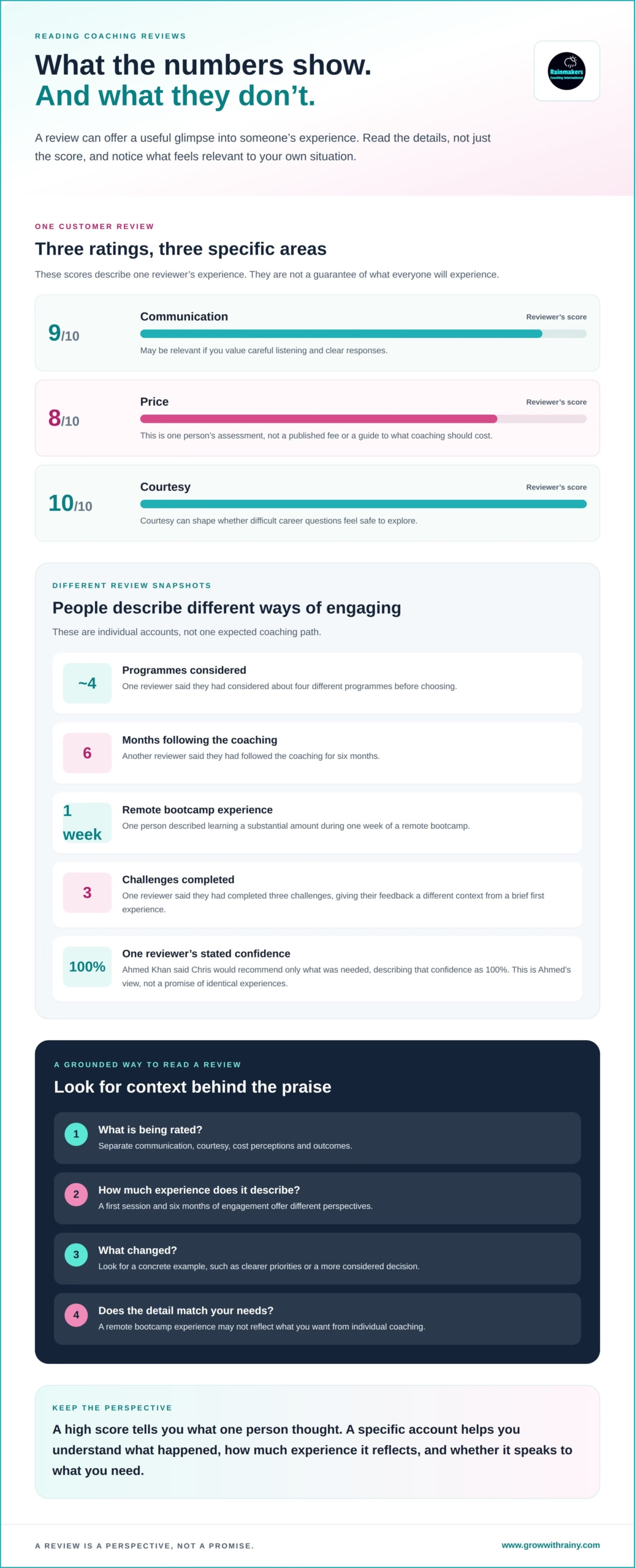
Review scores can offer a useful snapshot, but they don’t tell the whole story. One initial customer review rated communication 9 out of 10, price 8 out of 10, and courtesy 10 out of 10. These scores point to the reviewer’s experience in three specific areas. They aren’t a guarantee that every person will experience coaching in the same way.
The communication score may be relevant if you’re looking for a coach who listens carefully and responds clearly. Courtesy can affect whether difficult career questions feel safe to explore. The price score reflects one reviewer’s assessment, not a published fee or a guide to what coaching should cost. Read each score alongside the words describing the experience.
Other examples show how people approached their decisions. One reviewer said they had considered about four different programmes before choosing. Another had followed the coaching for six months. A third described learning a substantial amount during a three months coaching journey. These accounts reflect different ways of engaging, not one expected path. Treat these recommendation as individual experiences, rather than a promise that every recommendation will feel identical to every client.
As you read reviews, look for details that help you picture the working relationship. Does someone describe feeling heard while discussing a career decision? Do they explain what changed in their thinking or actions? A specific account offers more context than a broad statement such as “great experience.”
A simple way to assess a review is to consider four questions:
- What is being rated? Separate communication, courtesy, cost perceptions and outcomes.
- How much experience does it describe? A first session and six months of engagement offer different perspectives.
- What changed? Look for a concrete example, such as clearer priorities or a more considered decision.
- Does the detail match your needs? A remote bootcamp experience may not reflect what you want from individual coaching.
Also notice what a review doesn’t establish. One person’s high score doesn’t prove that a particular result is typical, and a brief comment may leave out important context. If a review mentions career direction , confidence or leadership , consider whether it explains the process behind that change. This helps you assess its substance without treating a testimonial as a prediction.
When comparing feedback, focus on fit rather than searching for a perfect score. The most useful review may describe a challenge like yours and explain what the support felt like. Which detail would help you feel better informed: communication, the coach’s approach or a specific change in the reviewer’s working life?
A review can also be useful when it adds a practical consideration: a programme can seem worthwhile to one person and still be financially unaffordable for another. If cost is important to your decision, seek current information before deciding. Consider whether the review gives enough context to understand the person’s concern, and separate that concern from any broader judgement about the coaching itself. A budget limit is a real part of choosing, even when a reviewer also values other aspects of an experience.
The length of someone’s involvement can also help you interpret what they say. One reviewer said they had been coaching with Rainy Rainmaker for 6 months. That detail gives a reader a sense of the period behind the feedback, while leaving open what the reviewer followed or how often they engaged. It should not be taken as evidence that every client has the same experience over that period.
When you compare accounts, look for whether the person describes the nature of their involvement and connects it to a specific observation. Reviews are most useful when you can distinguish a personal perspective from a general claim, and when the details help you decide what questions to ask about your own needs.
Taken together, comments about affordability and time spent following a programme can help you assess fit without treating any single account as a verdict. Keep your own priorities in view, including what you hope to gain, what you can spend, and what kind of support would feel appropriate. A Google review can inform those questions, but your decision should rest on the circumstances that matter to you.
What results or outcomes do clients report after Rainmakers coaching?
Reported outcomes range from gaining a clearer life and career direction, finding a more purposeful, meaningful job, promotion to the next level, income growth, peace of mind, work life balance, and greater confidence in dealing with difficult stakeholders. These are real coaching outcomes, but they describe individual experiences. For a mid-career professional, the more useful question is what changed in the decisions and behaviours that produces the outcomes.
For someone navigating a career crossroads, internal change may first show up in ordinary moments. A professional who once stayed silent in meetings might offer a considered view. Someone who accepted every request might set a clearer boundary. A manager who relied on control might invite a colleague’s perspective. These actions can affect how a person works and relates to others, even before a larger career outcome becomes visible.
The Rainmakers inside-out transformational coaching starts with what’s happening internally, then connects that insight to practical choices. A coach might help a client notice a protective pattern, such as avoiding difficult conversations to prevent disapproval. A next step could be preparing one honest question for a manager and reflecting on the response. That small action can help the client practise self-trust without pretending the conversation is easy.
For a mid-career professional, meaningful progress may involve:
- Clearer direction: identifying which parts of a role feel aligned, and which create persistent friction.
- More grounded decisions: weighing a promotion or career shift against personal values, strengths and responsibilities.
- Changed leadership habits: replacing automatic rescuing or avoidance with direct, thoughtful communication.
- Greater follow-through: turning a personally meaningful goal into a specific next conversation or action.
These examples show why results can’t be reduced to a job title or sales figure. A person may first notice a quieter internal shift: less second-guessing, a clearer boundary or greater willingness to use a natural strength. Over time, those changes can influence how they lead, collaborate and make career choices. The outward result depends on what the person is working toward and how they apply new awareness in daily situations.
The coaching reviews are subjective and don’t describe every coaching client’s experience. For your own decision, look for the connection between inner change and observable action. What would you want to do differently at work if you trusted your judgement more?
A reported reaction, a client’s account of change and a measurable business result are different kinds of information. If you’re considering coaching, ask what changed, how it was noticed, and whether the account describes one person’s experience or a broader pattern.
Rainmakers Coaching International states they have coached local and international clients for many years across various regions. Representatives note that coaching engagements are flexible to accommodate different professional schedules and objectives. Those details describe stated experience and meeting arrangements, rather than evidence of a particular result.
A prospective client can use them to clarify whether the format, location and coaching focus match the question they want to address, then define what progress would look like before beginning.
Rainmakers Coaching International
Rainmakers Coaching International supports people who want career, leadership and personal change to begin from within. Its inside-out approach focuses on what shapes your choices: your values, strengths, self-trust and protective patterns. The work is not about adding another external framework. It helps you reconnect with your truth, then bring that awareness into how you work, lead and live.
This may resonate if you’re a mid-career professional who looks successful on paper but feels unsure what comes next. Perhaps you’re weighing a promotion, questioning whether your role still fits or noticing that your leadership style no longer feels like you. Coaching creates space to explore what’s underneath the question before rushing into a decision. From there, you can identify what you want to change and consider a grounded next step.
Different coaching needs can overlap. Career Coaching and Career development Coaching can help you explore direction, professional growth and how your strengths fit your working life. If you’re carrying uncertainty beyond your job title, Life Coaching can bring attention to personal values and the changes you want in daily life. For people responsible for teams or complex decisions, Executive Coaching can focus on how internal patterns influence leadership and relationships at work.
These aren’t separate boxes. Learning to trust your judgement may help you speak more clearly at work and set boundaries outside it. A leader who recognises a habit of avoiding conflict can practise addressing an issue directly, rather than letting discomfort shape the conversation.
As inner awareness shifts, outward choices can shift too. The aim is to draw on your strengths and hidden resources while loosening patterns that once protected you but no longer serve your direction.
A coaching conversation can begin with a question you’re carrying now. For example: “Do I want a different role, or do I want to feel differently in the role I have?” Together, you can explore what feels misaligned, which strengths you may be underusing and what you want your work and life to make room for. A practical next step might be a clearer career decision, a new approach to a leadership challenge or a more honest understanding of what matters to you.
Coaching reviews can help you understand how others describe their experience, but your priorities matter most. Consider what you want support with, whether that’s career direction, personal development, leadership or a connection between them. You don’t need a complete plan to begin. A clear concern, a decision you’re facing or a sense that something needs to change can be a meaningful starting point.
If you’re considering coaching, you’re welcome to contact Rainmakers Coaching International and share what you’re hoping to understand or change. What would you most want to feel clearer about?
Frequently Asked Questions
What do customers say in reviews of Rainmakers coaching?
In Rainmakers coaching reviews , customers discuss communication, courtesy, perceived value, learning and experiences with different programmes. These comments offer personal perspectives, not outcomes everyone should expect. If you’re considering coaching for a mid-career decision, look for feedback that describes a situation like yours. A review about gaining clarity, for example, may be more relevant than one focused mainly on a short programme.
What are the pros and cons of Rainmakers coaching according to reviews?
Positive feedback on Google reviews point to a considerate experience and clear communication, while one reported reservation concerns how the cost felt to that reviewer. These are individual impressions, not a complete picture of what coaching will be like for you. To make the feedback useful, separate comments about the coaching relationship from comments about value, then consider what matters most to your decision and expectations.
Are Rainmakers coaching reviews independently verified?
Customer feedback shouldn’t be treated as independently verified just because it appears as a review or testimonial. Verification depends on whether a third-party platform explains how it checks reviewers or their service experience. A conversation with the coach can still help you get a sense coaching fit.

Article by
Rainy Rainmaker
Rainy Rainmaker is the founder of Rainmakers Coaching International and a transformational coach for confidence, self-trust, and authentic leadership. Based in Singapore, she helps high-achieving professionals, managers, and leaders who appear capable on the outside but feel quietly held back by self-doubt, overthinking, imposter feelings, burnout, or a loss of direction. Through her signature Rainmaker Transformation Journey™, Rainy helps clients uncover the insights already within them and turn inner clarity into aligned action that creates lasting change in how they work, lead and live.
