You’ve done everything right. You climbed the ladder, earned the title, and now lead a team that looks to you for answers. From the outside, you are the picture of success. But inside, it feels like you’re playing a role – one that is becoming increasingly exhausting to maintain.
This is the quiet paradox of the high-achieving leader: the more capable you become, the more you can feel like an imposter. You spend your days managing expectations, making high-stakes decisions, and projecting an image of unwavering confidence. Yet, the energy it takes to keep this performance going leaves you feeling disconnected from the person you are behind the professional mask.
The truth is, effective leadership isn’t about perfecting a performance. It’s about reconnecting with who you already are. Authentic leadership coaching is not a program for becoming someone new; it’s a process of removing the protective layers you’ve built over a lifetime so you can lead with the grounded clarity and self-trust you already possess.
Key Takeaways from This Article
- Authenticity is Uncovered, Not Added: True leadership isn’t about learning new tricks. It’s about removing the learned protective patterns – the “mud” that hide the capable, decisive leader you already are.
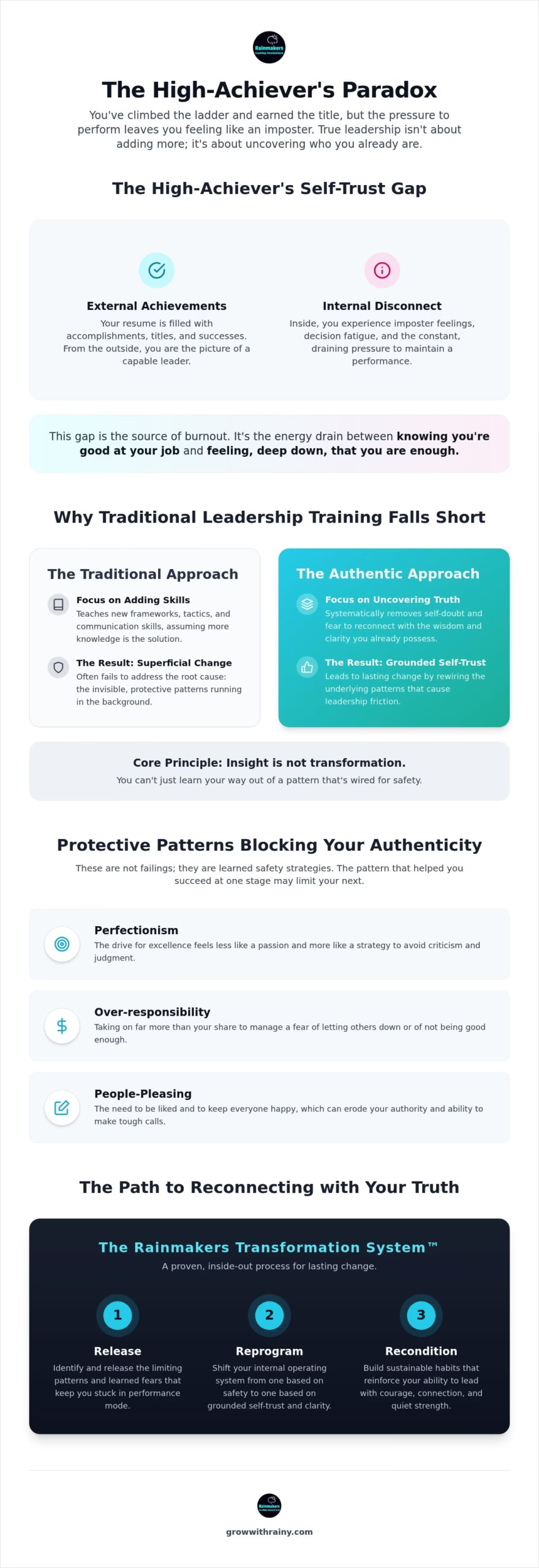
- The High-Achiever’s Self-Trust Gap: Many successful leaders experience a disconnect between their external achievements and their internal sense of self. This gap is the source of imposter feelings, burnout, and decision fatigue.
- Protective Patterns Limit Your Leadership: Behaviours like Perfectionism, Over-responsibility, and People-Pleasing are safety strategies that helped you succeed in the past but now limit your ability to lead with courage and connection.
- Transformation is an Inside-Out Process: The path to authentic leadership involves moving from overthinking to decisive presence. This shift happens by building grounded self-trust, which allows you to lead from your core truth rather than from a place of fear or obligation.
- A Proven System for Lasting Change: The Rainmakers Transformation System™ (Release, Reprogram, Recondition) offers a guided path to identify and release these limiting patterns, helping you build sustainable self-trust and lead with quiet strength.
What is Authentic Leadership Coaching?
Authentic Leadership coaching is a deeply personal process of moving from a state of performing leadership to being a leader. It’s not about learning a new theory or adopting a different personality. Instead, it’s about systematically removing the “mud” – the self-doubt, learned fears, and protective patterns that covers your innate treasures of wisdom, courage, and clarity.
Authenticity isn’t a performance of honesty; it’s the state of being fully and consistently yourself, especially when the stakes are high. It’s the ability to make a tough call without agonizing for days, to give direct feedback with compassion, and to inspire a team not because you have all the answers, but because you are grounded in your own truth.
This journey is rooted in reconnecting with that truth. It’s a return to the core of who you are, before you learned that you had to be a certain way to be accepted, safe, or successful. As we see it at Rainmakers, you don’t always need more evidence of your capability; you need to learn to trust the evidence you already have.
The High-Achiever Self-Trust Gap
For many senior leaders, there is a painful friction between a resume filled with accomplishments and a persistent internal voice of self-doubt. This is the High-Achiever Self-Trust Gap. It’s the space between knowing you’re good at your job and feeling, deep down, that you are enough.
This gap is the reason you feel exhausted. It’s the energy drain of constantly “performing” the role of a leader, second-guessing your decisions, and worrying about being “found out.” It drives you to over-prepare, over-deliver, and take on far more than your share of responsibility. While this looks like dedication from the outside, it’s a strategy to manage the internal fear of not being good enough.
This is where we must contrast generic confidence with deep, grounded self-trust. Confidence is often situational – it’s about feeling capable of a specific task. Self-trust is foundational. It’s the deep, unwavering belief in your own judgment, values, and ability to navigate uncertainty, even when you don’t have all the information.
Why Traditional Leadership Training Falls Short
Most leadership development programs focus on adding more to your plate. They teach new skills, frameworks, and communication tactics. While these can be useful, they often fail to address the root cause of leadership friction: the invisible patterns running in the background.
These programs operate on the assumption that “more knowledge” is the solution. But for the high-achiever, the problem is rarely a lack of knowledge. You’ve already read the books and attended the seminars. The real challenge is that your internal operating system is wired for safety, not for the vulnerability and courage that authentic leadership requires.
This brings us to a core Rainmakers Principle: Insight is not the same as transformation. You can understand intellectually why you should delegate more or stop people-pleasing, but you won’t change the behaviour until you address the underlying pattern that makes it feel unsafe to do so. Authentic leadership coaching works at this deeper level, focusing on releasing the blocks rather than just adding more skills on top of them.
Identifying the 7 Protective Patterns Blocking Your Authenticity
The “mask” you wear at work is not a personal failing; it’s a sophisticated strategy for safety. Over your lifetime, you developed a set of protective patterns – ways of thinking and behaving designed to keep you safe, loved, and accepted. These are not clinical diagnoses but learned survival strategies that were once incredibly effective.
However, another Rainmakers Principle states: The pattern that helped you succeed at one stage may limit your next. The same drive for perfection that earned you a promotion can now prevent you from taking the creative risks your role requires. The need to please everyone that made you a beloved team player can now erode your authority as a leader.
These seven patterns create an invisible barrier, preventing you from connecting authentically with yourself and your team. They are the source of the performance, the exhaustion, and the feeling of being an imposter. Releasing them is the key to leading from a place of grounded truth. Recognising them is the first step.
Perfectionism and Overachievement as Safety Strategies
Does your drive for excellence sometimes feel less like a passion and more like a relentless pressure? For many high-achievers, perfectionism isn’t about high standards; it’s about avoiding criticism and judgment. The Rainmakers Principle: Perfectionism is often a strategy for protecting self and worthiness.
Similarly, overachievement uses performance as a currency to buy value. It’s the belief that your worth is directly tied to your last success. This constant need to prove yourself takes a heavy toll, making it feel dangerous to delegate, innovate, or admit you don’t have the answer. It keeps you trapped in a cycle of doing more to feel worthy, which is the very definition of burnout . Read more about releasing the protective patterns of high achievers to understand this cycle better.
The Burden of Over-Responsibility and People-Pleasing
If you feel a compulsive need to make sure everyone on your team is okay, you may be carrying the weight of over-responsibility. This pattern often starts early in life. The Rainmakers Principle: Over-responsibility often begins with a need to keep everyone ‘okay’. As a leader, this manifests as micromanaging, an inability to let others fail, and carrying the emotional weight of your entire team.
This is often paired with people-pleasing and approval-seeking. People-pleasing is a strategy to preserve safety and belonging by avoiding conflict at all costs. Approval-seeking takes it a step further, creating a trap where others’ responses determine your sense of worth. These patterns may make you well-liked, but they erode your ability to make unpopular but necessary decisions, hold people accountable, and lead with authority.
The Path to Reconnecting with Your Truth
The journey of authentic leadership coaching is a shift from the head to the core. It’s about moving from a life run by anxious thoughts and external validation to one guided by grounded self-governance. The goal is not just to achieve more, but to become more fully yourself in the process.
This transformation requires a safe space. You cannot be expected to take off your protective armour in the same environment where you felt the need to put it on. Coaching provides a confidential, non-judgmental container where you can explore the roots of your patterns and begin to release the “mud” that obscures your clarity.
Ultimately, this path is about leading from a place of being, not just doing. It’s about showing up with an inner strength that inspires trust and creates psychological safety for your team, because you are no longer trying to prove anything.
From Overthinking to Decisive Presence
Overthinking is not a sign of intelligence; it’s a symptom of anxiety. The Rainmakers Principle: Overthinking is an attempt to create safety by eliminating uncertainty. Leaders caught in this loop spend countless hours replaying conversations, analyzing worst-case scenarios, and delaying decisions in a futile attempt to find the “perfect” answer.
Grounded self-trust is the antidote. When you trust your own judgment, you can make decisions with incomplete information, navigate ambiguity with composure, and move forward with conviction. You can quiet the mental clutter because you have a deep, internal sense of your own capacity.
Reflect for a moment: What would become possible if the energy you currently spend on overthinking was redirected toward clear, visionary action?
The Role of Vulnerability in Grounded Leadership
One of the biggest objections to authentic leadership is the fear that it will be perceived as weakness. We are taught that leaders must be stoic, certain, and invulnerable. But this is a myth. True strength lies not in having an impenetrable facade, but in having the courage to be yourself.
When a leader shows up authentically – admitting they don’t know something, sharing a personal challenge, or asking for help, it doesn’t diminish their authority. It deepens it. It signals to the team that this is a safe place to be human, to take risks, and to be honest. Research has consistently shown that leader authenticity is a key driver of psychological safety, which in turn fuels team innovation and performance.
Remember this Rainmakers POV: A professional problem rarely stays just at work. The stress of performing a role follows you home, affecting your health, your relationships, and your overall sense of fulfilment. Reconnecting with your truth is not just a professional strategy; it’s a life strategy.
Practical Steps: Moving Toward Authentic Alignment
Transformation doesn’t happen overnight, but you can begin shifting your perspective today. These coaching insights are designed to help you start noticing the patterns that keep you stuck, so you can begin to choose a different way of being.
Start by identifying which of the seven protective patterns (Perfectionism, Overachievement, Over-Responsibility, People-Pleasing, Approval-Seeking, Overthinking, Control) feels most active in your life right now. Simply naming it without judgment is a powerful first step.
Next, consider your relationship with feedback. A grounded approach means learning to receive it without the mask of perfectionism. Instead of immediately defending or deflecting, can you get curious about the information being offered? This practice builds resilience and demonstrates true confidence.
In fact, research by Avolio et al. in 2004 found that authentic leadership is positively correlated with follower trust and commitment, and a leader’s ability to self-regulate and be transparent is a key part of that. (Source: The Leadership Quarterly)
Audit Your Protective Strategies
- Define the Pattern: Write a single sentence describing how one of the seven patterns shows up in your leadership. For example: “My over-responsibility shows up when I stay late to rewrite a team member’s report because I’m worried it’s not good enough.”
- Identify the Cost: What is the cost of this pattern in terms of your energy, time, and team connection? Does it empower or disempower your people?
- Envision the Alternative: Reflect on what might emerge if this strategy was no longer needed. What would you do with the reclaimed energy? What new leadership possibilities might open up?
Practice Grounded Visibility
- Shift Your Focus: In your next high-stakes meeting, shift your goal from “getting it right” to “being myself.” Focus on listening fully and speaking your truth, rather than trying to say the perfect thing.
- Use If-Then Thinking: Catch your patterns in real-time with a simple diagnostic thought. “If I feel the urge to immediately say ‘yes’ to a request I don’t have time for, then I will pause and say, ‘Let me check my priorities and get back to you.'”
- Build Deeper Confidence: For more strategies on showing up with grounded presence, explore our Rock Solid Confidence guide for high-achieving leaders.
The Rainmakers Transformation System™ for Leaders
Lasting change requires more than just awareness; it requires a systematic process to rewire the patterns that hold you back. The Rainmakers Transformation System™ is a proprietary three-stage methodology designed specifically to address the High-Achiever Self-Trust Gap and guide you back to your authentic self.
The three stages are: Release, Reprogram, and Recondition.
This is not a system for “fixing” your flaws. It’s a compassionate and effective process for “releasing” what prevents you from being yourself. It acknowledges that you are already whole and capable; you’ve just developed some very clever, and now limiting, strategies to protect yourself. True transformation is not measured by what you know, but by who you become.
Release and Reprogram: Breaking the Cycle
The first stage, Release, involves identifying the specific protective patterns at play and understanding their origin. We go to the root of the issue, exploring when and why these strategies were first adopted and releasing it. This isn’t about blaming the past; it’s about understanding it so you can finally let it go.
Next, in the Reprogram stage, we work to remove the “mud” and install a new internal operating system based on self-trust. This is where you begin to internalise that your worth is not conditional on your performance. You learn to access your own inner authority and make decisions from a place of clarity, not fear. This is the heart of the transformation life coaching process.
Recondition: Building Sustainable Self-Trust
Finally, the Recondition stage is about practice. This is where you integrate these new ways of being into your daily leadership habits. You learn to catch the old patterns before they take hold and consciously choose a different response. It’s about building the muscle of self-trust until it becomes your default state.
This system creates change that lasts because it works from the inside out. It doesn’t just give you new actions to take; it changes the very foundation from which you act.
I’ll leave you with a final reflection question: Who would you be as a leader if you no longer needed to prove your worth through performance?
If you’re ready to find out, let’s talk. Explore a 90-minute coaching conversation to begin your transformation from performing a role to leading as yourself.
Frequently Asked Questions About Authentic Leadership Coaching
What is the difference between authentic leadership and just being ‘honest’?
Honesty is about telling the truth. Authenticity is about being your truth. It’s a deeper alignment between your values, beliefs, and actions. An authentic leader doesn’t just share facts; they lead in a way that is consistent with who they are at their core, which builds trust and inspires others.
Can authentic leadership coaching help with imposter syndrome?
Absolutely. Imposter syndrome is a direct symptom of the High-Achiever Self-Trust Gap. By identifying and releasing the protective patterns (like perfectionism and overachievement) that fuel the feeling of being a fraud, coaching helps you build genuine self-trust and internalise your success.
Will being an authentic leader make me appear less professional or ‘soft’?
This is a common fear, but the opposite is true. Authenticity is not about a lack of boundaries or oversharing. It’s about grounded strength. When you lead from your truth, you are more decisive, consistent, and trustworthy – qualities that are seen as strong, not soft. It allows you to be both compassionate and direct.
How long does it take to see results from authentic leadership coaching?
Clients often report feeling a shift in perspective and a sense of relief after the very first few sessions. Deeper, more sustainable transformation happens over several months as you work through the Release, Reprogram, and Recondition stages. The goal is not a quick fix, but a lasting change in your internal operating system.
What are the common protective patterns found in senior executives?
While any of the seven patterns can be present, senior executives often struggle with a combination of Overachievement, Perfectionism, and Over-responsibility. The pressure at senior levels can amplify these patterns, leading to burnout and a sense of isolation.
How do I know if I have a ‘Self-Trust Gap’ in my leadership style?
Signs of a Self-Trust Gap include chronic second-guessing of your decisions, difficulty delegating important tasks, feeling like you have to have all the answers, and a persistent feeling of exhaustion despite your success. If your external achievements don’t match your internal sense of confidence, you likely have a gap.
Is authentic leadership coaching suitable for founders and business owners?
Yes. Founders and business owners face unique pressures and often feel the weight of the entire company on their shoulders. Authentic leadership coaching helps them lead with vision and resilience, make decisions from a place of clarity instead of fear, and build a company culture that reflects their core values.
How does the Rainmaker Transformation System™ differ from standard executive coaching?
Standard executive coaching often focuses on behavioural changes and skill development – addressing the “what” and the “how.” The Rainmaker Transformation System™ goes deeper to address the “why” and the identity. It focuses on releasing the underlying protective patterns that drive behaviour and building the identity that supports the goal, leading to more profound and sustainable change from the inside out.

Article by
Rainy Rainmaker
Rainy Rainmaker is the founder of Rainmakers Coaching International and a transformational coach for confidence, self-trust, and authentic leadership.
Based in Singapore, she helps high-achieving professionals, managers, and leaders who appear capable on the outside but feel quietly held back by self-doubt, overthinking, imposter feelings, burnout, or a loss of direction. Through her signature Rainmaker Transformation Journey™: Release, Reprogram, Recondition – Rainy helps clients uncover the insights already within them and turn inner clarity into aligned action that creates lasting change in life, career, and leadership.
