

You have a track record of success. You’ve earned the promotions, led the projects, and delivered the results. Yet, when faced with a new challenge, a familiar tightness grips your chest. The thought of making a mistake – of being seen as anything less than perfect is paralysing.
This isn’t just pressure; it’s a constant, draining state of high alert. You might overthink every decision, work late to triple-check every detail, and find your sense of worth tied directly to your last achievement. If this sounds familiar, you are not alone, and you are not broken.
The common advice is to “be more confident” or “just face your fears.” But what if that fear isn’t a flaw to be conquered? What if it’s an outdated protective strategy, a heavy coat you put on long ago that no longer fits? Learning how to overcome fear of failure at work isn’t about fighting an internal enemy. It’s about gently understanding and releasing the invisible patterns that keep you stuck, so you can reconnect with the grounded, capable leader you already are.
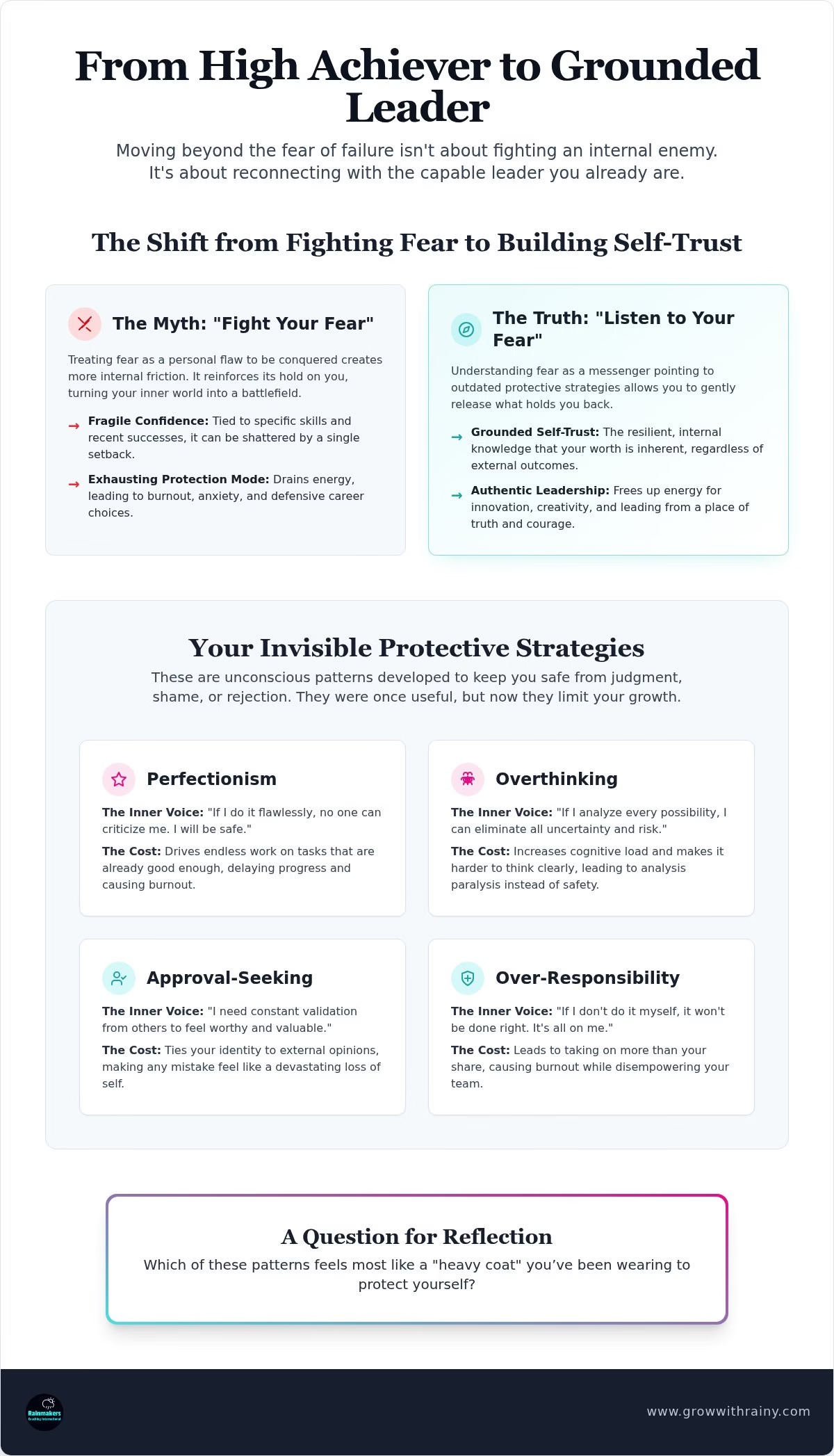
Beyond the Myth: Why “Fighting” Your Fear of Failure Usually Backfires
For many high-achievers, the fear of failure is seen as a personal flaw – a sign of weakness or a lack of confidence that must be stamped out. We are told to be courageous, to push through it, to build a thicker skin. But this approach often creates more internal friction. When you treat fear as an enemy to be fought, you inadvertently give it more power, reinforcing its hold on your decision-making and turning your inner world into a battlefield.
This is why many high-achievers experience more fear as they become more successful. With each new level of responsibility, the stakes feel higher, and the potential fall feels greater. The very strategies that helped you succeed – diligence, attention to detail, a drive for excellence can become twisted by fear into perfectionism and overthinking.
The focus needs to shift from “fixing a flaw” to compassionately understanding an internal mechanism that is trying to keep you safe.
The “More Confidence” Fallacy
Seeking “more confidence” is often a symptom, not a solution. It’s a common response to the discomfort of self-doubt , but it rarely addresses the root cause. This is because we often confuse situational confidence – the self-assurance that comes from mastering a specific skill, with a deeper, more resilient self-trust.
Situational confidence is fragile; it can be shattered by a single failed project, a critical comment from a senior leader, or a move into an unfamiliar role. Grounded self-trust, however, is different. Self-trust is the ability to remain connected to your truth regardless of external outcomes. It’s the quiet, internal knowledge that your worth is inherent and not tied to your performance.
When you have self-trust, you can make a mistake without believing you are a mistake.
The Cost of Constant Protection
Operating in a constant state of “protection mode” is exhausting. It drains the energy you could be using for innovation, creativity, and strategic thinking. This is the paradox of the “Anxious Achiever”: a professional who succeeds because of their fear-driven diligence but suffers deeply in the process. They climb the ladder, but the journey is filled with anxiety, burnout, and a persistent feeling of not being good enough.
When your primary motivation is avoiding failure, your career choices become defensive. You might turn down a promotion because you fear the new responsibilities, avoid speaking up in meetings for fear of saying the wrong thing, or stick to a familiar but unfulfilling career path because it feels safe. This protection, which once served you, eventually leads to stagnation.
Reflective Question: If you weren’t using so much energy to keep yourself safe from failure, what would you have the space to create instead?
The Rainmakers Lens: Identifying Your Invisible Protective Strategies
So, if fighting fear doesn’t work, what does? The first step is to see the fear for what it is: a messenger. It’s pointing toward a set of deeply ingrained “protective strategies.” These are the invisible barriers – the unconscious rules and behaviours that you developed to navigate the world and protect yourself from judgment, shame, or rejection. They were once useful, but now they limit your growth.
In my work with leaders, I use the Rainmakers Pattern Library to help them diagnose these patterns. We don’t judge them; we get curious about them. By identifying these strategies, you can begin to see how they mask your “hidden treasures” – your innate wisdom, courage, and purpose. In high-stakes corporate environments like those in Singapore and Hong Kong, these protective patterns can feel like a necessary armour, but they also prevent you from leading with authenticity and freedom.
Perfectionism and Overthinking at Work
Two of the most common protective strategies for high-achievers are perfectionism and overthinking. Perfectionism isn’t just about having high standards; it’s a strategy to avoid the shame you believe is attached to failure.
It’s the voice that says, “If I do it perfectly, no one can criticize me. If it’s flawless, I’ll be safe.” This drives you to spend hours on a presentation that’s already good enough or to delay launching a project in an endless search for an unattainable ideal.
Overthinking is a related strategy used to create a false sense of safety. By mentally rehearsing every possible outcome and analyzing every piece of data, you attempt to eliminate all uncertainty before taking action. However, research shows this has the opposite effect. Operating from a place of fear significantly increases your cognitive load, making it harder to think clearly and access your creative problem-solving abilities. Instead of creating safety, it creates paralysis.
Approval-Seeking and Over-Responsibility
Another pair of patterns involves how we relate to others. Approval-seeking is the need for constant external validation to feel worthy. When this pattern is active, failure feels like a direct loss of identity. A mistake isn’t just a mistake; it’s proof that you are not as smart, capable, or valuable as everyone thought. This can lead you to say “yes” to things that don’t align with your priorities, just to be seen as a team player.
Over-responsibility is the burden of taking on more than your share to prove your worth and maintain control. You might believe, “If I don’t do it, it won’t get done right,” or feel personally responsible for the emotions and workloads of your colleagues. This not only leads to burnout but also disempowers your team, as you inadvertently signal a lack of trust in their abilities.
Reflective Question: Which of these patterns feels most like a “heavy coat” you’ve been wearing to protect yourself?
Protection vs. Freedom: Re-framing Failure as Information
The journey from fear to self-trust involves a fundamental shift in mindset. It’s about moving from a “Protection Mindset” to a “Freedom Mindset.” In the Protection Mindset, failure is a verdict on your identity. In the Freedom Mindset, failure is simply data – information that tells you what didn’t work so you can adjust your approach.
This shift is rooted in the understanding that your value as a person does not disappear when you make a mistake. Your core strengths, your “hidden treasures,” are always there, even if they are covered by layers of fear and self-doubt.
Think of it as “the gem within” – your innate capacity for compassion, purpose, and wisdom is already present. The work is not to build something new, but to clear away the debris that hides it.
This table illustrates the difference between actions driven by these two mindsets:
| Fear-Led Action (Protection Mindset) | Truth-Led Action (Freedom Mindset) | |
|---|---|---|
| Motivation | To avoid being judged or seen as a failure. | To learn, grow, and contribute from a place of purpose. |
| Decision-Making | Paralyzed by overthinking; seeks 100% certainty. | Takes calculated risks; comfortable with ambiguity. |
| Response to Setbacks | Internalizes failure as a personal flaw; leads to shame. | Views setbacks as feedback; leads to resilience. |
| Focus | On external validation and managing perceptions. | On internal alignment and authentic expression. |
| Outcome | Burnout, stagnation, and a feeling of being an imposter. | Sustainable growth, fulfilment, and grounded confidence. |
The Myth of the Permanent Setback
At the heart of the fear of failure is a catastrophic belief: that one mistake will unravel a decade of career progress, that you will be “found out,” and that the damage will be permanent. This is a cognitive distortion. While mistakes can have consequences, they rarely have the earth-shattering impact we imagine.
A core Rainmakers Principle is that your worth is inherent, not performance-based. It cannot be earned through success or erased by failure. When you truly integrate this understanding, you can approach challenges with a sense of perspective. You begin to trust in your ability to handle whatever comes your way.
Many of my clients are relieved to discover this through their own journeys, moving from paralysis to powerful action. You can read some of their coaching breakthrough stories to see what this transformation looks like in the real world.
Reclaiming Your Hidden Treasures
When you are no longer consumed by protecting yourself from failure, your true strengths can finally surface. The compassion you were afraid to show because it might be seen as “soft,” the bold ideas you kept to yourself for fear they weren’t “perfect,” the quiet wisdom you ignored because it wasn’t backed by enough data – these are your hidden treasures.
Moving into a grounded state allows these qualities to emerge naturally. You don’t have to force them. By releasing the need for perfection and control, you create the space for your authentic self to lead. This is where true professional growth and fulfilment are found.
Reflective Question: What parts of your natural talent have you been hiding because you were afraid they weren’t “perfect” enough?
The Path to Self-Trust: Release, Reprogram, and Recondition
Understanding your patterns is the first step, but lasting change requires a structured process. The Rainmakers Transformation System™ is a proven framework designed to help you move from protection to freedom. This is not about adding new skills or “hacks” on top of a shaky foundation. It’s a deep process of reconnecting with your truth so that your actions become a natural extension of who you are.
The system is built on three core stages: Release, Reprogram, and Recondition. Before you begin, it can be powerful to understand where you currently stand. Taking a moment for a Self-Confidence Survey can provide a clear baseline for your journey.
Step 1: Release the Protective Strategy
The first stage is about learning to see your protective patterns in real-time, without judgment. Using what I call “The Rainmakers Lens,” you begin to observe your fear as a neutral observer. You notice the physical sensations, the thoughts that arise, and the urge to fall back into an old behaviour like overthinking or seeking approval.
“Releasing” is not about forcefully stopping a behaviour; it is about seeing it for what it is – a protective mechanism and choosing not to be led by it. The moment you can name the pattern (“Ah, this is perfectionism trying to keep me safe”), you create a space between the trigger and your response. In that space lies your freedom to choose a different path.
Practical Tip: The next time you feel the urge to overthink a decision, pause. Take a breath. Ask yourself, “What protective pattern is at play here? What is it trying to protect me from?” Simply naming it reduces its power.
Step 2 & 3: Reprogram and Recondition
Once you can see your patterns, you can begin to reprogram the deep-seated beliefs that fuel them. This involves actively challenging the old stories you’ve told yourself – for example, the belief that “failure is dangerous” or “I must be perfect to be valued.” You replace these fear-based beliefs with grounded truths, such as “My worth is inherent” or “Mistakes are opportunities for growth.”
Reconditioning is where the new belief becomes your new reality. You do this by taking small, “grounded” risks – actions that are slightly outside your comfort zone but not overwhelming. You might share a half-formed idea in a meeting or delegate a task without micromanaging the outcome. Each time you take such an action and see that you are okay, you build concrete evidence of your resilience. This process, supported by 3R Integration, ensures these shifts become a lasting part of your professional identity.
Building Grounded Resilience
Grounded resilience is your ability to stay connected to your self-trust, especially under pressure. It’s what allows you to remain centered during a high-pressure presentation or a major project launch. A key component of this is self-compassion. When you are reconditioning, you will inevitably stumble. Instead of criticising yourself, you treat yourself with the same kindness you would offer a trusted colleague.
This compassion is the fuel that allows you to get back up and try again, reinforcing the new neural pathways you are building.
Reflective Question: What is one small, “imperfect” action you can take today to practice self-trust?
Transforming Your Career: From Fear to Authentic Leadership
The ultimate goal is not to become fearless. Fear is a natural human emotion. The goal is to no longer be led by it. When your decisions are guided by your purpose and values instead of a need for protection, you begin to embody authentic leadership. You are no longer performing a role; you are expressing who you truly are.
This internal shift has a profound impact on your team and your organization’s culture, particularly in the demanding professional landscapes of SE Asia. When you are no longer protecting a facade of perfection, you create a space of psychological safety for others to do the same. This is where true collaboration and innovation thrive. This deep, transformational work is the focus of Executive Coaching in Singapore, providing a dedicated space for leaders to release these limiting patterns.
Leading with Compassion and Clarity
Leaders who have released their own fear of failure are uniquely equipped to foster psychological safety. They model vulnerability, encourage intelligent risk-taking, and treat mistakes as learning moments for their team. Their leadership style naturally shifts from one of “Control” (driven by a fear of things going wrong) to “Empowerment” (driven by a trust in their team’s capabilities).
This doesn’t mean standards are lowered. It means you lead from a place of clarity and trust, not anxiety. You inspire commitment rather than demanding compliance. This approach is central to the 10 key qualities of an impactful leader, where empathy and resilience are as critical as strategy and execution.
Your Invitation to Transformation
Releasing a lifelong fear of failure is a journey, not an overnight fix. It requires curiosity, courage, and compassion. But you don’t have to do it alone. The first step is acknowledging that your fear is not a sign of weakness but a signal that a part of you is ready for a new way of being.
Your worth is not up for debate. It is not measured by your successes or diminished by your failures. If you are ready for a guided path to release these protective patterns, you can schedule a complimentary 90 minutes coaching conversation with coach Rainy .
Final Reflective Question: Are you ready to stop protecting who you think you should be and start being who you truly are?

Article by
Rainy Rainmaker
Rainy Rainmaker is the founder of Rainmakers Coaching International and a transformational coach for confidence, self-trust, and authentic leadership.
Based in Singapore, she helps high-achieving professionals, managers, and leaders who appear capable on the outside but feel quietly held back by self-doubt, overthinking, imposter feelings, burnout, or a loss of direction. Through her signature Rainmaker Transformation Journey™: Release, Reprogram, Recondition – Rainy helps clients uncover the insights already within them and turn inner clarity into aligned action that creates lasting change in life, career, and leadership.
