
What if the belief holding you back is less a fact about your ability and more a familiar way to protect yourself? You may have years of experience and still second-guess a decision, replay a mistake, or worry about getting it wrong. It’s reasonable to wonder whether coaching for overcoming limiting beliefs can offer more than insight or encouragement.
Coaching won’t erase every difficult thought or diagnose what’s behind it. It can give you a thoughtful space to question a recurring belief, notice the pattern beneath it, and consider a response grounded in your experience. The aim isn’t to force positivity. It’s to reconnect with what you know about yourself and build self-trust, one choice at a time.
In this article, you’ll explore how coaching can help you recognise protective patterns without treating them as diagnoses, what coaching can and cannot offer, and a practical reflection to try when self-criticism takes over. You’ll also learn how to identify a useful next step, so an old belief doesn’t have to make the decision for you. What might change if you met that belief with curiosity instead of immediately accepting it as true?
Key Takeaways
- A limiting belief is an assumption about yourself or your options that can make your choices feel narrower than they are.
- Coaching for overcoming limiting beliefs offers space to notice recurring situations, explore the belief beneath them, and consider a different response. It isn’t a diagnosis or a promise that a belief will disappear.
- More evidence of your capability may not be the only thing you need. Practising trust in what you already know about yourself can also help you move forward.
- Before an important decision, write down the moment, the thought that arises, its effect, another possible interpretation, and one manageable action.
- Coaching may be worth considering if a recurring concern keeps shaping your choices and you want guided reflection. It remains a choice, not a requirement.
What Are Limiting Beliefs, and How Can They Shape Your Choices?
You know you have the experience to contribute, yet you hold back in a meeting. You could make the decision, but keep reviewing it for fear of getting it wrong. These moments can feel confusing: if you’re capable, why does the next step feel so difficult?
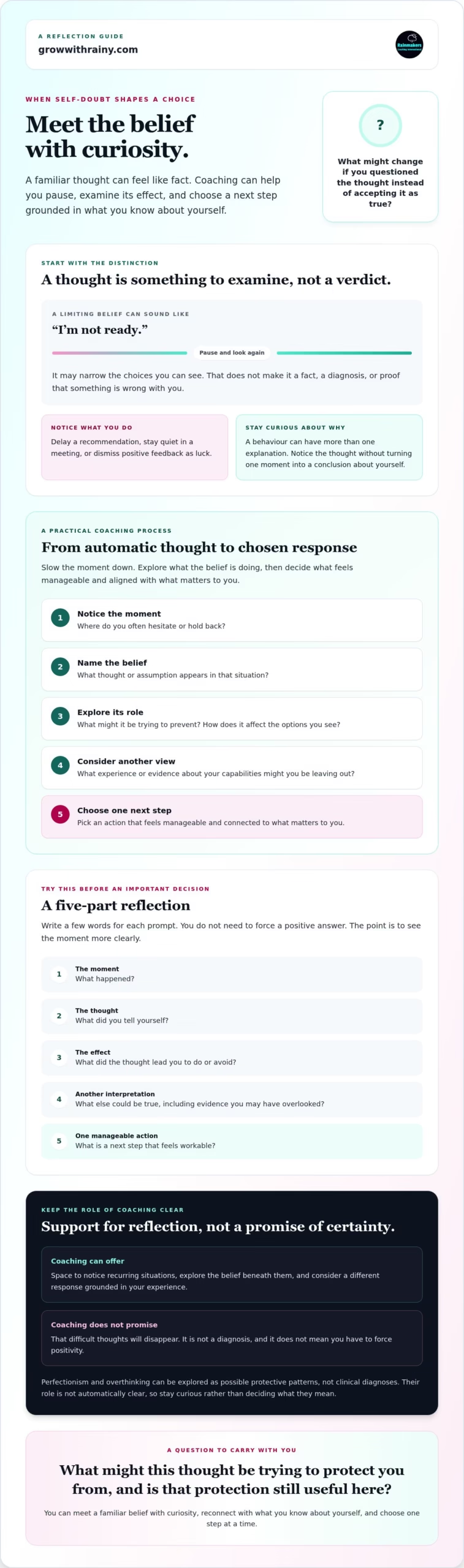
A limiting belief is an assumption about yourself or your options that can narrow the choices you believe are available to you. It might sound like, “I’m not ready,” or “If I speak up, I’ll make a mistake.” A thought can feel convincing without being a fact, a diagnosis, or proof that something is wrong with you. Noticing it gives you something to examine with curiosity.
Limiting beliefs can overlap with patterns often called cognitive distortions, or habitual ways of interpreting situations that may not reflect the full picture. The point isn’t to label every doubtful thought as inaccurate. It’s to ask whether the thought helps you see your options clearly. If you’re curious about the broader role of coaching in personal change, explore transformation life coaching.
How can a belief show up in everyday professional life?
Start with what you can observe. You might delay sending a recommendation, rehearse a contribution but stay silent, or dismiss positive feedback as luck. Those behaviours are visible, but their cause isn’t automatically clear. A delay can have several explanations, so avoid turning one moment into a conclusion about yourself.
Instead, notice the thought that appears. Do you tell yourself, “I need to be completely certain,” or “They’re only being polite”? If a similar thought returns in different situations, that repetition may be worth exploring. Ask what it leads you to do or avoid. Does it help you prepare, or does it keep you from taking a step you value?
When might a belief be serving a protective purpose?
Sometimes, a familiar response may have developed as a way to reduce risk or discomfort. Perfectionism might prompt repeated checking before you share work; Overthinking might keep you reviewing options instead of choosing. These are possible interpretations, not universal explanations. In coaching, Perfectionism and Overthinking are protective-pattern constructs, not clinical diagnoses. You can explore what a response does for you without deciding it defines you.
That shift matters. Rather than asking, “What’s wrong with me?” try, “What might this thought be trying to prevent, and is that protection still useful here?” Coaching for overcoming limiting beliefs can make room for that inquiry, helping you distinguish a familiar assumption from what you know about your abilities and choices.
How Does Coaching for Overcoming Limiting Beliefs Work?
A useful coaching conversation doesn’t begin by telling you what your belief means. It begins with curiosity. You and the coach can explore a recurring situation without treating a thought as a diagnosis or promising that it will disappear. The focus is on understanding how the belief affects your choices and finding a response that feels more grounded in your experience.
The process can move through a few practical steps:
- Notice a situation where you often hesitate or hold back.
- Name the thought or assumption that appears.
- Explore what role it may play and how it affects your options.
- Consider another interpretation, including evidence you may have overlooked.
- Choose one action that feels manageable and aligned with what matters to you.
Notice the moment, name the belief, explore its role, consider another view, and choose one next step.
What questions might help you examine a limiting belief?
A coach might ask, “What happened?” and “What did you tell yourself in that moment?” From there, you can notice what you felt able to do next. Did you speak, wait, or step back? What might the belief be trying to protect you from, without assuming where it came from? What experience or evidence about your capabilities might you be leaving out?
These questions aren’t a test with a right answer. They help you slow down an automatic conclusion and see more of the situation. Insight can make a pattern clearer, but understanding it isn’t the same as change. A new response takes practice in real choices, at a pace that feels workable for you.
What do Release, Reprogram, and Recondition mean in the Rainmakers approach?
Rainmakers Coaching International uses the Rainmakers Transformation System™, which names three stages: Release, Reprogram, and Recondition. Release means exploring what may no longer serve you, not expecting a difficult thought to vanish on demand. Reprogram and Recondition are the framework’s next stages. They describe parts of the approach, not guaranteed outcomes or a fixed promise about how change will unfold.
In coaching for overcoming limiting beliefs, the value isn’t simply collecting a fresh insight. It’s having space to consider what you want to do with it, reconnect with strengths you may have overlooked, and try a different response.
If you’d like to explore a belief with a coach, you can consider a coaching conversation as one possible next step.
Does Coaching Change Limiting Beliefs, or Is More Evidence Enough?
Coaching can help you examine a limiting belief, but it can’t promise that the belief will disappear. Not everyone needs coaching to question a thought or make a difficult choice. Sometimes, a new experience or a conversation with someone you trust is enough to help you see a situation differently.
There’s also a difference between collecting more proof and learning to trust what you already know. If you keep waiting for complete certainty before acting, another achievement may not quiet the doubt for long. A coaching conversation can help you look at the evidence you have, notice what you dismiss, and decide on a considered next step. That isn’t a guarantee of change. It’s a way to practise responding with greater self-trust.
A 2021 meta-analysis of 45 studies involving 3,382 participants found cognitive restructuring effective for improving outcomes in adults with depression. Those findings concern treatment for depression, not coaching, so they don’t show that coaching produces the same effects or that a particular belief will change. They offer context for why examining and reframing thoughts is studied in psychological care.
A pattern that once helped you avoid criticism or reduce risk may feel restrictive in a different context. That may be true for you, or it may not. The useful question is whether your familiar response still fits the choice in front of you.
Why might success fail to quiet self-doubt?
You may have delivered strong work, taken on responsibility, or earned trust, yet still question whether you’re capable. Perhaps capability isn’t the issue. The pattern beneath the doubt may deserve attention, such as repeatedly raising the standard you must meet before you let yourself feel ready. This is a possibility to explore, not a diagnosis or a label. For another perspective on confidence and leadership, see this guide to building rock-solid confidence.
Try asking: “What do I already know from experience, and what am I still asking myself to prove?” The answer may help you distinguish a useful desire to prepare from a demand for certainty that keeps moving further away.
When might coaching not be the right form of support?
Coaching focuses on reflection, choices, and personal or professional development. It isn’t clinical assessment or treatment. If what you’re experiencing feels beyond that scope, or you need support with clinical concerns, consider speaking with a qualified clinical professional. Choosing another form of support isn’t a failure to make progress. It’s a way to seek care suited to your needs.
Coaching for overcoming limiting beliefs may be one option if you want guided reflection, but it isn’t a requirement. What kind of support would feel appropriate for the challenge you’re facing now?
How to Explore a Limiting Belief Before Your Next Important Choice
You don’t need to wait until you feel completely certain to examine a thought. Try this brief exercise with a manageable decision, such as whether to share an idea, ask for clarification, or take on a task. The aim isn’t to prove the thought wrong. It’s to see how it shapes your options and choose a considered next step.
What should you write down when a limiting belief appears?
Use a few lines in a notebook or a note on your phone. Describe the moment, then write the thought exactly as it came to you. For example: “I’m not ready to ask for input.” Next, notice what the thought encourages you to do or avoid in that specific situation. Does it help you pause and prepare, or keep you from taking a step you value?
This is one reflection, not a complete assessment of you or the reasons you respond as you do. Stay with what you can observe. If you notice a recurring thought, you can explore it further without treating it as a fact or a label.
How can you test a different response without forcing positivity?
Write an alternative that makes room for uncertainty and the evidence you already have. Instead of “I’ll definitely get this right,” you might try, “I can’t know exactly how this will go, but I have handled similar parts of it before.” A balanced thought doesn’t promise success. It gives you a fairer view of the situation.
Then choose one proportionate action that fits your values and circumstances. You might ask one clear question, share an early draft with a trusted colleague, or set a time to make the decision rather than reviewing it indefinitely. Afterward, note what happened and what you learned. The aim isn’t to demand certainty before acting, but to gather useful experience from a thoughtful step.
A useful next step doesn’t promise immediate confidence; it gives you a chance to act with care and learn from what follows.
If your example centres on needing every detail to be flawless before you begin, this guide to identifying a perfectionist mindset may help you reflect further. Coaching for overcoming limiting beliefs can also offer guided space to notice a pattern and consider a response, but you can begin with this exercise on your own. What small, grounded action would help you learn more about the choice in front of you?
When Could Coaching for Limiting Beliefs Be a Helpful Next Step?
Coaching may be worth considering if the same concern keeps shaping your choices and you’d like a thoughtful space to explore it. Perhaps you repeatedly hold back from opportunities, discount your own judgement, or feel caught between what you know and what you trust yourself to do. You don’t need to be certain that coaching is right for you before asking questions.
It’s a choice, not a requirement. Reflection on your own, a conversation with someone you trust, or taking one manageable action may be enough for now. Coaching for overcoming limiting beliefs is one possible way to explore a recurring pattern, not a promise that every doubt will disappear or that you’ll reach a particular outcome.
What might you want from a coaching conversation?
You can bring a current challenge, a question you’ve been turning over, or uncertainty about what to do next. You might ask how the coach approaches beliefs, how reflection connects with practical action, and what falls outside the limits of coaching. Their answers can help you decide whether the conversation feels respectful and useful to you. For background, read about how transformational life coaching works.
You don’t have to arrive with a polished explanation. A simple starting point could be: “I keep doubting myself in this situation, and I want to understand what’s happening before I decide how to respond.” That gives you room to explore without turning a difficult thought into a judgement about who you are.
How can Rainmakers coaching support a self-trust journey?
Rainmakers Coaching International’s approach centres on exploring learned protective patterns, reconnecting with hidden strengths, and becoming more fully yourself. Depending on the context you want to explore, Life Coaching, Career Coaching, or Executive / Leadership Coaching may be relevant. The focus is not on changing who you are, but on making space to reconnect with your own perspective and consider how you want to move forward.
For readers whose focus is confidence, Rainmakers also offers the Building Rock Solid Confidence Program. You can ask what the approach involves and whether it fits what you’re looking for. No particular result is guaranteed, and you’re free to take time to consider your options.
What would feel most useful right now: more space to reflect, a practical next step, or a guided conversation to explore the pattern?
If you’d like to explore whether coaching feels like a fit, explore a coaching conversation with Rainy.
Choose a More Self-Trusting Next Step
A limiting belief can shape your choices without being the whole truth about your ability. When you notice a familiar thought, pause to name it, consider how it affects your options, and choose one manageable action. You don’t need to feel completely confident before taking that step.
Coaching for overcoming limiting beliefs offers guided space to explore recurring patterns with curiosity, not as a diagnosis or a promise that every difficult thought will disappear. Rainmakers Coaching International brings more than a decade of experience coaching leaders, professionals, and individuals. Its Rainmakers Transformation System™ is built around Release, Reprogram, and Recondition, with a focus on reconnecting with self-trust and becoming more fully yourself.
If you’re curious about exploring a current challenge with support, take time to consider whether a coaching conversation feels right for you.
You can begin where you are, with one honest question and one grounded next step. Your self-trust can grow through the choices you make along the way.
Frequently Asked Questions
Can coaching help you overcome limiting beliefs?
Coaching can help you explore a limiting belief, understand how it may be affecting your choices, and consider a different response. It can’t guarantee that a belief will disappear, and not everyone needs coaching to work through self-doubt. In coaching for overcoming limiting beliefs, the focus is on curiosity and practical reflection, so you can decide what feels useful and build self-trust through your own choices.
What happens in coaching for limiting beliefs?
A coaching conversation may begin with a situation that keeps recurring. You might describe what happened, name the thought that arose, and explore how it shaped what you felt able to do. The coach may invite you to consider another interpretation and choose a manageable action. This is collaborative exploration, not diagnosis. The questions and next steps should relate to your goals and circumstances.
Are limiting beliefs the same as clinical diagnoses?
No. A limiting belief is an assumption about yourself or your options that may narrow what you see as possible. It isn’t, by itself, a clinical diagnosis or proof that something is wrong with you. Rainmakers describes patterns such as Perfectionism and Overthinking as coaching constructs, not diagnoses. If you’re concerned about your mental health, consider speaking with a qualified clinical professional for appropriate assessment or support.
Can you change a limiting belief without a coach?
Yes. You can notice a thought on your own, write down what it encourages you to do or avoid, and consider what evidence or experience you might be overlooking. Then try one proportionate action and reflect on what you learn. You don’t have to force positive thinking or wait for total certainty. Coaching is one possible source of guided reflection, not a requirement for every difficult decision.
Why do I still doubt myself even after succeeding?
Success doesn’t always quiet self-doubt. You may be capable, yet still rely on a familiar pattern, such as setting a very high bar before you trust your judgement. That’s a possibility to explore, not a diagnosis. Ask yourself what you already know from experience and whether you’re dismissing it. The aim isn’t to collect endless proof, but to consider how you might trust the evidence you have.
How do you know if a belief is limiting you?
Look for a recurring thought that seems to narrow your choices or influence what you avoid. For example, “I must be completely certain” might lead you to keep delaying a decision. One instance doesn’t define you, and there may be practical reasons for pausing. Notice whether the thought returns in different situations, what effect it has, and whether it reflects the full range of your options.
Is coaching the same as therapy for changing beliefs?
No. Coaching focuses on creating conversation that expands choices. It guides and keeps clients accountable for their personal or professional development. It isn’t psychotherapy, clinical counselling, or clinical assessment and treatment. If your needs involve clinical concerns or fall outside a coach’s scope, consider seeking support from a qualified clinical professional. You can ask a coach how they approach beliefs and practical action, and how they recognise when another form of support may be more appropriate. What kind of support feels right for you now?

Article by
Rainy Rainmaker
Rainy Rainmaker is the founder of Rainmakers Coaching International and a transformational coach for confidence, self-trust, and authentic leadership. Based in Singapore, she helps high-achieving professionals, managers, and leaders who appear capable on the outside but feel quietly held back by self-doubt, overthinking, imposter feelings, burnout, or a loss of direction. Through her signature Rainmaker Transformation Journey™, Rainy helps clients uncover the insights already within them and turn inner clarity into aligned action that creates lasting change in how they work, lead and live.
