As a senior executive, you’re expected to provide direction, navigate competing priorities and make decisions with far-reaching consequences. When a leadership challenge proves difficult to resolve, it can help to consider both what the situation demands and what may be influencing your response.
Leadership coaching for senior executives creates space to examine those challenges, clarify what matters and recognise where a different approach could help. Sometimes, the difficulty involves organisational constraints or complex relationships. At other times, expectations you place on yourself may also play a part.
A desire to get things right, for example, can support careful judgement – but may also make it harder to act without certainty. Coaching can help you recognise these influences and draw more fully on your strengths, so you have greater choice in how you lead.
Key Takeaways
- If your responsibilities have grown but your familiar approach feels constrained, identify the specific challenge you want to work through.
- Leadership coaching for senior executives can help you examine your responses, choose a practical experiment, and reflect on what you learn.
- Compare coaching with mentoring, training, consulting, therapy, and peer support by asking what kind of help your situation calls for.
- Before choosing a coach, clarify the change you want, consider your readiness, and assess whether the working relationship feels like a good fit.
- Rainmakers Coaching International’s Executive / Leadership Coaching connects self-trust with practical leadership reflection, without promising a predetermined outcome.
Why senior executives consider leadership coaching at a pivotal moment
Your responsibilities have grown. Decisions carry more weight, more people depend on your judgement, and the leadership approach that once worked may now feel constrained. That doesn’t mean you’ve failed or lost your capability. It may mean the demands of your role have changed, and it’s worth considering what they ask of you now.
Executive leadership coaching is a reflective conversation that helps a leader examine a work-related challenge, consider choices, and decide what to try next. It isn’t a ready-made answer or a promise of a particular result. Business and executive coaching describes coaching in a business context. In practice, the focus should be shaped around the leader’s goals and situation.
What challenges can executive leadership coaching help you examine?
The question might be how to make a difficult decision when no option feels straightforward, how to lead through a transition, or how to respond to changing responsibilities. You may want to consider a recurring tension with a colleague or team. The focus depends on the person and their circumstances, not a standard list of executive problems.
A coach can help you slow down, look at the context, and consider how different responses might align with your goals. That differs from training, which typically teaches a skill or framework; mentoring, which draws on someone else’s experience; and consulting, which may involve expert recommendations. Coaching isn’t therapy or HR consulting either. It focuses on work-related goals and choices, rather than clinical care or organisational HR matters.
When does a leadership challenge call for reflection?
A strategy that helped you earn trust as a functional leader may not serve you in the same way when your role expands across teams or the organisation. The answer isn’t automatically to discard what worked. First, notice where the fit may have changed.
Think about a recent situation: What happened? How did you respond? What followed? If a similar pattern keeps appearing, that may be a useful question to explore, alone or with a coach. Leadership coaching for senior executives can provide space to examine the pattern without assuming its cause or prescribing a solution.
Coaching isn’t necessary for every executive. A clear decision may call for direct advice from someone with relevant expertise, while a specific skills gap may be better addressed through training. If the challenge feels less like a lack of information and more like uncertainty about your response, reflection may help. Rainmakers Coaching International also shares a broader perspective on transformational life coaching, where self-trust and personal change are central themes.
What leadership situation keeps returning, and what would you like to understand about your response to it?
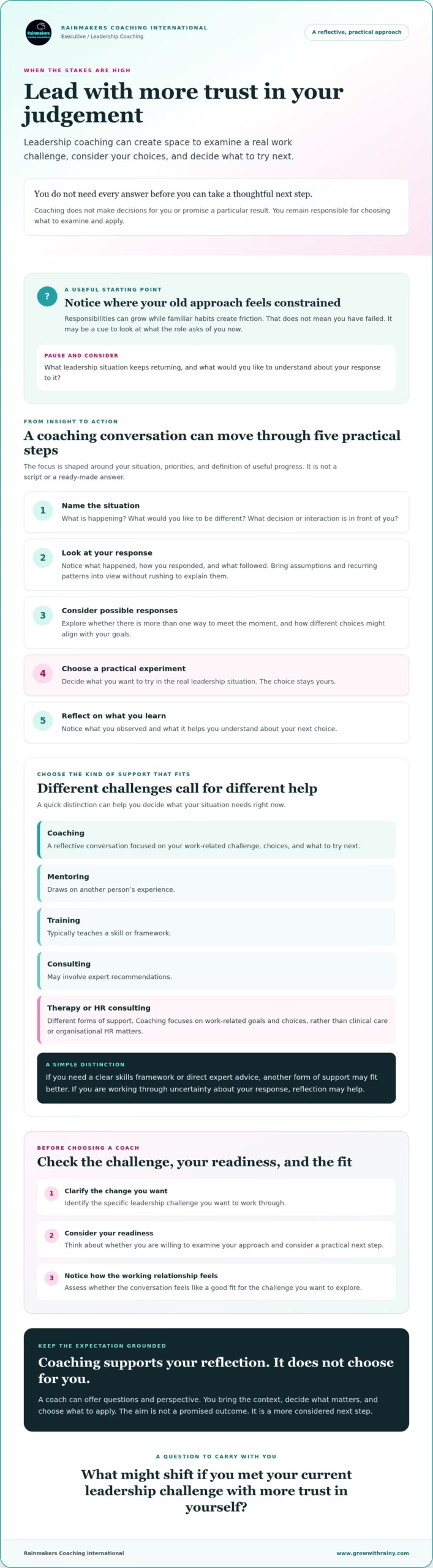
How leadership coaching for senior executives connects insight to action
Reflection is most useful when it helps you meet a real leadership moment differently. A coaching conversation can move from understanding what’s happening to choosing a practical response to test. The aim isn’t to follow a script. It’s to connect what you notice about yourself with the decisions and behaviours you want to bring to your role.
Insight can clarify a choice; sustained change asks you to practise that choice in the situations where it matters. In leadership coaching for senior executives , that practice is shaped by your context, priorities, and definition of useful progress. A coach can offer questions and perspective, but you remain responsible for deciding what to examine and apply.
What might a coaching conversation explore?
It may begin with your current situation: what’s happening, what you want to be different, and what decision or interaction is in front of you. Questions can help bring assumptions into view. Are you treating one response as the only option? Do you notice yourself taking on responsibility that could be shared? These are prompts for reflection, not diagnoses or conclusions about why you act as you do.
From there, you and the coach can explore possible responses, choose a small experiment, and later reflect on what you observed. You might ask a clarifying question before making a recommendation, or invite a colleague’s perspective earlier. The experiment should fit the situation. If it doesn’t, you can learn from that too.
This developmental view of coaching is also discussed in Harvard Business Review’s article on developing the capabilities of high-potential performers. The focus is not only on addressing a difficulty, but also on helping a leader examine how they want to grow into their responsibilities.
How can the Rainmakers Transformation System™ inform the process?
Rainmakers Coaching International uses the Rainmakers Transformation System™: Release, Reprogram, and Recondition. The stages provide a framework for exploring responses, beliefs, and choices in the context of a leader’s own experience. They are coaching concepts, not clinical diagnoses, and they don’t assume every leader has the same patterns.
The framework also includes 3R Integration. It offers a way to consider how inner reflection and practical leadership choices relate to each other, not a promise of a set result or a prescribed timeline. If you’re curious about applying this kind of reflection to a current leadership question, you can find details about a coaching conversation .
What is one response you’d like to approach with greater self-trust?
How to compare executive coaching approaches without chasing promises
A confident promise can sound reassuring when a leadership challenge feels uncertain. But no coach can responsibly guarantee how a complex decision, team dynamic, or transition will unfold. A better test is whether the approach fits your goals, the coach can engage with your work context, and reflection connects to choices you can make in practice.
Ask how a conversation might address a real situation. If you’re preparing for a difficult board discussion, for example, will you have space to examine your assumptions, clarify what matters, and consider how you want to respond? If reflection feels too abstract, ask how you and the coach will connect it to your day-to-day leadership.
What should you look for in an executive coach?
Fit is more than a pleasant conversation. Ask how the coach works with goals, what reflection looks like, how confidentiality is handled, and how you’ll discuss progress. If an organisation is involved, clarify what may or may not be shared with a sponsor. You can also ask how the coach will understand the pressures and context of your role before suggesting a way forward.
Notice whether you feel able to speak honestly and whether the questions help you think, rather than steer you towards a predetermined answer. A useful executive coaching approach should make room for your priorities and judgement, not ask you to adopt someone else’s leadership style.
Is coaching different from mentoring or leadership training?
Each form of support serves a different purpose. None is automatically right for every leader. Use this comparison to clarify what kind of help you’re seeking.
| Approach | Typical focus |
|---|---|
| Coaching | Explores your goals, context, assumptions, choices – and keeps you accountable for your actions. |
| Peer community | Offers shared experience, discussion, opinion and connection with people facing related responsibilities. |
| Training | Builds knowledge or skills, often through a planned curriculum or practice. |
| Mentoring | Draws on another person’s experience, often with more direct advice and perspective. |
| Therapy | Addresses mental health and clinical concerns, a different purpose from workplace coaching. |
| Consulting | Typically brings specialist analysis or recommendations to an organisational question. |
Leadership coaching for senior executives may suit you if you want a thought partner to help you examine your own response, rather than simply receive a framework or expert recommendation. If your main need is clinical support, training, or specialist advice, consider that distinction as you assess your options. What kind of support would help you meet your current leadership challenge with greater clarity?
How senior executives can decide whether coaching fits their situation
You don’t need to be certain that coaching is right for you before exploring it. Start with the leadership question you’re carrying, then consider what kind of support would help you think and act more clearly. A simple way to assess fit is to name the challenge, define a useful change, check your readiness, and ask questions about the working relationship.
What should you clarify before choosing coaching?
Be specific about what you want to examine. It might be a decision about competing priorities, a transition into a broader role, or how you respond when conversations become difficult. Then picture what a more grounded response would look like in practice. Would you speak more directly, pause before committing, or invite a different perspective?
Consider whether you have the time and willingness to reflect on familiar responses, not just seek a quick answer. Coaching may be a fit if you want to explore your choices and decide what to try. If you’re looking for recruitment, job-search support, or HR services, that’s a different request. Be clear about the kind of help you need.
How can you tell whether the coaching relationship feels right?
Use an initial conversation to ask how goals are set, how progress is discussed, and how the coach approaches your context. Notice whether the exchange feels respectful, focused, and relevant to the leadership situation you named. You should be able to ask direct questions and consider whether the approach makes sense for you, without feeling pushed towards a predetermined outcome.
If you want more context before speaking with a coach, read this executive coaching guide. It can help you reflect on what you’re seeking and the questions you may want to bring.
Leadership coaching for senior executives isn’t the right next step for everyone. You might first need information, a skill-building opportunity, or practical advice from someone with relevant expertise. If you’re still unsure, ask yourself: What would make a coaching conversation useful, and what would help me recognise a good fit?
What leadership coaching with Rainmakers Coaching International can offer
Rainmakers Coaching International offers Executive / Leadership Coaching for high-achieving, experienced professionals and leaders. The work brings attention to both the leadership challenge in front of you and the inner responses you bring to it. Practical responsibilities still matter. Reflection is not a substitute for making decisions, having difficult conversations, or following through at work. It can help you consider how you want to meet those demands while reconnecting with self-trust.
For leaders exploring leadership coaching for senior executives, this inside-out perspective may be useful if you’re looking beyond a quick technique and want to understand what shapes your choices. The aim isn’t to become someone else. It’s to allow hidden strengths and qualities to emerge, then consider how they might inform your leadership in real situations.
How does Rainmakers approach leadership growth?
One useful question is whether a learned response is influencing a situation. For instance, if you find yourself revisiting a decision repeatedly, you might explore whether Overthinking is relevant to that moment. It is a coaching construct, not a diagnosis, and it won’t apply to everyone. The focus stays on your experience, what matters to you, and what response you want to choose.
The Rainmakers Transformation System™ uses the stages Release, Reprogram, and Recondition. Together, they provide a framework for reflection and for considering how a more grounded choice might be practised in your leadership. They don’t prescribe a particular outcome. How the work relates to your role and goals depends on your context.
This approach holds inner reflection alongside practical leadership work. You might bring a current decision, a conversation you’re preparing for, or a recurring point of tension. From there, the useful question is not simply, “What did I notice?” but also, “What do I want to do with that awareness in my work?”
What is a useful next step if you are considering coaching?
Bring one current leadership question and a sense of the direction you’d like to move towards. You don’t need to arrive with a polished goal. You can ask how the approach might relate to your situation and consider whether the conversation feels relevant and respectful. For more information about the offer, read about executive coaching.
A conversation can help you explore fit. There’s no need to decide in advance that coaching is right for you. What would you want to understand about your leadership before choosing your next step?
Lead with greater clarity and self-trust
As your responsibilities change, the leadership approach that once served you may need fresh attention. Leadership coaching for senior executives can offer space to examine a specific challenge, explore your responses, and consider a practical next step. The right fit depends on your goals, readiness, and the quality of the coaching relationship, not on promises of a particular outcome.
Rainmakers Coaching International has more than a decade of experience coaching leaders, professionals, and individuals. Its Rainmakers Transformation System™ brings together Release, Reprogram, and Recondition as a framework for reflection on the choices you make in your work. It’s a framework for exploration, not a prescribed path or guarantee.
If you’re curious, bring one leadership question and the direction you’d like to move towards. You don’t need to have everything figured out before exploring whether coaching feels useful.
Your next step can be thoughtful and unhurried. Trust yourself to choose the kind of support that fits where you are now.
Frequently Asked Questions
What does leadership coaching for senior executives involve?
Leadership coaching for senior executives involves focused conversations about leadership challenges, goals, and choices. You might explore a role transition, a difficult decision, or how you want to respond in a recurring situation. The coach helps you reflect and consider practical ways forward, while you decide what fits your context. It isn’t a guarantee of a particular result, and it differs from training, mentoring, therapy, and consulting.
Is executive leadership coaching worth considering if I am already an experienced leader?
It can be worth considering if your responsibilities have changed or an approach that once worked no longer feels useful. Experience doesn’t mean you have to navigate every decision alone. Coaching can give you room to examine assumptions, consider new responses, and reconnect with your own judgement. It may not be the right fit if you mainly need specialist advice, formal skills training, or clinical support.
How does leadership coaching help senior executives make changes at work?
Coaching can help you turn reflection into a practical step by clarifying what you want to change and identifying a response to try in a real work situation. For example, you might choose to pause before making a decision or ask a colleague a more open question. You can then reflect on what happened and what you learned. Coaching supports this process, but doesn’t guarantee workplace outcomes.
What happens in an executive coaching session?
A session usually centres on a leadership question or goal you bring. You and the coach may clarify the situation, explore your perspective, and consider possible choices or actions. The conversation should relate to your context, rather than follow a one-size-fits-all script. Rainmakers Coaching International’s approach uses the Rainmakers Transformation System™: Release, Reprogram, and Recondition. Ask the coach how sessions are conducted and how progress is discussed.
How do I choose a leadership coach as a senior executive?
Start by asking how the coach approaches goals, reflection, confidentiality, and progress. Check whether they can engage with the realities of your role and whether their way of working feels respectful and relevant. Bring a current leadership question to an initial conversation and notice whether the discussion helps you think clearly without pushing a predetermined answer. Clarify what information, if any, may be shared with an employer or sponsor.
How much does leadership coaching for senior executives cost?
Fees vary between coaches and depend on what an engagement includes, so there isn’t one price that applies to every senior executive. Ask the provider directly about current fees, what is included, how sessions are arranged, and whether any additional costs apply before you decide.

Article by
Rainy Rainmaker
Rainy Rainmaker is the founder of Rainmakers Coaching International and a transformational coach for confidence, self-trust, and authentic leadership. Based in Singapore, she helps high-achieving professionals, managers, and leaders who appear capable on the outside but feel quietly held back by self-doubt, overthinking, imposter feelings, burnout, or a loss of direction. Through her signature Rainmaker Transformation Journey™, Rainy helps clients uncover the insights already within them and turn inner clarity into aligned action that creates lasting change in how they work, lead and live.
