You’ve done the work. You’ve delivered the results. You are, by every objective measure, a high performer. Yet, when opportunities for promotion arise, your name isn’t on the list. You watch as others, perhaps less technically skilled, move up the ladder while you remain the reliable, unseen expert in the background.
If this feels familiar, you are not alone. For many high-achieving professionals in Singapore and Australia, the gap between their contribution and their recognition feels like a constant source of frustration. The conventional advice to “be more visible” often feels hollow, conjuring images of performative self-promotion or ‘wayang’ that goes against your values of integrity and quiet competence.
But what if visibility isn’t about becoming louder? What if it’s not about adding another task to your already full plate? True visibility is not a performance. It is the natural result of releasing the internal, protective strategies that have taught you to stay small, allowing the impact you already create to finally be seen.
Key Takeaways
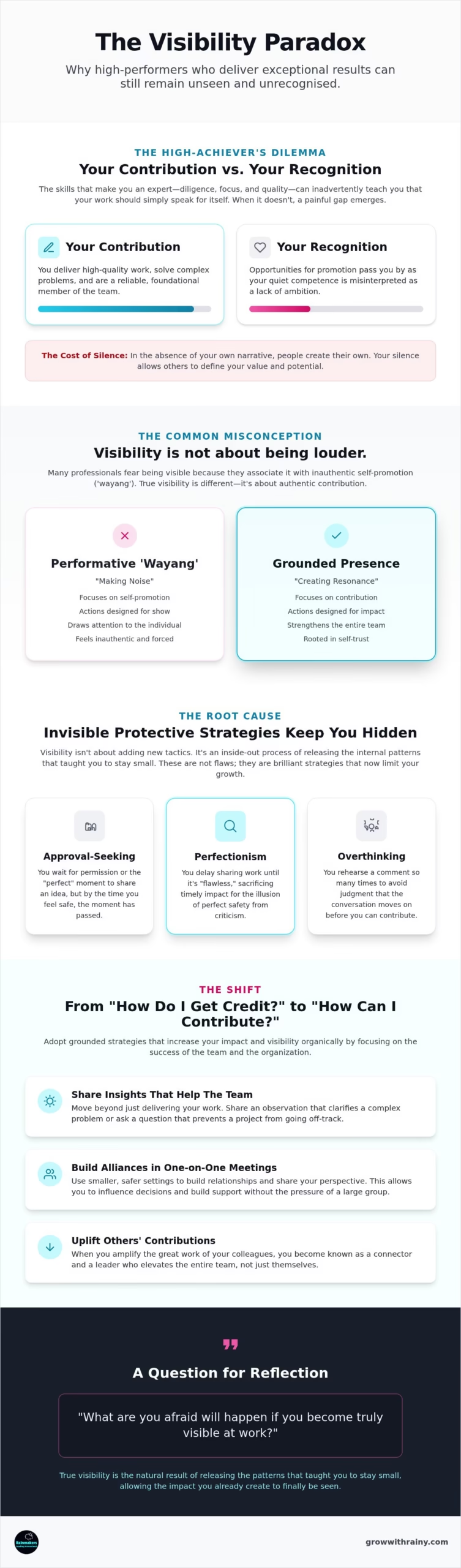
- Visibility is an Inside-Out Process: Lasting visibility doesn’t come from learning new tactics for self-promotion. It comes from identifying and releasing the invisible protective patterns – like Perfectionism or Approval-Seeking that cause you to hide your contributions.
- Differentiate ‘Wayang’ from Authentic Presence: The fear of being seen as performative (‘wayang’) or fake is a common barrier for Singaporean professionals. The goal is not to ‘make noise’ but to develop a ‘grounded presence,’ where your communication is rooted in self-trust and a genuine desire to contribute.
- Focus on Contribution, Not Credit: Shift your focus from “how do I get credit?” to “how can I contribute more effectively?” Grounded strategies like sharing insights that help the team, building alliances in one-on-one meetings, and uplifting others can increase your impact and visibility organically.
- Your Hard Work is Not Enough: In the absence of your own narrative, people will create their own. Staying silent allows others to misinterpret your quiet competence as a lack of ambition or leadership potential. Visibility is about ensuring the perception of your value matches the reality of your contribution.
Why Visibility Feels Like a Threat: Understanding the High-Achiever’s Paradox
For many professionals, the call to be more visible at work feels less like an opportunity and more like a threat. This isn’t a sign of weakness; it’s often a paradox of high achievement. The very skills that made you an expert – diligence, deep focus, and a commitment to quality – can inadvertently lead you to believe that your work should simply speak for itself.
At its core, professional visibility is the alignment between the value of your contribution and your organisation’s perception of that value. When there’s a gap, your career stalls. Yet, the more competent you become, the more you might hide to avoid the scrutiny that comes with the spotlight. You fear being exposed as a fraud or being judged for a minor mistake.
This is where we must challenge the assumption that visibility equals being performative. It’s not about becoming the loudest person in the room. It’s about understanding that hiding is an ‘invisible protective strategy’ – a learned behaviour that once kept you safe from judgment but now limits your growth.
The Cost of Professional Silence
Staying silent in your career carries a heavy price. It’s the primary reason why capable leaders are overlooked for promotions, not because of a lack of skill, but because their presence isn’t felt by decision-makers. This creates the painful dynamic of the ‘side-lined expert’: the person who does the foundational work while a more visible colleague presents it and receives the credit.
Your silence doesn’t create a neutral space; it creates a vacuum. And into that vacuum, others will pour their own assumptions. They might assume you’re not interested in leadership, that you lack strategic insight, or that you’re content in your current role. Your lack of visibility becomes a story written by others, and it’s rarely the one you would write for yourself.
Visibility vs. Performative ‘Wayang’
The term ‘wayang’ resonates deeply with many professionals in Singapore because it captures the essence of what they despise: inauthentic, performative action designed purely for show. This cultural sensitivity is why so many recoil from the idea of standing out. They’ve seen colleagues who are ‘all talk and no action’ and want to be the opposite.
But there is a profound difference between ‘making noise’ and ‘creating resonance’. Making noise is about drawing attention to yourself. Creating resonance is about contributing in a way that makes the entire team, and the organisation, stronger. It’s about sharing an insight that clarifies a complex problem, asking a question that saves a project from going off-track, or connecting two colleagues who can help each other succeed. This is the heart of grounded, authentic visibility.
Reflection Question: What are you afraid will happen if you become truly visible at work?
Identifying the Protective Strategies That Keep You Hidden
If you recognise the cost of silence but still feel an intense internal resistance to speaking up, it’s because you’re contending with powerful, deeply ingrained protective strategies. These are not character flaws; they are brilliant strategies you developed, often early in life, to navigate the world and protect yourself from judgment, rejection, or failure .
Using the Rainmakers Lens, we don’t see you as someone who needs to be fixed. We see that you already possess ‘hidden treasures’ – your insights, skills, innate gifts, and wisdom. The work is not to add a new layer of “confidence” on top, but to gently remove the protective layers of mud that obscure the value already within.
Consider these common patterns:
- Approval-Seeking: This strategy makes you wait for permission to speak or act. You hold back a valuable idea in a meeting, waiting for the perfect moment or for a senior leader to invite your opinion. By the time you feel safe enough, the moment has passed.
- Perfectionism: This pattern prevents you from sharing work until it’s “flawless.” You might delay submitting a report, miss a window of opportunity to influence a decision, or avoid volunteering for a project because you don’t feel 100% ready. You sacrifice impact for the illusion of perfect safety.
- Overthinking: This is a strategy to eliminate the uncertainty of being judged. You rehearse a comment in your head so many times that the conversation moves on before you can say it. You analyse every possible negative outcome of speaking up, effectively paralysing yourself with “what-ifs.”
The Seven Patterns of Protection
These strategies are part of a larger set of seven protective patterns we see at Rainmakers Coaching International, including People-Pleasing, Over-Responsibility, Control, and Overachievement. Each of these patterns was once a useful tool for ensuring your safety and acceptance. A child who learns they are praised for getting perfect grades, for instance, may develop Perfectionism as a way to secure love and approval.
However, what once kept you safe as a child can become an invisible barrier in your adult professional life. When over-used, these strategies prevent you from taking the necessary risks for growth, speaking your truth, and allowing your contributions to be fully seen. They keep you playing small while a part of you yearns for more.
Releasing the Need to Stay Small
The first stage of the Rainmakers Transformation System™ is called Release. It begins with the profound recognition that these patterns are not who you are; they are strategies you use. This distinction is the key to freedom. It allows you to observe a pattern like Perfectionism without judgment and ask, “Is this strategy actually serving me right now?”
Releasing is about understanding that your intrinsic value does not disappear when you make a mistake, receive critical feedback, or take a risk and fail. It’s the process of unlearning the false belief that your worth is conditional on your performance. This is the foundational step toward showing up with grounded confidence, free from the constant need for external validation.
This internal work is often the missing piece for those struggling with what is commonly called Imposter Syndrome. Read more here: Overcoming Imposter Syndrome After a Promotion.
Shifting from Performance to Presence: Reconnecting with Your Truth
Many high-achievers, when faced with a lack of visibility, default to their most trusted strategy: working harder. They believe that if they just produce more, better, or faster work, their value will become undeniable. But this is rarely the solution. If your contributions are already being overlooked, increasing the volume of those contributions won’t solve the underlying perception problem.
The real shift is not from inaction to action, but from ‘Performance’ to ‘Presence’. Performance is an external act. It’s about what you are doing to prove your worth. Presence is an internal state. It is a grounded sense of self-trust that allows you to be comfortable in your own skin, even in high-stakes environments.
When you operate from a place of fear, you are performing. You choose your words based on what you think others want to hear. When you operate from a place of self-trust, you are present. You speak because you have something of value to contribute. This is the essence of ‘grounded’ leadership – leading from a place of truth, not from a script.
The Rainmakers Principle of Human Transformation
At Rainmakers, we believe that transformation begins the moment you stop trying to ‘fix’ yourself and instead focus on uncovering the treasures already within you. This is a core tenet of the Rainmakers Principles of Human Transformation. Your goal is not to become a different person; it is to become more fully yourself.
Self-trust is the bedrock of this journey. When you trust yourself, your voice carries a natural authority. You no longer need to force your point or fill every silence. You can listen more deeply, speak more intentionally, and command attention without demanding it. This quiet authority is often far more influential than loud, performative confidence.
Learn more about developing this authentic influence through Executive Coaching in Singapore.
Developing Quiet Authority
The most visible people are not always the loudest; they are the most resonant. They have what is often called ‘Executive Presence’. Research from the think tank Coqual (formerly the Center for Talent Innovation) breaks this concept down into three pillars: gravitas (confidence and “grace under fire”), communication (assertiveness and emotional intelligence), and appearance (acting and looking the part of a leader).
However, many of these qualities cannot be faked. True gravitas, for example, comes from a deep sense of self-trust . It’s a quiet confidence that isn’t shaken by challenges or criticism. Grounded communication is not about having the most eloquent words, but about speaking with clarity and conviction because you are connected to your own truth. It’s this internal alignment that others sense and are drawn to.
Grounded Strategies for Increasing Your Impact
Once you begin the internal work of releasing protective patterns and building self-trust, you can start implementing strategies for visibility that feel authentic and aligned with your values. These are not about “shameless self-promotion” but about strategically and generously sharing your value.
- Focus on Contribution over Credit. Instead of worrying about who gets the credit, shift your focus to making the team and the project successful. When you share insights, resources, or perspectives that help everyone win, your value becomes undeniable. People will naturally associate you with progress and success.
- Use the ‘Pre-Meeting’ Strategy. If speaking up in a large group feels daunting, build your alliances beforehand. Schedule brief, one-on-one chats with key stakeholders to share your perspective and understand theirs. This not only socialises your ideas but also makes you feel safer and more prepared to contribute during the main meeting.
- Document Your ‘Client Story and Evidence Vault’. Keep a simple record of your accomplishments, positive feedback, and the problems you’ve solved. This is not for boasting; it’s a private vault of evidence to remind yourself of your capabilities when self-doubt creeps in. It also gives you concrete, fact-based examples to share in performance reviews or career conversations.
- Practice ‘Strategic Vulnerability’. Visibility isn’t about being perfect; it’s about being real. Sharing a challenge you’re working through or admitting you don’t have an immediate answer can build trust and make you more relatable as a leader. It shows confidence in your ability to navigate uncertainty, which is a hallmark of strong leadership.
Authentic Networking in Singapore and Beyond
Building a strong internal network is crucial for visibility, but it doesn’t have to feel ‘salesy’. The goal is to build a high-trust internal brand. Think of it as being known for something specific – perhaps as the go-to person for untangling complex data or the one who always stays calm in a crisis.
One of the most powerful ways to build this brand is by ‘Uplifting Others’. When you publicly acknowledge a colleague’s contribution or connect someone with an opportunity, you demonstrate leadership and a collaborative spirit. This generosity not only makes others more likely to support you but also positions you as a central node in the network, increasing your visibility in a way that feels genuinely good.
For a deeper dive into this, consider the Building Rock Solid Confidence program.
Visibility in the Virtual Office
In a hybrid or remote work environment, the challenge of being seen is even greater. Digital silence can be easily misinterpreted as disengagement. To counter this, you must be more intentional.
Be an ‘Active Participant’ even when you’re not speaking. Use the chat function in Zoom or Teams to ask questions, share relevant links, or agree with a point being made. Turn your camera on to show you are engaged. These small actions maintain your presence in the virtual room. The goal is to ‘Reprogram’ your response to the digital environment, shifting from passive consumption to active, thoughtful participation.
From Protection to Freedom: Reclaiming Your Seat at the Table
The journey to becoming more visible at work is not about learning to perform. It is a journey of subtraction, not addition. It’s about moving from a state of ‘Protection’ – where your career is dictated by a fear of judgment to a state of ‘Freedom’, where your actions are guided by self-trust and a desire to contribute your unique value.
You already carry the ‘hidden treasures’ required for your next level of success. Your wisdom, your experience, your unique perspective, your innate gifts – these are the things your organisation needs. The final stage of the transformation journey, which we call Recondition, is about making this authentic visibility a natural and sustainable part of your professional identity.
It’s time to ask yourself: are the protective strategies that have gotten you this far still serving the person you want to become?
Taking the First Step Toward Transformation
Generic, knowledge-based advice often fails because it doesn’t address the root cause of why you stay hidden. You can read a dozen articles about “how to speak up in meetings,” but they won’t help if an unconscious pattern of Approval-Seeking is holding you back.
This is where personalised transformation succeeds. Applying a ‘Rainmakers Lens’ to your specific career hurdles allows you to see the invisible patterns at play and provides a clear path to releasing them. It’s a process that honours your unique journey and empowers you to lead from a place of grounded authenticity.
Reflection Question: If you were 10% more courageous today, what is one thing you would say or do in your next meeting?
Start Your Coaching Conversation
If you are tired of being the best-kept secret in your organisation and are ready to let your true impact be seen, the first step is a conversation. A 90-minute coaching dialogue is a dedicated space to go beyond the surface-level challenges and uncover the invisible barriers that are truly holding you back.
This is not a sales call. It is a deep, reflective, and practical exploration of your professional life, designed to give you immediate clarity and a tangible path forward. Let’s discover the hidden treasures you’re ready to share with the world.
Frequently Asked Questions
How can I be more visible at work if I am an introvert?
Visibility is not about personality type. Introverts can be highly visible by leveraging their natural strengths: deep listening, thoughtful preparation, and meaningful one-on-one connections. Focus on strategies like the ‘Pre-Meeting’ approach and contributing high-value, well-considered insights rather than trying to dominate the conversation.
Is it possible to be visible without being seen as ‘wayang’ or performative?
Absolutely. The key is to root your actions in a genuine desire to contribute. When your intent is to help the team succeed, share valuable information, or solve a problem, your visibility will be perceived as leadership, not performance. Authenticity is the antidote to ‘wayang’.
What should I do if I feel like a fraud when speaking up in meetings?
This feeling, often called Imposter Syndrome, is common among high-achievers. It’s typically driven by a protective pattern like Perfectionism or Approval-Seeking. The first step is to acknowledge the feeling without letting it dictate your actions. Ground yourself by focusing on the facts of your contribution and remind yourself that your perspective has value, even if it’s not perfectly articulated.
How do I deal with a manager who takes credit for my work?
This is a challenging situation that requires a calm, strategic approach. Start by ensuring your work is documented and that your contributions are known to others on the team through collaborative updates. Then, have a direct, non-confrontational conversation with your manager, focusing on your desire for growth and asking how you can get more exposure for the work you are leading.
Can executive coaching help me increase my visibility?
Yes. Effective executive coaching goes beyond tactical advice. It helps you identify and release the underlying protective patterns (like Approval-Seeking or Perfectionism) that cause you to hide. A coach provides a safe space to practice new behaviours and build the self-trust needed to be visible in a way that feels authentic to you.
What are the first steps to building confidence after being overlooked for a promotion?
First, allow yourself to process the disappointment without making it mean you are not good enough. Second, seek direct and honest feedback from the decision-makers to understand the specific gaps in perception. Third, focus on a small, manageable action to increase your visibility, such as volunteering for a short-term, high-impact project.
How do I maintain visibility in a hybrid or remote work environment?
In a virtual setting, visibility must be more intentional. Make it a habit to provide regular, concise updates on your work. Be an active participant in virtual meetings by using the chat and other engagement tools. Schedule virtual ‘coffee chats’ with colleagues to maintain personal connections and stay informed.
Why is my hard work not enough to get me noticed by leadership?
Hard work is the foundation, but it is not the whole structure. Leaders are often too busy to investigate everyone’s individual contributions. They notice the people who can articulate the value of their work, connect it to the organisation’s broader goals, and demonstrate leadership potential by influencing others. Visibility is the bridge between your hard work and their perception of your value.

Article by
Rainy Rainmaker
Rainy Rainmaker is the founder of Rainmakers Coaching International and a transformational coach for confidence, self-trust, and authentic leadership.
Based in Singapore, she helps high-achieving professionals, managers, and leaders who appear capable on the outside but feel quietly held back by self-doubt, overthinking, imposter feelings, burnout, or a loss of direction. Through her signature Rainmaker Transformation Journey™: Release, Reprogram, Recondition – Rainy helps clients uncover the insights already within them and turn inner clarity into aligned action that creates lasting change in life, career, and leadership.
