What if the reason you haven’t been promoted yet isn’t because your work is invisible, but because you’re still waiting for someone else to tell you that you’re ready? It’s a heavy, exhausting feeling to be a capable performer who feels overlooked. You might find yourself caught in a cycle of anxiety about the perfect timing or fearing that being direct will damage your professional relationships. Learning how to ask for a promotion and get it requires more than a polished resume; it demands that you close the self trust gap.
Recent data from Mercer shows that US employers plan to promote approximately 9% of their workforce in 2026, a slight decrease from previous years. In a cautious labor market, the differentiator isn’t just your output, but your ability to advocate for yourself with a grounded sense of authority. This guide will help you navigate the promotion conversation by moving beyond approval-seeking patterns. You’ll learn to lead with a strategy that feels both authentic and earned.
We’ll explore how to reconnect with your truth and prepare for a conversation that reflects the leader you’ve already become. If you stopped waiting for permission, what would be the first thing you’d say to your manager today?
Key Takeaways
- Recognize why high performance alone doesn’t lead to advancement and how closing the self trust gap ends the cycle of waiting for permission.
- Identify how protective patterns like approval seeking stall your career growth by allowing others to define your professional worth.
- Master how to ask for a promotion and get it by moving away from permission seeking toward a grounded declaration of your impact.
- Learn to build a compelling business case using a Value Impact Document that positions your promotion as a strategic investment.
- Ensure your new leadership role feels authentic by reconnecting with your truth rather than relying on overachievement for validation.
The Self-Trust Gap: Why Capability Isn’t Always Enough
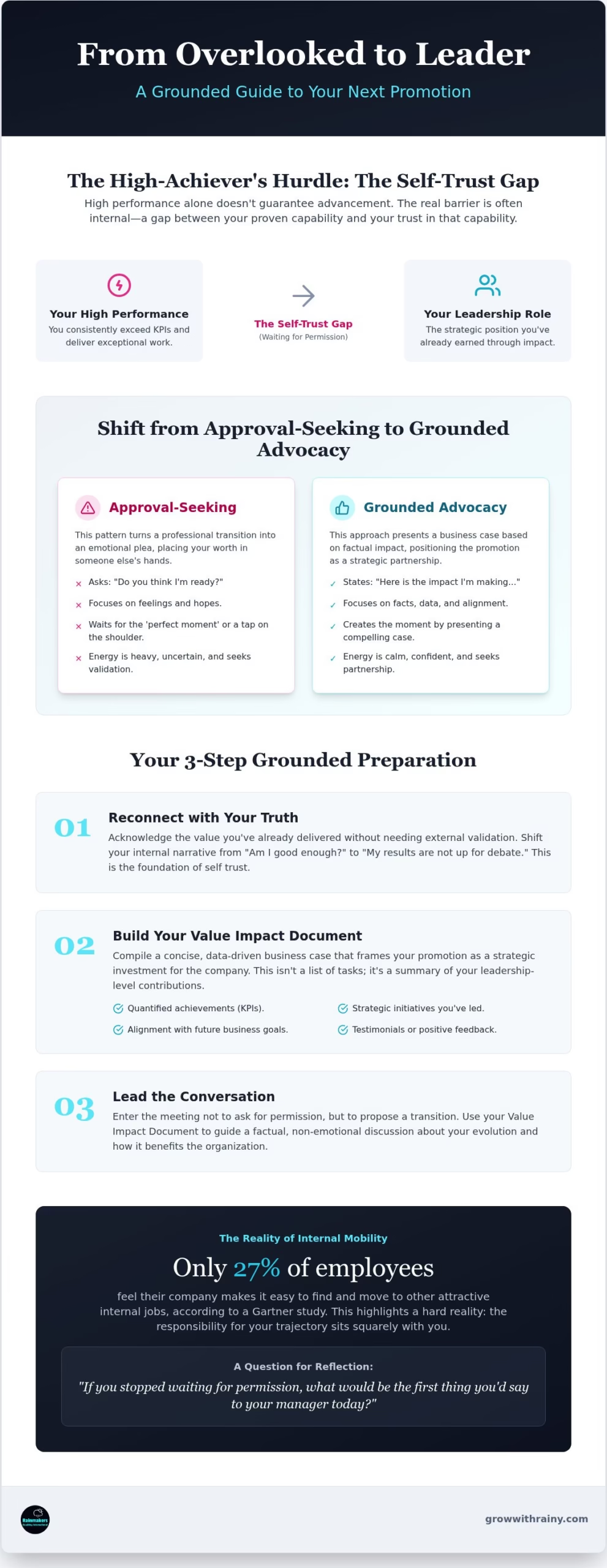
You’ve hit every KPI, yet the title remains just out of reach. It’s a common frustration for high achievers who believe that excellence is its own advocate. Many professionals spend years waiting for a ‘tap on the shoulder’ that never comes.
They assume that if they do enough, someone will eventually notice and hand them the keys to the next level. This is the core of the High-Achiever Self-Trust Gap. You don’t need more evidence of your capability; you need to trust the evidence you already have.
When you’re trying to figure out how to ask for a promotion and get it, the hurdle isn’t usually your skill set. It’s the internal friction that tells you you’re not quite ready, or that the timing isn’t perfect. This gap creates a ceiling on your growth that no amount of overtime can break through. It’s the difference between being a reliable contributor and being seen as a strategic leader.
The Myth of the Perfect Moment
The belief that ‘hard work speaks for itself’ is one of the most damaging myths in the corporate world. If you’re waiting for the perfect moment to climb the career ladder, you might be waiting forever. Waiting for permission is a protective pattern that keeps you safe but stationary.
Reconnecting with your truth means acknowledging the value you’ve already delivered without needing an external stamp of approval to validate it. It requires a grounded approach to your own worth where you stop seeing your career as a series of tests to be passed.
When Success Feels Like a Performance
For many leaders, success feels more like a performance than an identity. You might feel like an imposter, fearing that the moment you advocate for yourself, you’ll be ‘found out’ as someone who doesn’t belong. This anxiety is especially sharp during a promotion ask. It’s why Imposter Syndrome in Senior Leaders is so prevalent; the higher you go, the more you feel you’re acting a part rather than inhabiting a role.
A Gartner study suggests that only 27% of employees feel their company makes it easy to find and move to other attractive internal jobs. This statistic highlights a hard reality: the responsibility for your trajectory sits squarely with you.
If you don’t close the self trust gap, you’ll continue to view your career as something that happens to you rather than something you direct. Grounded leadership begins when you decide that your results are no longer up for debate.
If you didn’t need permission to be a leader, what would change about the way you present your business case today?
The Internal Friction: How Approval-Seeking and Perfectionism Stall Growth
Why does asking for a higher title feel like you’re asking for a personal favour? If you find yourself rehearsing your script with a sense of dread, you’re likely experiencing internal friction.
At Rainmakers Coaching International, a core principle of human transformation is that approval becomes dangerous when we allow others to determine our worth. When you rely on external validation to feel successful, your career growth is no longer in your hands. It becomes a hostage to someone else’s opinion.
Approval-Seeking is often a subconscious strategy for preserving safety at work. You don’t want to rock the boat or appear ‘annoying’ to your manager, so you stay quiet. This pattern turns a professional transition into an emotional plea.
To master how to ask for a promotion and get it, you must shift from ‘needing a yes’ to ‘proposing a transition.’ If you’re struggling to find that inner certainty, a coaching conversation can help you identify where these patterns are holding you back.
Approval-Seeking vs. Grounded Advocacy
Approval-Seeking turns the workplace into a courtroom where you are constantly on trial. When you are in this pattern, you aren’t just asking for a new title; you’re asking for permission to feel valuable. This creates a heavy energy that managers can sense.
Grounded advocacy is different. It’s about stating facts and alignment rather than seeking validation. It’s the difference between saying “Do you think I’m ready?” and “Here is the impact I’m making and how it aligns with the senior role.” One seeks a gold star; the other seeks a partnership.
The Perfectionism Trap in Career Goals
Perfectionism creates a ‘not yet’ loop that keeps you stationary. It’s the voice that says you need one more certification or one more flawless project before you’re ready to speak up. However, perfectionism is often just a strategy for protecting your worthiness. If you never ask, you can’t be rejected, and your sense of self stays safe.
This is a major hurdle when setting 2026 career goals. You must realize that a promotion is an investment in your future trajectory, not a reward for being perfect in the past. Research from Harvard Business Review on how to ask for a promotion suggests that successful candidates treat the request as a series of ongoing conversations. They don’t wait for a single, high-stakes moment.
Consider that only about one-third of critical roles in organizations are backed by a formal succession plan. If you aren’t advocating for yourself, there’s a 66% chance no one else is planning your next move. Relying on perfectionism to get you noticed is a losing strategy.
When you operate from a place of self trust, you no longer see a ‘no’ as a rejection of your identity. It becomes a data point in a larger negotiation about how to ask for a promotion and get it on your terms.
Whose permission are you still waiting for before you believe you’ve earned the next step in your career?
Grounded Preparation: Building Your Business Case with Self Trust
Why do we treat a promotion like a gold star for good behaviour? If you view your career as a series of rewards for past performance, you’re likely stuck in an approval-seeking loop. A promotion is actually a forward-looking business decision. It is an investment in your future trajectory, not a retroactive payment for the hours you’ve already logged.
To master how to ask for a promotion and get it, you must stop looking backward and start presenting a grounded case for what you will deliver next. Preparation begins with an audit of your hidden treasures—and for those in technical fields like construction, you might visit A1 Crane Academy to see how professional certifications can help formalize those strengths. These are the assets you often take for granted because they come naturally to you.
You might see your ability to calm a high-stakes meeting as “just being helpful,” but to the business, that is a critical leadership skill. When you audit these strengths, you build the self trust necessary to speak with authority. You aren’t guessing your value; you’re documenting it—often by formalizing your skills through accredited frameworks with Yellowhouse. This shift is vital because 83% of employers in 2026 plan to distribute salary budgets equally across organizations. If you want to be the exception, your case must be undeniable.
The Value Impact Audit
Most professionals walk into a promotion meeting with a list of tasks they completed. This is a mistake. To understand how to ask for a promotion and get it, you need a Value Impact Document. This document translates your past achievements into future strategic contributions.
Instead of saying you managed a team, describe how you moved from “over-responsibility” to “strategic ownership,” freeing up resources for higher-level goals. You are showing your manager that you are already operating at the level of the role you’re asking for.
Research by Bowles and Babcock (2013) highlights that self-advocacy can carry a “social cost,” particularly for women or those in collaborative cultures. However, they found that “relational accounts” – where you explain how your promotion benefits the organization and the team – significantly reduce this friction. By aligning your growth with the collective good, you move from sounding entitled to sounding like a partner in the company’s success.
Aligning Your Ask with the Company Vision
Your growth shouldn’t just be about a higher salary; it should be an expression of your professional truth. When you have a clear life vision, your career moves become grounded and purposeful. You aren’t just climbing a ladder; you’re navigating toward a state of alignment.
Does the organization’s current direction have space for the leader you are becoming? If your personal trajectory and the company’s needs don’t meet, no amount of preparation will make the role feel authentic.
Does this new role allow me to become more fully myself, or am I just chasing a title to prove my worth?
The Conversation: How to Ask for a Promotion and Get It
Energy is the invisible weight in the room. If you enter a meeting seeking permission, you’ve already ceded your authority. To master how to ask for a promotion and get it, you must realize that the energy of the ask is just as important as the words you choose.
When you speak from a place of self trust, your manager doesn’t feel pressured; they feel reassured by your clarity. This isn’t about a rehearsed performance. It’s about a grounded declaration of where you are already standing.
Setting the stage requires intentionality. Don’t squeeze this conversation into the last five minutes of a routine 1:1. Instead, request a specific time to discuss your trajectory and alignment. Lead with shared goals. You might say, “I’ve been reflecting on our team’s objectives for the next quarter and how my role can best support that growth.”
This opens the door with partnership rather than a demand. Once the door is open, present your Value Impact Document. Let the data speak for your results while your presence speaks for your leadership.
The Script for Grounded Authority
Phrases that project executive presence and self trust avoid the “asking for a favor” trap. Instead of saying, “I was wondering if you’d consider me for a promotion,” try, “I have realized my impact is currently at the Senior level, and I am proposing a realignment of my title to reflect that reality.” It’s direct, calm, and professional.
If you receive a “not right now” response, don’t let your self trust collapse. Treat it as a request for more information. Ask, “What specific indicators do we need to see to make this transition a reality in the next six months?” This keeps you in the driver’s seat of your career.
Negotiation as a Collaborative Dialogue
Reframing the ask as a strategic realignment changes the entire dynamic. You aren’t fighting for a bigger piece of the pie; you’re discussing how to bake a larger one together. The Harvard Negotiation Project emphasizes “Interest-Based Negotiation,” which focuses on mutual gains rather than positions. By using “we” language, you anchor your promotion in the success of the team and the organization. You are showing your manager that your advancement is a win for them, too.
This collaborative approach is a key part of how to ask for a promotion and get it without damaging professional relationships. It turns a potentially high-stakes confrontation into a grounded conversation about future impact.
If you were already certain that you deserved the role, how would that change the way you sit, breathe, and speak during the conversation?
Beyond the ‘Yes’: Reclaiming Your Truth in the New Role
The “yes” you’ve been waiting for has finally arrived. You mastered how to ask for a promotion and get it, but now a new weight sits on your shoulders. If you aren’t careful, the old story of “not being good enough” will simply upgrade its wardrobe for the new office.
While the strategy behind how to ask for a promotion and get it is about your business case, the transition itself is about your identity. The goal isn’t just more success; it’s to lead more authentically.
At Rainmakers, we recognize that overachievement often begins when performance is used as proof of value. If you don’t address the underlying patterns that made you wait for permission, you’ll spend your first six months in the new role trying to prove you belong there.
This is where the Rainmakers Transformation System™ becomes essential. It’s about reconditioning your identity for the director level so you can stop performing and start leading from a place of self trust.
Managing the Transition Friction
Success often triggers a fresh wave of overthinking and a desire for control. You might feel that because you’ve been promoted, your margin for error has disappeared. This is a trap. In your first 90 days, it is critical to set grounded boundaries.
If you continue to operate with the same “over-responsibility” that defined your previous role, you will burn out before you can make a strategic impact. Engaging with Executive Coaching Singapore can provide the psychological safety to navigate this friction with clarity.
The Path to Authentic Leadership
Transformation is measured by who we become, not just the title on our business card. A 2026 report indicates that only about one-third of critical roles in organizations are backed by a formal succession plan.
This means your promotion was likely a result of your own advocacy and internal shifts rather than a pre-ordained corporate path. You didn’t just get lucky; you created the opening by reconnecting with your truth.
Authentic leadership requires you to look at your “mud”, those protective patterns like perfectionism or approval-seeking, and decide what no longer serves you. If you bring the same armour to the new role, you’ll never experience the freedom of the position you worked so hard to reach. Reclaiming your truth means leading from a place of alignment rather than a place of proof.
Invitation to the Rainmaker Transformation System™
What part of your protective patterns can you leave behind in your old role to make space for the leader you are becoming?
Your Next Level is a Choice, Not a Gift
You now have the roadmap to move beyond the protective patterns that keep you waiting for permission. We’ve explored the internal shifts needed to close the self trust gap and the practical steps of building a Value Impact Document that speaks to future strategic contributions. Learning how to ask for a promotion and get it isn’t about luck or perfect timing; it’s about presenting a grounded case for the leader you have already become.
Through more than a decade of experience coaching capable professionals and leaders, I have seen how the proprietary Rainmakers Transformation System™ helps professionals move from the heavy “promoted but not good enough” story into a state of authentic authority.
You don’t have to wait for a tap on the shoulder to claim the role you’ve earned. If you are ready to stop performing for validation and start leading with a sense of innate strength, the path is open to you.
Your career trajectory is no longer something that happens to you; it’s something you direct.
What would change in your professional life if you decided today that you are already ready?
Frequently Asked Questions
What is the best way to ask for a promotion without sounding entitled?
The most effective way to approach this conversation is to frame your request as a strategic realignment rather than a personal favour. You aren’t asking for a reward; you’re proposing a partnership. Focus on the value you’ve already delivered and how a new title allows you to solve larger organizational problems. When you lead with a grounded perspective, your manager sees a leader ready for the next level, not an employee seeking validation.
How do I know if I am actually ready for a promotion?
You don’t always need more evidence that you’re capable; often, you just need to trust the evidence you already have. If you are already performing a significant portion of the responsibilities in the next role, you are ready. Readiness isn’t about being perfect. It’s about having the grounded confidence to handle the challenges of the new level. Look for where you’ve already moved from over-responsibility to strategic ownership.
What should I do if my request for a promotion is rejected?
Treat a “no” as a data point rather than a rejection of your worth. Ask for specific, measurable indicators your manager needs to see over the next six months. This turns a setback into a clear roadmap for your development. Maintaining your self trust during this period is vital. If the organization cannot provide a clear path forward, it may be time to reflect on whether your current environment still aligns with your direction.
How long should I be in a role before asking for a promotion?
Impact usually matters more than the number of months on a calendar. While many organizations look for 12 to 18 months of tenure, your business case should focus on your results. If you have consistently delivered at a higher level and closed the self trust gap, you have a reason to speak up. Don’t let an arbitrary timeline become a protective pattern that keeps you waiting for permission when your value is already evident.
How do I prepare a business case for my promotion?
Preparation is the key to how to ask for a promotion and get it. Create a Value Impact Document that translates your achievements into future strategic contributions. Audit your hidden treasures and quantify how your leadership has saved time, generated revenue, or improved team cohesion. You are showing the business that promoting you is a low-risk, high-reward investment. This grounded approach ensures your request is based on documented reality rather than a plea for approval.
Should I ask for a promotion during my annual performance review?
While the annual review is a natural touchpoint, it shouldn’t be the first time your manager hears about your ambitions. Master how to ask for a promotion and get it by treating it as a series of ongoing conversations. If you wait for the review, budgets may already be locked. Start planting seeds months in advance. This ensures that when the review arrives, the decision feels like a natural and inevitable transition for both of you.
How do I deal with imposter syndrome after getting promoted?
Imposter syndrome often flares up when we use performance as proof of our value. To quiet the inner critic, you must recondition your identity for the new level. Recognize that your promotion was earned through your grounded results and self trust. If you find yourself slipping into overthinking or control, pause and reconnect with your truth. You don’t need to prove you belong; you already do. Transformation is measured by who you are becoming.
Can coaching help me get a promotion faster?
Coaching facilitates faster growth by helping you identify the protective patterns, like perfectionism or approval-seeking, that stall your progress. At Rainmakers Coaching International, we focus on closing the self trust gap so you can advocate for yourself with clarity. By releasing the invisible strategies that keep your treasures hidden, you move from hesitation to decisive action. This inside-out transformation ensures that your external career moves are a reflection of your internal grounded strength.
If you stopped viewing your career as a series of hurdles to clear, what would be the very next step you would take toward your own growth?

Article by
Rainy Rainmaker
Rainy Rainmaker is the founder of Rainmakers Coaching International and a transformational coach for confidence, self-trust, and authentic leadership.
Based in Singapore, she helps high-achieving professionals, managers, and leaders who appear capable on the outside but feel quietly held back by self-doubt, overthinking, imposter feelings, burnout, or a loss of direction. Through her signature Rainmaker Transformation Journey™: Release, Reprogram, Recondition – Rainy helps clients uncover the insights already within them and turn inner clarity into aligned action that creates lasting change in life, career, and leadership.
