What if the invisible protective habits that drove your early career success are the very things exhausting you today? When you decide to hire a leadership coach, standard advice tells you to find someone who can polish your executive presence or offer fresh management tactics. Yet if you’ve sat through conventional corporate training, you already know that generic frameworks fail to resolve internal friction. They don’t quiet the late-night overthinking, the subtle pull toward people-pleasing, or the heavy weight of over-responsibility in high-stakes roles.
Your capability was never broken, and genuine transformation isn’t about fixing flaws. Sustainable leadership emerges when you step past learned protective patterns, reconnecting with your truth and cultivating grounded self trust. In this guide, you’ll discover how to evaluate and partner with an executive coach who addresses root behavioral drivers rather than temporary performance tricks. We’ll walk through the essential vetting criteria, the diagnostic questions you must ask, and the benchmarks that ensure your coaching partnership creates lasting clarity.
Key Takeaways
- Recognize when past success habits have turned into invisible ceilings that extra management training cannot break.
- Distinguish between tactical skills training, peer mentoring, and transformational coaching to invest your resources with clarity.
- Learn the grounded criteria you need to evaluate and hire a leadership coach who works at the level of behavioral drivers rather than surface symptoms.
- Spot critical coaching red flags early, from rigid dogmatism to advice-giving that compromises your inner decision-making.
- Discover how identifying the seven protective patterns enables you to dismantle internal friction and lead with lasting self trust.
When Is It Time to Hire a Leadership Coach?
Most senior leaders don’t seek developmental support because they lack technical competence. You likely reached your current role by being exceptionally capable, driving outcomes, and carrying complex projects across the finish line. The challenge arrives when the very behaviors that earned your promotions begin producing internal friction. You find yourself managing wider ambiguity, yet more spreadsheets, strategy frameworks, and corporate training seminars don’t relieve the pressure.
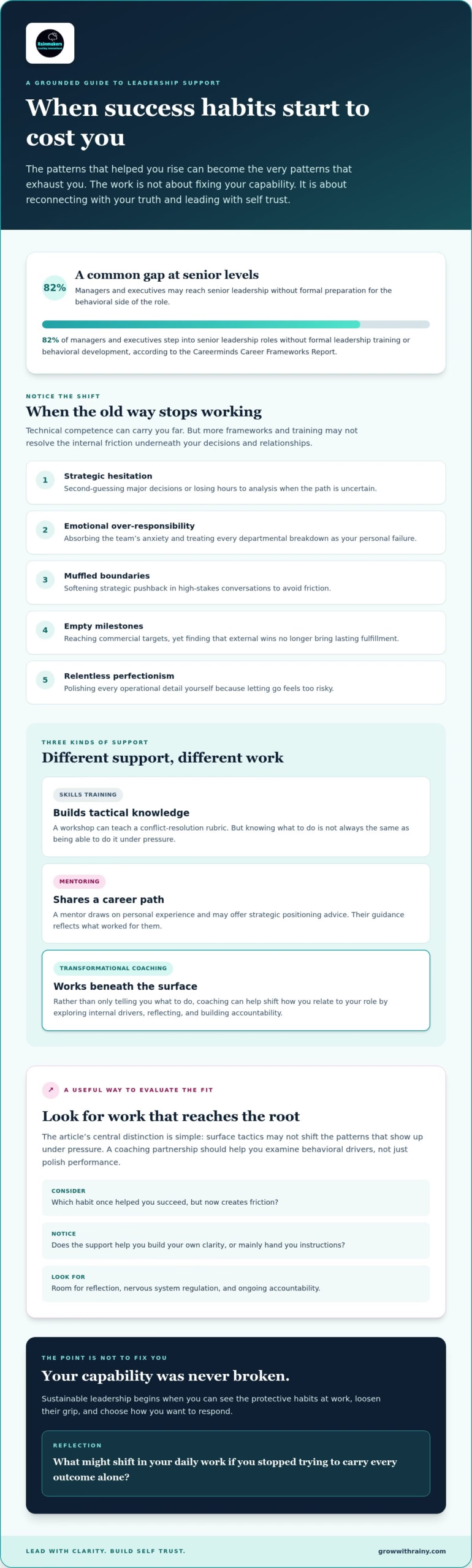
According to the Careerminds Career Frameworks Report, 82% of managers and executives step into senior leadership roles without receiving formal leadership training or behavioral development. When you operate without an intentional framework, you naturally fall back on learned survival habits: over-responsibility, overthinking, and personal control. Recognizing when to hire a leadership coach isn’t about remediation or fixing flaws. It’s about recognizing that technical competence cannot solve internal alignment challenges.
The Hidden Plateaus of High-Achieving Leaders
High achievers often hit an invisible ceiling not because their intelligence fails them, but because their inner operating model reaches capacity. The pattern that helped you succeed at one stage frequently limits your next stage of growth. You may maintain flawless professional composure in boardrooms while silently battling impostor syndrome after a promotion. True growth requires stepping away from external validation and reconnecting with your truth so that your authority stems from grounded self trust rather than constant overcompensation.
Five Telltale Signs You Need Developmental Support
When evaluating the distinction between coaching and mentoring, remember that transactional advice tells you what to do, whereas transformational coaching shifts how you relate to your role. Consider whether you recognize these behavioral signals:
- Strategic hesitation: Second-guessing major decisions or losing hours to analysis paralysis when navigating market ambiguity.
- Emotional over-responsibility: Absorbing your team’s collective anxiety and treating every departmental breakdown as your personal failure.
- Muffled boundaries: Softening strategic pushback during high-stakes stakeholder discussions to avoid interpersonal friction.
- Empty milestones: Hitting major commercial targets yet discovering that external wins no longer produce lasting personal fulfillment.
- Relentless perfectionism: Polishing operational details yourself because letting go feels like an unacceptable risk.
If you recognize these habits, it may be the exact moment to hire a leadership coach who helps you dismantle protective patterns. What would shift in your daily work if you stopped trying to carry every outcome alone?
Comparing Leadership Coaching, Mentoring, and Skills Training
Many executives assume that seeking professional support means choosing between a training workshop, an industry mentor, or a coach. While all three offer value, they operate on completely different psychological planes. Confusing them often leads to frustration, wasted budgets, and stagnant growth. When you hire a leadership coach, you aren’t paying for a generic playbook or prescriptive instructions; you’re investing in deep personal clarity.
The Limits of Transactional Executive Training
Traditional corporate training focuses on imparting tactical information. You attend a two-day workshop, learn a conflict-resolution rubric, and return to your desk with tidy slide decks. Yet when a high-stakes board discussion turns tense, intellectual knowledge dissolves. You react from habitual survival patterns instead of intentional presence.
Classroom learning fails to shift executive behavior because knowing what to do isn’t the same as having the internal capacity to do it under pressure. Sustainable growth requires iterative reflection, nervous system regulation, and continuous accountability. In fact, real behavioral change happens only when you look beneath surface goals into internal drivers; exploring the deeper layers of understanding motivation reveals why willpower alone never creates lasting leadership presence.
Mentorship versus Transformational Coaching
Mentorship is inherently backward-looking and directive. A mentor draws on their historical career path, essentially telling you, "Here is what worked for me in 2015." While industry wisdom can be helpful for strategic positioning, it carries an inherent flaw: it filters your challenges through someone else’s subjective worldview. Their coping strategies might not align with your core values or temperament.
Transformational coaching, by contrast, operates from the conviction that you don’t need fixing. Rather than handing you borrowed scripts, an experienced coach creates psychological safety so you can dismantle defensive habits and lead from authentic self trust.
Industry research from the International Coaching Federation confirms this shift in executive maturity; 85% of corporate coaching clients now actively prioritize verified competency models, such as established ICF credentialing and standards, over unvetted informal advice.
If you’re ready to explore whether your current leadership ceiling is an information gap or a behavioral pattern, scheduling a 90-minute coaching conversation can clarify where your focus belongs. Are you looking for another person’s answers, or are you ready to reconnect with your own grounded discernment?
Core Criteria to Evaluate When You Hire a Leadership Coach
Corporate procurement teams often default to industry matching when vetting candidates. They look for someone with identical sector experience, assuming an ex-banker is required to coach a banking director. Yet functional expertise rarely shifts human behaviour – because that’s a better approach for hiring an industry mentor. When you prepare to hire a leadership coach, your primary focus should be assessing whether the practitioner operates at the level of symptoms or root patterns, does it increases your capacity as a thought leader and help you to be the authentic leader you are meant to be.
Assessing Coaching Philosophy and Transformation Frameworks
Inquire directly into their developmental methodology. Does the practitioner rely on rigid diagnostic slide decks and framework, or do they offer a responsive process that meets your specific challenges? Influential Harvard Business Review research on executive coaching highlights that senior executives primarily engage coaches to address deep behavioral habits and facilitate transitions, rather than acquire basic business knowledge.
Notice how they speak about high-stakes behaviors. A skilled coach recognizes that habits like control, perfectionism, and overachievement aren’t fatal flaws to be erased. They are learned strategies that once protected your belonging and success.
Purposeful executive leadership coaching doesn’t hand you pre-packaged advice; it helps you release protective patterns that no longer serves you, so you can lead with grounded clarity. True transformation isn’t measured by how much information you collect, but by who you become when the pressure mounts. If you are curious about what’s really getting in your way, you can take the Rainmakers Pattern Map Assessment™.
The Chemistry Check: Psychological Safety and Trust
Rapport isn’t about pleasant small talk; it’s about psychological safety. In enterprise leadership, you’re constantly evaluated by boards, investors, and direct reports. A coaching engagement must offer a rare container where you can set down professional posturing without fear of judgment.
Pay close attention during initial chemistry conversations. Does the coach nod passively along with your narrative, or do they ask incisive questions that gently challenge your comfortable assumptions?
You need a partner possessing intuitive depth, someone who listens between your words and holds a calm, unwavering presence. When you evaluate prospective coaches, ask yourself: do you feel safe enough with this person to tell the messy truth about your leadership experience?
Key Questions to Ask and Red Flags to Avoid
A discovery conversation shouldn’t feel like an aggressive sales pitch. It is an audition of presence. When you prepare to hire a leadership coach, the way that person listens during your initial conversation reveals far more than their pitch deck. If a coach rushes to diagnose your situation within ten minutes, they are likely projecting their own preconceptions onto your career.
Essential Questions to Ask During Your Discovery Call
To uncover a practitioner’s depth and emotional discernment, move beyond questions about scheduling logistics. Pose questions that test their developmental philosophy:
- "How do you distinguish between tactical execution problems and deeper internal friction?" Listen for whether they explore root behavioral patterns or simply offer surface management tricks.
- "What is your process for helping leaders cultivate lasting self trust?" An effective coach guides you back to your own inner compass rather than encouraging reliance on their personal guidance.
- "How do you respond when a client displays subtle resistance or defensive habits?" You want a coach who meets hesitation with calm inquiry and psychological safety, not impatient pushing.
A seasoned coach won’t rush to validate your ego or soothe your discomfort prematurely. They will hold space for the pause, giving you room to articulate your own core values.
Critical Red Flags in Executive Coaching Engagements
With an estimated 122,000 active coaching practitioners globally, the coaching industry remains largely unregulated. An International Coaching Federation industry analysis found that 73% of corporate buyers formally demand proven developmental methodologies precisely because superficial advice-giving is so prevalent. Vetting candidates carefully protects both your time and your emotional energy.
Watch for these immediate warning signs:
- Guaranteed external results: Anyone promising rapid promotions or specific corporate titles is selling hype rather than developmental growth.
- Dominating the dialogue: If the practitioner spends half the consultation lecturing on their past corporate triumphs, they are mentoring from memory, not coaching.
- Treating you as broken: Transformational coaching is never about fixing flaws. Beware practitioners who frame your protective survival habits as character defects rather than adaptive patterns that have simply outlived their usefulness.
Take time to review our comprehensive guide on what to know before hiring a coach to refine your evaluation checklist before committing resources.
When you reflect on your past conversations with mentors or advisors, did they leave you feeling managed, or did they create the safety needed to examine your truth?
The Rainmakers Approach: Releasing Hidden Protective Patterns
When executives decide to hire a leadership coach, they often believe they need to acquire new personality traits. At Rainmakers Coaching International, led by Rainy Rainmaker with more than a decade of experience guiding executives, coaching starts from a different premise. Your capability was never broken. The invisible protective armor you built to safeguard your early success is simply creating friction at this stage of your journey.
Understanding the Seven Learned Protective Patterns
High achievers typically rely on seven learned protective patterns: Perfectionism, Approval-Seeking, People-Pleasing, Over-Responsibility, Overthinking, Control, and Overachievement. These are not character defects or clinical diagnoses. They are intelligent, adaptive strategies developed early in life to guarantee belonging, safety, or validation.
As enterprise responsibilities expand, what once served as an asset becomes a bottleneck. Relentless overachievement creates chronic exhaustion. The compulsion toward control stifles team ownership. Overthinking drains decisive clarity during strategic crossroads. Learning how to lead with impact begins when you set down this armor, reconnecting with your truth so that your innate wisdom can guide your decisions.
The 3R System: Release, Reprogram, Recondition
To produce lasting behavioral shifts without superficial performance hacks, Rainmakers utilizes the proprietary Rainmaker Transformation System™. This framework moves through three grounded phases:
- Release: Acknowledging and setting down the emotional weight of outdated survival habits without self-judgment.
- Reprogram: Reconnecting with your truth and shifting core assumptions that mistakenly equate your self-worth with constant overextension.
- Recondition: Embedding responsive, authentic habits through sustained reflective practice and daily executive presence.
A landmark benchmark by Manchester Consulting demonstrated that executive coaching delivers a 5x to 7x return on investment when directly connected to lasting behavioral change. Moving beyond surface tactics cultivates a deep, unshakeable self trust that stabilizes you through organizational turbulence. When you hire a leadership coach focused on root drivers, you create space to lead with quiet confidence rather than constant effort.
If you’re ready to explore what lies beyond your protective habits, step into a grounded conversation on executive leadership.
Which of your historic success habits is currently costing you the most peace?
Leading With Grounded Clarity and Self Trust
True executive growth isn’t about collecting more management theories or maintaining rigid composure under pressure. When you choose to hire a leadership coach, your greatest return comes from addressing root behavioral drivers rather than polishing symptoms. By dismantling protective habits like perfectionism or over-responsibility, you create room to lead from authentic presence.
With more than a decade of experience guiding high achievers, Rainmakers Coaching International uses the proprietary Rainmaker Transformation System™ to help you release old survival strategies and recondition unshakeable self trust. You don’t need fixing; your capability is already whole. Transformation simply clears away the internal friction so your natural wisdom can lead.
Schedule a 90-Minute Coaching Conversation with Rainy Rainmaker
Give yourself the psychological safety to pause, reflect, and step into the grounded clarity your leadership deserves.
Frequently Asked Questions
How do I know if I need a leadership coach or a therapist?
Therapy focuses on resolving psychological distress, mental health conditions, and past trauma, while leadership coaching focuses on personal alignment, professional growth, and present-day behavioral patterns. Rainmakers Coaching International does not provide clinical counseling. If your primary challenge involves navigating executive friction, releasing chronic over-responsibility, or stepping past internal ceilings at work, an executive coach provides the developmental space needed to cultivate self trust.
What is the typical duration of an executive leadership coaching engagement?
Most executive coaching partnerships span three to six months, though complex organizational transitions may extend through a full year. Sustainable behavioral change requires iterative reflection and real-world testing. Rather than isolated advisory sessions, a multi-month coaching journey gives you time to establish new boundaries, observe your habitual reactions during high-stakes board reviews, and firmly recondition a grounded leadership presence across ambiguous business situations.
Can leadership coaching help me overcome imposter syndrome and self-doubt?
Yes. Transformational coaching directly addresses the invisible self-trust gap that often emerges following promotions or enterprise expansions. High achievers frequently lean on protective patterns like overthinking or overachievement to validate their worth. Coaching doesn’t dismiss self-doubt with surface motivational affirmations. Instead, it guides you to understand the protective intention behind the doubt, helping you trust your accumulated capability and lead from authentic presence.
What is the difference between an executive coach and a business consultant?
A business consultant analyzes external systems to prescribe specific commercial or operational strategies and tells you what to do, while an executive coach focuses on internal leadership capacity and decision-making clarity. Consultants tell you what to do with your business model. When you hire a leadership coach, the work centers on who you are becoming as a leader, helping you dismantle personal bottlenecks like control or people-pleasing so you can execute strategy effectively.
How do I measure the return on investment when hiring a leadership coach?
Executive coaching ROI is measured through qualitative shifts in personal clarity alongside tangible operational performance. Leaders frequently see immediate gains in recovered time through effective delegation, reduced team friction, and decisive momentum during ambiguous negotiations. When you hire a leadership coach to address root behavioral drivers, the organizational return compounds through calmer executive presence, healthier culture, and greater leadership sustainability.
What should I expect during my first executive coaching discovery conversation?
Expect a reflective, confidential dialogue rather than a high-pressure sales pitch or transactional assessment. Your initial conversation serves as a mutual chemistry check to evaluate psychological safety. You’ll explore current leadership bottlenecks, examine what has prevented you from resolving them independently, and experience firsthand whether the coach’s presence invites honest inquiry or merely relies on superficial advice-giving.
How does the Rainmakers Transformation System differ from traditional leadership coaching?
Traditional leadership coaching often polishes surface management tactics, whereas the proprietary Rainmaker Transformation System™ operates at the level of human behavioral constructs. Drawing on more than a decade of experience, Rainy Rainmaker guides leaders through three grounded phases: Release, Reprogram, and Recondition. Instead of attempting to fix flaws, this approach addresses which of the seven protective patterns is creating friction, helping you lead with authentic self trust.

Article by
Rainy Rainmaker
Rainy Rainmaker is the founder of Rainmakers Coaching International and a transformational coach for confidence, self-trust, and authentic leadership. Based in Singapore, she helps high-achieving professionals, managers, and leaders who appear capable on the outside but feel quietly held back by self-doubt, overthinking, imposter feelings, burnout, or a loss of direction. Through her signature Rainmaker Transformation Journey™, Rainy helps clients uncover the insights already within them and turn inner clarity into aligned action that creates lasting change in how they work, lead and live.
