This is the quiet paradox of high-achievers in Singapore. The very drive that fuels your success – the relentless attention to detail, the need to anticipate every risk, the sense of total responsibility can become a gilded cage. You’re running on a treadmill of overthinking, and the exhaustion is setting in.
You know you need a shift, not just another leadership seminar. You’ve started searching for an executive coach, but the landscape is confusing. It’s a sea of impressive corporate logos, complex accreditations, and promises to “unlock your potential.” But your entry question isn’t about potential; it’s about pressure. How do you find the one person who can help you dissolve this internal friction, not just polish your external performance?
This guide is different. It’s not about finding a coach with the most impressive resume. It’s about finding the coach who sees the hidden treasures within you, even when all you can feel is the weight of your own armour. It’s about moving from a transactional, skills-based search to a transformational one that reconnects you with your own grounded confidence.
Beyond the Resume: Why the “Best” Executive Coach in Singapore is the One Who Sees You
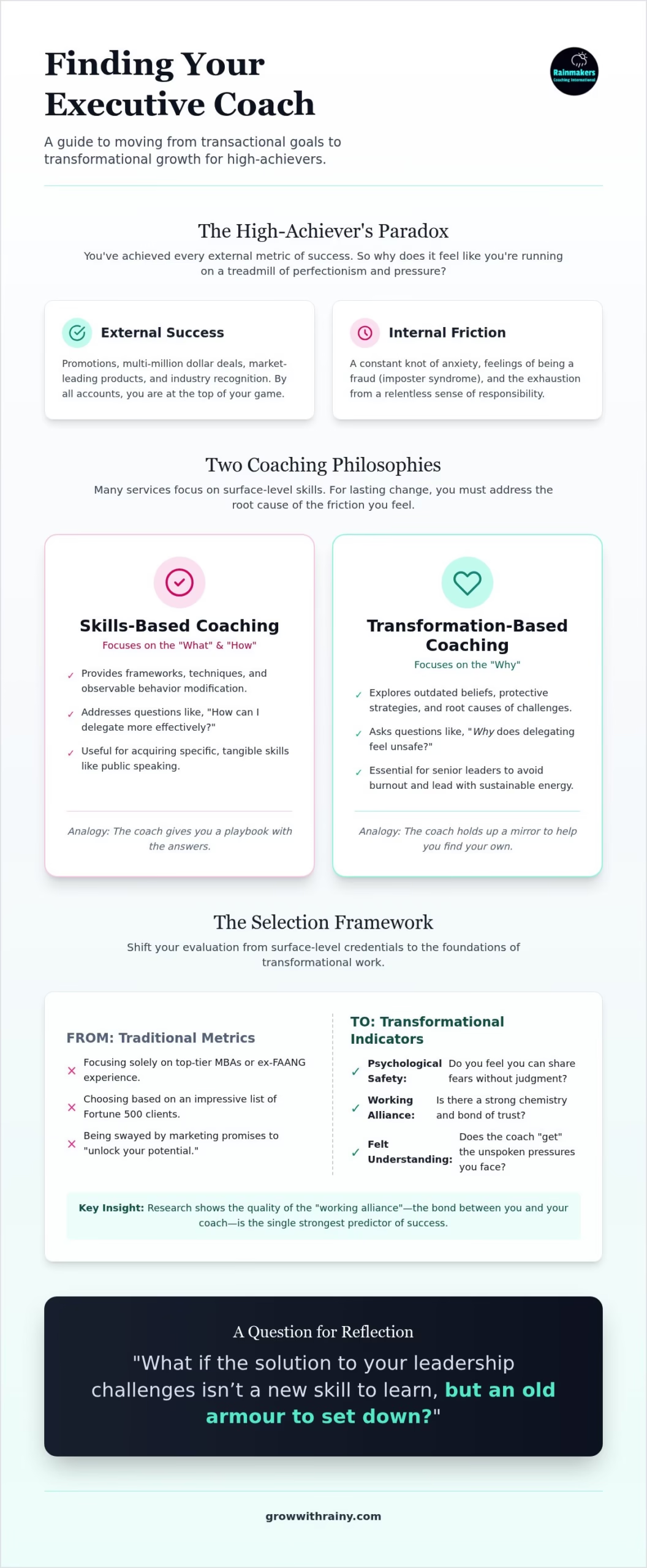
In the high-stakes finance and tech hubs of Singapore, we are conditioned to evaluate everything based on credentials. We look for the top-tier MBA, the ex-FAANG experience, the list of Fortune 500 clients. While these are markers of experience, they don’t answer the most important question: can this coach create the psychological safety you need to do real, transformational work?
True executive coaching isn’t about skill acquisition; it’s a process of subtraction. It’s about helping you release the protective strategies and outdated beliefs that are weighing you down. It’s about reconnecting with the truth of who you are beneath the layers of expectation.
The relentless pressure of the Singapore market often forces our greatest strengths into overdrive until they become barriers. A healthy drive for excellence becomes crippling perfectionism .
A strong sense of responsibility becomes a chronic inability to delegate. The right coach doesn’t just see the over-used strength; they see the brilliant, innate quality beneath it. They see the gem, even when you can only see the flaw.
This is the fundamental difference between a consultant and a transformational coach. A consultant arrives with a playbook and gives you the answers. A coach holds up a mirror and asks the questions that help you find your own.
The Difference Between Skills-Based and Transformation-Based Coaching
Many coaching services focus on observable behaviours, which can be useful but often misses the root cause of a leadership challenge.
- Skills-based coaching focuses on the “what” and “how”: how to delegate more effectively, how to run a better quarterly review, how to improve your presentation skills. It provides frameworks and techniques.
- Transformation-based coaching focuses on the “why”: why the thought of delegating a critical project makes you feel unsafe, why you rehearse difficult conversations in your head for hours, why you feel the need to personally review every line of code before a release.
For senior leaders in Singapore, the latter is essential. You already know how to do your job. The friction you’re feeling comes from the internal, invisible patterns that drain your energy and limit your impact. Addressing these is the only way to avoid burnout and lead with sustainable energy.
Why Chemistry Outweighs Credentials in Leadership Growth
When you’re exploring the deepest drivers of your leadership style, trust is non-negotiable. Decades of research confirm that the single strongest predictor of success in coaching and therapy is the quality of the “working alliance” – the bond between you and your coach.
This isn’t a vague, “feel-good” concept. It’s about psychological safety. Do you feel you can share your fears of failure without being judged? Can you admit to feeling like an imposter without the coach rushing to “fix” you with platitudes? This sense of safety is the foundation for deep, reflective work.
Look for a coach who has not only the credentials, but also a proven track record of coaching clients navigating high-stakes environments. They understand the unspoken pressures and can hold space for complexity without rushing to simplify it. Feeling deeply understood creates the trust and safety needed for meaningful transformation
Reflective Question: What if the solution to your leadership challenges isn’t a new skill to learn, but an old armour to set down?
Identifying Your Internal Friction: What are You Really Solving For?
Most leaders begin their search for a coach with a surface-level goal. “I need more confidence.” “I need to manage my time better.” “I need to be more assertive.” These are symptoms, not the source of the problem. The real work lies in understanding the internal friction that creates these symptoms.
This friction often comes from a set of deeply ingrained “protective strategies.” These are behaviours and thought patterns we developed years ago to keep ourselves safe – safe from failure, criticism, or uncertainty. They worked beautifully to get us to this point in our careers. But now, at a senior level, these same strategies are the very things holding us back.
Are you running away from the fear of failure, or are you running toward a compelling vision? The first is a state of protection, driven by anxiety. The second is a state of freedom, driven by purpose. A great coach helps you see which state you’re operating from, moment to moment.
This process of self-discovery is the heart of our work. It’s about building a foundation of self-trust so you no longer need the armour of protection. The Building Rock Solid Confidence Program is designed around this very framework, helping you identify and release these patterns.
Common Protective Patterns in Singaporean Leaders
While everyone’s internal landscape is unique, certain patterns show up frequently among high-achievers in demanding environments. See if any of these resonate:
- Overthinking: You believe that if you can just analyze a problem from every possible angle, you can prevent any negative outcome. This creates a false sense of control but leads to analysis paralysis, mental exhaustion, and a team that is waiting for you to make a decision. The tech lead who stays up until 2 AM re-reading code commits is running this pattern.
- People-Pleasing: You avoid healthy conflict or difficult feedback to maintain harmony. You might say “yes” to a project you know is a bad idea to avoid disappointing a stakeholder. This erodes strategic clarity and can breed resentment in your team, who see you prioritizing likability over leadership.
- Over-Responsibility: You carry the weight of the entire team’s success on your shoulders. You’re the first one in, the last one out, and you secretly believe that if you don’t personally oversee every detail, things will fall apart. This makes true delegation impossible and creates a bottleneck that stifles your team’s growth.
Moving from Protection to Freedom
The first step is to acknowledge that these patterns served a purpose. Overthinking may have helped you pass a difficult exam. Over-responsibility may have earned you that first promotion. The goal is not to demonize them, but to recognize that they are no longer serving you at this level of leadership.
The role of a coach is to help you see these invisible barriers and gently challenge them. They create a safe space for you to experiment with new ways of being. What would it feel like to trust your team with a critical task and not check in every hour? How would you lead if you no longer needed everyone to like you?
This shift from protection to freedom is the core of transformational change. It’s not about becoming a different person; it’s about becoming more of who you truly are.
Reflective Question: What protective strategy are you most reliant on, and what is it costing you in terms of energy and impact?
The Selection Framework: Evaluating Methodology over Marketing
As you narrow down your search for an executive coach in Singapore, you’ll encounter a heavy focus on accreditation. Certifications from bodies like the International Coaching Federation (ICF) are important – they establish a baseline of ethics and training. But they are the beginning of your inquiry, not the end.
An accreditation tells you a coach has met a standard. It doesn’t tell you how they facilitate change. This is where you need to look beyond the logo and evaluate their methodology. Do they have a clear, coherent process for guiding a client from where they are to where they want to be? Or do they rely on generic, motivational language?
A grounded, sustainable approach is far more powerful than one based on hustle or hype. We use the Rainmakers Transformation System™, a three-phase process designed for lasting change: Release, Reprogram, Recondition. The essential first step is the “Release” phase, where we work to dissolve the mental clutter and protective strategies that keep you stuck.
Release, Reprogram, Recondition: A Roadmap for Change
A clear methodology provides a roadmap, giving you confidence that your investment of time and energy will lead to a tangible outcome. Our system is designed to create change from the inside out:
- Release: This first phase is about letting go. We identify the invisible protective strategies like perfectionism or overthinking that are consuming your energy. Through deep inquiry, we help you see how these patterns are holding you back, creating space for something new.
- Reprogram: Once you’ve released the old patterns, you can begin to shift the underlying beliefs that created them. This is where we work to replace self-criticism with self-trust and replace the fear of failure with a commitment to learning.
- Recondition: Lasting change comes from practice. In this final phase, we focus on integrating your new beliefs and perspectives into your daily leadership habits. It’s about taking small, consistent actions that recondition your nervous system to operate from a place of grounded confidence, not anxiety.
Questions of Integrity: Does the Coach Walk the Talk?
The most effective coaches are those who are committed to their own growth. They continue to do their own internal work, invest in supervision, and live the principles they teach. Look for signs of this commitment. Do they speak with humility and self-awareness?
Beyond a list of corporate logos, look for evidence of real-world impact. Social proof in the form of detailed coaching breakthrough stories or testimonials can be far more telling than a polished marketing page. These stories reveal the coach’s ability to facilitate genuine shifts in perspective.
Finally, consider the integrity of their engagement process. A coach who is confident in their ability to deliver value will often offer a way for you to experience their work before you commit. A “90-minute coaching conversation,” for example, is not a sales pitch; it’s a demonstration of their depth and a chance for both of you to determine if the chemistry is right.
Reflective Question: When you review a coach’s website, do you feel like you’re being sold to, or do you feel like you’re being seen?
Five Questions to Ask During Your Discovery Call
The discovery call, or “chemistry session,” is your most important vetting tool. This is your chance to move beyond the website and get a felt sense of the coach’s presence and depth. To make the most of this conversation, go beyond surface-level questions about their experience. Here are five deep-dive questions designed to reveal their methodology and approach.
- How do you handle the “inner critic” when it shows up in senior leaders?
This question tests their understanding of internal dynamics. A great coach won’t suggest simply ignoring it or “thinking positive.” They will likely talk about understanding its protective intent and learning to unhook from its narrative. - What is your process for moving beyond surface-level goals to find the real internal friction?
This reveals their depth. A transactional coach might take your goal of “better time management” at face value. A transformational coach will ask questions to uncover the fear of letting go or the belief that “busyness equals value” that is driving the time management issue. - Can you share a time you challenged a leader’s core assumption that felt uncomfortable but necessary?
This question assesses their courage and their ability to create safety. You want a coach who will challenge you, but do so with compassion and respect, not aggression. Their answer will tell you a lot about their style. - How do you ensure that the changes we make in our sessions are “grounded” and sustainable in a high-pressure work environment?
This probes their approach to integration. Look for answers that involve somatic practices (connecting to the body), habit formation, and small, consistent actions rather than just “mindset shifts.” - How is your approach different from mentorship or therapy?
This is a critical clarifying question. It ensures the coach has strong professional boundaries and understands their unique role. For more on this, you can explore the differences between various helping professions in our guide on how to find the right life coach.
Listening for the “Unspoken” in Their Answers
As they answer, pay attention not just to what they say, but how they say it. Is the coach truly listening to your words, or are they waiting for their turn to talk? Do they seem more interested in understanding your unique context or in fitting you into their pre-existing model?
A grounded coach holds space for your complexity. They don’t jump to “fix” you or offer easy solutions. They will be comfortable with silence and will not promise overnight success. Instead, they will speak of a steady, sustainable transformation built on a foundation of self-awareness and self-trust.
Assessing Cultural Nuance in Singapore
It is also important to consider whether the coach understands the cultural and workplace dynamics common in Singapore and across APAC, including hierarchy, saving face, stakeholder expectations, and the challenge of speaking up while maintaining relationships.
Look for a coach who has experience coaching senior leaders and experienced professionals through challenges such as managing difficult stakeholders, building executive presence, communicating with greater confidence, navigating organisational dynamics, and developing a more authentic leadership style.
This relevant coaching experience helps the coach understand the context behind your challenges and support you in finding approaches that are both personally meaningful and practical within the environment you work in. This cultural awareness is an important part of effective executive coaching in Singapore.
Reflective Question: Which of these five questions feels most important for you to ask right now, and what are you hoping to hear in the answer?
From Hesitation to Decisiveness: Starting Your Coaching Journey
You’ve read the articles, considered the options, and you know a change is needed. Yet, you might still feel a sense of hesitation. This is completely normal. In fact, the “overthinking” strategy you use at work is likely showing up here, urging you to do “just one more week of research.”
Recognize this hesitation for what it is: another protective pattern. It’s the part of you that fears vulnerability and wants to keep you safe in the familiar, even if the familiar is exhausting.
The first conversation with a potential coach is a safe, confidential space to explore the hidden treasures you hold within – the clarity, courage, and grounded confidence that have been obscured by years of pressure and expectation.
The 90-Minute Conversation: A Catalyst for Clarity
The best way to move from hesitation to a clear decision is to experience coaching firsthand. This is why we offer a complimentary 90-minute coaching conversation. This is not a sales pitch or a superficial chat. It is a real, deep-dive coaching experience designed to give you immediate value.
In this session, you can expect deep inquiry into your current challenges, a focus on emotional relevance, and a tangible shift in your perspective. It is a powerful catalyst for clarity and the best way to experience if our approach is the right fit for you. You will walk away with a deeper understanding of your own internal friction and a clearer sense of the path forward, whether you choose to continue with us or not.
Your Future as a Grounded Leader
Imagine leading your next high-stakes meeting not from a place of anxiety and self-doubt , but from a place of deep self-trust. Imagine making difficult decisions with clarity and conviction, free from the need for external validation. This is the outcome of transformational coaching .
When you lead from this grounded place, the ripple effect is immense. Your team feels more psychologically safe, your organization benefits from your increased strategic clarity, and you finally get to enjoy the success you’ve worked so hard to achieve.
This journey is about more than just your career; it’s about reclaiming your energy, your purpose, and yourself. For a deeper look into this philosophy, explore our complete guide to releasing your hidden leadership treasures.
Reflective Question: What is the one thing you are protecting that is actually ready to be released?
Frequently Asked Questions About Executive Coaching in Singapore
Is executive coaching in Singapore different from therapy?
Yes, they are distinct. Therapy often focuses on healing past trauma and treating clinical conditions like anxiety or depression, facilitated by a licensed mental health professional. Executive coaching is forward-looking and performance-oriented. It partners with mentally healthy individuals to identify and overcome internal barriers, enhance leadership skills, and achieve specific professional goals. While coaching can feel therapeutic, it is not therapy.
How much does executive coaching typically cost for senior leaders?
The investment for premium executive coaching in Singapore for senior leaders typically ranges from SGD 8,000 to SGD 30,000+ for a six-month engagement. The cost depends on the coach’s experience, the program’s duration and depth, and the level of support provided. It’s best to view it as an investment in your long-term leadership capacity and well-being.
How long does it take to see real results from coaching?
While many clients report a shift in perspective after the very first session, sustainable change takes time. Meaningful results, such as a noticeable decrease in overthinking or an increase in confident decision-making, often become apparent within the first three months. A typical transformational engagement lasts six to twelve months to ensure new mindsets and behaviours are fully integrated.
Can I hire an executive coach even if my company isn’t paying for it?
Absolutely. A growing number of senior leaders are personally investing in their own development. Self-funding your coaching gives you complete confidentiality and the freedom to choose a coach based on personal chemistry and fit, rather than being limited to a company-approved vendor list. It is a powerful statement of commitment to your own growth.
What happens if I don’t feel a “click” with my coach after the first session?
This is why the initial “chemistry session” is so critical. A professional coach will understand that the working alliance is paramount. If the fit doesn’t feel right for either party, they should be transparent about it. At Rainmakers, our 90-minute introductory conversation is designed to ensure mutual fit before any long-term commitment is made.
How do I balance coaching sessions with a high-pressure work schedule?
Coaching is designed to create more capacity, not drain it. Sessions are typically 60-90 minutes and occur every two to three weeks, making them easy to schedule. A good coach helps you create leverage, so the insights gained in a single session can save you hours of wasted energy and indecision in the weeks that follow.
Is coaching only for leaders who are “struggling” or “failing”?
This is a common misconception. Coaching is most effective for leaders who are already successful but know they are capable of more – more impact, more fulfilment, and more ease. Just as top athletes have coaches to stay at the top of their game, high-performing leaders use coaching to move from good to great and to lead in a more sustainable way.
What is the difference between an executive coach and a mentor?
A mentor is typically a more experienced professional in your field who provides advice, shares their own experiences, and helps you navigate your career path . Their role is to give you answers based on their own journey. A coach, on the other hand, does not give advice. Their role is to ask powerful questions to help you access your own wisdom and find your own answers. They focus on your inner world – your mindsets, beliefs, and behavioural patterns to unlock your capacity.

Article by
Rainy Rainmaker
Rainy Rainmaker is the founder of Rainmakers Coaching International and a transformational coach for confidence, self-trust, and authentic leadership. Based in Singapore, she helps high-achieving professionals, managers, and leaders who appear capable on the outside but feel quietly held back by self-doubt, overthinking, imposter feelings, burnout, or a loss of direction.
Through her signature Rainmaker Transformation Journey™: Release, Reprogram, Recondition – Rainy helps clients uncover the insights already within them and turn inner clarity into aligned action that creates lasting change in life, career, and leadership.
