What if the restless feeling you wake up with isn’t a sign of failure, but a signal that you’ve outgrown the pot you were planted in? Many professionals reach a point where finding a fulfilling career after 40 feels less like a luxury and more like a necessity. You might feel like a bonsai tree, meticulously trimmed to fit a specific container, while your roots are cramped. You’ve hit the markers of success, but the High-Achiever Self-Trust Gap has left you feeling disconnected from the path you built.
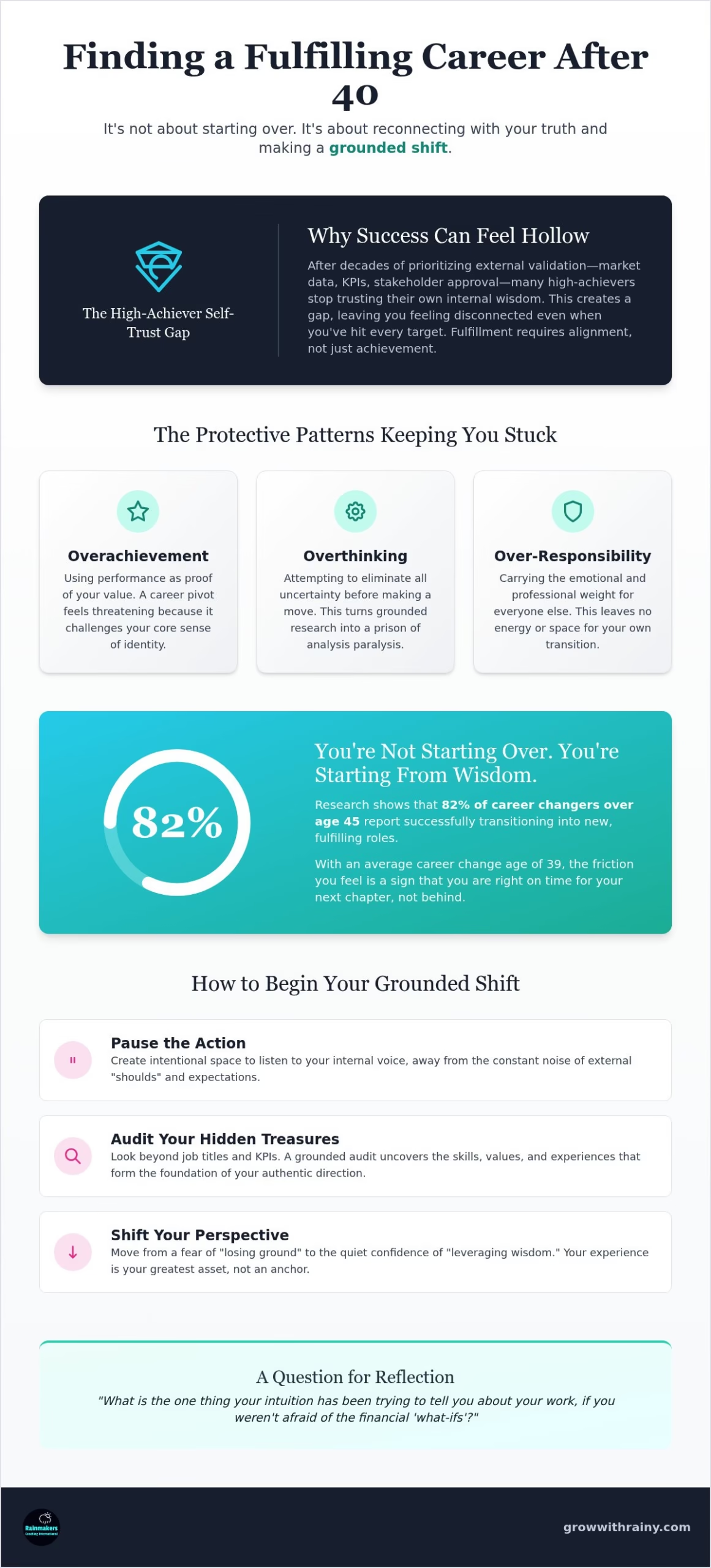
It’s natural to fear that a transition means risking your financial stability. However, your next chapter isn’t about “fixing” what is broken; it’s about reconnecting with your truth. Data from 2026 shows that 82% of career changers over age 45 report successfully transitioning into new roles. You aren’t losing ground. You’re preparing for a grounded shift toward alignment.
We’ll explore how to release the internal patterns keeping you stagnant and uncover the hidden treasures of your experience. If you weren’t afraid of the financial “what-ifs,” what is the one thing your intuition has been trying to tell you about your work?
Key Takeaways
- Understand that the friction you feel in your current role is a call to begin reconnecting with your truth rather than a sign of failure.
- Identify how protective patterns like Overachievement keep you stuck in roles that no longer fit your authentic direction.
- Shift your perspective from “starting over” to leveraging decades of wisdom when finding a fulfilling career after 40.
- Learn to conduct a grounded audit of your hidden treasures to determine where your skills and purpose naturally align.
- Discover how the Rainmaker Transformation System™ uses the Release phase to clear the mental clutter blocking your next move.
Why does finding a fulfilling career after 40 feel so difficult?
You’ve spent two decades building a reputation, hitting targets, and climbing ladders. Yet, as you navigate Middle age, that familiar drive feels different. It’s heavier. Many high-achievers find that the very success they worked for now creates a sense of internal friction. This isn’t a “crisis” in the way society describes it; it’s actually a vital stage of growth where your internal compass is signaling that it’s time for a change. Finding a fulfilling career after 40 often feels difficult because you aren’t just looking for a new job. You’re looking for a way of reconnecting with your truth.
This friction often stems from the High-Achiever Self-Trust Gap. You’ve learned to trust the data, the market, and your stakeholders, but you’ve stopped trusting your own internal wisdom. You’ve become an expert at “doing” while neglecting the “being,” which leaves you feeling hollow even when the balance sheet looks perfect.
The difference between success and fulfillment
Why does the promotion you spent years chasing suddenly feel like a burden? It’s a question many senior leaders ask when success no longer feels meaningful. Think of a bonsai tree. To keep it small and aesthetically pleasing for its pot, its branches are constantly trimmed. You may have spent years trimming your own interests, values, and energy to fit into a corporate container that was never meant to hold your full expansion. Fulfillment requires alignment, whereas achievement only requires effort. If your work doesn’t reflect your values, no amount of status will quiet that “midlife itch.”
Reconnecting with your truth after decades of ‘shoulds’
Over twenty years, it’s easy to lose your voice to the “shoulds” of your industry. You should take the lead on this project. You should aim for the C-suite. You should prioritize the bottom line above your own well-being. After a while, these external expectations become so loud you can’t hear your own voice. Finding a fulfilling career after 40 requires a grounded approach that prioritizes your internal hidden treasures over external validation.
The first step is pausing the constant cycle of action to examine who you are beneath the titles. Recent data suggests this shift is more common and successful than you might fear. In 2026, research shows that 82% of career changers over the age of 45 report successfully transitioning into their new roles. You aren’t starting over. You’re starting from a place of deep, hard-earned wisdom.
Reflection Question: What would you choose to do tomorrow if you didn’t need anyone’s approval?
The hidden patterns preventing your midlife career pivot
Most advice on finding a fulfilling career after 40 suggests you simply need a better resume or a new certification. But if you’re a high-achiever, the barrier isn’t your skill set; it’s the protective patterns you’ve used to navigate the professional world for decades. These aren’t clinical diagnoses or personality flaws. They’re learned strategies. At Rainmakers, we recognize that Overachievement often begins when a person learns to use performance as proof of their value. If you stop performing at a high level, you stop feeling worthy. This pattern keeps you tethered to a hollow role because the risk of a pivot feels like a risk to your very identity.
Overthinking is another common shield used to stave off the unknown. You try to eliminate every ounce of uncertainty before making a move, but this leads to paralysis. While researching practical steps for a career change at 40 is a grounded starting point, overthinking turns that research into a prison. It’s an attempt to create safety in a transition that inherently requires a leap of self trust. Interestingly, the average age for a career change is 39. You’re right on time, and the friction you feel is just the weight of these old patterns finally becoming too heavy to carry.
How Over-Responsibility keeps you stuck
Over-responsibility often begins when we feel we must keep everyone else okay. You might tell yourself you can’t leave your current position because the “team needs you” or the department will crumble without your oversight. You’ve become the primary load-bearer for everyone else’s stress.
This pattern is a heavy burden that leaves no room for your own purpose. You’re so busy ensuring the ship doesn’t sink that you’ve forgotten you aren’t the captain of everyone else’s life. You’re only responsible for your own.
People-Pleasing and the fear of the pivot
People-pleasing is a strategy for preserving safety and belonging. When finding a fulfilling career after 40, you might worry about what peers or family will think of a move that looks “lateral” or “downward” on paper. This fear of losing status is actually a fear of losing connection.
Reclaiming your agency means realizing that external approval won’t fill the void of a misaligned life. If you’re ready to look beneath these patterns and reclaim your direction, we can explore these shifts together in a 90-minute coaching conversation.
Reflection Question: Which of these patterns—Overachievement, Over-Responsibility, or People-Pleasing—is currently making the loudest argument for you to stay exactly where you are?
Is it too late to change careers, or are you starting from experience?
The biggest lie we tell ourselves in midlife is that changing direction means going back to the starting line. You’ve likely spent twenty years or more honing your craft, managing people, and navigating complex systems. If you feel like a novice when considering finding a fulfilling career after 40, it’s usually because you’re looking at your skills through the lens of your old protective patterns.
I like to use the “diamond in the mud” metaphor. Your hard-earned wisdom, leadership instincts, and creativity are the diamond. The mud represents the patterns like Overachievement or People-Pleasing that have obscured your reconnecting with your truth.
At Rainmakers, we see this often. The very strategies that helped you succeed in your thirties can become the primary obstacles to your growth in your forties. You don’t need to find a new version of yourself. You need to release the “mud” so your innate courage can finally lead.
Statistics from 2026 show that 87% of career changers over age 45 report being happy with their decision. They didn’t start over; they pivoted from a foundation of deep experience.
The power of crystallized intelligence
Psychologist Raymond Cattell identified two types of intelligence: fluid and crystallized. While fluid intelligence (the ability to solve new problems quickly) peaks in early adulthood, crystallized intelligence (the ability to use learned knowledge and experience) continues to grow well into your sixties.
This is why professionals over 40 often have superior pattern recognition and leadership instincts. You can see the “whole board” in a way a twenty-year-old simply cannot. Finding a fulfilling career after 40 is about translating this grounded wisdom into a new context.
You aren’t learning how to be a professional; you’re learning how to apply your mastery to a path that actually fits your soul.
From fixing flaws to releasing treasures
Transformation is not about becoming someone else or fixing what is “broken” within you. It’s about removing the friction that stops you from being who you already are. When we move from a state of hesitation to decisiveness, we aren’t just changing jobs. We’re changing our state of being.
Transformation is who we become, not just what we know. By focusing on your hidden treasures, you can transition with a sense of quiet strength rather than the frantic energy of someone trying to “prove” themselves all over again.
Reflection Question: If you viewed your age as your greatest competitive advantage rather than a liability, how would that change your next move?
Grounded career planning: Practical steps to identify your next move
Most professionals begin the journey of finding a fulfilling career after 40 by scouring job boards. This is often a mistake. Starting with external listings before doing internal work is like trying to build a house on shifting sand. You don’t need a new job title yet; you need a grounded strategy that honours your decades of experience while reconnecting with your truth.
Real clarity doesn’t come from a search engine. It comes from a sequence of intentional shifts.
- Audit your current ‘fit’: Identify exactly where the friction is. Is it the industry, the specific company culture, or the protective patterns, like Over-Responsibility, that you’ve allowed to define your role?
- Identify your hidden treasures: Look beyond your resume. Your true value lies in your wisdom, your ability to navigate complex human dynamics, and your unique creative instincts. These are the assets that remain relevant even as technology shifts.
- Test small: You don’t need to risk your financial security to explore. Can you take on a small consulting project, volunteer for a board, or start a “passion project” on the side? Testing allows you to gather data without the weight of a total leap.
- Build self trust: Confidence isn’t the absence of fear. It’s the belief that you can handle whatever happens next. You’ve navigated twenty years of professional challenges already. You have the evidence that you are capable.
The Rainmakers Change Sequence
There’s a significant difference between “Insight” and “Transformation.” You might have the insight that you’re unhappy, but transformation only happens when you move from “knowing” you need a change to “embodying” that change.
This requires releasing the old strategies that kept you safe but stuck. If you’re ready to move past the mental clutter and find a concrete direction, our Find Your Career Path program is designed to guide you through this exact evolution.
Grounded decision making under pressure
We often use overthinking as an attempt to eliminate uncertainty. We want a guarantee that the next move will be “the one.” However, waiting for 100% certainty is just another form of procrastination.
Research indicates that mid-career transitions are remarkably stable. In fact, 77% of career changers earn the same or more within just two years of their transition. For those aged 45 to 54, the average wage gain sits at 7.4%. The data proves that you aren’t falling behind; you’re moving toward a more sustainable and profitable alignment.
Reflection Question: What is the smallest, lowest-risk step you could take today that feels like it aligns with your truth?
Navigating the transition: How the Rainmaker Transformation System™ supports you
A new job title on a broken foundation is often just a different version of the same exhaustion. If you approach finding a fulfilling career after 40 as a purely tactical exercise, you’ll likely find yourself recreating the same friction in a new office.
Real change requires a grounded approach to your internal landscape. This is why we use the Rainmaker Transformation System™, a three-phase methodology designed to move you from hesitation to decisiveness.
- Release: This phase is about letting go of the protective patterns, such as Overachievement or Over-Responsibility, that have dictated your value for decades. These patterns served you once, but now they are the “mud” obscuring your path.
- Reprogram: We focus on reconnecting with your truth by bridging the High-Achiever Self-Trust Gap. You learn to listen to your own internal wisdom instead of the loud, external “shoulds” of your industry.
- Recondition: You create new, sustainable habits that align with your meaningful direction. This ensures your next move is built on self trust rather than a desperate need for a quick fix.
Why a ‘career coach’ isn’t always enough
Many professionals seek out a traditional career coach to fix their resume or optimize their LinkedIn profile. While those tactics have their place, they rarely address the deep inner friction that high-achievers face. A professional problem rarely stays at work; it usually mirrors an internal misalignment that affects your health, relationships, and peace of mind.
This is the core difference in Transformation Life Coaching. We aren’t just looking for your next paycheck. We’re looking for a state of being where your work feels like an expression of your hidden treasures. When you change your internal state, the external move becomes a natural, effortless extension of who you are.
Your second act: Becoming more fully yourself
The goal of this transition isn’t just a new business card. It’s about a fuller life vision. You’ve spent the first half of your career meeting everyone else’s expectations; the second half is about finally meeting yourself.
Data from 2026 shows that 82% of career changers over the age of 45 report successfully transitioning into their new roles, and 87% report being happy with their decision. These aren’t just numbers. They are proof that your wisdom is your greatest asset, not a liability. You aren’t behind; you are exactly where you need to be to begin.
Reflection Question: If you trusted yourself completely, what would your work look like tomorrow?
Your second act begins with a single grounded step
The journey of finding a fulfilling career after 40 isn’t about reinventing yourself from scratch. It’s about stripping away the protective patterns, like Overachievement and Over-Responsibility, that have kept you in a “bonsai” state for too long.
By applying the proprietary 3-R methodology, Release, Reprogram, and Recondition, you can bridge the High-Achiever Self-Trust Gap and finally let your internal hidden treasures lead the way.
With more than a decade of experience coaching leaders through these high-stakes transitions, I’ve seen professionals move from deep friction to a state of ‘Meaningful Direction.’ You aren’t just looking for a new role; you’re reconnecting with your truth.
The data from 2026 confirms that success in midlife is common, sustainable, and often more profitable than staying stuck. If you’ve been waiting for a sign that it’s safe to move, this is it. You have the wisdom, the experience, and the capacity to build a career that finally feels like home.
If you trusted your experience as much as your stakeholders do, what is the first conversation you would have today?
Your wisdom is your greatest asset. It’s time to trust it and step into the alignment you’ve earned.
Frequently Asked Questions
Is it realistic to change careers at 45 without a pay cut?
It is absolutely realistic, provided you pivot into a role that values your leadership mastery. While we’ve seen that many career changers in this age group maintain or increase their earnings, the key is positioning your crystallized intelligence correctly. You aren’t entering as a novice; you’re entering as a strategist. This grounded approach ensures you’re compensated for your decades of wisdom rather than just your technical output.
How do I know if I’m burnt out or if I actually need a new career?
Burnout is typically a depletion of energy, whereas career misalignment is a depletion of meaning. If a period of rest doesn’t remove the internal friction you feel when thinking about your work, the issue is likely your direction. You aren’t just tired; you’re disconnected from your truth. Coaching helps you bridge the High-Achiever Self-Trust Gap to distinguish between a need for rest and a need for finding a fulfilling career after 40.
What are the best industries for professionals over 40 to pivot into in 2026?
In 2026, industries prioritizing “human-centered” skills like emotional intelligence and complex leadership are the most welcoming to mid-career professionals. Sectors such as sustainability strategy, executive mentorship, and social impact leadership are actively seeking the deep pattern recognition that only comes with experience. These roles reward your ability to see the “whole board,” making your age a competitive advantage rather than a liability.
Do I need to go back to university to start a new career after 40?
Formal degrees are rarely the only path in today’s skills-based economy. Employers increasingly value micro-credentials and a proven track record of results over traditional university titles. Rather than “starting over” in a classroom, focus on reconnecting with your truth by identifying how your existing leadership treasures translate. Upskilling is essential, but it should be a grounded, targeted effort that builds on your existing foundation.
How can I explain my career change to recruiters without sounding like I’m having a midlife crisis?
Frame your transition as a deliberate evolution based on self trust. Recruiters are drawn to leaders who are intentional about their impact and growth. Instead of describing an escape from your current role, describe an attraction to a new context where your grounded skills can have a higher level of alignment. This shifts the narrative from a “crisis” to a strategic expansion of your professional contribution.
What if I don’t have a ‘passion’ to follow?
You don’t need a singular “burning passion” to find fulfilment. Often, passion is simply the energy that returns when you stop shrinking yourself to fit someone else’s expectations. Start by noticing where your curiosity naturally leads or where your skills solve problems effortlessly. As you Release old protective patterns, your authentic direction reveals itself through reconnecting with your truth, one small step at a time.
How does career coaching differ from recruitment services?
Recruitment is an outside-in service designed to fill a vacancy for an employer. Career coaching is an inside-out transformational process designed for your long-term alignment. We don’t just help you find a new seat; we help you address the internal friction that keeps you stuck. This ensures you don’t bring the same protective patterns into your next role, allowing for a grounded and permanent shift in your professional life.
How long does a typical career transformation take?
Transformation is a methodical process rather than a quick fix. Using the Rainmaker Transformation System™, we guide you through the Release, Reprogram, and Recondition phases to ensure your new direction is sustainable. This approach allows you to build a grounded foundation of self trust at a pace that respects your current responsibilities. It’s about moving from hesitation to decisiveness with a sense of quiet strength.
If you knew your next move was destined to be your most successful yet, what is the very first thing you would stop doing today?

Article by
Rainy Rainmaker
Rainy Rainmaker is the founder of Rainmakers Coaching International and a transformational coach for confidence, self-trust, and authentic leadership.
Based in Singapore, she helps high-achieving professionals, managers, and leaders who appear capable on the outside but feel quietly held back by self-doubt, overthinking, imposter feelings, burnout, or a loss of direction. Through her signature Rainmaker Transformation Journey™: Release, Reprogram, Recondition – Rainy helps clients uncover the insights already within them and turn inner clarity into aligned action that creates lasting change in life, career, and leadership.
