

Sometimes the problem is not that you don’t know what to do. It is that you keep getting stuck in the same patterns when you try to do it. So, **what problems does a life coach solve? **Life coaching can support challenges such as feeling stuck, lacking clarity, second-guessing important decisions, struggling with confidence, repeating unhelpful patterns, or knowing you want change without being sure how to move forward.
A coach role is to help you understand what may be getting in the way, guide you towards making the decision, and take greater ownership and accountability of the changes you want to create.
In this article, we’ll look at the personal and professional challenges life coaching can support, how the process works, and where coaching ends and counselling or therapy may be more appropriate.
Key Takeaways
- What problems does a life coach solve? Coaching can help you work through goals, decisions, confidence, career direction, and leadership challenges, depending on your needs and readiness to reflect and act.
- If the same difficulty keeps returning, explore whether a learned strategy may be influencing your choices. Coaching patterns are useful ways to reflect, not clinical diagnoses or universal explanations.
- Use coaching to clarify what matters to you and choose practical actions. Its purpose and scope differ from therapy, so consider what kind of support best fits your concern.
- To assess whether coaching fits, name the concern, identify what feels stuck, and describe the change you want. Separate what you know from the assumptions you may be making about yourself.
- Explore how the Rainmakers Transformation System™ uses Release, Reprogram, and Recondition to support self-trust and grounded action, without promising a particular external result.
What Problems Does a Life Coach Solve? Common Challenges, Clearly Explained
A life coach can help you work through goals, difficult choices, confidence, career direction, and leadership challenges. The focus is on understanding what matters to you and identifying actions you’re willing to take. If you’re asking, “What problems does a life coach solve?”, the honest answer depends on your situation, what kind of support you need, and whether you’re ready to reflect and act.
For example, you might be weighing a career move but keep postponing a decision. Or you may have taken on a leadership role and want to communicate more clearly without feeling you have to become someone else. Coaching offers space to examine the challenge, consider your options, and choose a next step that feels grounded in your priorities. It doesn’t promise that every obstacle will disappear.
Personal challenges a life coach can help you explore
If you’ve started doubting a decision you once felt confident about, coaching can help you look at what’s informing that doubt. Is it new information, competing priorities, or an assumption about what you’re capable of? The aim isn’t to tell you what to believe. It’s to help you hear your own judgement more clearly.
Feeling stuck can also be a useful prompt. You might clarify what matters now, which choices are within your control, and what small step would give you more information. Confidence, in this context, doesn’t mean becoming louder or more forceful. It can mean expressing a view honestly, setting a boundary, or making a choice that feels more like you.
Work and life challenges that can overlap
Career direction, professional development, a significant transition, or the demands of leading others can all be coaching topics. Whether you are navigating current workplace pressures or exploring entirely new pathways—such as training with Active Health Group to move into health and wellness coaching—a work decision influences how you spend your time and what you want from the next stage of life. Coaching can help you consider those factors together without assuming one explains the other.
If your central concern is that success no longer feels connected to what matters to you, explore when success no longer feels meaningful. That question may call for reflection on purpose, not simply a new goal.
Life coaching is a collaborative, forward-looking conversation, not a clinical diagnosis or treatment. A coach may help you clarify what you want to work on, but coaching isn’t a substitute for mental health care when clinical support is needed. For a general overview of the field, see the Wikipedia article on life coaching.
As you consider whether coaching fits, ask yourself: What’s the specific challenge I want to explore? What have I already tried? What would I be willing to do differently? Your answers can help distinguish a coaching focus from a need for another kind of support. If you’re comparing coaches, this guide to finding the best life coach in Singapore for your needs can help you assess their experience and approach.
Why the Same Challenge Can Keep Returning: Look Beneath the Immediate Problem
A recurring difficulty can feel like evidence that you should know better by now. But repetition doesn’t automatically mean you’re failing. Sometimes, a response that once helped you manage pressure or uncertainty continues out of habit, even when the situation has changed.
A protective pattern is a learned way of responding that may have helped you feel safer or more in control, but can become limiting when circumstances change.
In coaching, patterns are reflective tools, not clinical diagnoses or universal explanations. They aren’t labels to attach to yourself. A repeated response may have several influences, and only you can explore what fits your experience.
How protective patterns may appear in everyday choices
Imagine delaying a decision while searching for more certainty. That could be Overthinking, or it could reflect a genuine need for information, competing responsibilities, or the importance of the choice. The behaviour alone doesn’t tell the whole story.
Perfectionism may be worth exploring if you notice yourself polishing work long after it meets the need. Over-Responsibility may be a useful coaching lens if you regularly take on tasks that belong to others. These names describe possible patterns, not fixed traits. The question isn’t “Which label am I?” but “What is this response helping me manage, and what is it costing me now?”
From noticing a pattern to reconnecting with self-trust
Noticing a response creates a pause between the familiar impulse and your next choice. If you see yourself searching for certainty, you might ask: “What information do I truly need, and what am I hoping certainty will protect me from?” You don’t have to force an answer. Curiosity can reveal options that weren’t visible while you were caught in the loop.
At Rainmakers, this work is about uncovering strengths and reconnecting with your truth, not turning you into someone else. A capacity for careful thinking, for example, can remain valuable while you practise deciding without resolving every uncertainty first. The broader grounded approach to transformational life coaching offers a way to explore what may sit beneath the immediate challenge while keeping your own experience central.
So, what problems does a life coach solve? Sometimes the useful starting point is not the visible problem alone, but the response that keeps appearing around it. In a coaching conversation, you can examine the situation, consider what the pattern may be doing for you, and choose a small, deliberate experiment. That might mean making one decision with the information you have, or pausing before you automatically take on another person’s task. Then notice what happens, without treating one result as proof about who you are.
If you’d like to explore a recurring challenge through coaching, you can arrange a conversation with Rainy.
For now, ask yourself: what response keeps returning, and what new choice might become possible if you meet it with curiosity?
What Life Coaching Does and Does Not Do: Process, Partnership, and Boundaries
Coaching isn’t someone handing you a ready-made answer. It’s a collaborative conversation that gives your concern room to become clearer, so you can decide what you want to do next. The coach brings attentive listening and questions; you bring your experience, priorities, and choice about what action feels right.
What happens when you bring a problem to coaching?
You might begin with something broad, such as “I’m not sure what to do about work.” Together, you can clarify the specific concern: perhaps a decision feels difficult, competing priorities are crowding each other, or you’re unsure what you want from a transition. A coach may ask what you’ve considered, what matters most, and what you haven’t yet said aloud.
The coaching conversation can help you separate facts from assumptions and see where you have room to choose. From there, you might identify a practical next step, such as gathering information, having a conversation, or setting aside time to weigh your options. The action belongs to you. A coach can support your thinking, but shouldn’t take ownership of your decisions or pressure you into a choice.
That partnership is central to understanding life coaching benefits, methods, and misconceptions. The process stays focused on your concern and what you want to explore, rather than applying the same answer to everyone. You can also say when a question doesn’t fit or when you need more time to think.
When coaching may not be the right kind of support
Coaching has boundaries. It isn’t psychotherapy or clinical counselling, and a coach doesn’t diagnose or treat mental health conditions. If your concern involves clinical symptoms, significant distress, or a need for treatment, qualified mental-health support may be more appropriate than coaching alone. Seeking that support isn’t a failure of will or a sign that your experience is “just a mindset problem.”
“Coaching can support clarifying goals, creating consistent action that support the desired change; clinical care can assess and treat mental-health concerns.” The distinction is about purpose and scope, not about one kind of support mattering more. People’s needs can differ, and in some situations coaching may sit alongside other professional support. If you’re uncertain, consider what kind of help your concern calls for before deciding how to proceed.
So, what problems does a life coach solve? Coaching may be a useful space for concerns you want to understand and act on, while other needs may call for clinical or professional care. Notice what you’re hoping support will do. Do you want help clarifying a decision and choosing a next step, or do you need assessment or mental health treatment?
If a coaching conversation feels like a suitable way to explore your concern, you can arrange a conversation with Rainy.
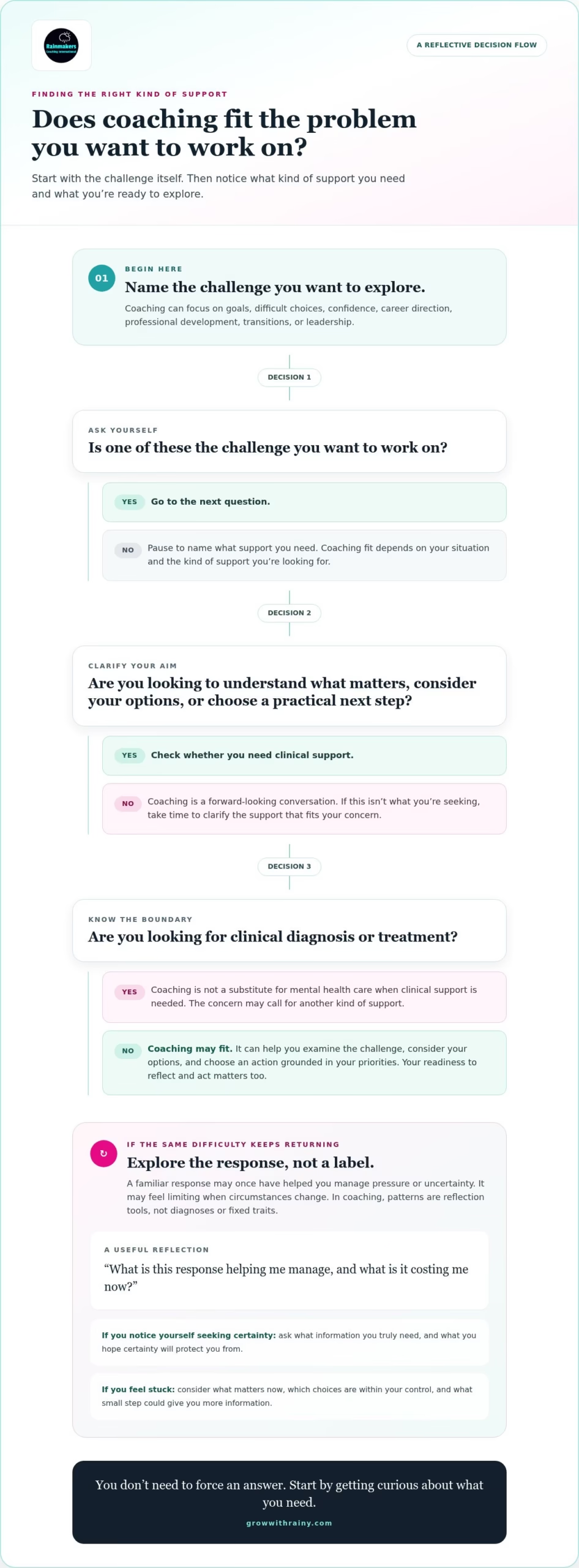
How to Tell Whether Life Coaching Fits Your Problem
You don’t need to have everything figured out before seeking support. But it can help to pause and name what you want help with. The question “What problems does a life coach solve?” matters less than whether coaching’s reflective, action-oriented approach fits your concern and what you need right now.
Questions to clarify what you want help with
Try this short reflection. Write down your answers without judging them or turning them into a diagnosis:
- Name the concern. What situation keeps occupying your attention? Describe what is happening as plainly as you can, without deciding what it says about you.
- Notice what feels stuck. What have you already tried? Is the difficulty choosing, trusting your judgement, following through, or knowing what matters most?
- Separate facts from assumptions. “I haven’t made a decision yet” is something you know. “I’m incapable of making good decisions” is an interpretation. What evidence supports that story, and what might complicate it?
- Describe the change you want. What might a more grounded choice look like, even if the outcome isn’t certain? You may want clearer direction, a way to reflect, support with accountability, or something else.
Then ask what kind of help would feel useful. Do you want someone to help you think through options, or are you looking for clinical care, specialist advice, or practical assistance? Being specific can make your next step clearer. Coaching may suit a concern you’re ready to explore and act on, but it doesn’t have to be the answer to every difficulty.
Choosing a useful next step without rushing yourself
You can start small. Set aside a few minutes to write down the decision in front of you, what you know, what you’re assuming, and one question you still need to answer. Or choose a modest action that gives you useful information, such as noting what matters most before a conversation. You’re not trying to force a final answer. You’re making space to hear yourself.
If you’re uncertain about readiness, consider whether you’re open to reflection and willing to choose an action, even a small one. If you’d rather pause, gather your thoughts, or explore another kind of support, that’s a valid choice too. Signs you may not need a life coach can help you consider whether now is the right time.
There’s no need to turn this into a test you must pass. Let your answers guide you, not pressure you. What would feel most helpful today: space to reflect, direction on a decision, support to follow through, or a different kind of care?
Explore whether life coaching fits your current challenge
How Rainmakers Life Coaching Works With Challenges Beneath the Surface
A challenge can look straightforward on the surface, yet carry a deeper question: what is making this choice difficult for you? At Rainmakers Coaching International, life coaching creates space to explore that question with care. The focus is not to impose an answer, but to support self-trust, inner transformation, and grounded action that reflects what matters to you.
The Rainmakers Transformation System™ has three stages: Release, Reprogram, and Recondition. These names describe a coaching framework for reflection and change, not a clinical model or a promise of a particular result. The process centres on your experience and the choices you want to make.
A coaching approach centred on self-trust
Release invites you to look at what may be weighing on you in relation to the challenge and releasing it. Reprogram creates space to question familiar assumptions or responses that may no longer serve your needs and replace it with empowering beliefs and perspectives. Recondition focuses on considering and practising more grounded ways of responding until it becomes a part of yourself. The stages offer a path for exploration, rather than a fixed explanation of why a problem exists.
For instance, if you find yourself taking on more responsibility than feels sustainable, the conversation might explore what that response means in your particular circumstances. It isn’t assumed to be the cause of your difficulty, or a label that defines you. The intention is to notice what’s happening, reconnect with your personal truth, and make space for strengths that may be harder to access when you’re under pressure.
What problems does a life coach solve? The framework doesn’t prescribe a single answer. A career decision, a leadership concern, or a personal goal can each bring different needs and context. Coaching offers a collaborative space to understand what the challenge means to you and consider actions that feel aligned. The work may support change in how you relate to the situation, but it can’t guarantee a particular external outcome.
Rainmakers Coaching International brings more than a decade of experience coaching leaders, professionals, and individuals. That experience informs a human-centred approach, while your own perspective remains essential. You decide what you’re ready to explore and which actions, if any, you want to take. No framework can replace your agency or explain every part of your story.
Explore whether coaching could support your next step
If you’d like to understand the broader approach, explore life coaching with Rainmakers Coaching International. You can take your time deciding whether this way of working fits. Perhaps begin by naming the concern you keep returning to, then notice what you’d want from a conversation: greater understanding, a clearer sense of direction, or a grounded next step.
What challenge are you ready to explore with more honesty and self-trust?
Choose a Next Step That Feels True to You
Progress doesn’t always begin with a dramatic decision. It can begin when you give yourself permission to question what success means now, rather than measuring your next move against an old definition.
What problems does a life coach solve? The question is personal. The more useful question may be whether the challenge you’re facing is one you want to explore with curiosity, and whether coaching feels like the right kind of support. You’re allowed to take time before deciding.
For now, notice what feels important enough to give your attention. You don’t need a perfect plan or complete certainty to take yourself seriously. A considered next step, chosen at your own pace, can be a meaningful beginning.
What is one honest next step you feel ready to take?
Frequently Asked Questions
What problems does a life coach help with?
A life coach may help you explore goals, work-life balance, confidence, relationship or significant life transition. For example, you might want to prepare for a new responsibility at work while deciding what boundaries will help you manage it.
A 2014 meta-analysis by Theeboom, Beersma and van Vianen found positive effects of workplace coaching across several individual outcomes, including goal-directed self-regulation. That doesn’t guarantee a particular result for every person.
Can a life coach help with confidence and self-doubt?
Yes, coaching can help you examine where self-doubt shows up and decide how you want to respond. You might notice it most when sharing an idea in a meeting, even though you feel confident in one-to-one conversations. Rather than assume a cause, a coach can help you consider what you’re telling yourself and what evidence you already have. You remain responsible for deciding which action feels right.
How is life coaching different from therapy?
Life coaching generally helps you reflect on goals, choices, and actions, while therapy and clinical counselling address mental-health needs within their professional scope. The distinction isn’t about one being better. For example, exploring how you want to approach a career decision may be a coaching focus. If you need clinical assessment or treatment, coaching shouldn’t be treated as a substitute for that support.
What happens when you discuss a problem with a life coach?
You’ll discuss the concern you want to understand, and the coach may listen, challenge assumptions, and help you consider possible next steps. You might arrive unsure how to raise a concern with a colleague and leave with a clearer sense of what you want to say. You decide what fits and whether to take the step you’ve identified.
Will a life coach tell me what to do?
A life coach should support your thinking rather than make your decisions for you. If you’re choosing between two roles, a coach might help you examine what you value in each, what information is missing, and what trade-offs you’re willing to accept. The choice remains yours. If you expect someone else to decide on your behalf, collaborative coaching may not match what you’re looking for.
Is life coaching useful if I do not know what my goal is?
Yes, you can begin without a clearly defined goal. Start with what has been taking up your attention, such as feeling unsettled about your next career step or unsure what you want more of in your life. A coach can help you explore the question before you settle on a direction. You don’t need to arrive with a polished plan, and one conversation may not resolve everything.

Article by
Rainy Rainmaker
Rainy Rainmaker is the founder of Rainmakers Coaching International and a transformational coach for confidence, self-trust, and authentic leadership. Based in Singapore, she helps high-achieving professionals, managers, and leaders who appear capable on the outside but feel quietly held back by self-doubt, overthinking, imposter feelings, burnout, or a loss of direction. Through her signature Rainmaker Transformation Journey™, Rainy helps clients uncover the insights already within them and turn inner clarity into aligned action that creates lasting change in how they work, lead and live.
