
You can care deeply about your team, and still not always come across as empathetic. Learning how to become a more empathetic leader often begins with noticing the gap between your intentions and how people actually experience you. Under pressure, your attention naturally shifts to deadlines, decisions, problems and performance. You become more direct, more efficient and more focused on what needs to get done. And somewhere along the way, connection can get lost.
Becoming a more empathetic leader is not about becoming softer, lowering your standards or taking responsibility for everyone’s emotions. It is about staying connected to people while still leading with clarity and accountability. Empathy helps you notice what may be happening beneath the surface – the hesitation behind someone’s silence, the concern behind resistance, or the pressure someone may not know how to express.
For high-achieving leaders, this can become harder as responsibilities grow. The more you carry, the easier it is to become focused on outcomes and lose touch with the human experience behind them. The goal is not to choose between results and relationships. It is to become the kind of leader who can hold both.
Key Takeaways
- Understand why empathy is a hidden treasure you already possess, rather than a skill you need to manufacture from scratch.
- Identify the specific protective patterns that create a distance between you and your team as you climb the leadership ladder.
- Learn how to become a more empathetic leader by reconnecting with your truth and building the self trust necessary to lower your guard.
- Move beyond intellectual insight toward a grounded transformation that changes how you perceive and respond to team needs.
- Discover how shared understanding reduces personal burnout and fosters an environment where retention and trust flourish naturally.
Why Leadership Often Erodes Empathy (And How to Reverse It)
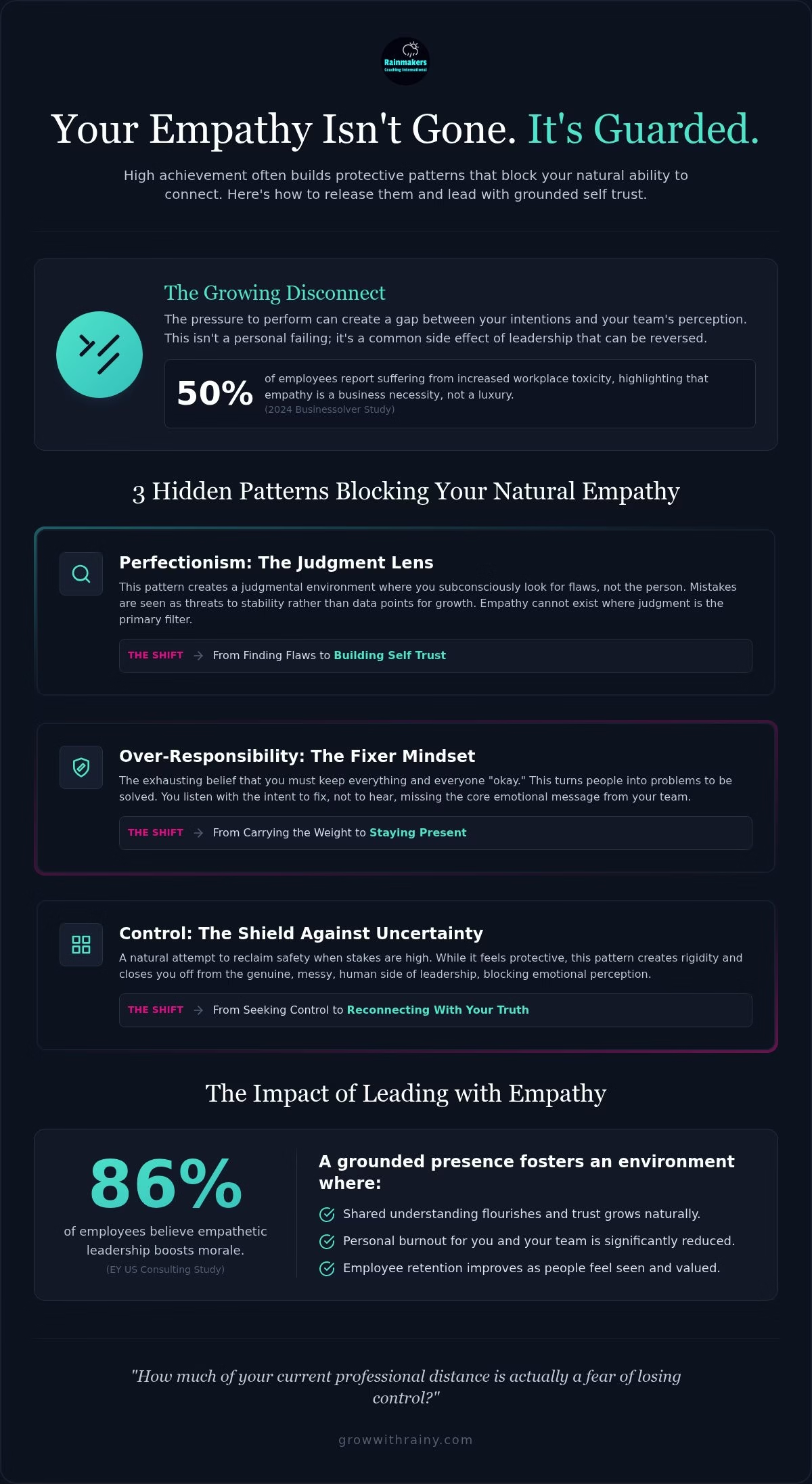
The climb to the top often comes with an unspoken trade: your sensitivity for your stability. As you move into senior roles, the pressure to deliver results creates what I call the High-Achiever Self-Trust Gap. You may trust your ability to hit targets, but you doubt your ability to navigate the messy, human side of leadership.
This isn’t because you’ve become a different person. It’s because you’ve adopted a strategy for safety. Learning how to become a more empathetic leader requires you to see that your current guardedness is a tool that has outlived its usefulness.
Empathy isn’t a soft trait that weakens your authority. It’s actually a form of quiet strength that makes your leadership more grounded. When you lead from a place of self trust, you don’t need to hide behind a title. You can stay present with your team without feeling like their emotions are a threat to your productivity.
The Power-Empathy Paradox
Senior roles often force a focus on results over relationships as a survival mechanism. There’s a specific moment where efficiency begins to feel like detachment to your team. You might think you’re being clear and direct, but they experience it as transactional. This shift is common, yet it contradicts the 10 key qualities of a leader that truly inspire.
When we look at Compassionate leadership, we see a model that prioritizes the human element to drive long-term success. A study by EY US Consulting found that 86% of employees believe empathetic leadership boosts morale. If the morale is low, the results will eventually follow.
When Performance Becomes a Shield
At Rainmakers Coaching International, we believe the patterns that helped you succeed in the past may now be limiting your growth. Overachievement often becomes a shield. It’s a way to stay safe by staying busy. If you view human connection as a distraction from the "real work," you’re likely leading without emotional perception.
This transactional view of people creates internal friction and eventually leads to burnout . You aren’t just carrying the weight of the work; you’re carrying the weight of the disconnection. How to become a more empathetic leader starts with acknowledging that your performance shouldn’t be a barrier to your presence.
Transformation happens when you stop trying to fix your team and start reconnecting with your truth. When you are grounded in who you are, you don’t need the shield of over-responsibility to feel valid.
How much of your current professional distance is actually a fear of losing control?
The Hidden Patterns Blocking Your Natural Empathy
You don’t need to be fixed. At Rainmakers, we operate from the belief that your empathy is a hidden treasure already within you. It hasn’t disappeared; it’s simply been covered by the mud of protective patterns. If you’ve felt a growing distance between yourself and your team, it’s likely because your "survival" strategies have become so thick that they’ve blocked your ability to connect.
Understanding how to become a more empathetic leader isn’t about learning a new trick. It’s about releasing the weight of these patterns to let your natural perception breathe again.
Perfectionism is one of the most common blockers. It creates a judgmental environment where mistakes are seen as threats rather than data points. When you are caught in this pattern, you aren’t looking at the person; you’re looking for the flaw. Empathy cannot exist in a space where judgment is the primary lens. To change this, you must shift toward a state of self trust, allowing yourself to be human so your team can do the same.
How Over-Responsibility Mutes Your Ears
Over-Responsibility is the exhausting belief that you must keep everything and everyone okay at all times. While it feels like a virtue, it’s actually a barrier to connection. When you feel over-responsible, you listen to your team with the intent to fix the situation rather than hear the human. You’re so busy calculating solutions in your head that you miss the emotional tone of the person standing in front of you.
This pattern turns people into problems to be solved. If you want to know how to become a more empathetic leader, you have to stop carrying the weight of everyone’s success and start staying present with their experience.
Control and the Fear of Uncertainty
Controlling behavior often begins as a desperate attempt to reclaim safety. When the stakes are high, uncertainty feels dangerous. To mitigate that danger, you might find yourself micromanaging or narrowing the space for your team’s input. This need for safety through control effectively silences your team’s voice.
Overthinking is the companion to this pattern; it keeps you trapped in a loop of "what-ifs" that prevents you from being truly present. Research by EY US Consulting found that 87% of employees believe empathetic leadership is essential for fostering an inclusive environment.
You can’t be inclusive if you are too busy controlling the outcome. If this feels like your current reality, a coaching conversation can help you identify which patterns are currently running the show.
Which of your current "strengths" is actually a protective pattern that’s keeping your team at arm’s length?
Reconnecting With Your Truth: The Foundation of Genuine Empathy
Empathy is often taught as an outward skill. We’re told to "put ourselves in their shoes." But you can’t step into someone else’s shoes if you’re too busy worrying about how your own look. Genuine empathy requires self trust. If you are constantly defending your ego or your position, your guard is too high to let anyone else in.
Learning how to become a more empathetic leader starts with a quiet, internal shift. It’s about reconnecting with your truth so you no longer need the loud, performative confidence that masks your insecurities.
Think of your natural empathy as a diamond. Over years of high-pressure environments, that diamond has been covered by the mud of protective patterns. We don’t need to add anything to you. We simply need to remove the mud.
When you stop trying to "fix" your team and start trusting your own innate value, the connection happens naturally. This is the difference between a leader who performs and a leader who transforms.
The High-Achiever Self-Trust Gap
Many leaders trust their capability. You know you can hit the target. But do you trust your innate value when the target is missed? This is the core of the High-Achiever Self-Trust Gap. It’s where imposter syndrome on senior leaders takes root. You feel like you have to prove your worth in every meeting.
When you’re in "proving" mode, you aren’t listening. You’re waiting for your turn to look smart. True self trust allows you to move from proving yourself to simply being yourself, even in high-stakes environments.
Grounded Leadership Presence
A grounded presence is the hallmark of a leader who has done the internal work. You aren’t easily rattled by the emotions of others because you aren’t seeking their approval to feel stable. This sense of reconnecting with your truth creates a field of psychological safety.
Your team can feel that you aren’t judging them because you’ve stopped judging yourself. In this space, empathy isn’t a chore. It’s a natural byproduct of being present. Authentic connection replaces transactional management, and your team begins to trust you because you finally trust yourself.
A global survey by Zurich and YouGov found that 73% of respondents would avoid companies that demonstrate a lack of empathy. This isn’t just about being nice; it’s about the grounded survival of your organization.
If you didn’t have to prove your value today, how would you listen differently to your team?
Practical Steps to Lead with Emotional Perception
Transformation isn’t a destination you reach; it’s a practice you maintain. Once you’ve started the work of releasing the protective patterns discussed earlier, you need a way to navigate the daily pressures of the office without sliding back into old habits.
At Rainmakers, we guide leaders through the Rainmakers Transformation System™, which involves the stages of Release, Reprogram, and Recondition. If you want to know how to become a more empathetic leader in the heat of a board meeting or a difficult one-on-one, you must learn to create space where there was once only reaction.
The goal is to move from a state of judgment to a state of curiosity. When you are in judgment, you’ve already decided what the problem is and who is to blame. This closes your ears and hardens your heart.
Curiosity, however, is a grounded state that allows you to see the "hidden treasures" in your team that were previously obscured by your own need for control. It requires you to stop being the one with all the answers and start being the one with the right questions.
The Power of the Strategic Pause
Most high-achievers are addicted to speed. You likely pride yourself on your ability to make quick decisions. However, that same speed often bypasses your emotional perception. The Strategic Pause is a leadership tool that creates a grounded gap between a stimulus and your habitual reaction, allowing your natural empathy to surface.
Before you dive into "problem-solving" mode, take three seconds to simply breathe and observe the person across from you. This small window of time allows you to understand the sentiment behind the words, rather than just the data within them.
Embracing Radical Curiosity
Radical curiosity is the antidote to the transactional leadership that erodes trust. Instead of directing your team, try inviting their perspective with open-ended questions. Ask "What is the biggest friction point for you right now?" or "How can I better support your focus on this project?" This shift signals that you value their experience as much as their output.
This isn’t just a "feel-good" strategy; it’s backed by data. Research from the Center for Creative Leadership (CCL) analyzing 360-degree feedback found a strong correlation between empathy and job performance.
Specifically, managers who demonstrate more empathy toward their direct reports are consistently rated as better performers by their own bosses. Empathy is a high-performance metric.
Book a 90-minute coaching conversation to identify your specific empathy blockers
How much of your daily communication is spent defending your own position versus discovering the positions of others?
Cultivating a Grounded Leadership Presence Through Coaching
Insight is not the same as transformation. You might now understand the mechanics of how to become a more empathetic leader, but understanding isn’t the same as becoming. Many high-performing leaders collect leadership books like trophies, yet find themselves reacting with the same old protective patterns when the pressure mounts.
Real change happens when you move from the intellectual "knowing" to a deeply felt state of being. This is where the Rainmakers Transformation System™ creates a bridge. By moving through the stages of Release, Reprogram, and Recondition, you don’t just learn about empathy; you reclaim it.
This process is about long-term sustainability. If you only "try harder" to be nice, you’ll eventually burn out because you’re still carrying the weight of those internal blockers. The 2024 "State of Workplace Empathy Study" by Businessolver found that 92% of employees believe an empathetic employer drives retention.
However, you can’t provide that environment if you are still operating from a place of internal friction. Reclaiming your empathy is a journey of reconnecting with your truth. When you are grounded in your own value, you no longer see the emotions of others as a threat to your efficiency.
Moving Beyond ‘Fixing’ to Releasing
Traditional executive coaching often focuses on "fixing" behaviors. At Rainmakers, we look deeper. We identify the patterns beneath the performance. A senior leader I coached realized that his transactional style wasn’t a character flaw. It was a shield he used to manage his own anxiety about meeting targets. Once he moved into the "Release" stage, his natural warmth returned. He didn’t need to learn how to become a more empathetic leader; he just needed to stop defending himself.
As your coach, I act as an Empathetic Catalyst, helping you see the treasures that your success has hidden.
Your Next Step Toward Transformation
Your evolution requires a deliberate leadership development plan that prioritizes internal alignment over external metrics. If you feel that a lack of self trust is keeping you guarded, it’s time to address the gap.
Our Building Rock Solid Confidence program is designed to help you bridge this divide, moving you from a state of hesitation to one of decisive, empathetic presence. You can’t lead a team you don’t truly hear. Transformation happens when you stop performing and start being.
What strategy are you currently using to stay safe that is actually preventing you from hearing your team?
Reclaiming Your Natural Leadership Presence
You’ve spent years building the patterns that ensured your survival and success. Now, you can choose to release the weight of those guards. Reclaiming your empathy starts with reconnecting with your truth and recognizing that your natural sensitivity is a hidden treasure, not a liability.
Understanding how to become a more empathetic leader isn’t about adding more to your plate; it’s about removing the protective mechanism that is getting in your way to become a more empathetic leader.
I’ve spent more than a decade coaching leaders through these transformations. Using the signature 3-R methodology (Release, Reprogram, Recondition), we move past simple insight into true transformation. This shift allows you to lead from a place of innate strength and genuine human connection. When you lead from a place of self trust, your team finally feels safe enough to trust you back.
You’ve already proven you can win. Now, give yourself permission to be present. The connection you’ve been missing is waiting just beneath the surface of your next strategic pause.
What would change if you stopped trying to solve every person and started simply hearing them?
Frequently Asked Questions
Can empathy really be developed if it doesn’t come naturally?
Empathy is a natural state that is often buried under protective patterns like Overachievement or Control. You don’t need to manufacture it; you need to release the inner barriers preventing it from surfacing. At Rainmakers, we see empathy as a hidden treasure. By moving through the Rainmakers Transformation System™, you learn to trust yourself enough to lower your guard. This isn’t about learning a new trick, but about becoming more fully yourself.
Does being an empathetic leader mean I can’t hold people accountable?
Accountability and empathy are not mutually exclusive. In fact, they work best together. When you lead with a grounded presence, you can hold high standards while acknowledging the human experience of your team. Reconnecting with your truth allows you to set clear boundaries without the internal friction of People-Pleasing. Empathy helps you understand why a goal was missed, while self trust gives you the courage to address it directly.
How do I show empathy when I’m under extreme pressure and tight deadlines?
Pressure often triggers patterns like Overthinking or a need for Control. To maintain empathy during tight deadlines, practice the strategic pause. This creates a grounded space between the stress and your response. By taking just three seconds to breathe and observe, you can shift from a transactional "fix-it" mode to a more perceptive state. It’s about staying related to the person even when the project is demanding.
What is the difference between empathy and sympathy in a leadership context?
Sympathy often creates a distance where you feel sorry for someone, which can strip them of their agency. Empathy is about perspective-taking and human connection. It involves understanding the internal state of another without losing your own grounded sense of self. In a professional context, empathy fosters inclusive environments and deeper trust. It’s the difference between looking at someone’s struggle and standing beside them within it.
Will my team think I’m weak if I start showing more empathy?
Showing empathy is a sign of strength, not weakness. Teams often perceive guarded, transactional leaders as insecure or disconnected. When you demonstrate how to become a more empathetic leader, you actually build a more resilient and inclusive culture. Data indicates that empathetic leadership boosts morale and retention. It takes far more courage to be authentic and present than to hide behind the shield of a corporate title.
How can I tell if I have a ‘protective pattern’ blocking my empathy?
You can identify a protective pattern by looking for areas of recurring internal friction. If you feel a constant need for Perfectionism or feel the need to be in control for everything that is happening, your empathy is likely being muted. These patterns are learned strategies for safety that eventually limit your growth. If your interactions feel transactional or "cold," it’s a signal that you’ve disconnected from your own truth to protect your ego.
Is there a specific research study that proves empathy helps business results?
A significant study by the Center for Creative Leadership (CCL) analyzed 360-degree feedback and found that managers who show more empathy are rated as better performers by their bosses. This research suggests that empathy is a fundamental business metric, not just a soft skill. Also, 92% of employees in the 2024 Businessolver study stated that an empathetic employer is a key driver for retention. Empathy directly impacts your organization’s bottom line.
How long does it take to see the results of leading with more empathy?
You will often notice a shift in team sentiment and trust almost immediately after you start practicing radical curiosity and strategic pauses. However, deep, lasting change requires a methodical approach. The Rainmakers Transformation System™ uses the three stages of Release, Reprogram, and Recondition to ensure that your new, grounded leadership presence becomes your natural state. Transformation is a journey of becoming, and the most sustainable results come from consistent, intentional practice.

Article by
Rainy Rainmaker
Rainy Rainmaker is the founder of Rainmakers Coaching International and a transformational coach for confidence, self-trust, and authentic leadership.
Based in Singapore, she helps high-achieving professionals, managers, and leaders who appear capable on the outside but feel quietly held back by self-doubt, overthinking, imposter feelings, burnout, or a loss of direction. Through her signature Rainmaker Transformation Journey™: Release, Reprogram, Recondition – Rainy helps clients uncover the insights already within them and turn inner clarity into aligned action that creates lasting change in life, career, and leadership.
