Choosing a life coach can feel surprisingly difficult. There are different coaching styles, credentials, specialities and approaches, and a coach who is right for one person may not be right for you. So, how do you choose a life coach you can genuinely trust with something as personal as your growth? A good coaching relationship goes beyond credentials or chemistry. You want someone who can help you see what you may not be seeing, challenge you without imposing their answers, and create a space where you can be honest without feeling the need to perform.
The right coach should not make you more dependent on them. They should help you understand yourself more deeply, trust your own judgement and create changes you can sustain beyond the coaching relationship.
In this guide, we’ll look at what to consider when choosing a life coach – from experience and coaching approach to trust, fit and the depth of transformation they are equipped to support.
Key Takeaways
- Identify why the high-achiever self-trust gap often triggers patterns like perfectionism or overthinking when you are trying to make a pivotal life decision.
- Learn how to choose a life coach who prioritizes a grounded partnership and understands how to help you release learned protective strategies.
- Shift your perspective from being a problem to be fixed to a person with hidden treasures, ensuring your coaching journey is truly transformational.
- Discover the specific questions to ask during a consultation to ensure your coach provides the psychological safety needed for deep growth.
- Understand how the right partnership facilitates reconnecting with your truth, allowing you to move from internal friction to authentic leadership.
Beyond the Credentials: Why High-Achievers Struggle to Choose a Coach
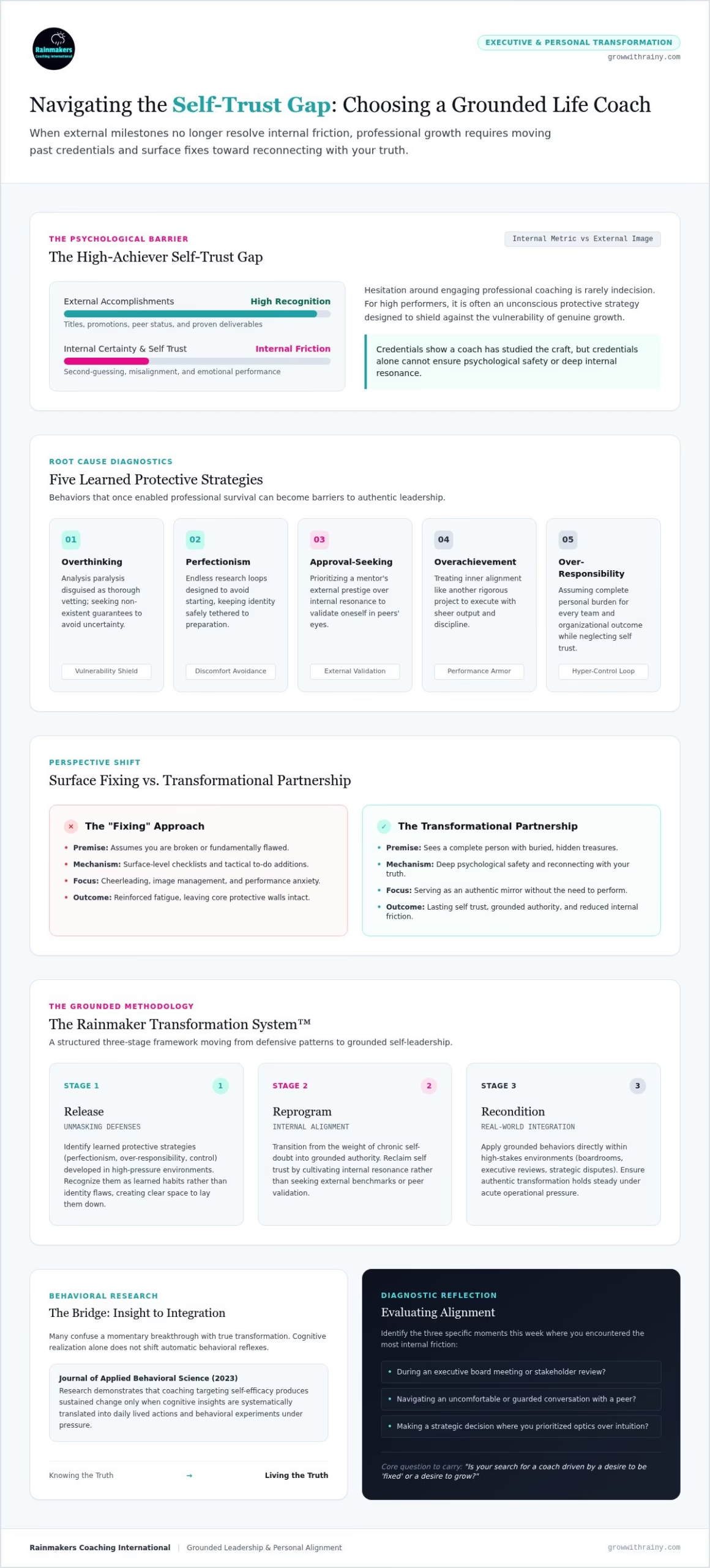
If you are a high achiever, the process of learning how to choose a life coach often feels like another high stakes project. You research credentials, compare methodologies, and look for the best in the field. Yet, this search frequently triggers the very patterns you are trying to move past. We call this the High-Achiever Self-Trust Gap.
It is the distance between your external accomplishments and your internal certainty. While many look at the core principles of professional coaching to find a standard of excellence, a long list of certifications does not guarantee a transformational result. Credentials show a coach has studied the craft. They do not ensure the psychological safety or the alignment you need to truly thrive.
When you are accustomed to success, the pattern of Overthinking can lead to analysis paralysis during your search. You might find yourself comparing dozens of options, looking for a guarantee that doesn’t exist. This hesitation is often a protective strategy. It keeps you safe from the vulnerability required for real growth. By focusing on the "perfect" choice, you avoid the discomfort of the journey itself.
The Perfectionism Trap in Professional Growth
The need for a perfect coach can keep you stuck in a loop of research, effectively preventing you from actually starting. This is where your learned strategies can work against you.
You might also find that Approval-Seeking influences your choice. Are you looking for a coach whose prestige will look good to your peers, or one who resonates with your specific internal friction?
When you prioritize external validation over internal resonance, you are repeating a pattern of looking for truth outside of yourself. Real growth begins when you prioritize self trust over a polished image.
Reflection question: Is your search for a coach driven by a desire to be "fixed" or a desire to grow?
When Success No Longer Feels Meaningful
For many leaders in Singapore, traditional career advice feels hollow when the problem is internal alignment. If you feel a persistent sense of friction despite your promotions, it is a sign that you are moving away from your own center. Reclaiming this requires reconnecting with your truth.
This isn’t about fixing yourself, because you aren’t broken. It is about identifying the protective strategies, like Overachievement or Over-Responsibility, that have served you well but are now standing in your way. A grounded partnership provides the mirror you need to see these patterns clearly.
Practical tip: List the three moments this week where you felt the most friction in your leadership. Was it during a board meeting? A difficult conversation with a peer? Noticing these moments helps you identify where you need support most.
The Three Pillars of a Grounded Coaching Partnership
When you are evaluating how to choose a life coach, it’s helpful to look beyond the surface of a discovery call. You need a framework that ensures the work goes deep enough to create lasting change.
At Rainmakers Coaching International, we utilize the Rainmakers Transformation System™, a three stage process designed to move you from internal friction to a state of alignment. This isn’t about adding more to your plate. It’s about stripping away the layers that no longer serve you.
The first stage is Release. A grounded coach helps you identify the learned protective strategies you’ve used to survive high pressure environments. These include patterns like Perfectionism, Control, or Over-Responsibility. By seeing these as strategies rather than personality flaws, you create the space to let them go.
Next is the Reprogram stage, where you move from the weight of self doubt into a grounded sense of authority. Finally, Recondition focuses on integration. This is where your coach supports you as you apply new behaviors in high stakes situations, ensuring your growth holds up under pressure.
Moving from Insight to Integration
Many people mistake a "breakthrough" for a transformation. Insight is valuable, but it isn’t the same as change. You can’t just think your way into a new life; you have to live your way into it. You need a coach who understands how to move you from "knowing" a truth to "becoming" that truth in your daily actions.
Research supports this approach. A 2023 study in the Journal of Applied Behavioral Science suggests that coaching for self efficacy is significantly more effective when it includes a behavioral reconditioning component. This ensures that your new perspectives don’t just stay in your head but actually change how you lead and live.
Reclaiming Self-Trust as the Ultimate Metric
A truly grounded coaching relationship doesn’t make you dependent on the coach. In fact, it does the opposite. It builds your internal authority so you can make decisions with clarity and speed.
While it’s helpful to understand the differences between coaching and therapy, the focus in this partnership is always on your agency. Your coach shouldn’t be the expert on your life. Instead, they act as a guide to your own wisdom. By focusing on understanding life coaching benefits through the lens of self trust, you ensure that the partnership is empowering rather than prescriptive.
If you feel ready to explore what this alignment looks like for you, consider a 90 minute coaching conversation to begin identifying your own protective patterns.
Identifying the Difference Between Fixing and Transformational Coaching
When you begin researching how to choose a life coach, you’ll likely encounter a lot of language centered around "fixing" things. It’s tempting to look for someone who promises to repair your time management or solve your lack of motivation.
But here is a core insight: you are not a problem to be solved. You are a person with hidden treasures. At Rainmakers, our philosophy is that transformation is about removing the "mud" to let the diamond shine. You already possess the value; the work is about releasing the learned strategies that obscure it.
Spotting "fixer" language in marketing is a vital skill. If a coach promises to "fix" your productivity or "rebuild" your personality, they are operating from a deficit model. This can be particularly draining for high performers who already feel the pressure of maintaining a successful image.
Instead, look for a compassionate framework. A coach should honor the resilience that got you to where you are today while gently challenging the patterns that no longer serve your growth. This ensures the process feels like an evolution rather than a correction.
The High-Achiever Paradigm: Success vs. Fulfillment
Many leaders in Singapore find themselves trapped in the pattern of Overachievement. This often begins early in life, when we learn to use performance as the sole proof of our value. While this strategy leads to impressive titles and high salaries, it rarely leads to fulfilment.
A grounded coach respects your professional capability but understands that your worth isn’t tied to your next KPI. They help you move from seeking external validation to reconnecting with your truth. This shift is what allows success to finally feel meaningful.
Uncovering Your Hidden Treasures
Think of your growth like a bonsai tree. It has been shaped by the winds of expectation and the constraints of your environment. Coaching isn’t about snapping the branches; it’s about providing the space for the tree to grow into its natural, magnificent form. This approach puts the client in the driver’s seat, ensuring that every step forward is fuelled by your own agency.
Whether you are navigating a massive career transition or simply seeking more peace, a transformational partnership helps you navigate the journey with self trust.
Reflection question: What would your leadership look like if you stopped trying to prove your worth?
Five Essential Questions to Ask During a Coaching Consultation
The discovery call is often where your learned protective strategies show up most clearly. You might find yourself Approval-Seeking, trying to be the "perfect" client, or Overthinking every word the coach says. To cut through the mental clutter, you need a specific script. Knowing how to choose a life coach involves moving beyond talk of fees and schedules to test the depth of the partnership. These questions help you determine if a coach can facilitate the grounded transformation you seek.
- "How do you handle clients who use Overthinking as a safety strategy?" This reveals if the coach understands that your hesitation is a learned protection rather than a character flaw.
- "Can you explain your methodology for moving from insight to actual behavioral change?" You need to know how they help you integrate new truths during high stakes moments, not just in the safety of a session.
- "What is your philosophy on self trust versus generic confidence?" Confidence is often a performance; self trust is an internal anchor. Look for a coach who prioritizes your internal authority.
- "How do you help leaders recognize when their protective patterns, like Over-Responsibility, are getting in the way?" A good coach identifies these strategies in real time without making you feel "broken."
- "How do you maintain psychological safety while challenging my current narrative?" Growth requires friction, but it must happen in a container of deep trust and empathy.
Evaluating the Coach’s Emotional Intelligence
During the consultation, listen for what isn’t being said. Does the coach use non-judgmental language? Do they offer a sense of calm reassurance, or do they seem rushed to close a sale?
Research shows that the "working alliance," or the quality of the relationship, is the strongest predictor of coaching success (Gessnitzer & Kauffeld, 2015). If a coach simply agrees with everything you say, they aren’t acting as a mirror. You need someone who can challenge your assumptions while maintaining a grounded, supportive presence.
Spotting the Signs of a Mismatched Partnership
Red flags are often subtle. Be wary of overly corporate jargon, aggressive sales tactics, or promises of "instant" transformation. These are signs of a "fixer" mentality rather than a transformational one.
You might also want to review six signs you don’t need a life coach before committing to a long term engagement. Pay close attention to your physical response during the call. Do you feel "lighter" and more seen, or do you feel a sense of tension in your chest? Your body often recognizes a lack of alignment before your mind does.
Reconnecting With Your Truth: Your Next Step Toward Authentic Leadership
Choosing a coach is a declaration that you’re ready to stop performing and start leading from a place of alignment. While the search for how to choose a life coach often begins with a specific career hurdle, it ends with a deeper understanding of your own agency.
If you are currently navigating the transition from a manager to a director level role, you know that the stakes have shifted. You can’t rely on the same protective patterns like Over-Responsibility or Control to lead at this scale. Reclaiming your self trust is what allows you to move from micromanagement to visionary leadership.
The Rainmakers Transformation System™ is designed for high achievers who are ready for this deep work. It isn’t a quick fix for your calendar. It is a grounded process of releasing the strategies that once protected you but now limit your growth.
When you stop using Overachievement as proof of your worth, you create the space for authentic leadership to emerge. This shift doesn’t just change your title; it changes how you experience your life.
The Ripple Effect of Inner Transformation
A professional problem rarely stays at work. If you feel a constant sense of internal friction in the boardroom, that weight inevitably follows you home to your personal relationships and your well being. You can’t compartmentalize your truth. When you begin Executive Coaching in Singapore, you’ll find that as your internal authority grows, your personal life feels lighter and more connected.
This holistic impact is why 87% of coaching clients report a positive return on investment according to the 2025/2026 ICF Coaching Statistics. The value isn’t just in the results you achieve, but in the person you become while achieving them.
Beginning the Conversation
It’s easy to get stuck in the "thinking" phase of how to choose a life coach. You might find yourself Overthinking the possibilities or waiting for the "perfect" moment to start. I encourage you to move into the "exploring" phase instead.
A 90 minute coaching conversation at Rainmakers isn’t a sales pitch. It is a dedicated space of psychological safety where we begin to look at the "mud" of your current challenges to find the "diamond" of your innate value. It is an opportunity to experience a grounded partnership before you make a long term commitment.
Reflection question: If you trusted yourself completely, what is the very first thing you would change in your life today?
Reclaiming Your Internal Compass
Learning how to choose a life coach is ultimately about learning how to listen to yourself again. You’ve spent years building a successful career based on external benchmarks, but authentic leadership requires a grounded internal authority.
By moving beyond a "fixer" mentality and focusing on a partnership that prioritizes psychological safety, you allow your innate value to emerge. It’s time to stop letting learned strategies like Overthinking or Perfectionism dictate your pace.
With more than a decade of experience guiding senior leaders through the Rainmakers Transformation System™, I’ve seen that the most significant shifts happen when we start trusting our own resonance.
Data from the ICF suggests that 87% of coaching clients see a positive return on investment; however, the real value is in reconnecting with your truth. You don’t need to be repaired; you simply need the space to begin leading with a grounded presence that feels as good as it looks.
If you trusted your intuition as much as your intellect, what would be your next right move? I’m here to help you find that answer when you’re ready.
Frequently Asked Questions
What is the difference between a life coach and a therapist?
Life coaching focuses on your future agency and releasing learned protective strategies. It differs from psychotherapy, which involves clinical diagnosis and treating mental health disorders. While therapy often looks backward to resolve trauma, coaching is a grounded partnership designed to help you move from internal friction to step into the next level of your life. It is about reconnecting with your truth rather than fixing a broken part of yourself or your history.
How much does a life coach cost in 2026?
Fees for professional coaching in Singapore are often quoted in S$ and vary widely based on the practitioner’s experience. When you research how to choose a life coach, you’ll find that many established transformational coaches move away from hourly rates toward structured 3- to 6-month engagements. These packages reflect the depth of the work required to move beyond generic advice and into true behavioral reconditioning.
How long does a typical coaching engagement last?
A typical transformational engagement usually spans six to twelve months. This duration allows enough time for the three stages of the Rainmakers Transformation System™: Release, Reprogram, and Recondition. Short-term fixes often fail because they don’t address the underlying patterns that cause friction. A longer commitment ensures that new insights are integrated into your daily habit – transforming how you work, lead and live.
Can I hire a life coach if I am already successful in my career?
Most people who seek coaching are already highly successful when they begin coaching. In fact, high levels of success often trigger the High-Achiever Self-Trust Gap, where your external titles don’t match your internal certainty. If you find that patterns like Overachievement or Control are causing burnout or internal friction, a coach can help you transition into a more sustainable and authentic way of leading that prioritizes fulfillment.
What should I look for in a coach if I have imposter syndrome?
Look for a coach who views imposter syndrome as a learned protective strategy rather than a personal flaw. If you struggle with feeling "not good enough," you need a partner who can identify patterns like Perfectionism or Approval-Seeking. The goal of the partnership should be to move from seeking external evidence of your worth to building a solid, grounded foundation of self trust and internal authority.
Is it better to have an in-person or online life coach?
The effectiveness of coaching depends more on the quality of the relationship than the physical setting. Whether you meet in person in Singapore or connect online, the most important factor is whether or not you feel save to open up and engage in the difficult conversation that will make the difference. Online coaching offers significant flexibility for busy executives, while in-person sessions can deepened the sense of connection and warmth.
How do I know if the coaching is actually working?
You’ll know the coaching is working when your internal friction decreases and your sense of agency increases – and how it impacts your life. When you understand how to choose a life coach who acts as a mirror for your strengths, you’ll see changes in how you handle uncertainty. Real transformation isn’t just about hitting a new KPI; it is measured by who you become and how fully you trust your own truth.

Article by
Rainy Rainmaker
Rainy Rainmaker is the founder of Rainmakers Coaching International and a transformational coach for confidence, self-trust, and authentic leadership.
Based in Singapore, she helps high-achieving professionals, managers, and leaders who appear capable on the outside but feel quietly held back by self-doubt, overthinking, imposter feelings, burnout, or a loss of direction. Through her signature Rainmaker Transformation Journey™: Release, Reprogram, Recondition – Rainy helps clients uncover the insights already within them and turn inner clarity into aligned action that creates lasting change in life, career, and leadership.
