You can reach your 40s with a career you worked hard to build, and still wonder whether it fits the person you are now.
Perhaps the role still looks good on paper, but the work no longer feels as meaningful. You may be thinking about a different direction, a new challenge or simply a way of working that feels more aligned with what matters to you now.
If you are finding a fulfilling career after 40, the answer does not have to be starting over.
At this stage, you are making decisions with more experience, clearer priorities and greater awareness of the life you want your career to support. Financial commitments, family responsibilities and years of professional experience all matter, but so do your values, strengths and sense of purpose.
In this guide, we’ll explore how to clarify what fulfilment means to you now, identify realistic career options, and decide what kind of change would create a more satisfying next chapter without disregarding everything you have already built.
Key Takeaways
- Define fulfillment by what feels meaningful and sustainable to you now, not by a title or status marker.
- Use your experience to notice which priorities have shifted and where an old definition of success may no longer fit.
- Finding a fulfilling career after 40 doesn’t require assuming age decides what’s possible or making an immediate, dramatic change.
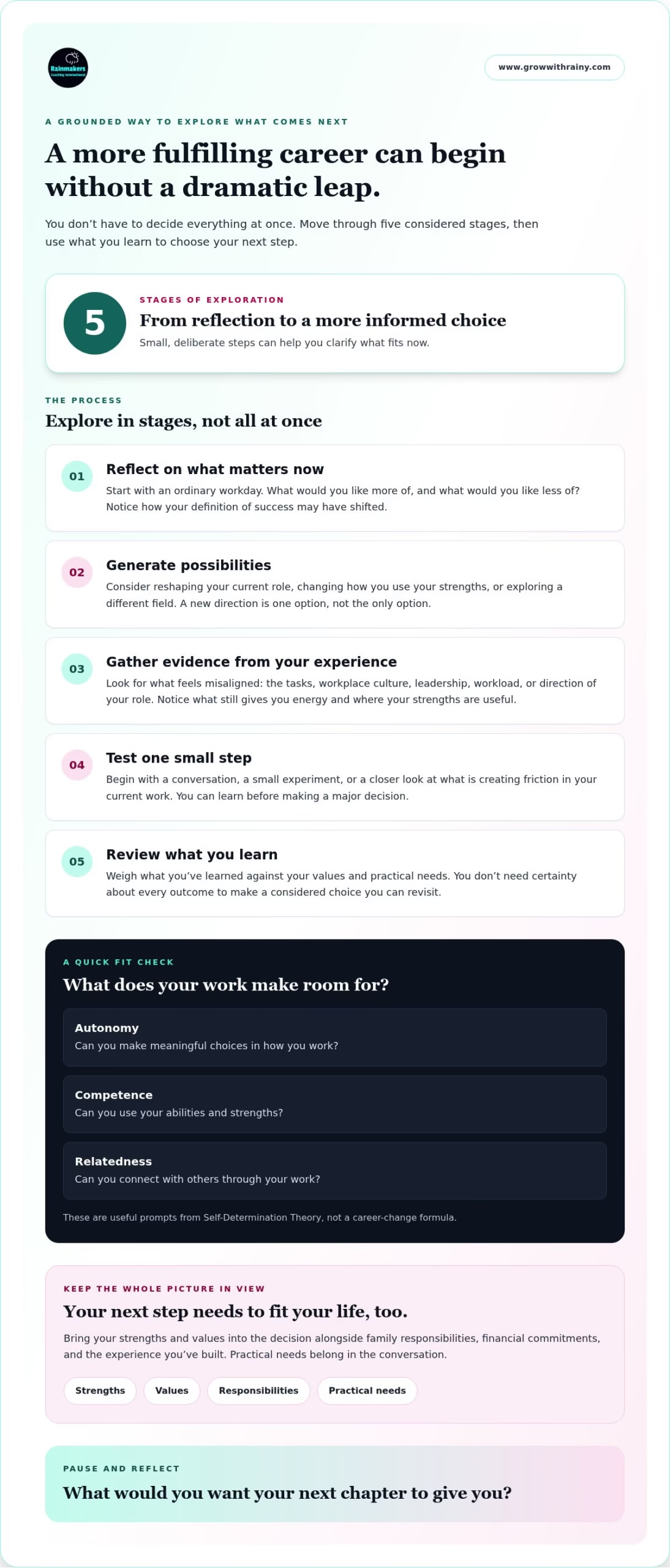
- Explore options in stages: reflect, generate possibilities, gather evidence, test a small step, then review what you learn.
- Career Coaching can help you clarify direction and strengthen self-trust when reflection alone isn’t helping you move forward.
Finding a Fulfilling Career After 40 Starts with Defining Fulfillment
You can be experienced, capable and respected, yet feel uncertain about what comes next. Perhaps the work that once mattered now feels flat. Or perhaps you can’t tell whether you need a different role, a new direction or a change in how you work. That uncertainty isn’t a failure. It’s a reason to get curious before making a major decision.
Career fulfillment is work that feels personally meaningful and fits the life you want to live, not work that earns the most recognition from others. Meaning might come from solving complex problems, contributing to a team, having room to make decisions or keeping enough energy for life beyond work. No single job title guarantees it.
Researchers Amy Wrzesniewski and colleagues explored how people relate to work as a job, a career or a calling in a 1997 study published in the Journal of Research in Personality. Their work offers a useful lens, not a formula: people can find meaning in work for different reasons, so an impressive title alone can’t tell you what will feel fulfilling. You can read the study, “Jobs, Careers, and Callings: People’s Relations to Their Work”.
Fulfillment may mean reshaping your current role, such as seeking more responsibility or changing how you use your strengths. It may also mean exploring a different field. Reflection can help you see possible paths, but it can’t guarantee a particular outcome. Its value is in helping you choose with greater clarity and self-trust.
What does a fulfilling career mean at this stage of life?
Start with the texture of an ordinary workday, not an idealised job title. What would you like more of: focused time, collaboration, autonomy, learning or a sense of contribution? What would you like less of: constant urgency, draining tasks, unclear expectations or work that conflicts with your values?
Then ask whether your definition of success has changed alongside your responsibilities and priorities. A promotion may still matter, or it may matter less than flexibility, purpose or a healthier pace. Your answer doesn’t need to impress anyone else. If you’re reflecting on personal growth alongside career choices, this personal development coaching guide offers another way to consider what matters to you.
Is dissatisfaction a sign that you need a completely new career?
Not necessarily. First, identify what feels misaligned. Is it the tasks, workplace culture, leadership, workload or direction of your role? If you enjoy the work but feel worn down by the workload, a new profession may not address the real issue. If the work itself no longer fits, exploring another direction may deserve attention.
One difficult season alone doesn’t prove that your career is wrong for you. Notice what has persisted, what has changed and what still gives you energy. What, specifically, would you want your working life to feel different?
Why Career Priorities and Self-Trust Can Shift After 40
Experience can sharpen your sense of what matters. You may have learned which strengths you want to use, what kind of environment helps you do good work, and what you’re no longer willing to trade away for recognition. That doesn’t mean everyone reaches the same conclusions after 40. It means you have more evidence from your own working life to consider.
Career clarity grows when you understand what matters to you now, not only what once helped you succeed. A strategy that served you well, such as saying yes to every opportunity or measuring progress through promotion, may feel limiting if your responsibilities or priorities have changed. The strategy wasn’t necessarily wrong. It may simply need to be reconsidered.
Self-Determination Theory, developed by psychologists Edward Deci and Richard Ryan, describes autonomy, competence and relatedness as important psychological needs. It offers a useful prompt for career reflection: does your work give you room to make meaningful choices, use your abilities and connect with others? The theory isn’t a career-change formula, but it can help you name what feels present or missing.
How values, strengths, and responsibilities shape career direction
Separate what you value from what you’ve been taught to value. Ask yourself: would I still want this role if nobody else knew its title? Which expectations come from family, mentors or workplace culture, and which feel genuinely mine?
Then look for evidence in your experience. Which tasks draw on strengths you’ve built and leave you feeling engaged or useful? Which responsibilities matter outside work, and what time, energy or stability do they require? Practical needs are part of the decision, not proof that personal meaning must be set aside.
Self-trust doesn’t mean being certain about every outcome. It means weighing what you know, acknowledging what you don’t, and making a considered choice you can review as you learn more.
When achievement no longer feels like enough
Outward success and inward dissatisfaction can exist at the same time. You may be meeting expectations and still wonder why the work feels less meaningful. That feeling doesn’t automatically mean you chose the wrong career. It may be asking you to look more closely at the way you’re working, what success means to you or what has changed in your life.
If you recognise a pattern of continually striving for approval, Overachievement may be a useful coaching lens. If you keep analysing possible choices but struggle to act, Overthinking may be worth noticing. These are possible learned strategies, not diagnoses or explanations that apply to everyone. Consider whether either description fits your experience, and what it might be helping you manage.
Harvard Business Review’s Rethink Traditional Career Trajectories offers a perspective on moving beyond a single expected path. Career Coaching can support you in connecting reflection with considered professional choices. What has your experience taught you about the kind of work that fits your life now?
Is It Too Late to Find a Fulfilling Career After 40?
No. Age alone doesn’t decide whether a new direction is possible, though your circumstances and responsibilities matter. You may want to protect income stability, make room for family commitments or build on experience you’ve already earned. Those factors shape the choices available to you. They don’t automatically mean you must stay as you are or begin again from zero.
There are at least three paths to consider. Staying as you are may preserve familiarity, but leave the source of dissatisfaction untouched. Reshaping your current work could let you use familiar strengths in a role or environment that fits better. Exploring a different direction may bring a renewed sense of contribution, while asking you to learn or adapt. None is universally right.
A career change doesn’t have to mean discarding everything you’ve built. It might begin with new responsibilities, a related role or a gradual move towards work that uses your experience differently. Harvard Business Review’s 2023 article, “It’s Time to Rethink Traditional Career Trajectories”, challenges the assumption that a career must follow one fixed, linear path. For a closer look at whether your current work fits your needs, explore the Career Misalignment: The 4 Fit Model.
How to compare staying, reshaping, and changing direction
Compare each option against the same questions: Does it fit your values? Will you use strengths that matter to you? What might it mean for your energy, responsibilities and desired contribution? Note what each path could preserve, change or ask you to learn. Keep unknowns visible. “I’d have to start from scratch” may be an assumption you can investigate, not an established fact.
What makes a career transition feel risky?
Some concerns are practical: income needs, time, family responsibilities or the loss of a familiar professional identity. Name them clearly. You may be able to research what a different role involves or what skills it calls for. Other concerns, such as uncertainty about who you’d be outside a familiar role, may need reflection. Neither kind of concern has to be ignored.
You don’t need certainty before you explore. Gather information, speak with people familiar with a possible direction or test a small step that fits your circumstances. What would help you distinguish a risk you can plan for from a fear you need to understand?
How to Explore a More Fulfilling Career Without Making a Sudden Leap
You don’t have to decide your whole future before you take a first step. A grounded way to explore is to reflect, generate options, gather evidence, test one small action, then review what you learn. The point isn’t to force a quick answer. It’s to replace guesswork with information from your own experience.
A reflection exercise for clarifying your next career chapter
Set aside time to write without editing yourself. Begin with three prompts: What parts of my current work would I keep? What would I change? What would I leave behind? Then note the strengths you want to use more often, such as guiding others, solving problems or making complex decisions.
Picture an ordinary satisfying workday, not a perfect job title. What are you doing? Who are you working with? What pace feels manageable? Which responsibilities outside work need to fit alongside it? If you want a little more structure, explore these personal value examples and career goal-setting prompts as you reflect.
Ways to test a career direction before committing
Turn one possibility into a small experiment. If a different field interests you, speak with someone who understands its day-to-day work. If a new specialisation appeals, try focused learning—such as exploring professional certifications with Insight Security Training—or a project that lets you practise a relevant skill. These steps won’t guarantee a particular pathway, but they can help you gather useful evidence before making a larger commitment.
Testing a direction turns an imagined future into something you can observe, making your next decision clearer.
As you explore, keep a simple record. After each conversation, project or learning activity, note what gave you energy, what felt meaningful and where you drew on strengths you already have. Also notice what felt draining or difficult to reconcile with your responsibilities. One activity won’t tell you everything, but recurring themes can help you separate genuine interest from an appealing idea that may not fit your everyday life.
Choose a review point that makes sense for your circumstances. You might revisit your notes after a project, a series of conversations or a period of focused learning. Ask: What did I learn? What remains uncertain? What is the next useful test? This keeps exploration active without requiring a sudden leap. In finding a fulfilling career after 40, a small, deliberate experiment can be a meaningful step toward greater self-trust.
If you’d like to reflect on these questions with support, you can explore a conversation about your career direction.
When Career Coaching Can Help You Find a Clearer Direction
Sometimes reflection brings you closer to an answer. Sometimes it leads to the same questions, revisited again and again. If you’ve weighed your options but find it hard to act on a considered choice, Career Coaching can offer a space to explore what’s keeping you uncertain and decide what you want to do next.
Career Coaching is collaborative support for career direction and professional development. It isn’t recruitment or job placement. The focus is on helping you examine your priorities, assumptions and possible paths, then connect that reflection with grounded actions you choose for yourself. You remain the decision-maker. Coaching can help you think through a choice, but it can’t guarantee a particular role or outcome.
What career coaching can support during a transition
You might be drawn to more than one direction, unsure whether to reshape your current role or hesitant despite having thought carefully about a change. Coaching can help you clarify what matters, notice where expectations may be influencing your choices, and consider what evidence you still need. The aim isn’t to push you towards a particular answer. It’s to help you make a choice that feels considered and aligned with your circumstances.
At Rainmakers Coaching International, the Rainmakers Transformation System™ uses the stages Release, Reprogram and Recondition where relevant. These stages can support reflection on what you’re ready to let go of, the beliefs or assumptions you want to reconsider, and the actions you choose to practise. They don’t decide your career for you. Your agency stays central.
Choosing a next step that fits your readiness
If you’re still discovering what matters, keep working with the reflection exercises. Notice what your experience is showing you, and give yourself room to gather more evidence before committing. If you’re ready to explore direction with support, Career Coaching can help you work through competing possibilities and identify a next step that fits your priorities and responsibilities.
Finding a fulfilling career after 40 doesn’t require having the whole path mapped out. It can begin with one clear question, a decision you’re ready to examine or a small action that helps you learn. What would you choose if you trusted the evidence you already have?
You can also schedule a conversation about your career direction with Rainy.
Take One Grounded Step Toward Work That Fits
Finding a fulfilling career after 40 starts with understanding what meaningful work looks like for you now. Your next step doesn’t have to be a dramatic change. Compare staying, reshaping your role and exploring a new direction, then gather evidence through small, considered actions.
If reflection keeps circling back to the same questions, support may help you move from uncertainty to a clearer choice. Rainmakers Coaching International has more than a decade of coaching experience, and Career Coaching supports career direction and professional development. Where relevant, the Rainmakers Transformation System™ works through Release, Reprogram and Recondition, while keeping your choices and agency at the centre.
You don’t need the whole path mapped out to begin. One honest, grounded next step can help you build confidence in what you already know. What is one question you’re ready to explore?
Frequently Asked Questions
How do I know whether I need a new career or a different role?
Look closely at what feels wrong before deciding. Is it the tasks, workplace culture, leadership, workload or the direction of your work? If you still value the work but feel drained by your environment or responsibilities, a different role may be worth exploring. If the work itself no longer feels meaningful, a broader change could be relevant. Track what gives you energy and what consistently creates friction.
Can I find meaningful work without starting over?
Yes, meaningful change doesn’t have to mean leaving your experience behind. You might reshape your responsibilities, use your strengths in a different way, move into a related role or explore a new direction gradually. A full career change is also an option, but it isn’t the only one. Consider what you want to preserve, what you want to change and what you’d need to learn before choosing a path.
What should I consider before changing careers after 40?
Consider your values, strengths, practical responsibilities and what you need from work, including income, time and stability. Ask which parts of your experience could transfer and which skills you may need to develop. Separate what you know from what you’re assuming. For instance, if you believe a new direction requires extensive study, find out what the work actually involves before treating that belief as fact; many specialized paths, such as programs offered by Optimal Security, rely on focused training and licensing rather than years of retraining.
How can I explore a new career direction while keeping my current job?
Start with manageable ways to gather evidence alongside your current responsibilities. You could speak with someone familiar with the field, attend a relevant learning session or try a small project that uses a skill you want to develop. Notice how each activity fits your energy, time and commitments. These experiments can inform your thinking, but they can’t guarantee a particular transition. Choose steps that feel realistic for your circumstances.
What happens if I do not know what kind of work would fulfil me?
You don’t need a job title in mind to begin. Notice which activities you enjoy, which strengths you want to use more often and what values you want your work to reflect. Also name what feels misaligned in your current work, such as the pace, tasks or lack of contribution. Look for patterns in your answers. Clarity can grow from understanding what you want more of and less of.
Can career coaching help me find a more fulfilling career after 40?
Career Coaching can offer collaborative space to examine your priorities, assumptions and possible directions. It may be useful if reflection keeps leading to indecision or you’re finding it difficult to act on choices you’ve considered carefully. You remain responsible for your decisions and next steps. Coaching supports career direction and professional development, but it isn’t job placement and can’t guarantee a specific role or career outcome.
If you’re ready to explore your next career chapter with support, schedule a conversation with Rainy. What would you like that conversation to help you clarify?

Article by
Rainy Rainmaker
Rainy Rainmaker is the founder of Rainmakers Coaching International and a transformational coach for confidence, self-trust, and authentic leadership. Based in Singapore, she helps high-achieving professionals, managers, and leaders who appear capable on the outside but feel quietly held back by self-doubt, overthinking, imposter feelings, burnout, or a loss of direction. Through her signature Rainmaker Transformation Journey™, Rainy helps clients uncover the insights already within them and turn inner clarity into aligned action that creates lasting change in how they work, lead and live.
