What would help you take the next step in your career: greater visibility, the confidence to pursue a bigger role, or clarity about where you want to go? Professional career advancement coaching can help you identify what progress means for you and what may be getting in the way.
Your next move may involve a promotion, broader responsibilities or a different organisation. Alongside practical considerations, it can help to examine how you recognise your strengths, communicate your contribution and respond to opportunities. External constraints may affect your progress; self-doubt or uncertainty about your readiness may also play a part.
In this [guide](https://growwithrainy.com/personal-development-guide/) , you’ll learn how career advancement coaching can support your growth, how it differs from mentoring and training, and what to consider when deciding whether it’s right for you. You’ll also find ways to clarify your priorities and identify a practical next step.
Key Takeaways
- Professional career advancement coaching can help you examine the beliefs and priorities shaping your next career decision.
- Turn reflection into action: name the question, explore what’s influencing it, choose a direction, and identify a practical next step.
- Coaching, mentoring, training, and manager support serve different purposes. Understanding the difference helps you choose support that fits your current need.
- Before setting a coaching goal, consider what you want to change and what progress would feel meaningful to you.
- Rainmakers Career Coaching uses a personalised, self-trust-centred approach to support clearer professional choices and intentional action.
What Professional Career Advancement Coaching Can Help You Clarify
You can be trusted with important work, deliver consistently, and still feel unsure about what should come next. Perhaps a promotion looks sensible on paper, but you’re not sure you want the responsibilities that come with it. Or your current role may feel too narrow, even though you’re proud of what you’ve built.
Professional career advancement coaching is goal-oriented support that helps you clarify your professional direction and development priorities. It doesn’t promise a promotion or a particular outcome. Instead, it gives you space to examine what you want, what may be shaping your choices, and which actions feel grounded in your values. For experienced professionals, that reflection can help distinguish a genuine ambition from a step that simply seems expected.
What counts as career advancement when your priorities change?
External markers such as a new title, higher pay, or greater responsibility can signal progress, but their meaning depends on what matters to you. You might want broader influence, recognition for your expertise, room to learn, or work that feels more aligned with your strengths. Career counselling also explores people’s working lives and direction; Career counseling offers a broader overview of that related field.
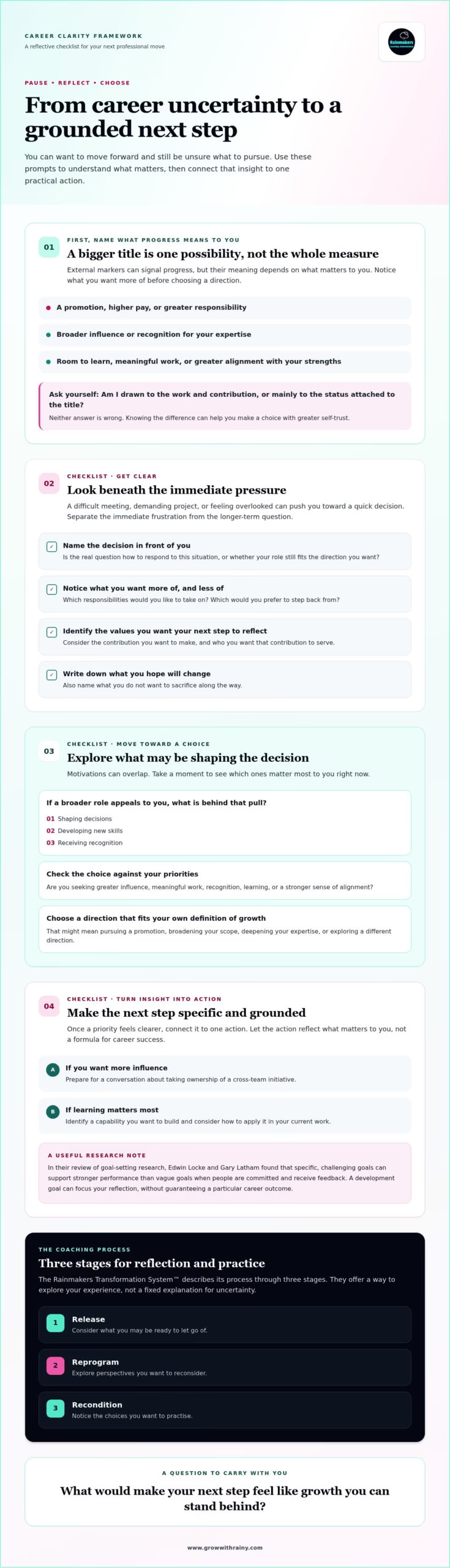
Before choosing a next step, name what you want more of. If you’re considering a management role, for example, ask whether you’re drawn to leading people and shaping decisions, or mainly to the status attached to the title. Neither answer is wrong. Knowing the difference can help you make a choice with greater self-trust.
Who might benefit from advancement-focused coaching?
Career advancement coaching may be useful if you’re an experienced professional or leader facing a meaningful decision: pursue a promotion, broaden your scope, deepen your expertise, or explore a different direction. Uncertainty at this point doesn’t mean you’ve failed or lost ambition. It may be a reason to pause and get clearer before committing to a path.
Coaching centres on your reflection, priorities, and development. Recruitment or job placement focuses on connecting candidates with roles, while CV writing focuses on presenting work history. If your central question is where you want to grow and why, career coaching gives you a space to explore your direction and make decisions about your development.
Start by writing down the decision in front of you, the change you hope it could bring, and what you don’t want to sacrifice along the way. Is your priority greater influence, meaningful work, recognition, learning, or a stronger sense of alignment? If success no longer feels meaningful, reflecting on what success means to you may help you see which priorities deserve a closer look.
Career progress doesn’t have to follow a single ladder. What would make your next step feel like growth you can stand behind?
How Career Advancement Coaching Turns Reflection into Professional Action
Reflection is useful when it helps you see a decision more clearly, rather than leaving you circling the same questions. Professional career advancement coaching can help you move from naming the question to exploring what may be shaping it, choosing a direction, and identifying an action you can take.
The Rainmakers Transformation System™ describes its process through three stages: Release, Reprogram, and Recondition. In career coaching, this framework can help you consider what you may be ready to let go of, what perspectives you want to reconsider, and what choices you want to practise. Coaching helps you explore what feels relevant to your experience.
Clarify the career question beneath the immediate pressure
A difficult meeting, a demanding project, or feeling overlooked can create pressure to make a quick decision. But is the real question how to respond to this situation, or whether your role still fits the direction you want? Separating immediate frustration from the longer-term question can make your options easier to assess.
Try writing a few honest answers before you decide:
- What responsibilities would I like to have more of, and which would I prefer to step back from?
- Which values do I want my next role or development goal to reflect?
- What kind of contribution do I want to make, and to whom?
Notice what you write without judging it. If you’re drawn to a broader role, ask whether the appeal is shaping decisions, developing new skills, or receiving recognition. These motivations can overlap, but knowing which matters most helps you weigh the choice more deliberately.
Move from insight to a grounded next step
Once you’ve clarified a priority, connect it to one action. If you want more influence, you might prepare for a conversation about taking ownership of a cross-team initiative. If learning matters most, identify a capability you want to build and consider how to apply it in your current work. The action should reflect your priority, not a formula for career success.
Research offers a reason to make that action specific. In their review of goal-setting research, Edwin Locke and Gary Latham found that specific, challenging goals can support stronger performance than vague goals when people are committed and receive feedback. A development goal can give your reflection a practical focus, without guaranteeing a particular career outcome.
Coaching supports reflection and action, but it doesn’t supply a guaranteed answer or control how others respond. If you’re considering a role change, exploring career misalignment and role fit may help you examine where your current work and priorities diverge.
If you’re ready to talk through the question shaping your next move, you can schedule a conversation with Rainy.
Reflection can help you choose a deliberate next professional action, even when the eventual outcome remains beyond your control. What is one conversation, decision, or development step that would bring your priorities into clearer view?
Career Advancement Coaching Compared with Mentoring, Training, and Manager Support
The right support depends on the question you’re trying to answer. Are you unsure which direction fits, looking to learn a specific skill, or seeking clearer expectations at work? Professional career advancement coaching, mentoring, training, and manager support can all contribute to development, but each serves a different purpose.
| Type of support | Purpose and typical focus | Question it can help address |
|---|---|---|
| Coaching | Supports your reflection, priorities, and professional direction. | What do I want to pursue, and why? |
| Mentoring | Draws on another person’s experience, perspective, and lessons. | What might I learn from someone who has faced a similar challenge? |
| Training | Builds knowledge or practises a defined skill. | What do I need to learn or practise? |
| Manager support | Connects development with role expectations, feedback, and workplace opportunities. | What’s expected in my role, and what growth opportunities are available? |
When is coaching different from mentoring?
Coaching helps you explore your own direction; mentoring can offer guidance shaped by another person’s experience. If you’re weighing whether to deepen your expertise or move towards leadership, a coach can help you examine what matters in that choice. A mentor with relevant experience may share how they approached a similar transition. Neither is universally better. The right fit depends on whether you need space to clarify your own answer, perspective from experience, or both.
Coaching doesn’t replace workplace expertise, honest feedback, or relevant training. You might use coaching to clarify why a leadership path appeals to you, then seek a mentor’s perspective on its demands and practise a skill through training.
How can you tell which kind of support fits your question?
Listen to the shape of your question. If it’s open-ended, such as “What kind of work do I want to grow into?”, coaching may help you explore your priorities. If you’ve identified a specific gap, such as presenting to senior stakeholders, targeted learning or practice may be more direct. If you’re unclear about how success is defined in your current role, your manager may be able to clarify expectations and possible development opportunities.
You don’t have to choose only one form of support. A question about direction may call for coaching, while a practical skill gap calls for learning and a workplace-specific question calls for manager input. These supports can complement one another without blurring their roles. If you’re focused on finding a next path, career coaching can help you explore what you want that path to reflect.
Before deciding, finish this sentence: “The question I most need help with is…” Does your answer call for reflection, another person’s experience, skill-building, workplace clarity, or a combination?
A Practical Way to Decide Whether Career Advancement Coaching Fits
You don’t need to have your whole career mapped out before considering coaching. It may be useful if you have a decision in front of you but aren’t sure what you want it to lead to. The question isn’t whether you already have a perfect goal. It’s whether you’re willing to examine what matters and consider a next step.
Use this brief check-in:
- The decision: What professional question keeps returning, even when the immediate pressure passes?
- The desired change: What would you like more of in your work, such as influence, learning, meaningful contribution, or room to grow?
- Your readiness: Are you open to reflecting on your priorities and taking a practical step, even if the full path isn’t clear yet?
If you can name a question but not the answer, professional career advancement coaching may give you space to explore it. If you already know the direction and need a specific technical skill, focused learning may be a more direct starting point. Neither choice says anything about your ability. It simply matches the support to the question you have today.
Questions to bring to a career coaching conversation
Begin with what feels unresolved about your professional direction. Ask yourself what a more aligned next step would look like in the ordinary rhythm of work: the responsibilities you’d carry, the people you’d work with, the decisions you’d influence, or the contribution you’d make. Then consider what you’ve already explored or tried. What did those experiences help you understand about what fits, and what doesn’t?
You don’t need polished answers. A few honest notes can help you notice whether you’re seeking a change in role, a different way of working, or greater clarity about your existing path.
Signs you may need a different kind of support
Some needs are more specific than career reflection. If you’re looking for recruitment, job placement, or CV writing, you’re seeking a different service from coaching. If your immediate question is about the exact expectations, systems, or requirements of your current role, a workplace resource may have the context to address it directly.
This distinction helps keep the purpose of coaching clear. Career coaching focuses on exploring your direction, priorities, and choices rather than preparing a CV or placing you in a role. Different forms of support can complement one another: workplace input may clarify the situation, while coaching helps you decide what that information means for your next move.
Before choosing a goal, write three short lines: My career question is… What matters most to me is… One action I could explore is… Your action might be gathering information, preparing for a conversation, or setting a development goal. Treat it as a step to test, not a promise about the outcome. What would progress look like if you defined it in your own terms?
How Rainmakers Career Coaching Supports Your Next Professional Chapter
Your next professional chapter doesn’t have to begin with a fixed destination. You may know that something needs to shift, while still feeling unsure whether that means pursuing broader responsibilities, changing roles, or finding more meaning in your current work. Rainmakers Career Coaching offers personalised support to explore your direction and development, with space to make choices that feel grounded in who you are.
A self-trust-led approach to career growth
Professional development isn’t only about what you learn or achieve. It can also involve noticing how you make decisions, what you value, and whether your work reflects those priorities. Rainmakers Coaching International brings more than a decade of experience coaching leaders, professionals, and individuals to this work, with an approach that centres self-trust alongside intentional action.
You might explore whether a particular thought or response is influencing your choices. Are you drawn to a new role because it genuinely interests you, or do you feel pressure to keep progressing in a familiar way? There’s no assumption that a hidden pattern is present. The aim is to approach your decision with curiosity, notice what feels relevant, and consider what you want to do next.
Inner reflection doesn’t replace practical career steps. It can help you choose them with greater intention, whether that means preparing for a conversation, exploring a development goal, or considering a change in direction. If you want a wider view of personal growth alongside your career questions, this personal development coaching guide offers broader context.
Choose a next step that matches your readiness
You don’t need a polished plan before beginning a conversation. If you’re still reflecting, bring one open question, such as “What kind of work do I want to grow into?” or “What do I want to feel more of in my working life?” You can also share what you’ve already considered and what still feels unclear.
A conversation with Rainy gives you space to explore your goals and whether coaching feels like a fit. It doesn’t promise a promotion or a particular career result. The purpose is to give attention to your priorities, build self-trust as you consider your choices, and decide what action feels right for you.
What would you like your next professional chapter to make room for?
Take Your Next Step with Greater Self-Trust
You don’t need to wait until every doubt has disappeared before making a thoughtful career decision. Sometimes the next step is giving yourself room to hear what you already know and what you’re still discovering. Professional career advancement coaching can support that process, helping you approach your choices with greater clarity while keeping the decision in your hands.
As you look ahead, ask yourself: what do I want my working life to make more room for, and what small step could bring that into focus? Your answer doesn’t need to be a complete plan. It can be the beginning of one.
If you’re ready to explore your next professional step with Rainy, start with a conversation about what matters to you and whether coaching feels like a fit.
Move at a pace that feels grounded. A career path shaped by your own priorities is worth taking the time to consider.
Frequently Asked Questions
What does professional career advancement coaching involve?
Professional career advancement coaching gives you a focused space to examine a career question and consider what you want to do about it. A conversation might explore a decision you’re delaying, the expectations you’re responding to, and what information would help you choose. You remain responsible for your choices. Your coach helps you think them through and identify useful questions or actions, rather than deciding your career path for you.
Can career advancement coaching help if I am not seeking a promotion?
Yes. You might want to contribute in a different way without moving up the hierarchy. For example, you may be considering whether to deepen your specialist knowledge, take on a project that draws on your strengths, or make more room for work that feels worthwhile. Coaching can help you understand what you hope those changes will bring and consider whether your current role could support them.
How is career coaching different from mentoring?
Career coaching centres on your questions and decision-making, while mentoring often includes a mentor sharing relevant experience or advice. If you’re weighing a move into a new function, coaching can help you examine your reasons and priorities. A mentor familiar with that function may offer perspective on its day-to-day demands. You can draw on both: coaching helps you clarify what you want, while mentoring may offer useful context.
Is career advancement coaching suitable for experienced professionals?
Yes. Experienced professionals may find it useful when their established skills no longer make the next choice obvious. You might be weighing a broader leadership remit against staying close to the work you know well, or reconsidering what you want this stage of your career to involve. Coaching gives you room to explore those questions without treating uncertainty as a sign that your experience or capability has failed you.
Can coaching help me decide whether to stay in my current role or change direction?
Coaching can help you examine both options, though it can’t make the decision or predict the outcome for you. Consider what specifically feels misaligned in your current role, what you would want to be different, and what draws you towards another direction. You might also ask what evidence would help you test each possibility, such as learning more about a role or discussing changes to your responsibilities.
Does career coaching include job placement or CV writing?
No. Career coaching with Rainmakers focuses on professional direction and development, not recruitment, job placement, or CV writing. If your main need is help presenting your experience in an application, that differs from exploring what kind of work you want to pursue. Being clear about your immediate need can help you decide whether coaching is relevant to the question you’re trying to answer.
How can I prepare for a career coaching conversation?
Bring one question you’d like to make clearer, rather than trying to prepare a complete career plan. It may help to note what prompted the question, what you’ve already considered, and what you hope will feel different in your working life. You can also name what you’re unsure about. A useful opening might be, “I’m deciding between these options, and I want to understand what matters most to me.”

Article by
Rainy Rainmaker
Rainy Rainmaker is the founder of Rainmakers Coaching International and a transformational coach for confidence, self-trust, and authentic leadership. Based in Singapore, she helps high-achieving professionals, managers, and leaders who appear capable on the outside but feel quietly held back by self-doubt, overthinking, imposter feelings, burnout, or a loss of direction. Through her signature Rainmaker Transformation Journey™, Rainy helps clients uncover the insights already within them and turn inner clarity into aligned action that creates lasting change in how they work, lead and live.
