
How do you communicate your perspective with clarity and conviction when the stakes are high? Executive presence coaching for senior managers can help you strengthen how you contribute, handle challenging conversations and build trust in your leadership.
Executive presence shows up in everyday moments: making a recommendation, responding to disagreement or holding your ground under scrutiny. Communication skills matter, and so can what happens within you. Concerns about being judged or getting something wrong may sometimes make it harder to express what you know.
In this guide, you’ll learn what executive presence means in practice, what may make it difficult to convey, and how coaching can help you develop a leadership presence that feels natural to you. You’ll also consider whether individual coaching could support the changes you want to make.
Key Takeaways
- Notice how your communication, judgement, and conduct shape the way others experience your leadership in high-stakes moments.
- Consider whether coaching constructs such as Overthinking or Approval-Seeking affect how you express your capability. They are not diagnoses.
- Executive presence coaching for senior managers can help you explore how to lead with greater self-trust without performing a different personality.
- Before your next consequential meeting, try a simple reflection to make your view clearer and easier to hear.
- Use practical questions about fit, focus, and progress to decide whether a coaching conversation feels right for you.
What executive presence means for senior managers in practice
You have the answer in a meeting. You’ve considered the risks, understand the trade-offs, and can see a way forward. Then the conversation moves on before you find a moment to speak. If that feels familiar, look beyond what you know and consider how your leadership is being experienced.
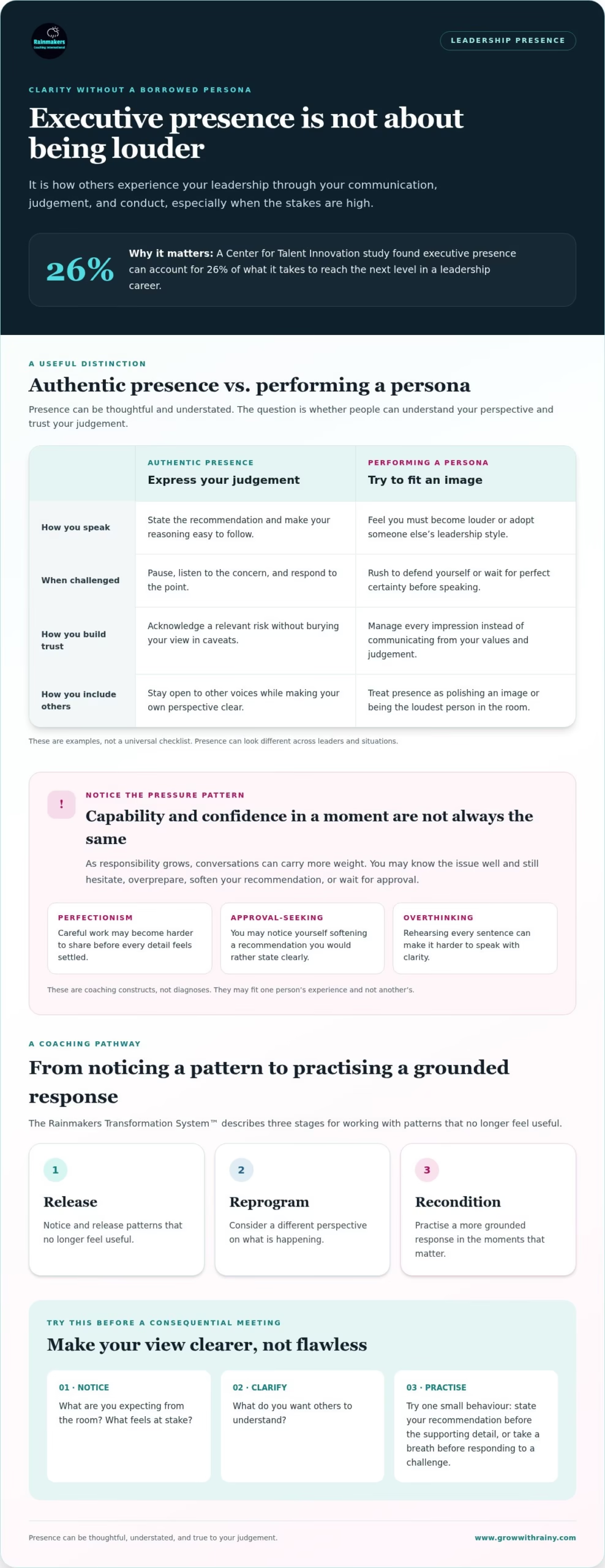
Executive presence is how others experience your leadership through your communication, judgement, and conduct, especially in consequential moments. It isn’t a fixed personality type, and it doesn’t require you to be the loudest person in the room. Presence can be thoughtful and understated. What matters is whether you express your perspective clearly and steadily enough for others to understand it.
How executive presence appears in senior-level work
Imagine presenting a recommendation to senior stakeholders. You explain the decision you support, make your reasoning easy to follow, and acknowledge a relevant risk without burying your view in caveats. Or someone challenges your proposal. You pause, listen to the concern, and respond to the point rather than rushing to defend yourself.
These are examples, not a universal checklist. One leader may bring calm through concise language; another may build trust by asking a careful question before offering a view. Clarity helps people follow your thinking. Steadiness can help them stay with the discussion when pressure rises. Listening shows that your judgement includes perspectives beyond your own.
Social psychology’s theory of impression management describes how people shape the way others perceive them. That idea can help explain why presence is noticed, but authentic leadership isn’t about managing every impression. It’s about communicating in a way that fits your values and judgement.
Why presence can feel harder as responsibility grows
As responsibility increases, conversations can carry more weight. A recommendation may affect priorities, resources, or relationships across teams. In that setting, self-doubt or overpreparation may surface, even when you understand the issue well. Capability and confidence in a particular moment aren’t always the same thing.
If you find yourself rehearsing every sentence or waiting for perfect certainty, ask what would help you speak clearly, not flawlessly. If reconnecting with your truth and self-trust feels relevant beyond work, explore transformation through life coaching as another coaching perspective.
Executive presence coaching for senior managers can offer space to examine how you show up in these moments, without assuming there’s one right way to lead. Start by noticing: when do you feel most grounded at work, and when does it become harder to make your perspective heard?
How executive presence coaching connects self-trust with leadership behaviour
You can be capable and still hold back in a moment that matters. Executive presence coaching for senior managers can create space to explore that gap, not to assume something is wrong, but to understand what may shape how you express your judgement under pressure.
At Rainmakers Coaching International, the coaching approach recognises that inner patterns may influence how capability shows up at work. Perfectionism, Approval-Seeking, and Overthinking are examples of coaching constructs, not diagnoses. They may be relevant for one person and not another. A coach can help you explore what fits your experience, rather than label you or decide in advance what is driving your behaviour.
When an old success strategy no longer serves the role
A strategy that once helped you succeed may feel different as your responsibilities change. Perfectionism might have supported careful work in one context, while now making it harder to share a view before every detail feels settled. Approval-Seeking may have helped you build relationships, yet you might notice yourself softening a recommendation you would rather state clearly. These are possibilities, not inevitable outcomes. The useful question is whether a familiar strategy still serves the situation you’re in.
What coaching can explore beneath visible behaviour
Before a difficult meeting, a coach might invite you to slow down and notice what happens just before you speak. What are you expecting from the room? What feels at stake? What do you want others to understand? From there, you can choose one small, observable behaviour to practise, such as stating your recommendation before giving the supporting detail or taking a breath before responding to a challenge.
Rainmakers’ approach uses the Rainmakers Transformation System™: Release, Reprogram, and Recondition. These stages offer a way to notice and release patterns that no longer feel useful, embrace a different perspective, and practise a more grounded response. The focus is not on performing a new personality. It is on reconnecting with your truth and building self-trust in the moments that matter.
Harvard Business Review’s New Rules of Executive Presence describes a more modern view of presence, including authenticity and inclusion. That perspective points to a useful distinction: leadership presence need not mean polishing an image. It can mean expressing your judgement while remaining open to other voices. Explore more about executive presence and authentic leadership if you’d like to consider how coaching might fit your situation.
If you’re curious about what this could look like in your work, a coaching conversation could give you space to explore the situation and consider whether the approach feels right. What might change if you trusted your perspective enough to express it clearly?
Authentic executive presence versus performing a leadership persona
Does coaching for executive presence mean changing your personality or learning to look more confident? It doesn’t have to. The aim isn’t to polish away who you are. It’s to communicate your judgement in a way that feels like you, even when the stakes are high.
Copying a leader you admire may seem like a shortcut. But if their style doesn’t fit yours, you may end up using language or gestures that feel disconnected from your own judgement. Deliberate practice is different. You can work on how you make a point, respond to a challenge, or invite another perspective without pretending to be someone else.
Extroversion, charisma, and constant certainty aren’t requirements for presence. A quieter leader can be clear and composed. A confident leader can still say, “I need to check that before I give you a firm answer.” Confidence isn’t about becoming louder. It’s about staying connected to yourself when pressure rises.
From performance to grounded presence
These examples aren’t rules or guaranteed formulas. They show how the same leadership moment can feel different depending on your intention and behaviour.
| Intention | Possible behaviour | Possible communication experience |
|---|---|---|
| Appear certain | Speak quickly and avoid acknowledging an open question | The message may sound polished, but leave less room for honest discussion |
| Make your view understood | State your recommendation, then explain the main reason | Others may find your position easier to follow |
| Protect your image | Defend your first response before fully hearing a challenge | The exchange may feel more like a contest than a discussion |
| Stay open and grounded | Listen fully, then respond to the concern you heard | The conversation may leave more space for shared understanding |
In practice, grounded presence might mean stating your view clearly without overexplaining, listening without planning your reply, or naming uncertainty honestly while explaining what you do know. Adapt these behaviours to your role and personality. They aren’t a script for influence. They’re options for making your communication reflect your actual thinking.
Executive presence can also be practised as a skill. Cornell’s executive presence coaching certificate is one example of formal learning focused on the topic. For a more personal exploration, executive and leadership coaching can give you space to consider which behaviours feel authentic and useful in your context.
Executive presence coaching for senior managers need not ask you to become someone else. It can help you notice where you’re performing, where you feel grounded, and what small adjustment might better reflect your values. In your next consequential conversation, what would it look like to be fully yourself and still make your view heard?
Practical ways to practise executive presence before seeking coaching
You don’t have to wait for a coaching conversation to practise. Before your next consequential meeting, try this sequence to prepare your message, notice what’s happening internally, and reflect afterwards without turning one conversation into a verdict on your leadership.
- Name the moment. What decision, concern, or recommendation do you want to contribute? Choose one point you most want others to understand.
- Shape a clear opening. Write one concise sentence that states your view, then choose one relevant example or reason to support it. Use this as a guide, not a script you must follow exactly.
- Notice your preparation pattern. Before the meeting, pause and ask: am I preparing what’s useful, or trying to remove every chance of disagreement? Is a wish for approval affecting how directly I plan to speak? Simply notice the reaction. You don’t need to label or judge it.
- Practise one observable behaviour. Choose something small, such as stating your recommendation before listing the details, finishing your point without apologising for taking the floor, or hearing a question fully before responding.
- Review the conversation with care. Write down what happened, then separate it from the meaning you’ve assigned to it. For example, “I shared my view and was asked a follow-up question” is an observation; “They didn’t trust my judgement” is an interpretation. Note one behaviour you’d repeat and one you might experiment with next time.
The sequence is simple: identify your message, prepare a clear opening and supporting example, notice your internal response, practise one visible behaviour, then separate observations from interpretations. It’s a way to learn about your leadership habits, not a promise that every meeting will go as planned.
If you’re building a broader direction for your growth, this leadership development planning for 2026 article may help you connect a specific communication practice with your wider leadership development.
Trying these steps can help you see what feels manageable on your own and where you might value a thinking partner. If similar moments keep raising the same questions, executive presence coaching for senior managers may offer space to explore your situation and decide what you want to practise. What is one behaviour you’d like to carry into your next important conversation?
When executive presence coaching may be a useful next step
You may have practised speaking more clearly and reflecting after important meetings. If the same situations keep bringing hesitation, overpreparation, or difficulty expressing your judgement, it may be worth exploring them with a coach. That doesn’t mean you lack ability. It means you’ve noticed a recurring experience and want to understand it more fully.
Executive presence coaching for senior managers can provide a focused space to discuss real leadership moments and consider what you want to approach differently. A conversation can also help you decide whether the coach’s approach feels relevant. You don’t need to arrive with a perfect goal. You can begin with one situation you’d like to understand.
Questions to ask before choosing an executive coach
Use an initial discussion to learn how the coach works and whether you feel at ease exploring your situation. Consider asking:
- How would we work with my goals and the leadership situations I bring?
- How do you handle confidentiality, and what expectations should I understand?
- How would we review progress together? What might we notice beyond external results?
- Can we focus on a specific communication challenge, such as sharing a recommendation or responding to challenge?
Notice your experience of the conversation, too. Do you feel listened to rather than judged? Does the coach’s explanation feel thoughtful, respectful, and connected to what matters to you? Fit matters. You should be able to ask questions and consider your options without feeling pressured to commit.
How Rainmakers approaches executive leadership coaching
Rainmakers Coaching International centres its coaching approach on self-trust and inner transformation. Its Rainmakers Transformation System™ is named Release, Reprogram, and Recondition. These stages describe the approach, not a guaranteed result or a required sequence of behaviours. Coaching may give you space to examine what is happening in a leadership moment and what feels aligned with the leader you want to be.
If you’d like to understand the approach before deciding, read more about what coaching with Rainy involves. You might bring a current challenge, explain what you hope to explore, and ask how the work could relate to your goals. The conversation is an opportunity to consider fit, not a promise that a particular outcome will follow.
If a recurring leadership situation is asking for more attention, you’re welcome to explore it in a coaching conversation and decide whether the next step feels right for you.
Lead with greater self-trust in your next leadership moment
Executive presence isn’t a louder voice or a borrowed persona. It’s how your judgement and communication come through when the stakes feel high. Small practices, such as preparing one clear contribution and reflecting on what happened afterwards, can help you notice what feels grounded and where you’d like to grow.
Executive presence coaching for senior managers offers space to explore recurring leadership moments and consider how you want to show up in them. Rainmakers Coaching International’s approach centres on self-trust and inner transformation through the Rainmakers Transformation System™: Release, Reprogram, and Recondition. The coaching manual describes more than a decade of coaching leaders, professionals, and individuals. A conversation can help you explore whether this approach fits your situation, without assuming a particular outcome.
You don’t need to become someone else to be heard. If you’re ready to reflect on a leadership moment that matters to you, explore a coaching conversation. How would you like to show up in your next important leadership moment?
Frequently Asked Questions
What is executive presence coaching for senior managers?
Executive presence coaching for senior managers is a form of executive coaching focused on how you communicate, use judgement, and conduct yourself in consequential leadership situations. It can help you explore moments when your expertise is harder to express and practise ways to make your perspective clearer while staying true to yourself. The focus is not on adopting a louder persona or following a fixed checklist for leadership.
Can executive presence be developed without changing your personality?
Yes. Developing executive presence doesn’t require changing your personality or copying another leader’s style. You might practise stating your recommendation clearly, listening fully to a challenge, or acknowledging uncertainty without withdrawing your view. These are behaviours you can adapt to your own way of leading. The aim is to communicate with greater self-trust in high-stakes moments, not to perform a personality that feels unfamiliar.
How does executive presence coaching help senior managers?
Executive presence coaching can help senior managers reflect on what happens before, during, and after difficult leadership moments. If you tend to overprepare or hesitate before sharing a view, coaching may help you explore whether those patterns fit your experience and what you’d like to try instead. You and your coach can identify a small, observable behaviour to practise, then reflect on what you noticed, without assuming a particular outcome.
What happens in an executive presence coaching conversation?
A coaching conversation may begin with a leadership situation you want to explore, such as presenting a recommendation or responding to a challenging question. The coach may ask what felt important, what you noticed in yourself, and what you’d like to communicate differently. You can also ask about the coach’s approach, confidentiality, expectations, and how you might review progress. The conversation is a chance to assess fit, not a promise of results.
Is executive presence coaching worth considering if I am already an experienced leader?
Experience and confidence in a specific moment aren’t always the same. Coaching may be worth considering if a recurring situation leaves you holding back, overthinking, or struggling to make your judgement heard despite your expertise. You don’t need to assume something is wrong. Ask whether exploring the situation with a coach could help you reconnect with your self-trust and decide on a practical next step.
How do I choose an executive presence coach?
Look for an approach that relates to your actual leadership situations and goals. Ask how the coach works with client priorities, handles confidentiality, sets expectations, and reviews progress. Notice whether their answers feel clear and whether the conversation feels respectful and relevant to you. Rainmakers Coaching International’s approach centres on self-trust and inner transformation through Release, Reprogram, and Recondition. Consider whether that focus fits what you want to explore.

Article by
Rainy Rainmaker
Rainy Rainmaker is the founder of Rainmakers Coaching International and a transformational coach for confidence, self-trust, and authentic leadership. Based in Singapore, she helps high-achieving professionals, managers, and leaders who appear capable on the outside but feel quietly held back by self-doubt, overthinking, imposter feelings, burnout, or a loss of direction. Through her signature Rainmaker Transformation Journey™, Rainy helps clients uncover the insights already within them and turn inner clarity into aligned action that creates lasting change in how they work, lead and live.
