

A tense meeting, a difficult conversation or an unexpected setback can bring up irritation, anxiety or defensiveness. The feeling itself does not determine how you lead; what matters is how you respond once you notice it. Emotional regulation techniques for leaders can help you create a little more room between a reaction and your next move.
Regulating emotion does not mean hiding it or forcing yourself to stay calm. It means recognising what is happening and finding a response that fits the situation and the leader you want to be.
This article introduces practical ways to steady your attention and reconsider how you interpret a tense moment. It also explains psychologist James Gross’s process model and how it can help you understand where you may be able to influence an emotional response.
Key Takeaways
- Emotional regulation means recognising what you feel and choosing how to respond, not pretending the emotion isn’t there.
- Use a brief pause to notice your cues, name the feeling and make room for a more intentional response.
- Use practical emotional regulation techniques for leaders in familiar situations, from tense conversations to high-pressure decisions.
- Practise with one recurring situation first, so regulation becomes a grounded habit rather than another demand to get everything right.
- If the same response keeps returning, leadership coaching can help you explore what may sit beneath it and build greater self-trust.
What Emotional Regulation Means for Leaders Under Pressure
You receive challenging feedback just before an important meeting. Frustration rises. You could dismiss the feedback, carry that tension into the room, or take a moment to understand what’s happening before deciding how to respond. The emotion is real. It doesn’t have to make the decision for you.
Emotional regulation is noticing an emotion and choosing how to respond to it, rather than pretending it isn’t there or letting it dictate your actions. This includes how you experience and express emotion. The overview of emotional self-regulation describes how people can initiate, inhibit or modulate their emotional states.
For leaders, that choice can shape the quality of a conversation, the questions considered before a decision, and how others experience disagreement. A deliberate response doesn’t guarantee agreement or a smooth outcome. It can help you act with more intention and communicate in a way that reflects your values, even when the moment feels charged.
Emotional regulation is not the same as staying emotionless
Emotions can offer information: frustration may point to a boundary or concern, while anxiety may signal uncertainty. They’re worth noticing, but they aren’t instructions you must follow. Regulation doesn’t mean being agreeable, silent or calm in every situation.
You might acknowledge, “I’m frustrated by this feedback,” without snapping back or concealing your reaction behind a forced smile. The aim isn’t to erase the feeling. It’s to make room to decide what’s useful to say and how you want to say it.
Why high-stakes leadership moments can feel activating
Disagreement in a meeting, uncertainty about a change, public criticism or responsibility for a visible decision can bring up strong reactions. One leader may feel an urge to answer immediately; another may go quiet, over-explain or revisit the moment long after it has passed. These responses vary. They aren’t, by themselves, diagnoses or proof of poor leadership.
Notice your own pattern. Which situations make it harder to respond as you intend? Is it a particular person, the fear of being misunderstood, or the pressure to decide before you feel ready? Naming the context can help you see where emotional regulation techniques for leaders may be useful. Start with one moment that repeats, rather than expecting yourself to change every response at once.
How Emotional Regulation Works: Notice, Pause, Choose
A reaction can gather speed before you’ve decided what you want to say. The aim isn’t to control every feeling. It’s to recognise what’s happening early enough to have a choice about your next move.
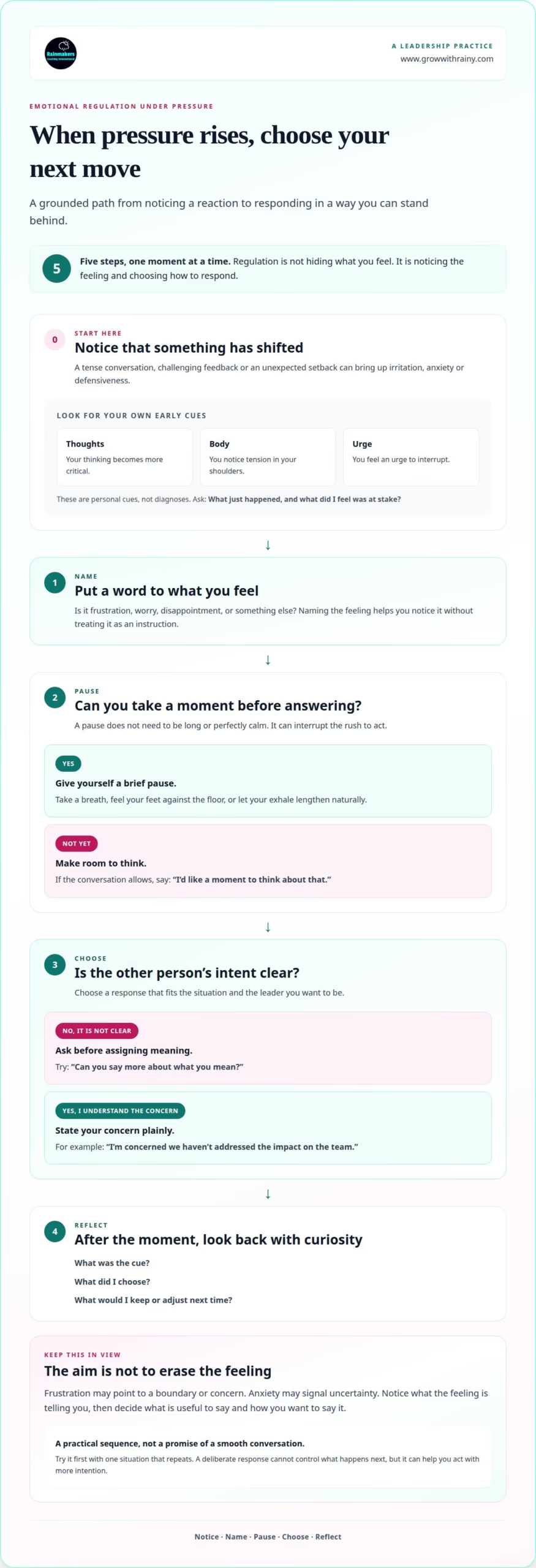
Try this simple sequence during a tense conversation or before replying to a difficult message:
- Notice: What changed in your thoughts, body or urge to act?
- Name: Is this frustration, worry, disappointment, or something else?
- Pause: Give yourself a moment before speaking or responding.
- Choose: What response fits the situation and the leader you want to be?
- Reflect: Afterwards, consider what helped and what you might try next time.
This is a practical sequence, not a clinical assessment or a promise that a conversation will go smoothly. It is also different from the Rainmakers Transformation System™. Psychologist James Gross’s Process Model of Emotion Regulation describes different points at which a person may influence an emotional response. The sequence here offers a simple way to bring awareness to a live moment.
Notice the early signs of an emotional response
Start with what you can observe. Perhaps your thoughts become more critical, you feel an urge to interrupt, or you notice tension in your shoulders. These are personal cues, not diagnoses. Ask yourself: What just happened, and what did I feel was at stake? Was it credibility, fairness, control, or being understood? You’re gathering information, not labelling yourself.
Create a pause before choosing what to do
If the conversation allows, take a breath before answering. You might feel your feet against the floor, let your exhale lengthen naturally, or say, “I’d like a moment to think about that.” A pause doesn’t require a long break or a perfectly calm mind. It simply interrupts the rush to act.
A pause creates room to consider your response, even when it can’t control what happens next.
A 2019 paper in Frontiers in Psychology examines emotion regulation strategies, including situation modification, cognitive reappraisal and suppression, in relation to leadership performance. Its discussion of beneficial emotion regulation strategies can help leaders consider more than suppression as a response to emotion. The useful question is not, “How do I stop feeling this?” but, “What response can I stand behind?”
After the moment has passed, reflect briefly: What was the cue? What did I choose? What would I keep or adjust next time? Which part of this sequence feels most useful in a situation you face often?
Practical Emotional Regulation Techniques for Leadership Situations
The most useful techniques are small enough to use in the middle of a real workday. Choose the situation that tends to pull you off course, then try one response at a time. You’re not aiming to deliver a perfect reaction. You’re practising a more intentional one.
When a difficult conversation raises frustration
Before you answer, pause and pinpoint what triggered the frustration. Was it the wording, the timing, or a concern that wasn’t addressed? Separating the specific issue from the heat of the moment can help you respond to what was said rather than the meaning you’ve assigned to it.
If the other person’s intent isn’t clear, ask: “Can you say more about what you mean?” Then state your concern plainly: “I’m concerned we haven’t addressed the impact on the team.” Clear language lets you disagree without adding unnecessary force.
When uncertainty or criticism triggers overthinking
Write down two short lists: what you know and what you’re assuming. For example, you may know that a decision has been delayed, but be assuming that the delay means your proposal has been rejected. Keep those separate. Then ask, “What’s the next useful question or action?” You don’t need to resolve every unknown before you can take one grounded step.
At Rainmakers, Overthinking is one of seven coaching constructs used to describe possible learned strategies, not a diagnosis or a label to place on yourself. If this response repeats, treat it as information to explore with curiosity.
When pressure makes it hard to stay present
If your attention is racing ahead, try a brief sensory reset: notice your feet on the floor and name a few things you can see. Or, if it feels comfortable, take a slower exhale. These are options, not requirements. Then narrow your focus: What is the next decision or conversation that needs your attention? You don’t have to solve the whole situation at once.
After the moment, take a minute to reflect. What cue did you notice? What helped you respond as you intended? What might you try next time? Reflection helps you learn from an interaction; replaying it repeatedly can keep you circling the same thoughts without adding insight.
For decision-related situations, connect this practice with a clear decision process. The Better Decisions Under Pressure article can offer a deeper look at that part of leadership. Together, these emotional regulation techniques for leaders can help you notice what’s happening, return to the issue in front of you and choose your next step with greater care. Which situation would you like to practise with first?
How Leaders Can Practise Regulation Without Suppressing Emotion
Regulation doesn’t mean agreeing to keep the peace, staying silent when something matters, or acting unaffected. You can feel disappointed and still speak clearly. You can feel frustrated and still set a boundary. The practice is not to erase your emotion, but to make choices that reflect what you want to stand for as a leader.
Rather than trying to change every reaction at once, choose one recurring situation. Maybe it’s receiving critical feedback, handling a missed commitment, or speaking up when a decision feels rushed. A focused practice gives you a chance to observe what happens and try a different response without judging yourself for having a feeling.
Build a personal practice around one recurring trigger
Before the situation next arises, decide what response you want to practise. Keep it within your control: asking one clarifying question, listening before replying, or stating your concern directly. You can’t control how another person responds, but you can prepare for how you want to show up. Afterward, review what you noticed and learned, rather than scoring the interaction as a success or failure.
Use reflection to understand what may sit beneath a reaction
After a challenging moment, make a brief note under five prompts:
- Situation: What happened?
- Emotion: What did I feel?
- Impulse: What did I want to do immediately?
- Chosen response: What did I do instead, if anything?
- Learning: What would I like to carry into next time?
Then ask gently: What might my reaction have been trying to protect? There may be several answers, or none that feel clear yet. If you notice yourself seeking approval or needing to control every detail, Approval-Seeking or Control may be useful coaching constructs to explore. They’re possible learned strategies, not diagnoses or fixed identities.
Know when self-guided practice may not be enough
If the same response keeps arising despite your efforts, treat that as an invitation to look more closely, not proof that something is wrong with you. Executive coaching can create space to explore the inner patterns beneath a high-pressure moment and strengthen self-trust. Rainmakers’ approach uses the Rainmakers Transformation System™: Release, Reprogram, and Recondition. Coaching can support your reflection and leadership development without guaranteeing a particular workplace outcome.
Practising emotional regulation techniques for leaders doesn’t ask you to become someone else. It can help you respond with more intention while staying connected to what you feel. What recurring situation would you be willing to explore with curiosity?
How Leadership Coaching Can Support More Intentional Responses
You may already know how you want to respond under pressure, yet find yourself falling into the same reaction. That repetition can be worth exploring with curiosity. A familiar response may have developed as a way to manage uncertainty, avoid conflict or feel prepared. It may once have served a purpose, even if it doesn’t fit every situation you face now.
Explore what a familiar response may be protecting
Ask yourself what feels at stake when the reaction appears. Are you worried about disappointing someone, losing control of a situation or being seen as unprepared? There may be more than one answer, and you don’t need to settle on a single cause. In coaching, Approval-Seeking and Control are names for possible learned strategies, not diagnoses or fixed identities. The purpose of noticing them is greater self-understanding, not self-criticism.
Connect inner reflection with a leadership intention
Leadership coaching offers room to reflect on the response beneath the moment and consider what you want to practise instead. You might begin with an intention within your control, such as listening before defending your position or stating a concern directly. The aim is not to remove emotion, but to support self-trust and a response that feels more authentic to you.
Rainmakers uses the Rainmakers Transformation System™: Release, Reprogram, and Recondition. These are the system’s three stages. They provide a framework for inner transformation without treating emotion as a flaw to eliminate. To learn more about Executive Coaching, explore how coaching can support reflection on your leadership.
Choose a next step that fits your readiness
You can continue practising on your own, using the techniques in this article to notice recurring cues and choose a response. If a pattern feels difficult to shift alone, coaching can be another space to examine it and reconnect with your truth. It’s a reflective support option for leadership development, not a guarantee of a particular workplace outcome.
Consider the moment where you most want more choice: a difficult conversation, a decision under uncertainty, or a familiar source of tension. What might you understand differently if you approached that response with curiosity rather than judgement?
If a coaching conversation feels like a useful next step, you can explore how Executive Coaching can support your leadership.
Make Space for a More Intentional Response
Emotional regulation isn’t about feeling less or presenting a polished version of yourself. It’s the practice of noticing what’s happening, pausing, and choosing a response that feels grounded and true to you. Small, practical emotional regulation techniques for leaders can help you meet difficult conversations, uncertainty and pressure with greater awareness.
If a familiar reaction keeps returning, consider what it may be protecting rather than criticising yourself for having it. Reflection can help you practise a different response; leadership coaching can offer space to explore recurring patterns and strengthen self-trust.
Rainmakers Coaching International brings more than a decade of experience coaching leaders, professionals and individuals. Its Rainmakers Transformation System™ is described through three stages: Release, Reprogram and Recondition. Coaching is one possible way to explore your leadership responses, not the only path to growth.
Which leadership moment would you like to meet with more choice and self-trust?
Schedule a conversation with Rainy
You can begin with one pause, one honest reflection, and one response that reconnects you with your truth. Each is a meaningful place to start.
Frequently Asked Questions
What are emotional regulation techniques for leaders?
Emotional regulation techniques for leaders are practical ways to notice an emotion and choose how to respond, rather than reacting automatically or hiding what you feel. You might name the feeling, pause before replying, ask a clarifying question, or separate known facts from assumptions. The right approach depends on the moment. The aim is to make space for a response that reflects your intentions, not to guarantee a particular outcome.
How can a leader stay calm during a difficult conversation?
You don’t need to appear perfectly calm to handle a difficult conversation thoughtfully. Before responding, notice what part of the exchange has affected you and take a breath if that feels useful. If the other person’s meaning is unclear, ask a question before assuming intent. Then state your concern directly and respectfully. If you need time to consider your response, say so rather than forcing an immediate answer.
Can leaders regulate emotions without suppressing them?
Yes. Regulation involves acknowledging an emotion and deciding how to act while it’s present. Suppression, by contrast, means trying to hide or push the feeling away. You can feel frustrated and still set a clear boundary, or feel anxious and still ask for the information you need. The feeling doesn’t have to disappear before you can choose your words. Noticing it can help you respond more intentionally.
What should a leader do when emotions affect decision-making?
Pause the decision if the situation allows, then distinguish what you know from what you fear or assume. Name the feeling and consider whether it points to a concern that deserves attention. Next, identify the information or perspective you still need, and decide when you’ll revisit the choice. A short pause won’t remove uncertainty, but it can help you assess the decision with more care.
How can leaders practise emotional regulation at work?
Choose one recurring work situation, such as receiving feedback or managing a tense discussion. After it happens, briefly record the situation, what you felt, your immediate impulse, how you responded, and what you learned. Before the next similar moment, choose one action to practise, such as listening before replying. Review your experience with curiosity rather than marking it as a success or failure.
When can leadership coaching help with emotional regulation?
Leadership coaching may be useful when a reaction keeps recurring and you want space to understand what may sit beneath it. Coaching conversations can help you explore learned strategies, reconnect with self-trust, and consider responses that feel more authentic. This is a reflective option for leadership development, not a clinical diagnosis or a guarantee of workplace results. You can also keep practising independently and decide what support feels right for you.

Article by
Rainy Rainmaker
Rainy Rainmaker is the founder of Rainmakers Coaching International and a transformational coach for confidence, self-trust, and authentic leadership. Based in Singapore, she helps high-achieving professionals, managers, and leaders who appear capable on the outside but feel quietly held back by self-doubt, overthinking, imposter feelings, burnout, or a loss of direction. Through her signature Rainmaker Transformation Journey™, Rainy helps clients uncover the insights already within them and turn inner clarity into aligned action that creates lasting change in how they work, lead and live.
