

To stop procrastinating on career goals, make the next step small, specific and easy to start. Set aside time, reduce distractions and keep a simple record of what you complete. Progress comes from returning to your goal, not waiting to feel perfectly motivated.
Career tasks are easy to postpone when they have no deadline, feel overwhelming or no longer seem meaningful. That doesn’t make you lazy. It may mean something about the task or the direction you’re pursuing needs a closer look.
This guide will help you identify what’s getting in the way, create a focused routine and track progress in a way that supports self-trust. You’ll also explore how to reconnect with motivation and when losing interest at work may be a reason to consider a career change. What small action could help you feel more grounded in your career direction today?
Key Takeaways
- Make career goals easier to begin by turning each one into a small, specific next action.
- Reduce friction by setting a focused work time, preparing a dedicated workspace and limiting the distractions that pull your attention away.
- Track completed actions, not just outcomes, so you can see progress and encourage yourself to continue.
- Notice whether anxiety, overwhelm, perfectionism or a lack of meaning is contributing to delay, then respond to the underlying barrier.
- If work feels persistently uninteresting, pause to consider whether your goals still reflect what matters to you and whether a career change deserves attention.
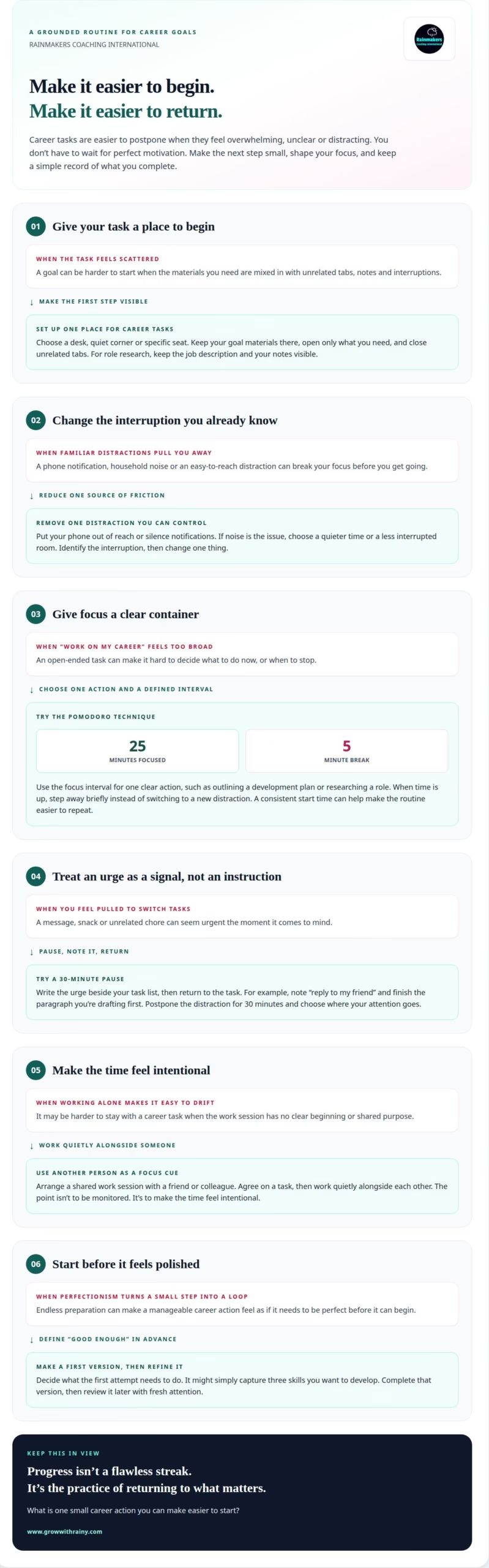
Reducing distractions
To reduce distractions, prepare a dedicated workspace, choose a focused work interval and remove interruptions you can control. To avoid perfectionism, decide what “good enough” looks like for a first attempt, then refine it once you’ve started.
- Set up one place for career tasks. Choose a desk, quiet corner or specific seat at home, and keep the materials for your goal there. Before a session, open only the document or page you need. If you’re researching a new role, keep the job description and your notes visible, and close unrelated tabs. A consistent workspace signals that this time is for career progress.
- Remove distractions you already recognise. If your phone draws you into social media, place it out of reach or silence its notifications. If household noise breaks your focus, choose a quieter time or a less interrupted room. Identify the specific interruption, then change one thing. That’s more practical than expecting yourself to concentrate while familiar distractions are close at hand.
- Work in a defined interval. Try the Pomodoro Technique: focus for 25 minutes, then take a 5-minute break. Use the interval for one clear action, such as outlining a professional development plan or researching a role. When the timer ends, step away briefly instead of switching to a new distraction. If you’re working at home, a consistent start time can make this routine easier to repeat.
- Delay the urge to switch tasks. When you feel pulled toward a message, snack or unrelated chore, write the urge down and return to your current task. You can try postponing that distraction for 30 minutes, rather than treating the urge as an instruction. For example, note “reply to my friend” beside your task list and finish the paragraph you’re drafting first. The pause gives you a chance to choose where your attention goes.
- Use another person as a focus cue. If you tend to drift when working alone, arrange a shared work session with a friend or colleague. Agree on a task, then work quietly alongside each other. You might tell your friend you’ll use the session to update one section of your career plan. The point isn’t to be monitored. It’s to make the time feel intentional.
- Set a “good enough” standard before you begin. Perfectionism can turn a small career action into an endless preparation loop. Decide what a first draft needs to do, such as capture three skills you want to develop, rather than make it polished. Complete that version, then review it later with fresh attention. If distractions still win, practical strategies for reclaiming your time can help you choose a manageable next step.
How can I measure my progress in overcoming procrastination?
Measure progress by tracking actions you control, not only outcomes you can’t control. A journal or productivity app can show what you completed, what you avoided and how you felt as you began.
- Choose a clear measure for each career goal. Turn “make progress in my career” into something observable, such as “write down three skills I want to use more often.” Record whether you took the action, rather than judging its quality. A clear measure helps you notice progress even when a promotion, role change or other external result takes longer.
- Keep a brief completion log. At the end of each session, note the task, what you did and the next step. For example: “Reviewed my development plan, identified a leadership skill to strengthen, next I’ll choose a learning opportunity.” A journal or productivity app can make this pattern visible without creating another complicated system.
- Track how you feel before and after starting. Before a career task, write down one word for your feeling, such as anxious, bored or unsure. After completing a small part, note whether that feeling shifted. This isn’t a score of your character. It helps you notice which tasks carry emotional friction and whether beginning changes your experience.
- Use deadlines as prompts, not verdicts. Put a specific action in your calendar, then record whether you started and finished it. If you miss the planned time, note what interrupted you and choose another time. A missed deadline tells you something about your plan, not that you can’t follow through.
- Encourage yourself with evidence. After completing a task, name what you did: “I spent time clarifying my next step, even though I felt uncertain.” That’s more useful than dismissing your effort as insignificant. If the task remains unfinished, recognise what you completed and identify one realistic next action.
- Pair progress with a meaningful reward. After completing a defined action, take a break, enjoy a favourite drink or share the milestone with a friend. Keep the reward proportionate to the effort, and don’t make it depend on a perfect result. Self-compassion means responding to a setback with a fair next step, not abandoning your goal or criticising yourself into action.
- Review your record and adjust. At the end of the week, look for patterns in your notes: which tasks moved forward, which feelings came up and what helped you begin? If your plan keeps slipping, make the next action smaller or change its timing. Progress isn’t a flawless streak. It’s a growing ability to notice, respond and return to what matters.
Common reasons for delaying tasks
People procrastinate on career goals when a task brings up anxiety, boredom or overwhelm, or feels unclear and unrewarding. Delay can be avoidance, not laziness. Identifying the feeling or barrier gives you a more useful place to start.
- Name the feeling attached to the task. Before you postpone a career action, write down what comes up. Updating your professional profile might trigger worry about being judged, while exploring a new field might feel overwhelming. Naming the response helps you see whether you’re avoiding the task itself or the discomfort you expect it to bring.
- Make vague tasks specific. “Figure out my career” can feel too big to start because it offers no clear first move. Turn it into a question you can explore, such as “Which parts of my current role give me energy?” Then write down a few examples from recent projects. If the next action is still unclear, break it down further.
- Notice whether the goal feels meaningful. A career task may keep slipping because its purpose no longer connects with what you value. For example, pursuing a promotion only because colleagues expect it may leave you feeling detached. Ask what the goal would change in your working life. If you can’t name a personally meaningful reason, reconsider the goal before blaming yourself for avoiding it.
- Account for the lack of deadlines and accountability. Career development is often self-directed, unlike a work assignment with a manager waiting for it. Without an external deadline, researching a skill or planning a next move can remain an intention. Set a clear finish point, such as completing a list of questions before your next development conversation. A defined commitment makes the action easier to see and revisit.
- Check what’s happening around you at work. Micromanagement can make you hesitate if every decision feels open to correction. A lack of meaning or perceived impact can also drain your willingness to begin. Note the conditions surrounding delayed tasks, such as unclear expectations or little room to choose your approach. This helps distinguish an internal fear from a work environment that needs attention.
- Look for the anxiety-delay loop. If a career task makes you anxious, avoiding it may bring brief relief. But an unfinished application, development plan or difficult conversation can then create more anxiety. Write down the concern, then identify the smallest action that addresses it. This gives you a practical way to tackle procrastination without waiting for the discomfort to disappear.
Considering career changes when work feels uninteresting
If work feels uninteresting, first notice whether the delay involves one task or your wider career direction. Burnout or dissatisfaction can contribute to procrastination, and ongoing anxiety about work may affect your energy, focus and performance.
To make a weekly career-development plan, choose a specific day and time for one practical action, then protect that space in your calendar. Balance it with work, family and rest by planning around existing commitments and keeping career tasks manageable.
- Separate a difficult week from a deeper mismatch. Write down which parts of work feel draining and which still interest you. For example, you might enjoy mentoring colleagues but feel disengaged by repetitive reporting. Look for patterns across tasks, relationships and responsibilities. This gives you clearer information than deciding to change careers after one frustrating meeting.
- Notice what the delay may be telling you. If you keep putting off the same career-development action, ask what happens inside when you consider it. Anxiety about change, exhaustion or a lack of meaning can all create resistance. Record the thought that comes up, such as “I don’t know what role would suit me.” Then turn it into a question to explore.
- Test your interest with a short work session. Spend five minutes on one low-pressure action, such as listing the skills you want to use more often. Starting small can help you discover whether the task feels difficult because it’s unfamiliar or because the goal no longer matters. Notice how you feel after beginning, rather than expecting instant certainty.
- Build a weekly plan around your actual life. Choose a specific day and time for one career action, such as reviewing a development goal or researching a role. Add it to your calendar alongside work, family responsibilities and rest. A plan that assumes unlimited energy is hard to sustain. If the week changes, reschedule the action instead of treating the change as failure.
- Create a routine for remote-work days. If you work from home, use a consistent cue to begin career-development time, such as closing work email and opening your planning notes. Keep the session separate from household tasks and work duties. A repeatable routine makes it easier to return to your goal without letting career planning take over time for family or recovery.
- Review the impact before choosing a new direction. Note how your current work affects your motivation, concentration and sense of contribution. Then consider what you want more or less of in a future role. If the same mismatch appears throughout your notes, explore career options deliberately. If your interest returns after adjusting a responsibility or routine, a broader change may not be the next step.
Motivation and career goals
Motivation is easier to sustain when a career goal feels meaningful and the next action is within your control. A practical way to stop procrastinating on career goals is to choose a personally relevant path, then notice the small signs of progress along the way.
Set SMART Career Goals
Write one career goal that is Specific, Measurable, Achievable, Relevant and Time-bound. For example, replace “find a better role” with “spend 30 minutes exploring roles that use my strengths.” Break that goal into actions you can complete in a single sitting. Check that the goal reflects what matters to you, not only what others expect.
Use an Accountability Partner or Coach
Share your goal with a friend, colleague or mentor, and agree on regular check-ins. Tell them what action you plan to complete before you speak again, such as identifying a skill to develop. An accountability partner can help you notice avoidance and acknowledge progress. A coach can help you explore what’s driving your hesitation without taking ownership of your decision.
- Choose a small number of priorities. Focus on one to three career goals at once. Several active ambitions can divide your attention, especially when work and personal responsibilities already compete for your time. Write your chosen goals somewhere visible, such as a notebook beside your work area. If a new idea comes up, save it for later rather than adding it immediately.
- Connect the task to its purpose. Before you begin, write one sentence about why the action matters. If you want to lead larger projects, a first step could be identifying a current project where you can practise coordination. Paying attention to how you work, why the task matters and what feels satisfying can support motivation beyond the final result.
- Make starting easier than avoiding. Set a five-minute timer and begin with the first visible action, such as listing relevant skills or opening a document. When the time is up, decide whether to continue. This lowers the pressure to finish everything at once and gives you the experience of starting, rather than waiting for motivation to arrive.
- Protect your choice and review the plan. Choose an approach that gives you some autonomy, then put the action in your calendar. If social media or another task tempts you away, return to the specific step you chose. If you’re working out how to stop procrastinating on career goals, use your next check-in to review what moved forward and adjust the next action. Motivation can grow as your choices begin to reflect your priorities. Which career priority matters most to you right now?
Rainmakers Coaching International: Life Coaching
Rainmakers Coaching International offers Life Coaching , Career Coaching , Executive Coaching and Career development Coaching for people seeking clearer direction and meaningful progress. If you understand the steps but still feel stuck, coaching can help you explore what’s beneath the delay.
Rainy’s inside-out approach focuses on reconnecting with your truth, recognising your innate gifts and hidden resources, and releasing outdated protective patterns. As your inner perspective shifts, you can make more grounded choices in how you work, lead and live. This isn’t about adding another framework. It’s space to understand what matters to you and build change that feels sustainable.
If you’re ready to explore your next career step with support, contact Rainmakers Coaching International.
Choose the next step that feels true
Career progress doesn’t have to begin with a dramatic decision. It can start with noticing what you’re ready to move towards and what you may be holding back to feel safe. That awareness can help you make choices that reflect who you are now, rather than old expectations about who you should be.
Learning how to stop procrastinating on career goals isn’t only about getting more done. It’s also an invitation to understand what your hesitation may be protecting, reconnect with your own judgment and take a grounded step. As your inner perspective shifts, the way you work, lead and live can shift with it.
If you’re ready to explore what’s behind the delay and find a direction that feels more aligned, coaching can give you space to reflect and move forward with greater self-trust.
Your next step doesn’t have to be perfect. Let it be honest, manageable and yours.
Frequently Asked Questions
What Is Procrastination?
Procrastination is choosing to delay an important task in favour of something more appealing, even when you expect the delay to create problems. For example, you might keep scrolling social media instead of preparing questions for a development conversation. The useful distinction is between a deliberate pause and avoidance: if you repeatedly postpone the same meaningful action, notice what you’re trying not to feel or face.
What is the 2-minute rule?
The 2-minute rule suggests doing a task immediately if it takes less than two minutes. For a career goal, that might mean saving a relevant professional development event to your calendar or sending a brief message to arrange an informational conversation. For a larger task, use two minutes to open your notes and write the first line. The aim is to reduce the threshold for starting, not finish everything at once.
What small habits can help overcome procrastination daily?
Choose one repeatable cue for beginning career work, such as reviewing your notes after lunch or opening a learning module before checking social media. At the end of the day, record one action you completed and the next step to remember. If you miss a day, return to the cue at the next opportunity rather than waiting for a fresh week or a perfect routine.
What time-management techniques help overcome procrastination?
Use the Eisenhower Matrix to sort tasks by urgency and importance, then prioritise actions that matter but lack an immediate deadline. A time audit can also reveal where spare pockets of attention actually fall. For example, a quiet period before your workday may suit professional learning better than late evening. Choose a method that fits your real commitments, not an idealised schedule.
What are the risks of delaying career goals for too long?
Long delays can leave fewer chances to build skills, explore different responsibilities or clarify what you want from work. They can also allow dissatisfaction to deepen before you make space to consider alternatives. Career growth may feel urgent only after a major disruption or intense unhappiness. Rather than waiting for pressure to force a decision, use recurring hesitation as a prompt to review your direction.

Article by
Rainy Rainmaker
Rainy Rainmaker is the founder of Rainmakers Coaching International and a transformational coach for confidence, self-trust, and authentic leadership. Based in Singapore, she helps high-achieving professionals, managers, and leaders who appear capable on the outside but feel quietly held back by self-doubt, overthinking, imposter feelings, burnout, or a loss of direction. Through her signature Rainmaker Transformation Journey™, Rainy helps clients uncover the insights already within them and turn inner clarity into aligned action that creates lasting change in how they work, lead and live.
