

Success can be real and still feel empty. Feeling unfulfilled at work despite success may point to a gap between what you’ve achieved and what matters to you, or to exhaustion after years of striving. It doesn’t mean you’re ungrateful or that your accomplishments don’t count.
You may have worked hard for a role, recognition, or financial security, only to wonder why the satisfaction didn’t last. That feeling deserves attention, not self-criticism. Achievement can bring comfort and opportunity, but it can’t meet every need for meaning, connection, and rest.
This article explores how a mismatch with your values, neglected self-care, burnout, and tying your worth to productivity can contribute to that emptiness. You’ll also find practical ways to notice what’s missing and begin reconnecting with what feels true, without rushing into a career decision. What might change if you treated this feeling as useful information rather than a personal failure?
Key Takeaways
- Notice when each achievement quickly becomes a new demand, and make space to acknowledge what you’ve already accomplished.
- Compare your work with the values that matter to you; persistent friction may be a signal to reassess what fulfilment means.
- Review where your time and energy go, and protect room for relationships, rest and activities that feel rewarding in themselves.
- Explore how perfectionism and constant pressure affect your wellbeing before treating exhaustion as a personal failing.
- Measure your life by more than productivity, and consider what support could help you reconnect with your own direction.
Is feeling empty after a major achievement normal?
Yes. A major achievement can bring relief without lasting fulfilment. The gap may reflect moving goals, pressure to perform, or emotional needs that achievement alone cannot meet.
Emptiness After Achievement
Emptiness after achievement is the flat or unsettled feeling that can follow reaching a long-awaited goal. You might earn a promotion, then feel little beyond relief once the celebration ends. This matters because the feeling can reveal what the milestone did not provide, such as connection, meaning, or time to recover. According to the American Psychological Association, long-term wellbeing involves emotional and relational factors, not achievement alone.
Moving Goalposts and Diminished Appreciation
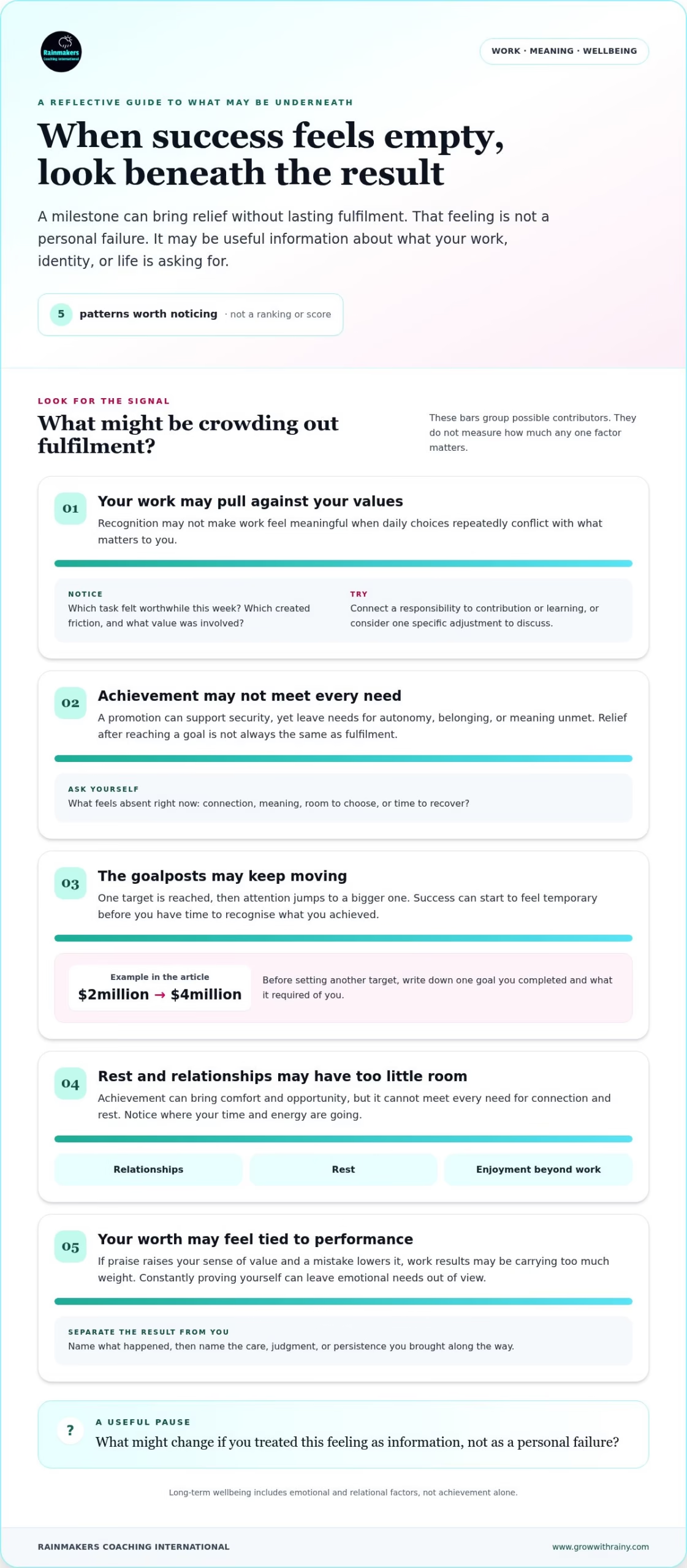
Moving goalposts happen when reaching one target quickly creates a more demanding one. Adam Fayed describes someone who aims to accumulate $2million and then wants $4million after reaching the first target. The pattern makes success feel temporary: attention moves to the next milestone before you can recognise what you accomplished. Try writing down one completed goal and what it required of you before setting another. That pause can help you see progress more clearly.
Achievement-Based Identity and Self-Worth
An achievement-based identity means treating performance as proof of personal worth. If your sense of value rises after praise and drops after a mistake, work results may be carrying too much weight. For example, a leader might see a difficult project as evidence of failure and overlook the care, judgment, and persistence they brought to it. Separate what you did from who you are: name the result, then the qualities you showed along the way.
If your success depends on how you lead, reflecting on leadership skills and real-world strategies can help you consider whether your working identity still fits.
Performance Pressure and Emotional Needs
Performance pressure is the demand to keep proving yourself, even after reaching a recognised milestone. Maslow’s hierarchy of needs suggests that people tend to move from basic needs toward higher-level needs, though not always in order. A promotion may support security while leaving autonomy, belonging, or meaning unmet. Ask which need feels absent before assuming another achievement will fill the gap.
To discuss changing your responsibilities, ask your manager for a focused conversation. Describe the work that energises you, the tasks that drain you, and a specific adjustment you’d like to explore. For example, propose shifting one responsibility while maintaining your core role, then agree on how to review the change.
To explore a career change while protecting financial stability, keep your current income as you research roles, build relevant skills, and review your regular commitments. Consider a gradual transition instead of resigning before you understand the practical demands of a new direction.
Mismatch between work and personal values
A role can look successful on paper and still conflict with what matters to you. If your daily choices repeatedly pull against your values, recognition alone may not make the work feel meaningful.
Finding Meaning in a Current Job
Finding meaning in your current job means connecting everyday responsibilities with values you genuinely care about. Purpose can sometimes grow through how you work, not only through changing jobs. If contribution matters to you, notice which tasks help colleagues or customers. If learning matters, identify a skill you can develop in your current role.
Try a simple reflection at the end of the week: name one task that felt worthwhile, one that created friction, and the value behind each response. A project update might feel satisfying because it gives a team clarity. A sales target might feel uncomfortable if it pressures you to recommend something you don’t believe customers need. These examples help distinguish the role itself from specific duties or workplace expectations.
Then look for a small adjustment you can discuss with your manager, such as taking ownership of a team improvement project or changing how a recurring task is handled. Be specific about the outcome you want and how it could support the team. If reflection points towards a larger career shift, career direction coaching can help you examine what fits your values and strengths.
Workplace Factors in Job Fulfillment
Workplace factors are the conditions and relationships that shape how your job feels each day. The same role can feel different depending on autonomy, respect, trust, and whether expectations align with your values. For example, a skilled employee may enjoy solving complex problems but feel diminished when every decision requires unnecessary approval.
Notice how your work environment handles disagreement, recognition, boundaries, and responsibility. If fairness matters to you, pay attention to how decisions are explained and applied. If collaboration matters, consider whether colleagues share information or work in isolation. These patterns can show whether dissatisfaction comes from your core duties, the team culture, or the way work is organised.
Job satisfaction is personal, so identify the conditions that help you contribute with integrity. Write down the values you want your work to honour, then compare them with specific moments from your working week. A gap between stated priorities and daily experience deserves attention. It doesn’t automatically mean you need to leave. It gives you firmer ground for a conversation or a considered career decision.
If you want support exploring how your values relate to your work, you can schedule a conversation about your career direction.
Neglect of relationships, hobbies, rest, and self-care
A calendar filled with deadlines can leave little room for the parts of life that restore you. If work takes every evening, friendship, movement, and quiet can become occasional extras rather than regular sources of energy. Constant achievement mode can leave you depleted, even when your career looks successful.
Start with a practical review of an ordinary week. Mark work hours, meals, rest, time with people, and activities you choose for enjoyment. For example, you might notice that several evenings went to unfinished tasks, while a close friend received only rushed replies. The point isn’t to judge your schedule. It’s to see what your time is already telling you.
Then identify one small change that can return time to something meaningful. You could protect an evening for dinner with a friend, take a short walk after work, or put a hobby back on your calendar. Treat the commitment as real, not as a reward you earn after finishing every task. If a work request repeatedly pushes it aside, notice the pattern.
Relationships need attention in specific, ordinary ways. A message asking how someone’s week is going, an unhurried meal, or a regular call can create space for honest connection. Close companionship and positive relationships are also part of an intrinsic-happiness scorecard. Ask yourself which person you miss spending time with, then suggest a concrete plan instead of waiting for a less busy week.
Rest also needs a place in your schedule. If you finish a demanding day by checking email through dinner, your mind may never register a clear pause. Try choosing a stopping point for work, closing your laptop, and shifting into a simple evening routine. Regular rest and connection can help address depletion when achievement mode continues without interruption.
Hobbies offer another kind of reward because they don’t need to produce a career outcome. Cooking a new dish, sketching, gardening, or playing a social sport can bring curiosity back into a week dominated by performance. Choose an activity because it engages you, not because it improves your profile or becomes another target to optimise.
Review your calendar after making a change. Did you protect the walk, meal, or rest period? If work displaced it, identify the specific pressure point and adjust your boundary or workload conversation. Fulfilment doesn’t require a perfect schedule. It can begin with a protected hour that reconnects you with people, interests, or rest you’ve been missing.
Perfectionism, stress, and burnout
Perfectionism can turn each task into a test of whether you’re good enough. A leader might revise a presentation repeatedly, even after it meets the brief, then spend the evening worrying about small imperfections. That pressure can make work less rewarding. If every success requires proof that you deserve your place, there’s little room to feel satisfied.
Stress can build when high standards meet a workload that leaves little room to recover. For example, you might accept a new project while continuing to answer messages late at night and correct every detail yourself. The immediate result may look strong, but the pace can be difficult to sustain. Notice where the pressure comes from: your expectations, unclear priorities, or the amount of work assigned.
Common signs of burnout can include ongoing exhaustion, growing distance from work, and feeling less able to complete familiar tasks. Feeling unfulfilled is more often a sense that work lacks meaning or fit, even when you still have energy for it. These experiences can overlap, so track what changes during a demanding week and what remains when the workload eases.
Try a practical check after your next demanding task. Write down what “good enough” would have looked like before you began, then compare it with the extra work you actually did. If you spent an hour adjusting a report that needed a clear summary, ask whether those edits improved its usefulness. This can reveal perfectionistic effort that consumes time without improving the outcome.
Next, make pressure more visible. List your current responsibilities, mark those with urgent deadlines, and identify any task without a clear owner or priority. Bring the list to your manager and ask which deliverable should take precedence. If you’re carrying several “top priorities,” ask what can wait. Clearer expectations can reduce avoidable strain without asking you to care less.
Recovery also needs to be part of how you work, not a prize for flawless performance. Choose a stopping point for one evening, take a proper break between demanding tasks, or delegate a detail someone else can complete. Then notice whether your energy or concentration changes. If pressure and detachment continue, consider what support or workload changes could help. What would you stop doing if “perfect” no longer defined success?
Recognising personal worth beyond productivity
If your first thought after finishing a task is to find the next one, work may have become your main measure of worth. A completed presentation, a strong review, or a promotion can show what you’ve done, but none can fully describe who you are. Separating your contribution from your identity helps you assess your life using more than performance metrics.
The National Institute of Mental Health describes emotional wellbeing as involving connection, meaning, and internal alignment, beyond simply functioning. That distinction matters when your calendar is full and your responsibilities are handled, yet your days feel thin. A reliable employee may meet every deadline while missing family dinners, creative interests, or time to consider what feels meaningful.
Try making two lists. On the first, write what you already have but rarely make time for, such as a close friendship, a favourite walk, or playing music. On the second, note what you want more of, perhaps learning, quiet, or contribution. These details can show whether your days reflect what you value, rather than only what your role rewards.
Next, consider intrinsic measures alongside career outcomes when reflecting on how life is going. You might ask whether you have choice in your day, opportunities to learn, time for companionship, and moments of genuine enjoyment. For example, a successful project could matter because you collaborated well, not only because senior colleagues praised the result. This gives achievement fuller context without dismissing it.
Notice the language you use about yourself after a setback. “I missed a deadline” describes an event. “I’m useless” turns one event into a verdict on your whole identity. Replace the judgment with concrete facts: what happened, what you contributed, and what you could change next time. A missed deadline may call for clearer priorities, not a conclusion that your worth has fallen.
Finally, choose a small action that expresses a value without needing to earn it. If connection matters, arrange lunch with someone you care about. If curiosity matters, explore a subject with no work outcome attached. If rest matters, protect a quiet evening instead of treating it as a reward for completing every task. These choices let your experience of yourself extend beyond what you produce.
If you want to explore what matters beyond performance and how it could shape your next steps, schedule a conversation about your personal direction.
Rainmakers Coaching International: Life Coaching
Rainmakers Coaching International offers Life Coaching for people who want to understand why achievement no longer feels meaningful. If your questions involve career direction or leadership, Career Coaching , Career development Coaching, or Executive Coaching can help you explore what needs to change from within.
This inside-out coaching approach helps you notice outdated protective patterns, uncover innate gifts and hidden resources, and reconnect with what feels true for you. As your inner perspective shifts, you can make more grounded choices about how you work, lead, and live. Change can grow from self-understanding rather than another external framework.
Choose a More Grounded Way Forward
If you’re feeling unfulfilled at work despite success, you don’t need to make a sweeping decision today. Start by noticing what feels misaligned, what still matters, and what small change could bring your choices closer to your values.
That reflection can shift more than your career. As your understanding of yourself changes, you can make clearer choices about how you work, lead, and live. The next step may be a conversation, a different boundary, or a new direction. Let it come from self-trust, not pressure to prove anything.
Rainmakers Coaching International offers space to explore what lies beneath the pressure to keep achieving and reconnect with your own resources. If you’re ready to consider what comes next, reach out for a conversation.
You’ve already shown you can achieve. Now you can let your next chapter reflect what matters to you, too.
Frequently Asked Questions
Why Do I Feel Depressed or Empty Despite Being Successful?
Success and emptiness can coexist because outward progress doesn’t automatically meet every emotional need. A promotion, for example, may change how others see you without changing loneliness or uncertainty in your daily life. Feeling empty doesn’t by itself mean you have depression. If low mood persists across work and personal life or makes daily tasks difficult, speak with a qualified health professional.
Does feeling empty mean I chose the wrong career?
No. Emptiness can reflect a specific role, team dynamic, or season of life rather than your whole career choice. Notice whether the feeling changes across tasks: you may enjoy solving problems but dread presenting them, or value your field but feel constrained by your current responsibilities. Exploring a project with different duties can help you gather evidence before deciding a complete career change is necessary.
How Can I Find Balance Without Losing My Drive?
Keep your ambition, but choose what deserves your effort instead of treating every opportunity as equally important. Before accepting another project, ask what it contributes to your priorities and what existing commitment it may displace. You might define a clear end to your workday or decide which responsibilities need your direct attention. Focused ambition directs your energy, rather than requiring you to be available for everything.
The Goal Was Yours, but Was the Definition of Success Yours?
Ask what made the goal appealing before you pursued it. Was it the work itself, the security it offered, the approval of someone important, or the status attached to the title? Imagine explaining your goal to someone whose opinion carries no weight in your decision. If the reason still feels meaningful, it may reflect your priorities. If not, consider what you’d choose without needing to prove anything.
What Does It Mean to Feel Successful but Unhappy?
It means your visible achievements and inner experience don’t currently match. You may be respected at work yet feel disconnected from your days, or enjoy financial security while wishing for more creative freedom. The contrast is worth examining, not dismissing. Define “successful” in observable terms, then describe what “happy” would look like on an ordinary Tuesday. The difference between those pictures can clarify what needs attention.
Why do people feel unfulfilled at work despite being successful?
People can feel unfulfilled at work despite success when their role’s daily demands no longer match what gives them a sense of purpose. A newly promoted specialist, for instance, may spend most days handling approvals instead of practising the craft they enjoyed. Recognition can confirm competence, but it may not make changed responsibilities satisfying. Look closely at how your actual working week differs from the work you expected to do.
How can I tell whether work dissatisfaction is temporary or a sign I need a career change?
Look for patterns across different circumstances. If dissatisfaction centres on one difficult project or a recent change in leadership, it may ease when that situation shifts. If the same concerns return across tasks, teams, and workload changes, they may point to a deeper mismatch. Before deciding, test a realistic adjustment, such as changing one responsibility, and notice whether your experience changes meaningfully.
What practical steps can I take to make my work more fulfilling?
Choose one part of your job to investigate instead of trying to redesign everything at once. Ask a trusted colleague what impact they see in your work, then compare their perspective with what feels meaningful to you. Identify a task where you could use a strength more fully, and raise a specific proposal with your manager. What meaningful change would you like to explore first?

Article by
Rainy Rainmaker
Rainy Rainmaker is the founder of Rainmakers Coaching International and a transformational coach for confidence, self-trust, and authentic leadership. Based in Singapore, she helps high-achieving professionals, managers, and leaders who appear capable on the outside but feel quietly held back by self-doubt, overthinking, imposter feelings, burnout, or a loss of direction. Through her signature Rainmaker Transformation Journey™, Rainy helps clients uncover the insights already within them and turn inner clarity into aligned action that creates lasting change in how they work, lead and live.
