
Leadership communication is more than delivering instructions. It helps people understand what matters, feel heard and move forward with trust. Communication skills coaching for leaders builds the awareness to listen before responding, clarify expectations and adapt a message to the people receiving it.
You may already know that communication shapes how a team works. Yet even a thoughtful message can create confusion when the goal is unclear, feedback is hard to hear or silence is mistaken for agreement. The shift begins when you notice not only what you’re saying, but how you’re showing up in the conversation.
In this article, you’ll learn why communication matters in leadership and how managers can use coaching skills to strengthen everyday conversations. We’ll explore practical ways to clarify goals, give useful feedback, ask open questions and adapt your message to different people and situations. What might change if you made more space to listen and trusted yourself to speak clearly?
Key Takeaways
- Listen to understand before responding, and use open questions to make space for honest input.
- Build trust through empathy, clear communication and feedback that helps people grow.
- Make goals and expectations easier to act on by clarifying what success looks like and inviting dialogue.
- Adapt your message to the person, context and communication channel so it can be understood and used.
- Notice the inner patterns shaping how you lead; greater self-trust can support more grounded, lasting change.
1. What’s Communication in Leadership & Why Is It Important?
Leadership communication shapes how people understand priorities, raise concerns and work together. In the workplace, unclear instructions can create confusion, tension and disengagement. Clear, respectful exchanges help teams see what matters and contribute with greater confidence. Communication is one of three critical competencies for successful change leadership.
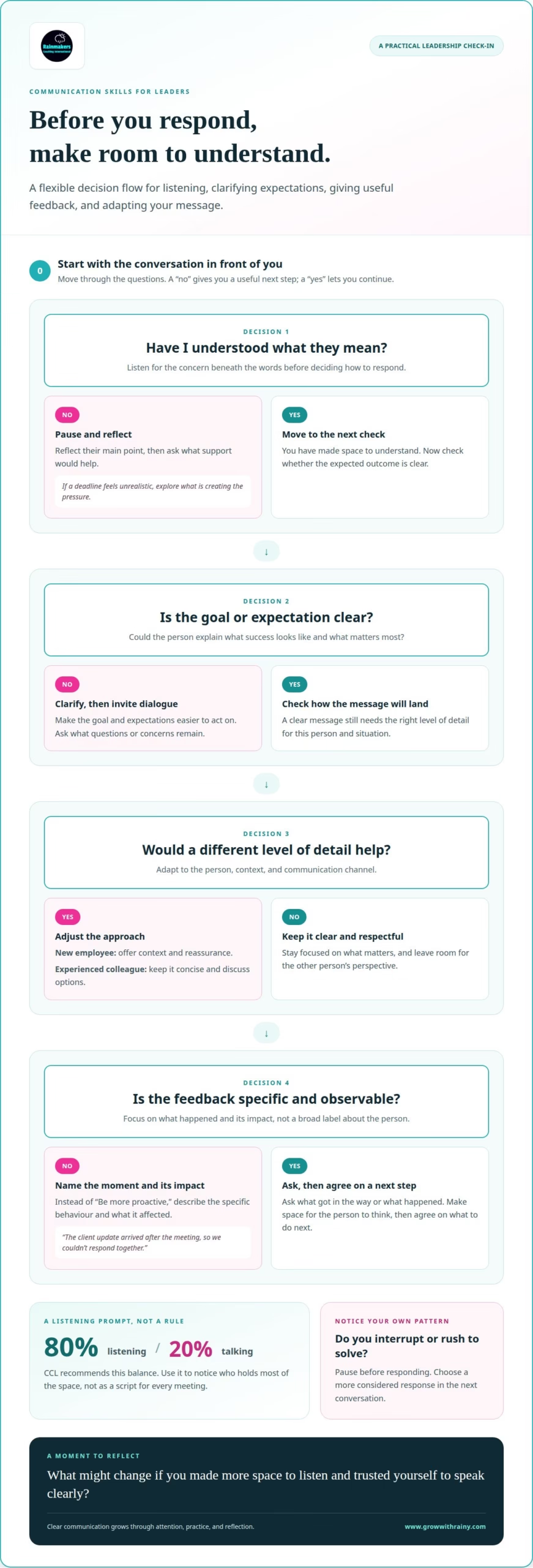
Active listening is more than staying quiet while someone speaks. It means focusing on their words, understanding their meaning, responding thoughtfully and remembering what they shared. Try a simple habit: pause, reflect their main point, then ask what support would help. If a team member says a deadline feels unrealistic, first explore what is creating the pressure.
CCL recommends an 80% listening and 20% talking balance during communication. Treat that as a prompt to notice who holds most of the space, not a script for every meeting. A leader who pauses before responding can hear the concern beneath a status update. That attention can strengthen bonds and encourage more honest input.
Open questions help leaders understand before deciding. Ask, “What feels most important to address?” or “What might I be missing?” These questions invite detail rather than a quick yes or no. Then adapt your response: a new employee may need context and reassurance, while an experienced colleague may prefer a concise discussion of options. Listening helps you choose the right level of detail.
Effective leaders need clear speaking, focused listening, empathy, emotional awareness and respectful feedback. They also need to ask thoughtful questions without turning a conversation into an interrogation. If someone misses an expectation, ask what happened and what they would do differently next time. This maintains accountability while giving the person room to think.
Communication coaching can help clarify expectations, strengthen trust and make conversations more useful. When people feel heard, they may raise concerns earlier and contribute ideas with less hesitation. A leader can also notice habits such as interrupting or rushing to solve problems, then practise a more considered response in the next meeting.
Choose a communication coach who understands leadership settings, listens carefully and helps you work on specific situations. Look for an approach that includes reflection, practical practice and feedback, rather than only advice or presentation techniques. If communication patterns connect to wider questions of purpose or self-trust, reconnecting with your truth may also help you understand what shapes your leadership.
The time it takes to develop leadership communication depends on the habit being changed, how often it is practised and the feedback available. A leader working on interruptions has a different focus from someone rebuilding trust after a difficult change. Reflecting regularly on real conversations helps turn awareness into a steadier practice.
A coach who doesn’t understand the context behind a communication challenge may offer generic guidance or miss when the issue falls outside coaching. That can leave a leader practising an unhelpful response. A clear coaching approach, relevant experience and a thoughtful first conversation can help establish whether the support fits the situation.
2. What are examples of coaching skills for managers?
Trust grows through repeated interactions, not a single inspiring speech. A manager who keeps a commitment, explains a decision and acknowledges uncertainty gives employees something consistent to rely on. These small actions help create a culture where people can raise concerns without disguising them as polished updates.
Useful coaching skills include communication, emotional intelligence, active listening, empathy, positivity, instruction and feedback, goal setting, and a growth mindset. In practice, a manager might notice a quiet employee during a project review and invite their view without putting them on the spot. That combines awareness with a clear invitation to contribute.
Confidence and executive presence don’t require a forceful voice. They show up in how a leader holds a pause, speaks with intention and stays steady when challenged. Before a difficult meeting, clarify the decision you need, the concern you expect and the question that will help you understand the other person’s position.
Feedback builds trust when it is specific, balanced and connected to observable behaviour. Instead of saying, “You need to be more proactive,” name the moment: “The client update arrived after the meeting, so we couldn’t respond together.” Then ask what got in the way and agree on a next step. The employee hears both the impact and the opportunity to improve.
Recognition also shapes culture. Name the contribution and its effect, such as, “Your clear handover helped the next shift resolve the issue without repeating work.” This is more useful than general praise because the employee knows what to repeat. When a team sees fair recognition and respectful correction, trust becomes a shared practice rather than a manager’s slogan.
Connected teams need communication that makes room for difference. During a project debrief, ask each person what helped progress and what created friction. If one employee values written context and another prefers a quick discussion, agree on a simple routine that respects both preferences. Small adjustments can reduce avoidable misunderstandings across a team.
In Singapore, communication skills coaching for leaders is offered through executive coaches and leadership-development coaching practices. The right fit depends on the manager’s situation, such as building confidence, handling difficult conversations or strengthening team trust.
SkillsFuture support depends on the specific course and its eligibility, rather than applying automatically to every form of communication coaching. Check the scheme’s criteria for the course before relying on funding; a private coaching engagement and an eligible training course may be treated differently.
If you want a grounded space to explore how your habits shape the way you lead, you can talk through your coaching needs.
3. Communicating goals, expectations, and feedback
A goal gives direction; clear expectations show team members how to move towards it. If an organization asks someone to “improve client communication,” that leaves too much open to interpretation. A manager can clarify the expected behaviour, such as sharing project updates before a client meeting, and explain how it supports the team’s commitment.
SMART goals make the next step clearer: specific, measurable, achievable, relevant and time-bound. For example, a project member could aim to submit a concise progress update before each scheduled review. The leader and employee can then agree on what the update should include, who will use it and how they’ll recognise progress.
Coaching conversations can turn a broad ambition into a useful development plan. A manager might ask, “What would stronger stakeholder communication look like in your next project?” Then explore the employee’s current approach, possible actions and chosen next step. This keeps the employee involved, rather than making the goal feel like another instruction imposed from above.
Feedback is most useful when it describes an observable action and its effect. Instead of saying, “You’re not committed,” a manager could say, “The last handovers lacked the risks section, so the incoming team had to follow up.” A specific example makes the issue discussable without turning it into a judgement about character.
Constructive feedback should pair accountability with a path forward. A manager might explain the required handover standard, ask what made it difficult and agree on a practical adjustment. If the employee needs instruction, demonstrate how to record risks clearly, then invite them to try. Direct guidance and coaching questions can work together.
Taking feedback seriously means closing the loop. If team members say project priorities keep shifting, acknowledge the concern, clarify what can change and report back on the decision. Even when a request can’t be adopted, explaining the reason shows that their input was considered. Following through helps make feedback a dependable part of the organization’s culture.
Mentoring and coaching both support development, but they serve different needs. A mentor can share experience to help someone think and act like a future leader. Coaching can help that person practise a specific skill, such as giving concise updates. A manager can choose the approach according to whether the employee needs perspective, skill practice or both.
After setting a goal, agree on how progress will be discussed and what evidence will matter. A completed presentation, clearer meeting summary or timely escalation can make growth visible. Ask, “What part of this conversation helped you move forward?” The answer can guide the next check-in and keep feedback focused on learning, responsibility and progress.
4. Adapting communication to different audiences
The same message can land differently with a project team, senior leaders and a new employee. Before speaking, identify who needs the information, what they already know and what action matters next. An executive update, for example, may need to lead with the decision and its impact. A delivery team may need context, dependencies and immediate next steps.
Keep the core message steady, then adjust its detail and framing. When explaining a process change, frontline employees may need to know how it affects daily tasks. A leadership group may need the reason for the change and its wider implications. This isn’t about changing the truth. It’s about making the message clear to the people receiving it.
The channel matters too. A complex or difficult conversation often benefits from direct discussion, where people can ask questions and clarify meaning. A written summary can then capture decisions and responsibilities. For a remote team working across time zones, share essential context before a meeting so members can prepare and contribute rather than respond without preparation.
Notice how the audience responds. If a presentation draws silence, don’t assume agreement or disengagement. Pause, invite questions with a specific prompt or offer a follow-up channel for people who prefer time to think. In a one-to-one conversation, a manager might ask, “Which part needs more context?” That question can reveal confusion without putting someone on the defensive.
Adapt your pace and language to the people in front of you. A technical specialist may value precise terms, while a cross-functional group may need plain language and a brief example. If you use an unfamiliar acronym, explain it once. Small adjustments can strengthen engagement and reduce the effort people spend decoding your meaning.
Resilient teams need room to adapt their communication as work changes. During a project handover, for instance, a team can agree on what belongs in a written update and what requires a conversation. If a deadline shifts, the leader can explain what changed, what remains stable and where decisions are needed. That clarity helps people respond without losing sight of shared priorities.
After an important conversation, check what people understood and what action they plan to take. Their answers show whether the message reached them as intended. If team members describe different next steps, clarify the point before work splits in separate directions. What could you change in your next message to make it easier for each person to act?
5. Coaching for communication skills
Communication techniques work best when they fit the leader, not just the meeting. A manager who rushes to solve every concern might practise pausing, naming their reaction and asking a curious question. In coaching, they can examine what is happening internally before choosing what to say. This can help them respond more intentionally, especially when pressure makes old habits feel automatic.
A practical programme starts by identifying a real leadership challenge, such as giving difficult feedback or presenting a change. The coach and leader clarify the outcome, explore what happens now, consider options and agree on an action. This follows the GROW sequence: Goal, Reality, Options and Will. The leader then practises the chosen approach in a relevant situation and reflects on what happened.
Practice should be specific. A leader preparing for a tense project review could rehearse a concise opening, a neutral question and a clear request. The coach might notice hurried speech or defensive wording, then invite the leader to try again. Repetition helps the leader experience how a small change in tone or timing can alter the conversation.
Coaching can also explore the beliefs beneath a communication habit. If a leader avoids disagreement to keep everyone positive, they can ask what that strategy costs the team. Perhaps concerns surface late, after decisions are harder to change. Recognising the pattern lets the leader choose a more honest response while staying respectful. The aim is not to perform confidence, but to act with greater self-trust.
After trying a new approach, the leader reflects on the evidence. Did the colleague understand the request? Did they speak more openly? What would the leader adjust next time? Feedback from a trusted team member can add another perspective. These observations keep development grounded in daily work, rather than turning coaching into techniques disconnected from real conversations.
Communication skills are learnable, and progress comes through awareness, practice and reflection. If a leader notices the same misunderstanding recurring, coaching can help them examine the pattern and try a different response. Change may begin internally, then show up in how they lead, collaborate and handle pressure. What conversation would you approach differently with more choice?
Rainmakers Coaching International: Executive Coaching for Leaders
Rainmakers Coaching International offers Executive Coaching for leaders who want their communication to feel clearer, more grounded and more like themselves. This inside-out approach looks beyond techniques to the beliefs and protective patterns shaping how you lead. By reconnecting with your own strengths and resources, you can build self-trust and support lasting change in how you work and lead.
Executive coaching can support leaders who are navigating promotion, executive presence, difficult conversations, team trust or broader leadership development. Turn to coaching when you notice a recurring pattern, such as holding back in important conversations or reacting defensively under pressure. Career coaching can also support you when communication challenges connect with wider questions about your direction or growth.
If you’d like to explore Executive Coaching for your leadership communication and development, learn more about the programme or get in touch with Rainmakers Coaching International.
Lead with more trust in your next conversation
Your next conversation is a chance to lead with more intention. You don’t need perfect words. Begin by noticing what you’re feeling, what the other person may need and what outcome would help you both move forward.
Communication skills coaching for leaders can create space to understand the habits beneath your words. As your inner responses shift, so can the way you work with others, lead through tension and make room for honest connection. The aim isn’t to follow a script. It’s to speak with greater clarity and self-trust.
Rainmakers Coaching International offers Life Coaching , Career Coaching and Executive Coaching. If you’re ready to explore a change in how you lead and live, take a thoughtful next step. You can begin with a conversation and decide what feels right for you.
Keep practising. Each grounded conversation can help you become a leader others trust while staying true to yourself.
Frequently Asked Questions
What’s Communication in Leadership & Why Is It Important?
Leadership communication is how a leader shares direction, responds to concerns and shapes working relationships. Its importance becomes clear during uncertainty, such as a project delay or a change in responsibilities. A clear explanation helps people understand what has changed and what remains undecided. For example, naming who owns a decision and when an update is due can reduce avoidable speculation.
How Does Effective Communication Set You Up for Managerial Success?
Effective communication helps managers align daily work with broader priorities. If a team member receives competing requests, a manager can clarify which task takes precedence and why. This makes it easier to coordinate effort and raise conflicts early. Over time, consistent explanations and follow-through help a manager build credibility, especially when decisions are difficult or not everyone gets their preferred outcome.
What are examples of coaching skills for managers?
Managers can use curiosity, empathy, goal setting and reflective questions to support employees’ thinking. After a project setback, for example, a manager might ask, “What would you keep, and what would you change next time?” The question encourages learning without avoiding responsibility. The manager can then agree on a practical action, such as asking for an early review before the next major deadline.
What leaders can learn from coaches?
Leaders can learn to resist filling every pause with advice. A coaching approach makes room for the other person to identify their own options and take ownership of a decision. Instead of immediately proposing a solution to a workload concern, a leader might ask which responsibility feels most urgent and what support would help. This can reveal needs that a quick instruction would miss.
What does leadership communication coaching cover?
Communication skills coaching for leaders can address how a leader prepares for important conversations, responds under pressure and makes their meaning clear. The focus might be a specific situation, such as presenting a decision to peers or addressing tension with a direct report. Rainmakers Coaching International offers Executive Coaching to support leaders in exploring how their inner patterns influence how they lead and communicate.
How does one-to-one coaching compare with group leadership communication training?
One-to-one coaching focuses on a leader’s own situations, habits and development priorities. Group training gives participants shared practice and a chance to hear how colleagues approach similar challenges. An individual, for example, might use coaching to prepare for a sensitive conversation, while a group might practise presenting ideas to different audiences. The best format depends on whether the immediate need is personal reflection or shared skill-building. Which approach would help you take your next step as a leader?

Article by
Rainy Rainmaker
Rainy Rainmaker is the founder of Rainmakers Coaching International and a transformational coach for confidence, self-trust, and authentic leadership. Based in Singapore, she helps high-achieving professionals, managers, and leaders who appear capable on the outside but feel quietly held back by self-doubt, overthinking, imposter feelings, burnout, or a loss of direction. Through her signature Rainmaker Transformation Journey™, Rainy helps clients uncover the insights already within them and turn inner clarity into aligned action that creates lasting change in how they work, lead and live.
