
The most meaningful life coaching benefits have little to do with productivity hacks or louder goals. They show up in the quiet places: how you talk to yourself on a Sunday evening, how you handle a difficult conversation with your loved ones, and whether you can say yes or no without a knot in your stomach.
If you keep overthinking a decision about life, feel guilty every time you put your own needs first, or carry everyone else’s worries as though they were yours, you aren’t flawed. You’ve relied on familiar protective patterns to keep yourself safe.
Real transformation isn’t about repairing who you are or collecting more advice. Think of it as clearing away the mud so the diamond underneath can shine. It’s about reconnecting with your truth. In this article, you’ll see how life coaching goes beyond goal-setting and helps you release the hidden patterns that keep you stuck, so you can trust yourself and live a more meaningful life.
Key Takeaways
- Life coaching benefits come from addressing what is happening inside, not only managing the symptoms you see on the surface.
- Protective patterns such as People-Pleasing, Overthinking and Over-Responsibility can quietly shape your relationships, family life and everyday choices.
- Self trust is different from performative confidence. It is a steadier way of being yourself when it matters.
- Progress can be tracked through real-life markers like clearer decisions, firmer boundaries and more presence at home.
- Releasing old protective strategies helps you become more fully yourself.
Beyond Goal Setting: What Life Coaching Really Offers
You may have a good life on paper. A stable home, people who care about you, things you’ve worked for. And still, something feels slightly off. You may find yourself wondering whether this is really the life you want, or whether you’ve simply been doing what was expected.
Many people assume coaching is for those who are struggling or broken. That’s a misconception. Life coaching is not about fixing what is wrong with you. It is about reclaiming the person beneath the roles you play, whether that’s partner, parent, son, daughter, friend or professional.
The Difference Between Advice and Transformational Coaching
Advice hands you someone else’s map. It can help, but it often can’t tell you which direction feels true for you. Transformational coaching helps you trust your own internal compass.
Most thoughtful people don’t lack information. You’ve probably read the books, listened to the podcasts and heard the opinions. Sometimes you don’t need more evidence that you’re capable. You need to trust the evidence you already have. For a wider view of how the field is understood, see this overview of coaching psychology.
Recognizing the Self-Trust Gap in Everyday Life
The self-trust gap is the distance between how capable you appear and how certain you feel inside. It can show up in small moments: asking three friends what to do before booking a holiday, rehearsing a conversation for days, or staying quiet at a family gathering to keep the peace.
That gap creates internal friction, and living with friction is tiring. If this sounds familiar, our piece on how to trust yourself again is a gentle place to continue.
Try this small reset. The next time you’re about to seek a second or third opinion on something personal, pause. Write down what your first instinct said. Notice what happens when you take it seriously.
What would change in your daily life if your private self-trust matched what others see in you?
Reconnecting With Your Truth: Releasing the 7 Protective Patterns
What if something you’re proud of is actually a protective strategy keeping you stuck? Maybe you learned early to be the easy one, the responsible one, the one who never made a fuss. It worked. It kept you safe and earned you praise. Over time, it hardened into a pattern.
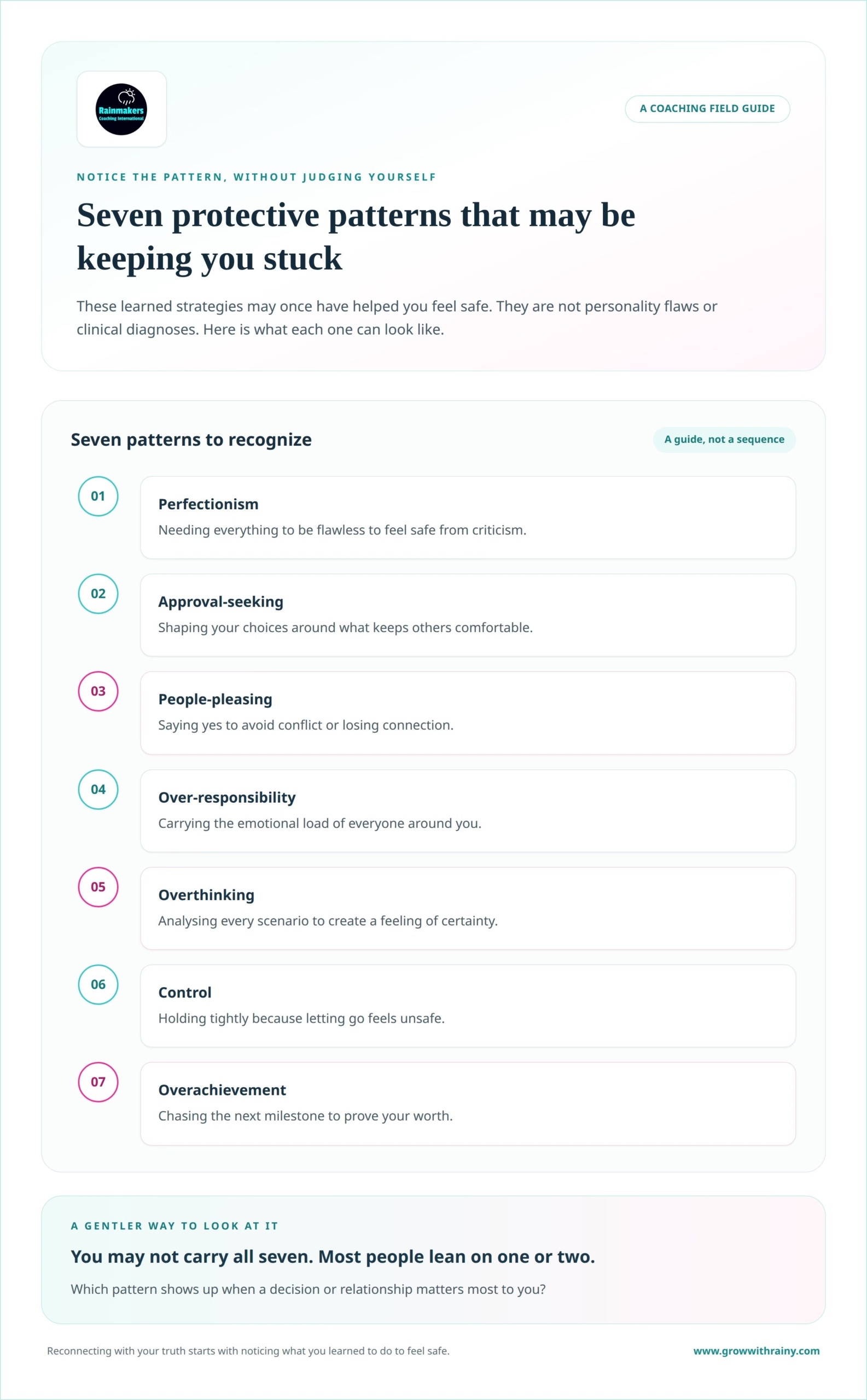
These patterns are learned strategies. They are not personality flaws and they are not clinical diagnoses. In coaching, we work with seven of them:
- Perfectionism: Needing everything to be flawless to feel safe from criticism.
- Approval-Seeking: Shaping your choices around what keeps others comfortable.
- People-Pleasing: Saying yes to avoid conflict or loss of connection.
- Over-Responsibility: Carrying the emotional load of everyone around you.
- Overthinking: Analysing every scenario to create a feeling of certainty.
- Control: Holding tightly because letting go feels unsafe.
- Overachievement: Chasing the next milestone to prove your worth.
As these patterns loosen, you stop over-performing and begin reconnecting with your truth instead of defending your worth. You may not carry all seven. Most people lean on one or two. If you are curious to find out what’s really getting in your way, you can take the pattern map assessment.
From Overthinking to Grounded Decisiveness
Rainmakers Principle: Overthinking is often an attempt to create safety by eliminating uncertainty.
Think of a big personal decision: moving house, ending a friendship, starting a new chapter. You research, ask around, list pros and cons, then do it all again. The question underneath is often, "What if I get it wrong?"
Coaching helps you meet that question directly. Instead of searching for a guarantee, you learn to trust that you can handle what unfolds. For more on this, see making better decisions under pressure by reclaiming self-trust. Which pattern do you lean on most when a decision truly matters to you?
The Cost of Over-Responsibility in Family and Friendships
Rainmakers Principle: Over-responsibility often begins when a child learns that they must keep everything and everyone okay.
As an adult, this can look like managing your parents’ moods, being the family’s problem-solver, or feeling that a friend’s unhappiness is yours to fix. It leaves you tired and, often, quietly resentful.
Try this: choose one situation this week where someone else can carry their own part. Step back, and notice what you feel. Guilt is common at first. It doesn’t mean you’re doing something wrong. If you’d like to explore this with support, you can learn more about transformation life coaching.
The Grounded Shift: How Self-Trust Differs From Generic Confidence
You don’t need to become louder to live well. You need to become more fully yourself. Confidence is often sold as projection and a bold presence. But being yourself when it matters isn’t about volume. It’s about inner steadiness.
Many people who seem confident still doubt themselves in private. Grounded self-trust doesn’t demand perfection. It offers the quiet certainty that you can handle whatever comes.
Performative Confidence vs. Grounded Self-Trust
| Dimension | Performative Confidence | Grounded Self-Trust |
|---|---|---|
| Core Driver | External validation and agreement | Internal alignment and values |
| Response to Mistakes | Defensiveness or hidden panic | Curiosity and ownership |
| Presence | Effortful, needs to impress | Calm, spacious, anchored |
If you’d like to go deeper, explore our Building Rock Solid Confidence program.
Living Without the Need for Constant Approval
Rainmakers Principle: Approval becomes dangerous when we allow other people’s responses to determine our worth.
When approval drives your choices, you may avoid honest conversations, keep commitments you no longer want, or hold back what you truly think. Choosing differently can feel risky.
Practise a silent pause before asking for reassurance. When you share an opinion with a friend or family member, resist adding "Is that okay?" Let it stand.
How different would your choices be if they were guided by your own convictions rather than other people’s reactions?
Measuring the Difference: Tangible Signs of Inner Change
Inner work can sound vague. Yet the signs tend to be very real. Imagine ending your day without replaying every conversation, or spending an evening with the people you love and actually being there.
Transformation is measured not by what you know, but by who you become. To notice your progress, look for three markers:
- Decision ease: Less time spent going back and forth before making personal choices.
- Boundary retention: Saying no to a request without lingering guilt or a long explanation.
- Presence: Being mentally with the people in front of you, rather than somewhere in your head.
The Ripple Effect Across Your Life
Coaching works from the inside out. When what is happening inside you shifts, how you rest, relate and live can look different. Our coaching breakthrough stories share client journeys such as "Confident Leadership," "Meaningful Direction" and "A Fuller Life Vision." For more on this topic, read when success no longer feels meaningful.
Whole-Life Success: Beyond the Boardroom
A problem rarely stays in one place. When Control shows up at home, it can strain relationships and make it hard to relax. When Over-Responsibility runs your weekends, rest never quite arrives.
Research on coaching points the same way. A meta-analysis by Theeboom, Beersma, and van Vianen reported coaching effects on both performance and skills (g = 0.60) and well-being (g = 0.46). Work and personal life are not separate worlds. You can also read the Harvard Business Review research on coaching to see why capable people seek coaches.
What would your evening look like if you stopped carrying the day’s weight into it?
The Rainmaker Transformation System™: Your Path to a More Meaningful Life
You are not a project to be fixed. You are a treasure waiting to be revealed. The mud is the protective patterns that built up over years. The diamond underneath is already intact.
With more than a decade of experience, Rainy Rainmaker developed the Rainmaker Transformation System™ to guide this work. It has three stages:
- Release: Identify and let go of protective patterns that no longer serve you.
- Reprogram: Realign your inner world with your truth rather than with fear.
- Recondition: Anchor new, grounded behaviours into daily life until they feel natural.
Is Coaching the Right Next Step for You?
If your life looks fine but feels hollow, or if you keep repeating the same patterns in relationships and choices, now may be the time. The goal isn’t simply more success. It’s to become more fully yourself. Learn more in understanding life coaching benefits, methods, and misconceptions.
Final Reflection
If you stopped using your main protective pattern today, who would you be at your next family dinner, or in your next honest conversation with a friend?
When you’re ready, schedule your call with Rainy or explore our coaching programs.
Step Into a More Meaningful Life
The deepest life coaching benefits appear when you stop managing survival strategies and reconnect with your truth. Releasing patterns like Overthinking, People-Pleasing and Over-Responsibility makes room for the person you’ve always been.
Rainmakers Coaching International, led by Rainy Rainmaker, uses the Rainmaker Transformation System™ to help you close the self-trust gap. You don’t need repairing. You need space to clear away the noise.
Frequently Asked Questions
What are the most common life coaching benefits?
People often describe clearer decisions, firmer boundaries, less second-guessing and a stronger sense of self trust. Coaching helps you spot protective patterns like Overthinking or People-Pleasing and release them.
How long does it take to see results from life coaching?
Early shifts often begin as you recognise your patterns. Deeper change develops with consistent practice. Inner release comes first, followed by changes in how you act.
Is life coaching different from career or executive coaching?
They overlap. Life coaching focuses on the whole person, while career and executive coaching focus on professional direction and leadership. Rainy offers all three, and the inside-out approach connects them.
Can life coaching help with imposter feelings?
Coaching explores how patterns like Approval-Seeking or Overachievement developed, so you can trust the evidence of your capability without needing constant validation. If this resonates after a big life change, read about impostor syndrome after a promotion.
Is life coaching worth it?
Many people judge worth by how they decide, rest and relate. For more, see Is It Worth Getting a Life Coach?
How do I know if I need a life coach or a therapist?
Therapy addresses mental health conditions and healing. Coaching is forward-focused and suits capable people who want their inner experience to match their outer life.
What happens during a coaching session?
You explore real situations in your life, uncover the patterns shaping your choices, and plan grounded steps to build self trust. You don’t receive prepackaged advice.
Is life coaching useful if my life already looks successful?
Yes. Success on paper can still feel empty. Coaching helps you stop proving your worth and enjoy what you’ve built, becoming more fully yourself.

Article by
Rainy Rainmaker
Rainy Rainmaker is the founder of Rainmakers Coaching International and a transformational coach for confidence, self-trust, and authentic leadership. Based in Singapore, she helps high-achieving professionals, managers, and leaders who appear capable on the outside but feel quietly held back by self-doubt, overthinking, imposter feelings, burnout, or a loss of direction. Through her signature Rainmaker Transformation Journey™, Rainy helps clients uncover the insights already within them and turn inner clarity into aligned action that creates lasting change in how they work, lead and live.
