The real test of your leadership rarely happens when everything is going well. It happens when you have to make an unpopular decision. When expectations conflict. When someone challenges you. When there is no obvious right answer and you have to decide what you stand for.
In those moments, it is easy to lead from what you think others expect of you, rather than from what you genuinely believe. That is why developing your personal leadership philosophy matters. A personal leadership philosophy is more than a statement about the kind of leader you want to be. It is an internal compass – a set of beliefs, values and principles that helps you decide how you want to lead, especially when the pressure is high.
Without that anchor, your leadership can easily become reactive. You may adapt yourself to please different stakeholders, second-guess your decisions, imitate leadership styles that do not feel natural to you, or lose sight of what matters most. With greater clarity about what you stand for, something changes.
You no longer have to reinvent yourself for every situation. You have a foundation you can return to. And this is where leadership philosophy and self-trust meet. In this guide, we’ll explore how to develop a personal leadership philosophy that reflects who you are, what you value and how you want to lead, so that your leadership becomes not only more intentional, but more grounded and authentically yours.
Key Takeaways
- Identify the source of internal friction by shifting from seeking external validation to building a grounded anchor of self trust.
- Start developing your personal leadership philosophy as a practical way of reconnecting with your truth during high-stakes decision-making.
- Distinguish between your authentic leadership presence and learned Protective Patterns like Perfectionism or Over-responsibility.
- Apply the Rainmaker Transformation System™ to release outdated habits and reprogram your internal narrative for greater clarity.
- Recondition your daily leadership rhythm so that your professional actions feel sustainable and deeply aligned with your personal values.
Why Leading Without a Personal Philosophy Leads to Internal Friction
Have you ever made a decision that looked right on paper but left you feeling misaligned? You hit the target, your team stayed on schedule, but you went home feeling a strange sense of emptiness. This is the hallmark of internal friction. It occurs when there’s a gap between your professional actions and your internal truth. Many senior professionals spend years climbing the ladder only to realize they’ve been using external validation as their compass. Without a grounded anchor, you’re constantly reacting to the winds of corporate expectation.
Developing your personal leadership philosophy is where you move from reacting to responding. It isn’t just a document for your HR file; it’s a declaration of self trust. Most leadership theories and styles focus on external behaviors, but true leadership is an internal state. It’s about who you become in the process of leading others. When you commit to developing your personal leadership philosophy, you stop trying to fix your personality and start trusting your innate value.
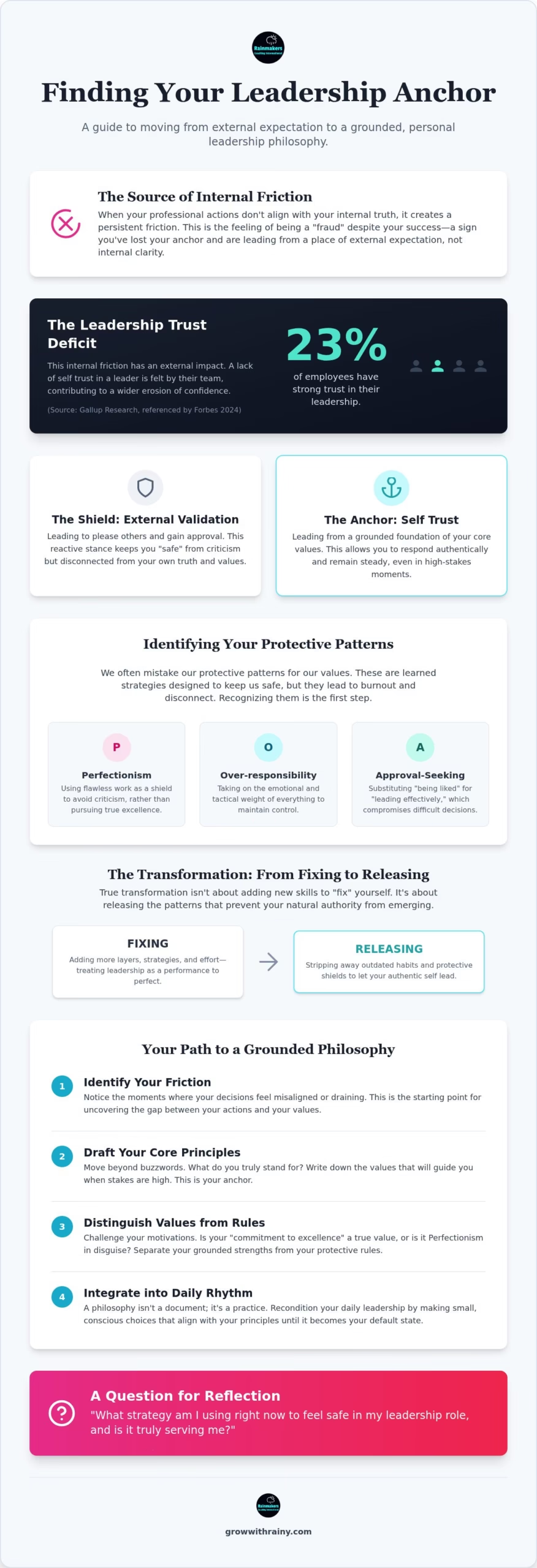
According to 2023 research from Gallup, only 23% of employees report having strong trust in their organization’s leadership. This trust deficit often begins within the leader. If you don’t trust your own internal guidance, your team will feel that hesitation. They don’t need a leader who is perfect; they need a leader who is grounded.
The High-Achiever Self-Trust Gap
There’s often a painful distance between your external capability and your internal certainty. You know how to run a meeting, but you don’t always know if you’re doing the “right” thing by your own standards. Capable leaders frequently substitute “pleasing others” for “leading others.” This Approval-Seeking acts as a protective strategy. It keeps you safe from criticism, but it also keeps you from reclaiming self-trust for authentic leadership. When you lead primarily to be liked, you lose the ability to lead with truth.
Moving from Fixing to Releasing
In the Rainmakers Transformation System™, I teach that transformation isn’t about adding new skills. It’s about removing what prevents you from being yourself. We often think we need to “fix” our indecision or our fear. In reality, we need to release the patterns that make us feel like we aren’t enough. Leadership isn’t a performance. It’s an emergence. When you peel back the layers of Over-responsibility, your natural authority finally has room to breathe.
Reflection: Ask yourself: “What strategy am I using right now to feel safe in my leadership role?”
Reconnecting With Your Truth: The Bedrock of Grounded Leadership
Your leadership philosophy is the grounded foundation that ensures you don’t blow over when the stakes are high. It’s easy to lead when things are calm, but when a crisis hits, you need an anchor. Most people think a philosophy is like a corporate mission statement, full of polished buzzwords and empty promises.
Research supports this internal focus. In a seminal study on authentic leadership , Bill George and his colleagues (2007) found that the most effective leaders lead from their values and life experiences rather than trying to mimic a “perfect” executive archetype.
There is a profound sense of relief that comes with this shift. You no longer have to perform. You simply have to be. By committing to developing your personal leadership philosophy, you can step into any room and remain steady, regardless of the personalities or pressures present.
The Difference Between Values and “Protective” Rules
We often mistake our protective rules for our values. If you value excellence, that’s a grounded strength. If you use Perfectionism to avoid being criticized, that’s a protective rule. These rules are designed to keep you safe, but they often lead to burnout .
A grounded philosophy allows you to be vulnerable without losing your authority. You can admit you don’t have all the answers because your worth isn’t tied to being right. It’s tied to defining your life values and living them out loud.
Self Trust vs. External Evidence
You don’t need another degree or a more prestigious title to lead effectively. You don’t need more evidence that you’re capable; you need to trust the evidence you already have. If you find yourself constantly looking for outside confirmation, you might be trapped in approval-seeking. This pattern clouds your judgment and creates internal friction.
Here are three signs you’re leading from a need for approval rather than self trust:
- You wait for someone else to speak first so you can align your opinion with theirs.
- You spend hours rewriting a simple email to ensure no one could possibly misinterpret it.
- You feel a sense of panic when a decision is met with even minor resistance.
If you’re tired of the second-guessing, a 90-minute coaching conversation can help you identify where these patterns are holding you back.
Reflection: If I didn’t need anyone’s approval today, what decision would I make?
Identifying the Protective Patterns That Shape Your Philosophy
Is your “Over-Responsibility” a leadership value, or a strategy you learned as a child to keep everyone okay? It’s a heavy question to ask. Many leaders arrive in senior roles by being the ones who could handle it all. They mistake their learned Protective Patterns for their actual leadership style. They think being the “fixer” or the “hardest worker” is their philosophy.
In reality, these are often just ways we’ve learned to feel safe in high-pressure environments. They are the “mud” that covers the diamond of your innate leadership value. When you start developing your personal leadership philosophy, you have to look past the performance. You have to see the strategies that have settled over your internal truth. These patterns aren’t flaws to be fixed; they are survival mechanisms that once served you but are now causing internal friction.
Reconnecting with your truth means identifying which parts of your leadership are authentic and which are just protective shields. Without this clarity, your philosophy will be built on a foundation of fear rather than a grounded anchor of self trust.
The 7 Patterns in the Boardroom
In the boardroom, these patterns often manifest as Overthinking or Perfectionism. Overthinking is rarely about being thorough. It’s usually an attempt to create safety by eliminating every possible uncertainty.
If you can just think of every outcome, you won’t be surprised by failure. Similarly, Perfectionism is often a strategy for protecting your sense of worthiness. You believe that if you do everything perfectly, you can avoid the pain of criticism. You aren’t actually leading; you’re just trying to remain beyond reproach.
This internal pressure is a primary driver of overcoming imposter syndrome for senior leaders. When your leadership is based on a protective shield, you’ll always feel like a fraud because you aren’t leading from your truth.
A 2024 Harvard Business Review survey found that 75% of employees wish for greater authenticity from their colleagues and leaders. People don’t want your perfection. They want your presence. They want a leader who has enough self trust to be human. Part of that presence is learning how to become a more empathetic leader — staying connected to your team even when the pressure to perform is at its highest.
Removing the “Mud” of Over-Responsibility
The Rainmakers Principle teaches that Over-responsibility begins when we feel we must keep everyone okay to be okay ourselves. It feels like empathy, but it’s actually a form of control. Is your philosophy about empowering others, or about carrying their weight so you feel safe?
If you are always the one catching the falling glass, your team never learns how to hold it. You aren’t helping them; you’re preventing them from growing so you can avoid the discomfort of their struggle. True leadership requires a grounded foundation. It means releasing the need to be the hero.
Today, identify one “protective” rule you can release. Perhaps it’s the rule that you must answer every email within ten minutes, or the rule that you must have the final word on every minor project. Releasing these rules creates space for your actual values to emerge. It allows you to move from a state of constant vigilance to a state of calm authority.
Reflection: Which of my “strengths” is actually a protective pattern I’m using to avoid feeling vulnerable?
A Step-by-Step Guide to Developing Your Personal Leadership Philosophy
This is the moment you move from insight to transformation. Developing your personal leadership philosophy isn’t about inventing a new persona or adopting a set of corporate buzzwords. It’s a homecoming to your own wisdom and creativity.
Think of it as an act of reprogramming your internal narrative. You’re shifting from a story of “I must perform to be safe” to “I lead from my truth.” This process requires courage. It demands that you look beneath the surface of your daily tasks to find the grounded anchor that truly holds you steady.
Phase 1: The “Release” Audit
Before you can build something new, you must clear the ground. This phase is about releasing the patterns that create internal friction. Step 1 is Identifying the Protective Patterns currently driving your decisions. Are you leading from Over-responsibility, or perhaps Perfectionism?
Step 2 is stripping away the “shoulds” you’ve inherited from previous bosses or rigid corporate cultures. These are often the rules that make leading feel like a performance rather than a service. When you stop carrying these external weights, your natural authority finally has room to breathe.
Reflection: What part of my leadership style feels heavy or like I am performing?
Phase 2: The “Reprogram” Drafting
Once you’ve cleared the mud, the diamond of your innate leadership value can emerge. Step 3 is defining your core mission using this gem metaphor. What is the unique value you bring when you aren’t trying to please everyone?
Step 4 involves drafting 3-5 grounded principles that describe how you show up when you are your most authentic self. These aren’t aspirational goals. They are current truths.
Finally, Step 5 is writing your philosophy down as a living document. It shouldn’t be static. It should evolve as you grow and as you deepen your self trust.
Research highlights why this internal work matters so much. A 2024 Harvard Business Review survey revealed that 75% of employees want greater authenticity from their leaders. When you know how to describe leadership effectively through the lens of your own truth, you create the psychological safety your team craves.
You aren’t just giving them a list of rules; you’re giving them a leader they can trust because that leader trusts themselves. This clarity reduces decision fatigue and creates a sustainable path forward.
Reflection: If I released the need to be the “fixer” today, what would my primary leadership goal become?
Integrating Your Philosophy: Reconditioning Your Daily Leadership Rhythm
The goal isn’t more success; it’s to become more fully yourself in every meeting. Developing your personal leadership philosophy is a powerful first step, but a philosophy only becomes real when it is reconditioned through daily practice.
In the Rainmakers Transformation System™, reconditioning is the phase where we bridge the gap between knowing your truth and living it. It is easy to stay grounded when you are alone with your thoughts. It is much harder when a deadline is looming and your team is looking to you for answers.
Staying true to your philosophy is difficult when the stakes are high. In those moments, your old Protective Patterns like Over-responsibility or Perfectionism will try to take the wheel. They promise safety, but they deliver internal friction. To counter this, you need specific habits and tools, such as those from A Phoenix Rising, that bring you back to your grounded anchor. This daily repetition is what builds the self trust required to lead with quiet strength rather than loud force.
According to 2024 research from Frontiers, there is a strong positive association between authentic leadership and higher levels of employee performance. When you are consistent, your team feels safe enough to be consistent too.
Using Your Philosophy as a Decision Filter
If you don’t trust yourself enough to choose, no amount of options will help. Your philosophy should act as a filter for Career Confusion and high-stakes choices. When you are faced with a difficult decision, don’t just look at the KPIs or the budget.
Look at your written principles. Ask yourself: “Does this choice reflect my core mission, or am I just trying to keep everyone okay?” This is a vital component of your leadership development plan 2026. By using your philosophy as a compass, you move from a state of hesitation to a state of decisiveness. A philosophy grounded in your values also makes it easier to understand how to become a more empathetic leader — because when you are clear on who you are, you have the capacity to genuinely notice and respond to what others are experiencing.
When Deeper Support is Needed
Insight is not the same as transformation. You might understand your patterns intellectually, yet still find yourself trapped in the cycle of over-achieving to prove your worth. Sometimes you need a guide to see the “mud” that you’ve grown too accustomed to.
Executive Coaching provides the psychological safety to explore these internal shifts. It’s about more than career tactics; it’s about reconnecting with your truth so that your leadership feels sustainable and authentic. When you have a partner to challenge your assumptions, the path to self trust becomes much clearer.
Reflection: Who would I be as a leader if I trusted my own wisdom as much as I trust my capability?
Stepping into Your Authentic Authority
You’ve spent years building your capability. Now, it’s time to build your certainty. Developing your personal leadership philosophy is the act of moving from a state of performance to a state of presence.
By releasing the protective patterns like Control or Approval-seeking, you allow your innate leadership value to emerge. This isn’t about becoming someone else. It’s about finally trusting the person you already are.
With over a decade of experience and the proprietary Rainmakers Transformation System™, I help high-performers bridge the self trust gap. We move beyond the exhaustion of fixing flaws and focus on grounded, authentic leadership that feels sustainable.
You don’t have to carry the weight of everyone’s expectations to be effective. You can lead from your truth and still achieve incredible results.
Explore Executive Coaching to Anchor Your Leadership in Self-Trust
Your wisdom is already there, waiting to be uncovered. It’s time to let it guide you. Who would you be if you stopped leading for approval and started leading from your truth?
Frequently Asked Questions
What is a personal leadership philosophy?
A personal leadership philosophy is a grounded anchor that defines how you lead based on your internal truth rather than external expectations. It acts as a compass for your professional actions. In the Rainmakers Transformation System™, we see it as a way of allowing your hidden treasures to emerge. It’s not a list of corporate rules; it’s a declaration of self trust that guides you through high-stakes moments.
How long should a leadership philosophy statement be?
A leadership philosophy statement should be concise enough to remember but deep enough to guide you. Most effective statements are between 3 to 5 core principles. The goal isn’t to write a long manual. Instead, you want to create a living document that you can quickly recall during a difficult meeting. It should feel like a homecoming to your own wisdom rather than a complex academic exercise.
Can my personal leadership philosophy change over time?
Yes, your philosophy should evolve as you grow and as your self trust deepens. While your core values often remain steady, how you apply them may shift as you move into different leadership stages. Developing your personal leadership philosophy is an ongoing process of reconditioning your daily rhythm. If you find a principle no longer resonates, it’s a sign that you’re ready to release an old pattern and reprogram a new truth.
How do I know if my philosophy is authentic or just “approval-seeking”?
Authentic philosophies feel light and empowering, while “approval-seeking” ones feel heavy and performative. If your principles are designed to make others like you or to avoid criticism, they’re likely protective patterns. True authenticity comes from reconnecting with your truth. Ask yourself if you would still hold these beliefs if no one was watching. If the answer is yes, you’ve likely found a grounded foundation that survives the pressure of high-stakes moments.
Should I share my leadership philosophy with my team?
Sharing your philosophy can build immense trust by providing your team with a clear “user manual” for your leadership. It creates psychological safety because people know what to expect from you. However, you must live it before you speak it. When your actions match your words, you bridge the self-trust gap. Sharing it allows your team to see the authentic person behind the title, which encourages them to be authentic too.
What is the difference between a leadership philosophy and a mission statement?
A mission statement usually focuses on “what” the organization does, while a leadership philosophy focuses on “how” you show up as a person. One is corporate; the other is deeply personal. Developing your personal leadership philosophy is about your internal state of being. While a mission statement might target a KPI, your philosophy targets the integrity of your character. It’s the difference between a destination and the way you walk the path.
How does a leadership philosophy help with decision fatigue?
It acts as a decision filter that removes the need to weigh every possible external opinion. When you have a grounded anchor, you don’t have to start from scratch with every choice. You simply check the decision against your core principles. This reduces the mental clutter caused by patterns like Overthinking. By relying on self trust, you save your cognitive energy for implementation rather than endless second-guessing and checking for validation.
Do I need a leadership coach to develop my philosophy?
While you can start the process alone, a coach helps you see the protective patterns that you might mistake for your style. Insight is not the same as transformation. A guide can help you identify if you’re leading from Perfectionism or Over-responsibility, or other hidden patterns. Through Executive Coaching, you can move through the Release, Reprogram and Recondition phases more effectively, ensuring your philosophy is built on your actual truth, not just a safer version of yourself.

Article by
Rainy Rainmaker
Rainy Rainmaker is the founder of Rainmakers Coaching International and a transformational coach for confidence, self-trust, and authentic leadership.
Based in Singapore, she helps high-achieving professionals, managers, and leaders who appear capable on the outside but feel quietly held back by self-doubt, overthinking, imposter feelings, burnout, or a loss of direction. Through her signature Rainmaker Transformation Journey™: Release, Reprogram, Recondition – Rainy helps clients uncover the insights already within them and turn inner clarity into aligned action that creates lasting change in life, career, and leadership.
